Question Library
Browse, filter, and study verified past examination questions with step-by-step mathematical reasoning.
Searching 18,000+ Questions...
Sifting topics, KaTeX formulas & verified solutions
Showing 61–75 of 784 verified questions
Sort by:
Physics
WAEC / WASSCE 2019
Waves and Optics
Solution
(a) State the principle of operation of fibre optics.
(b) State two applications of fibre optics in medicine.
medium Difficulty
Verified Correct Answer: Option
Physical Principles & Numerical Solution
(a) Principle of operation of fibre optics - Total internal reflection of light
(b) Applications of fibre optics in medicine
As:
- light guides
- imaging tools
- laser for surgery
Source: Myschool Past Questions Archive (Record #56511)
Physics
WAEC / WASSCE 2019
Waves and Optics
Which of the following waves is not mechanical?
A
Waves in pipes
B
Water waves
C
Radio waves
D
Sound waves
medium Difficulty
Verified Correct Answer: Option C
Physical Principles & Numerical Solution
No expanded working has been attached for this question yet. The verified answer is Option C.
Source: Myschool Past Questions Archive (Record #58800)
Physics
WAEC / WASSCE 2019
Waves and Optics
Which of the following cases cannot produce total internal reflection? A light ray travelling from
A
glass to water
B
kerosene to air
C
air to water
D
water to ice
medium Difficulty
Verified Correct Answer: Option C
Physical Principles & Numerical Solution
No expanded working has been attached for this question yet. The verified answer is Option C.
Source: Myschool Past Questions Archive (Record #58805)
Physics
WAEC / WASSCE 2019
Waves and Optics
In which of the following media is the speed of sound the least?
A
Air
B
Brass
C
Water
D
Wood
medium Difficulty
Verified Correct Answer: Option A
Physical Principles & Numerical Solution
No expanded working has been attached for this question yet. The verified answer is Option A.
Source: Myschool Past Questions Archive (Record #58885)
Physics
WAEC / WASSCE 2019
Waves and Optics
Solution
When ultraviolet light is incident on certain metallic p articles are emitted. These particles are called
A
positrons
B
protons
C
photoelectrons
D
photons
medium Difficulty
Verified Correct Answer: Option C
Physical Principles & Numerical Solution
Photoelectrons are electrons that are ejected from a material (usually a metal) when it absorbs photons of light, such as ultraviolet light. This phenomenon is known as the photoelectric effect.
Source: Myschool Past Questions Archive (Record #59035)
Physics
WAEC / WASSCE 2019
Waves and Optics
Diagram
Solution
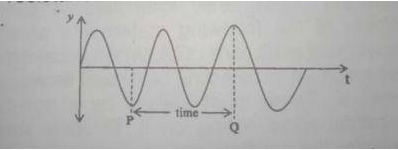
In the diagram above, the time taken to trace a wave between P and Q is?
Attached Figure / Diagram
A
2 periods
B
1 period
C
1\(\frac{1}{2}\) periods
D
1\(\frac{1}{4}\) periods
medium Difficulty
Verified Correct Answer: Option C
Physical Principles & Numerical Solution
frequency means no of oscillation per secs, so the time taken to trace a wave between p and q is 2secs.
Source: Myschool Past Questions Archive (Record #59024)
Physics
WAEC / WASSCE 2019
Waves and Optics
Diagram
Solution
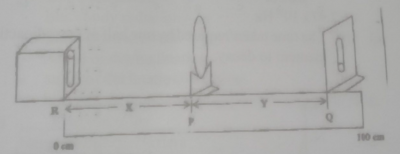
You are provided with a converging lens and holder, a screen, a ray box containing an illuminated object pin, and a meter rule.(See illustration above)
i. Place the lens in its holder such that it is facing a distant object seen through a well-lit laboratory window. Move the screen to and fro until a sharp image of the distant object is formed on it. Measure the distance, \(f_0\), between the screen and the lens.
ii. Clamp the meter rule securely to the table. Place the illuminated object pin at the end R of the meter rule.
iii. Place the lens at a position P such that X = RP = 20cm.
iv. Move the screen to a position Q to receive a sharp image of the object. Measure the distance Y = PQ.
v. Evaluate Z = (X+Y)
vi. Repeat the procedure for five other values of x = 25cm. 3Ocm, 35cm, 40cm and 45cm. In each case, record X,Y and evaluate Z.
vii. Tabulate the results.
viii. Plot a graph with Z on the vertical axis and X on the horizontal axis. Draw a smooth curve through the points.
ix. Determine from your graph the minimum value of Z=\(Z_0\) and its corresponding distance
x. Evaluate W = ½ (\(\frac{Z_0}{4} + \frac{X_0}{2}\))
xi. State two precautions taken to ensure accurate results.
(b) i. Draw a ray diagram to show how a Convex lens forms an image of magnification less than one.
ii. Name two pairs of features in the human eye and a lens camera that performs similar functions.
Attached Figure / Diagram
medium Difficulty
Verified Correct Answer: Option
Physical Principles & Numerical Solution
F = 13.0cm
Table of value
S/N
Xcm
Ycm
Z(x+y)cm
1
2
3
4
5
6
20
25
30
35
40
45
60
38
30
26
24
21
80
63
60
61
64
61
See graph above
Let 1cm represent5 units on the vertical axis and 1cm represent 5 units on the horizontal axis.
Minimum value of Z=\(Z_0\) from the graph = 60cm
Corresponding distance of \(X_0\) = 30cm
Evaluate W = ½ (\(\frac{Z_0}{4} + \frac{X_0}{2}\))
= ½(\(\frac{60}{40} + \frac{30}{2}\)
= ½(\(\frac{60 + 60}{4}\) = ½\(\frac{120}{4}\)
= ½(30) = 15
Precautions
- Coaxial arrangement of optional instruments/ray box, len and screen on a straight line.
- Avoided parallax error in reading metre rule.
- Lens kept uptight
- Repeated reading shown on table
- Surface of lens cleaned
- Noted/corrected/avoided zero error on metre rule.
(b)i.
See the diagram above(bi)
ii. Features performing the same function
Human eye
Lens camera
Retina
Film/screen
Eye lens
Camera lens
Iris
Diaphragm
Pupil
Aperture
Source: Myschool Past Questions Archive (Record #59766)
Physics
UTME / JAMB 2018
Waves and Optics
Solution
Which of the following does NOT describe the Image formed by a plane minor?
A
Erect
B
Laterally inverted
C
Same distance from mirror as object
D
Magnified
medium Difficulty
Verified Correct Answer: Option D
Physical Principles & Numerical Solution
The image formed by a plane mirror is always virtual (the light rays do not actually come from the image), upright, and of the same shape and size as the object it is reflecting.
Source: Myschool Past Questions Archive (Record #47381)
Physics
UTME / JAMB 2018
Waves and Optics
A narrow beam of white light can be split up into different Colours by a glass prism. The correct explanation is that
A
white light Is an electromagnetic wave
B
the prism has all the colours of the white light
C
different colours of white light travel with different speeds in glass
D
white light has undergone total Internal reflection in the prism
medium Difficulty
Verified Correct Answer: Option C
Physical Principles & Numerical Solution
No expanded working has been attached for this question yet. The verified answer is Option C.
Source: Myschool Past Questions Archive (Record #47385)
Physics
UTME / JAMB 2018
Waves and Optics
Which of the following may be used to explain a mirage?
I. Layers of air near the road surface have varying refractive indices in hot weather
II. Road surfaces sometimes becomes invisible in hot weather
III. Light from the sky can be refracted upwards after coming close to the road surface.
A
I and III only
B
II and III only
C
II only
D
I, II and III
medium Difficulty
Verified Correct Answer: Option A
Physical Principles & Numerical Solution
No expanded working has been attached for this question yet. The verified answer is Option A.
Source: Myschool Past Questions Archive (Record #47394)
Physics
UTME / JAMB 2018
Waves and Optics
Convex mirrors are used as driving mirrors because images formed are
A
erect, Virtual and diminished
B
erect, real and diminished
C
erect, virtual and magnified
D
inverted, virtual and diminished
medium Difficulty
Verified Correct Answer: Option A
Physical Principles & Numerical Solution
No expanded working has been attached for this question yet. The verified answer is Option A.
Source: Myschool Past Questions Archive (Record #47429)
Physics
UTME / JAMB 2018
Waves and Optics
Solution
Musical instruments playing the same note can be distinguished from one another owing to the difference in their
A
quality
B
pitch
C
intensity
D
loudness
medium Difficulty
Verified Correct Answer: Option A
Physical Principles & Numerical Solution
. Sound "quality" or "timbre" describes those characteristics of sound which allow the ear to distinguish sounds which have the same pitch and loudness.
Source: Myschool Past Questions Archive (Record #47430)
Physics
UTME / JAMB 2018
Waves and Optics
Solution
An object is placed 20cm from a concave mirror of focal length 10cm. The linear magnification of the image produced is?
A
0
B
\(\frac{1}{2}\)
C
1
D
2
medium Difficulty
Verified Correct Answer: Option C
Physical Principles & Numerical Solution
\(\frac{I}{V}\) = \(\frac{1}{f}\) – \(\frac{1}{u}\)
\(\frac{I}{V}\) = \(\frac{1}{10}\) – \(\frac{1}{20}\)
= \(\frac{1}{20}\) V
V = 20cm.
M = \(\frac{V}{U}\)
= \(\frac{20}{20}\)
= 1
Source: Myschool Past Questions Archive (Record #47686)
Physics
UTME / JAMB 2018
Waves and Optics
Solution
Which of the following concepts is not an evidence of the particles nature of matter?
A
Diffusion
B
Brownian motion
C
Diffraction
D
Esterification
medium Difficulty
Verified Correct Answer: Option D
Physical Principles & Numerical Solution
Diffusion is the net movement of molecules/atoms from a region of high concentration to low concentration.
Brownian motion is the erratic random movement of microscopic particles in a field.
Diffraction is the various phenomena that occur when a wave encounters an obstacle.
Source: Myschool Past Questions Archive (Record #47721)
Physics
UTME / JAMB 2018
Waves and Optics
Solution
A man hears his echo from a nearby hill 2s after he shouted. If the frequency of his voice is 260Hz and the wavelength is 1.29m, how far away is the hill?
A
330.0m
B
335.4m
C
660.0m
D
670.8m
medium Difficulty
Verified Correct Answer: Option B
Physical Principles & Numerical Solution
Recall V = F \times \(\lambda\)
= 260 \times 1.29
= 335.4ms\(^{-1}\)
Echo time = \(\frac{2}{2}\) = 1 sec
Distance = v x t = 335.4 x 1
= 335.4m
Source: Myschool Past Questions Archive (Record #47724)