Question Library
Browse, filter, and study verified past examination questions with step-by-step mathematical reasoning.
Searching 18,000+ Questions...
Sifting topics, KaTeX formulas & verified solutions
Showing 61–75 of 112 verified questions
Sort by:
Physics
NECO SSCE 2001
Modern Physics and Nuclear Physics
Solution
In 24 days a radioactive isotope decreases in mass from 128g to 2g. What is the half-life of the radioactive material?
A
2.54 days
B
4.00 days
C
4.80 days
D
6.00 days
E
8.00 days
medium Difficulty
Verified Correct Answer: Option B
Physical Principles & Numerical Solution
N = N\(_o\)(\(\frac{1}{2}\))\(^{\frac{t}{T_{\frac{1}{2}}}}\)
N = 2g, N\(_o\) = 128g, t =24days and \(T_{\frac{1}{2}}\) = ?
2 = 128(\(\frac{1}{2}\))\(^{\frac{24}{T_{\frac{1}{2}}}}\)
\(\frac{2}{128}\) = (\(\frac{1}{2}\))\(^{\frac{24}{T_{\frac{1}{2}}}}\)
\(\frac{1}{64}\) = (\(\frac{1}{2}\))\(^{\frac{24}{T_{\frac{1}{2}}}}\)
(\(\frac{1}{2}\))\(^6\) = (\(\frac{1}{2}\))\(^{\frac{24}{T_{\frac{1}{2}}}}\)
6 = \(\frac{24}{T_{\frac{1}{2}}}\)
\(T_{\frac{1}{2}}\) = \(\frac{24}{6}\) = 4 days.
Source: Myschool Past Questions Archive (Record #42856)
Physics
UTME / JAMB 2000
Modern Physics and Nuclear Physics
Solution
If the fraction of the atoms of a radioactive material left after 120years is 1/64, what is the half-life of the material?
A
24 years
B
20 years
C
10 years
D
2 years
medium Difficulty
Verified Correct Answer: Option B
Physical Principles & Numerical Solution
1/64 is the usual fraction left of any radio active material after 4 half-lives, since 1/64 = (1/2)6
This implies that 6 half lives have elapsed.
Thus 6 half lives = 120 years
∴ 1 half life = 120/6 = 20 years
Source: Myschool Past Questions Archive (Record #1447)
Physics
WAEC / WASSCE 2000
Modern Physics and Nuclear Physics
Solution
The cubic expansivity of mercury is 1.8 x 10⁻⁴K-1 and the linear expansivity of glass 8.0 x 10⁻⁶K-1, calculate the apparent expansivity of mercury in a glass container
A
1.00 x 10⁻⁴K-1
B
1.56 x 10⁻⁴K-1
C
1.72 x 10⁻⁴K-1
D
2.04 x 10⁻⁴K-1
medium Difficulty
Verified Correct Answer: Option B
Physical Principles & Numerical Solution
γ\(_r\) = γ + γ\(_{app}\)
1.8 x 10\(^{-4}\) = (3 x 8.0 x 10\(^{-6}\)) + γ\(_{app}\)
γ\(_{app}\) = 1.8 x 10\(^{-4}\) - 2.4 x 10\(^{-5}\)
= 1.56 x 10\(^{-4}\)K\(^{-1}\)
Source: Myschool Past Questions Archive (Record #33774)
Physics
WAEC / WASSCE 2000
Modern Physics and Nuclear Physics
Solution
A nuclide \(^{202}_{84} Y\) emits in succession an \(\alpha-particle\) and a \(\beta-particle\). The atomic number of the resulting nuclide is
A
198
B
83
C
82
D
80
medium Difficulty
Verified Correct Answer: Option B
Physical Principles & Numerical Solution
\(^{202}_{84} Y\) → \(^4_2\)He + \(^0_{-1}\)e + \(^{98}_{83}\)X
Therefore, the atomic number of the resulting nuclide = 83.
Source: Myschool Past Questions Archive (Record #33849)
Physics
NECO SSCE 2000
Modern Physics and Nuclear Physics
Solution
The half-life of a radioactive substance is 2 seconds. Calculate the decay constant.
A
2.890 s-1
B
1 .445 s-1
C
0.576 s-1
D
0.347s-1
E
0.152 s-1
medium Difficulty
Verified Correct Answer: Option D
Physical Principles & Numerical Solution
\(T_{\frac{1}{2}} = \frac{\ln 2}{\lambda}\)
where \(T_{\frac{1}{2}}\) = half-life of element; \(\lambda\) = decay constant.
= \(\frac{0.693}{\lambda}\)
\(\therefore 2 = \frac{0.693}{\lambda}\)
\(\lambda = \frac{0.693}{2}\)
= 0.3465 s\(^{-1}\)
\(\approxeq\) 0.347 s\(^{-1}\)
Source: Myschool Past Questions Archive (Record #42685)
Physics
NECO SSCE 2000
Modern Physics and Nuclear Physics
Solution
An element of nuclear number A and proton number Z emits an alpha particle from its nucleus. The nucleon number and the proton number of the new element formed are respectively
A
(A – 2) and (Z – 2)
B
(A + 4) and (Z + 2)
C
(A– 4) and (Z+2)
D
(A+ 4) and (Z – 2)
E
(A – 4) and (Z – 2)
medium Difficulty
Verified Correct Answer: Option E
Physical Principles & Numerical Solution
Let the element be S and the element formed after emission be X.
\(\implies ^{A} _{Z}S \to ^{4} _{2}He + X\)
\(\therefore X = ^{A - 4} _{Z - 2}X\).
Source: Myschool Past Questions Archive (Record #42704)
Physics
NECO SSCE 2000
Modern Physics and Nuclear Physics
Solution
A radioactive substance has a half-life of 3 minutes. After 9 minutes, the count rate was observed to be 200. What was the count rate at zero time?
A
200
B
1200
C
1600
D
2400
E
4800
medium Difficulty
Verified Correct Answer: Option C
Physical Principles & Numerical Solution
Let the count at zero time = Q,
then count after 3s = \(\frac{Q}{2}\)
but after 9secs., count was observed to be = 200
count after 9secs = \(\frac{Q}{8}\) = 200 ( remember here, that we are dealing with half-life)
Q = 8 x 200 = 1600
∴ count at zero time = 1600.
Source: Myschool Past Questions Archive (Record #42727)
Physics
UTME / JAMB 1999
Modern Physics and Nuclear Physics
In the Rutherford scattering experiment, a beam of alpha particles was fired at a thin gold film with some of the particles being considerably deflected. This shows that
A
a gold nucleus contains protons, neutrons and electrons uniformly distributed in a tiny volume
B
the gold nucleus is positively charged and is concentrated in a tiny volume
C
the gold nucleus emitted alpha particles
D
the gold nucleus is concentrated in a tiny volume and contains alpha particles
medium Difficulty
Verified Correct Answer: Option B
Physical Principles & Numerical Solution
No expanded working has been attached for this question yet. The verified answer is Option B.
Source: Myschool Past Questions Archive (Record #654)
Physics
UTME / JAMB 1999
Modern Physics and Nuclear Physics
Solution
2311Na + Proton → pqX + alpha particle
What are the values of p and q respectively in the equation above?
A
10 and 20
B
12 and 24
C
20 and 10
D
24 and 12
medium Difficulty
Verified Correct Answer: Option C
Physical Principles & Numerical Solution
2311Na + Proton → pqX + alpha particle
Represent;
2311Na + 11P → pqX + 42He
Thus from the above equations, p = 20 and q = 10
Source: Myschool Past Questions Archive (Record #655)
Physics
WAEC / WASSCE 1999
Modern Physics and Nuclear Physics
Bohr’s atomic model proves most successful for the explanation of the. I. structure of the hydrogen atom; II. line spectra of the hydrogen atom; III. Multi-electron atoms. Which of the statements above is/are correct?
A
I only
B
II only
C
I and II only
D
I and III only
medium Difficulty
Verified Correct Answer: Option C
Physical Principles & Numerical Solution
No expanded working has been attached for this question yet. The verified answer is Option C.
Source: Myschool Past Questions Archive (Record #25507)
Physics
WAEC / WASSCE 1999
Modern Physics and Nuclear Physics
The half-life of a radioactive substance is
A
its average life time
B
one-half the value of its decay constant.
C
the length of time needed by the substance to decay completely
D
the length of time during which the activity of the substance reduces by 50%.
medium Difficulty
Verified Correct Answer: Option D
Physical Principles & Numerical Solution
No expanded working has been attached for this question yet. The verified answer is Option D.
Source: Myschool Past Questions Archive (Record #25512)
Physics
WAEC / WASSCE 1999
Modern Physics and Nuclear Physics
The half-life of a radioactive element is 5 Calculate its decay constant
A
0.113s-1
B
0.436 s-1
C
0.139 s-1
D
0.193 s-1.
medium Difficulty
Verified Correct Answer: Option C
Physical Principles & Numerical Solution
No expanded working has been attached for this question yet. The verified answer is Option C.
Source: Myschool Past Questions Archive (Record #25513)
Physics
WAEC / WASSCE 1999
Modern Physics and Nuclear Physics
Which of the following are the essential parts of an atomic bomb?
A
Uranium and neutrons
B
Radium and polonium
C
Nitrogen and neutrons
D
ranium and α - particles.
medium Difficulty
Verified Correct Answer: Option A
Physical Principles & Numerical Solution
No expanded working has been attached for this question yet. The verified answer is Option A.
Source: Myschool Past Questions Archive (Record #25515)
Physics
WAEC / WASSCE 1998
Modern Physics and Nuclear Physics
Solution
If the cubic expansivity of brass between 27oC and 100oC is 5.7 x 10⁻⁵K-1, What is its linear expansivity?
A
2.85 x 10⁻⁵K-1
B
1.90 x 10⁻⁵K-1
C
1.86 x 10⁻⁵K-1
D
1.70 x 10⁻⁵K-1
E
1.63 x 10⁻⁵K-1
medium Difficulty
Verified Correct Answer: Option B
Physical Principles & Numerical Solution
\(\alpha\) = \(\frac{\Delta}{3} = \frac{5.7 \times 10^{-5}}{3}\)
= 1.90 x 10⁻⁵K-1
Source: Myschool Past Questions Archive (Record #33572)
Physics
WAEC / WASSCE 1998
Modern Physics and Nuclear Physics
Diagram
Solution
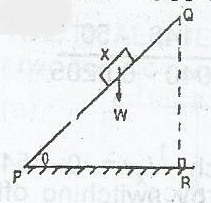
If \(\theta\) is equal to \(\alpha\) at the time the box is just about to slide down the plank, the coefficient of static friction between the plank and box is
Attached Figure / Diagram
A
sin\(\alpha\)
B
cos\(\alpha\)
C
tan\(\alpha\)
D
sec\(\alpha\)
E
cot\(\alpha\)
medium Difficulty
Verified Correct Answer: Option C
Physical Principles & Numerical Solution
\(\mu = \frac{F}{R} = \frac{W sin \theta}{W cos q}\)
= tan\(\theta\)
Source: Myschool Past Questions Archive (Record #33516)