Question Library
Browse, filter, and study verified past examination questions with step-by-step mathematical reasoning.
Searching 18,000+ Questions...
Sifting topics, KaTeX formulas & verified solutions
Showing 61–75 of 345 verified questions
Sort by:
Mathematics
UTME / JAMB 2016
Statistics and Probability
Solution
Find the mean of 10, 8, 5, 11, 12, 9, 6, 3, 15, and 23.
A
11.2
B
10
C
10.2
D
11.3
medium Difficulty
Verified Correct Answer: Option C
Step-by-Step Mathematical Solution
\(\frac{10 + 8 + 5 + 11 + 12 + 9 + 6 + 3 + 15 + 23}{10}\)
= \(\frac{102}{10}\) = 10.2
Source: Myschool Past Questions Archive (Record #44871)
Mathematics
UTME / JAMB 2016
Statistics and Probability
Diagram
Solution
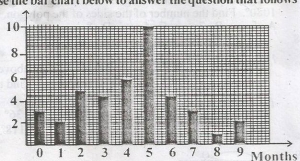
Determine the mean score of the student that took the mathematics test?
Attached Figure / Diagram
A
4.5
B
4.3
C
4.2
D
4.6
medium Difficulty
Verified Correct Answer: Option C
Step-by-Step Mathematical Solution
(3 x 0) + (1 x 2) + (5 x 2) + (5 x 3) + (5 x 4) +
(10 x 5) + (4 x 6) + (3 x 7) + (1 x 8) + (2 x 9) \(\div\) 40
= \(\frac{168}{40}\) = 4.2
Source: Myschool Past Questions Archive (Record #44878)
Mathematics
WAEC / WASSCE 2016
Statistics and Probability
Solution
Age(years)
13
14
15
16
17
Frequency
10
24
8
5
3
The table shows the ages of students in a club. How many students are in the club?
A
50
B
55
C
60
D
65
medium Difficulty
Verified Correct Answer: Option A
Step-by-Step Mathematical Solution
Number of students in the club is
10 + 24 + 8 + 5 + 3 = 50
Source: Myschool Past Questions Archive (Record #46123)
Mathematics
WAEC / WASSCE 2016
Statistics and Probability
Solution
\(\begin{array}{c|c}
Age(years) & 13 & 14 & 15 & 16 & 17 \\
\hline
Frequency & 10 & 24 & 8 & 5 & 3
\end{array}\)
Find the median age
A
13
B
14
C
15
D
16
medium Difficulty
Verified Correct Answer: Option B
Step-by-Step Mathematical Solution
Median = \(\frac{N}{2}\)th age
= \(\frac{50}{2}\)th age
= 25th age
= 14 years
Source: Myschool Past Questions Archive (Record #46126)
Mathematics
WAEC / WASSCE 2016
Statistics and Probability
Solution
A fair die is thrown two times. What is the probability that the sum of the scores is at least 10?
A
\(\frac{5}{36}\)
B
\(\frac{1}{6}\)
C
\(\frac{5}{18}\)
D
\(\frac{2}{3}\)
medium Difficulty
Verified Correct Answer: Option B
Step-by-Step Mathematical Solution
\(\begin{array}{c|c}
& 1 & 2 & 3 & 4 & 5 & 6 \\
\hline
1 & 1,1 & 1,2 & 1,3 & 1,4 & 1,5 & 1,6 \\ \hline 2 & 2,1 & 2,2 & 2,3 & 2,4 & 2,5 & 2,6 \\ \hline 3 & 3,1 & 3,2 & 3,3 & 3,4 & 3,5 & 3,6 \\ \hline 4 & 4,1 & 4,2 & 4,3 & 4,4 & 4,5 & 4,6 \\ 5 & 5,1 & 5,2 & 5,3 & 5,4 & 5,5 & 5,6 \\ \hline 6 & 6,1 & 6,2 & 6,3 & 6,4 & 6,5 & 6,6\end{array}\)
From the table above, event space, n(E) = 6
sample space, n(S) = 36
Hence, probability sum of scores is at least 10, is;
\(\frac{n(E)}{n(S)}\)
= \(\frac{6}{36}\)
= \(\frac{1}{6}\)
Source: Myschool Past Questions Archive (Record #46191)
Mathematics
WAEC / WASSCE 2016
Statistics and Probability
Solution
A bag contains 5 red and 4 blue identical balls. Id two balls are selected at random from the bag, one after the other, with replacement, find the probability that the first is red and the second is blue
A
\(\frac{2}{9}\)
B
\(\frac{5}{18}\)
C
\(\frac{20}{81}\)
D
\(\frac{5}{9}\)
medium Difficulty
Verified Correct Answer: Option C
Step-by-Step Mathematical Solution
n(red balls) = 5
n(blue balls) = 4
n(\(\iff\)) = 9
Hence, prob (R1, B2)
= \(\frac{5}{9} \times \frac{4}{9}\)
= \(\frac{20}{81}\)
Source: Myschool Past Questions Archive (Record #46215)
Mathematics
WAEC / WASSCE 2016
Statistics and Probability
Diagram
Solution
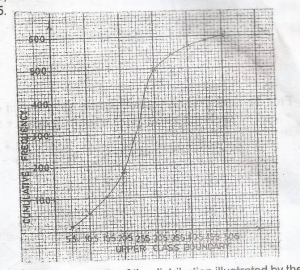
Find the lower quartile of the distribution illustrated by the cumulative frequency curve
Attached Figure / Diagram
A
17.5
B
19.0
C
27.5
D
28.0
medium Difficulty
Verified Correct Answer: Option B
Step-by-Step Mathematical Solution
Lower quartile,
Q1 = \(\frac{1}{4}\)Nth term
= \(\frac{1}{4}\) x 600th term
= 150th term
= 15.5 + 3 + 0.5
= 19
Source: Myschool Past Questions Archive (Record #46222)
Mathematics
UTME / JAMB 2015
Statistics and Probability
Solution
The probability of an event A is 1/5. The probability of B is 1/3 . The probability both A and B is 1/15. What is the probability of either event A or B or both
A
\( \frac{2}{15} \)
B
\( \frac{3}{4} \)
C
\( \frac{9}{15} \)
D
\( \frac{1}{15} \)
medium Difficulty
Verified Correct Answer: Option C
Step-by-Step Mathematical Solution
In probability, or = +
Prob( A or B or Both ) = \(\frac{1}{3} + \frac{1}{5} + \frac{1}{15}\) = \(\frac{5+ 3 + 1}{15}\) = \(\frac{9}{15}\) = \(\frac{3}{5}\)
Source: Myschool Past Questions Archive (Record #40716)
Mathematics
UTME / JAMB 2015
Statistics and Probability
Solution
The probability of an outcome A is 1/6 . The probability of the B outcome is 1/4 . If the probability of A or B or both is 1/12 . What is the probability of both outcomes A and B?
A
1/2
B
1/3
C
2/5
D
3/4
medium Difficulty
Verified Correct Answer: Option B
Step-by-Step Mathematical Solution
Prob.(A outcome) = \(\frac{1}{6}\), Prob.(B outcome) = ¼
P(A ∪ B) = 1/12, Prob.(A ∩ B)
Prob.(A ∩ B) = Prob.(A) + Prob.(B) − Prob.(A ∪ B)
1/6 + 1/4 − 1/12
= (2 + 3 − 1) ÷ 12
= 4/12
= 1/3
Prob.(A ∩ B) = 1/3
Source: Myschool Past Questions Archive (Record #41288)
Mathematics
WAEC / WASSCE 2015
Statistics and Probability
Solution
Score
0 - 4
5 - 9
10 - 14
Frequency
2
1
2
The table shows the distribution of the scores of some students in a test. Calculate the mean scores.
A
5.6
B
6.2
C
6.6
D
7.0
medium Difficulty
Verified Correct Answer: Option D
Step-by-Step Mathematical Solution
To calculate the mean of grouped data,
- First step to determine the midpoint (x) of each interval or class.
0 - 4 ►2
5 - 9 ► 7
10 - 14 ►12
These midpoints must then be multiplied by the frequencies of the corresponding classes:
2 X 2 = 4
1 X 7 = 7
2 X 12 = 24
Mean = ( 24 + 7 + 4) \div ( 2 + 1 + 2 )
: Mean = 7
Source: Myschool Past Questions Archive (Record #45822)
Mathematics
WAEC / WASSCE 2015
Statistics and Probability
Solution
The probability that kebba, Ebou and Omar will hit a target are \(\frac{2}{3}\), \(\frac{3}{4}\) and \(\frac{4}{5}\) respectively. Find the probability that only Kebba will hit the target.
A
\(\frac{2}{5}\)
B
\(\frac{7}{60}\)
C
\(\frac{1}{30}\)
D
\(\frac{1}{60}\)
medium Difficulty
Verified Correct Answer: Option C
Step-by-Step Mathematical Solution
Pr(Ebou did not hit the target) = 1 - \(\frac{3}{4}\) = \(\frac{1}{4}\) = Pr(E'), Pr(Omar did not hit the target) = 1 - \(\frac{4}{5}\) = \(\frac{1}{5}\) = Pr(O')
Hence the probability that only Kebba will hit the target
= Pr(K) x Pr(E') x Pr(O')
= \(\frac{2}{3} \times \frac{1}{4} \times \frac{1}{5}\)
= \(\frac{1}{30}\)
Source: Myschool Past Questions Archive (Record #45827)
Mathematics
WAEC / WASSCE 2015
Statistics and Probability
Which of the following is used to determine the mode of a grouped data?
A
Bar chart
B
Frequency polygon
C
Ogive
D
Histogram
medium Difficulty
Verified Correct Answer: Option D
Step-by-Step Mathematical Solution
No expanded working has been attached for this question yet. The verified answer is Option D.
Source: Myschool Past Questions Archive (Record #45864)
Mathematics
WAEC / WASSCE 2015
Statistics and Probability
Solution
Calculate the mean deviation of 5, 3, 0, 7, 2, 1
A
0.0
B
2.0
C
2.5
D
3.0
medium Difficulty
Verified Correct Answer: Option B
Step-by-Step Mathematical Solution
mean = \(\bar{x}\) = \(\frac{\sum x}{n}\)
= \(\frac{5 + 3 + 0 + 7 + 2 + 1}{6}\)
\(\frac{18}{6}\) = 3
\(\begin{array}{c|c}
x & x - \bar{x} & |x - \bar{x}|\\ \hline 5 & -2 & 2 \\ \hline 3 & 0 & 0 \\ \hline 0 & -3 & 3 \\ \hline 7 & 4 & 4 \\ \hline 2 & -1 & 1 \\ \hline 1 & -2 & 2 \\ \hline & & & \sum|x - \bar{x}| \\ \hline & & & 12
\end{array}\)
hence, MD = \(\frac{\sum|x - \bar{x}}{n}|\)
\(\frac{12}{6}\)
= 2
Source: Myschool Past Questions Archive (Record #45963)
Mathematics
WAEC / WASSCE 2015
Statistics and Probability
Solution
The table shows the marks scored by some candidates in an examination.
Marks (%)
0-9
10-19
20-29
30-39
40-49
50-59
60-69
70-79
80-89
90-99
Frequency
7
11
17
20
29
34
30
25
21
6
(a) Construct a cumulative frequency table for the distribution and draw a cumulative frequency curve.
(b) Use the curve to estimate, correct to one decimal place, the :
(i) Lowest mark for distinction if 5% of the candidates passed with distinction ; (ii) probability of selecting a candidate who scored at most 45%.
medium Difficulty
Verified Correct Answer: Option
Step-by-Step Mathematical Solution
Marks
(%)
frequency
(f)
Cumulative
frequency
Upper class
boundaries
0 - 9
7
7
9.5
10 - 19
11
18
19.5
20 - 29
17
35
29.5
30 - 39
20
55
39.5
40 - 49
29
84
49.5
50 - 59
34
118
59.5
60 - 69
30
148
69.5
70 - 79
25
173
79.5
80 - 89
21
194
89.5
90 - 99
6
200
99.5
(b) (i) If 5% of the candidates passed the examination, then (100 - 5)% = 95% passed with a mark \(\leq\) the lowest mark for distinction.
\(\text{95% of 200} = \frac{95}{100} \times 200 \)
= 190 candidates. From the ogive, 190 corresponds to 79.5 + 8 = 87.5 marks (to one decimal place)
(ii) From the ogive, the number of candidates who scored at most 45% is 69. Hence, the probability of selecting a candidate who scored at most 45%
= \(\frac{69}{200} = 0.345 \approxeq 0.3\) (1 d.p)
Source: Myschool Past Questions Archive (Record #52579)
Mathematics
UTME / JAMB 2014
Statistics and Probability
Solution
Find the minimum value of y = x2 - 2x - 3
A
4
B
1
C
-1
D
-4
medium Difficulty
Verified Correct Answer: Option D
Step-by-Step Mathematical Solution
y = x2 - 2x - 3,
Then \(\frac{\delta y}{\delta x} = 2x - 2\)
But at minimum point,\(\frac{\delta y}{\delta x} = 0\),
Which means 2x - 2 = 0
2x = 2
x = 1.
Hence the minimum value of y = x2 - 2x - 3 is;
ymin = (1)2 - 2(1) - 3
ymin = 1 - 2 - 3
ymin = -4
Source: Myschool Past Questions Archive (Record #27028)