Question Library
Browse, filter, and study verified past examination questions with step-by-step mathematical reasoning.
Searching 18,000+ Questions...
Sifting topics, KaTeX formulas & verified solutions
Showing 646–660 of 5315 verified questions
Sort by:
Physics
WAEC / WASSCE 2022
Heat Energy & Temperature
Solution
You are provided with a battery of e.m.f, E, a standard resistor, R, of resistance 2 \(\Omega\), a key, K, an ammeter, A, a jockey, J, a potentiometer, UV, and some connecting wires.
(i) Measure and record the emf, E, of the battery.
(ii) Set up the circuit as shown in the diagram above with the key open.
(iii) Place the jockey at the point, U, of the potentiometer wire. Close the key and record the reading, i, of the ammeter.
(iv) Place the jockey at a point T on the potentiometer wire UV such that d = UT = 30.0 cm.
(v) Close the circuit, read and record the current, I, on the ammeter,
(vi) Evaluate I\(^{1}\).
(vi) Repeat the experiment for four other values of d = 40.0 cm, 50.0 cm, 60.0 cm and 70.0 cm. In each case, record I and evaluate I\(^{1}\).
(vii) Tabulate the results
(ix) Plot a graph with d on the vertical axis and I on the horizontal axis stalling both axes from the origin (0,0).
(x) Determine the slope, s, of the graph.
(xi) From the graph determine the value \(I_1\), of I when d = 0. (ci) Given that=s, calculate 8.
(xii) State two precautions taken to ensure accurate results.
(xii) Given that \(\frac{E}{\delta}\) = s, calculate \(\delta\).
(b)(i) Write down the equation that connects the resistance, R, of a wire and the factors on which it depends. State the meaning of each of the symbols.
(ii) An electric fan draws a current of0.75 A in a 240 V circuit. Calculate the cost of using, the fan for 10 hours if the utility rate is $ 0.50 per kWh.
A
Operation of a grinding machine
B
Walking
C
Application of brakes
D
Moving piston in a sleeve
medium Difficulty
Verified Correct Answer: Option D
Physical Principles & Numerical Solution
(a) OBSERVATIONS
(i) Value of E correctly read and recorded to at least 1 d.p in volts.
(ii) Value of i correctly read and recorded to at least 1 d.pin amperes.
(iii) Five values of d correctly determined and recorded to at least 1 d.p in cm.
(iv) Five values of I correctly read and recorded to at least 1 d.p in amperes and in trend.
Trend; As d increases, I decreases
(v) Five values of I\(^{1}\) correctly evaluated to at least 3 s.f.
(vi) Composite table showing at least d, I, and I\(^{-1}\).
(ii) P = IV
Power P = \(\frac{240 \times 0.75}{100}\)
0.18kw
Energy consumed in 10hr = 0.18 x 10
= 1.8kWh
Cost of energy = 1.8 x 0.5 = $0.9
OR
Cost of energy = \(\frac{\text {P x cost x time}}{100}\)
\(\frac{0.7 \times 240 \times 10}{1000}\)
= $0.9
Source: Official Exam / Past Question Archive
Physics
UTME / JAMB 2022
Heat Energy & Temperature
Solution
If an object just begins to slide on a surface inclined at 30º to the horizontal,the coefficient of friction is?
A
√3
B
\(\frac{√3}{2}\)
C
\(\frac{1}{√2}\)
D
\(\frac{1}{√3}\)
medium Difficulty
Verified Correct Answer: Option D
Physical Principles & Numerical Solution
A body sliding down a plane inclined at 30o to the horizontal,
Has coefficient of friction = tan 30º or \(\frac{1}{\sqrt3}\)
Source: Official Exam / Past Question Archive
Physics
UTME / JAMB 2021
Heat Energy & Temperature
Solution
Calculate the mass of ice that would melt when 2kg of copper is quickly transferred from boiling water to a block of ice without heat loss (specific heat capacity of copper = 400Jkg\(^{1}\)k\(^{-1}\), latent heat of fusion of ice = 3.3 x 10\(^{5}\)Jkg\(^{-1}\))
A
\(\frac{8}{33}\)kg
B
\(\frac{3.3}{80}\)kg
C
\(\frac{80}{33}\)kg
D
\(\frac{3.3}{8}\)kg
medium Difficulty
Verified Correct Answer: Option A
Physical Principles & Numerical Solution
mc\(\Delta\theta\) = m\(\lambda\)\(_f\)
2 x 400 (100 - 0) = m(3.3 x 10\(^{5}\))
m = \(\frac{2 \times 400 \times 100}{3.3 \times 10^{5}} = \frac{8}{33}\)kg
Source: WAEC / JAMB / NECO Classroom Archive (Record #60780)
Physics
WAEC / WASSCE 2021
Heat Energy & Temperature
A metallic sphere is heated from 27°C to 200°C Without change of state. Which of the following changes would have resulted from the heating?
A
No changes occur in its volume and density
B
Its volume increases and its density increases
C
Its volume increases and its density decrease
D
Its volume increases without a change in density
medium Difficulty
Verified Correct Answer: Option C
Physical Principles & Numerical Solution
No expanded working has been attached for this question yet. The verified answer is Option C.
Source: WAEC / JAMB / NECO Classroom Archive (Record #61896)
Physics
UTME / JAMB 2021
Motion Force Circular Motion
Solution
Particles of mass 10\(^{-2}\)kg is fixed to the tip of a fan blade which rotates with angular velocity of 100rad\(^{-1}\). If the radius of the blade is 0.2m, the centripetal force is?
A
2N
B
20N
C
200N
D
400N
medium Difficulty
Verified Correct Answer: Option B
Physical Principles & Numerical Solution
Given
m = 10\(^{-2}\)
w = 100rads\(^{-1}\)
F = mw\(^{2}\)r
r = 0.2m
F = ?
= 10\(^{-2}\) x (100)\(^{2}\) x 0.2
= 20N
Source: WAEC / JAMB / NECO Classroom Archive (Record #60752)
Physics
WAEC / WASSCE 2021
Motion Force Circular Motion
Solution
A ball is swung in a horizontal circle of centre O with a constant speed. What is the direction of its acceleration?
A
Away from O
B
Along the Circumference of the circle
C
Toward centre O
D
Along a tangent to the circle
medium Difficulty
Verified Correct Answer: Option C
Physical Principles & Numerical Solution
Simple harmonic motion (SHM) is a special type of periodic motion where the restoring force on the moving object is directly proportional to the magnitude of the object's displacement and acts towards the object's equilibrium position.
Source: WAEC / JAMB / NECO Classroom Archive (Record #61906)
Physics
UTME / JAMB 2021
Work, Energy and Power
Solution
A ball of mass 0.1kg is thrown vertically upwards with a speed of 10ms\(^{-1}\) from the top of a tower 10m high. Neglecting air resistance, its total energy just before hitting the ground is? (Take g = 10ms\(^{-2}\))
A
5J
B
10J
C
15J
D
20J
medium Difficulty
Verified Correct Answer: Option C
Physical Principles & Numerical Solution
Givn
m = 0.1kg
u = 10ms\(^{-1}\)
h = 10m
g = 10ms\(^{-2}\)
At h\(_{max}\); v = 0
Using
\(\not v\) = \(\not u\) = \(\not gt\)
\(\not 0\) = \(\not w\) - \(\not 10t\)
v\(^{2}\) = u\(^{2}\) - 2gh
0\(^{2}\) = 10\(^{2}\) - 2 x 10h
20h = 100
h = 5m
Total height = 10 + 5
= 15m
Total energy = mghr = 0.1 x 10 x1 5
= 15J
Source: WAEC / JAMB / NECO Classroom Archive (Record #60754)
Physics
WAEC / WASSCE 2021
Work, Energy and Power
Solution
A man weighing 200 N runs up a staircase in 5s. If the height of the staircase is 9 m, calculate the power of the man.
A
1000 W
B
360 W
C
40 W
D
1800 W
medium Difficulty
Verified Correct Answer: Option B
Physical Principles & Numerical Solution
power = \(\frac{force * distance}{time}\) → \(\frac{200 * 9}{5}\)
power = 36w
Source: WAEC / JAMB / NECO Classroom Archive (Record #62301)
Physics
UTME / JAMB 2021
Linear Motion & Kinematics
Solution
The slope of the straight line displacement-time graph indicates?
A
distance traveled
B
uniform velocity
C
uniform acceleration
D
uniform speed
medium Difficulty
Verified Correct Answer: Option B
Physical Principles & Numerical Solution
\(\frac{\bigtriangleup s}{\bigtriangleup t}\) = uniform velocity
Source: WAEC / JAMB / NECO Classroom Archive (Record #60560)
Physics
UTME / JAMB 2021
Linear Motion & Kinematics
Solution
Two bodies have masses in the ratio3:1. They experience forces which impart to them, acceleration in the ratio 2:9 respectively. Find the ratio of forces the masses experienced
A
1:4
B
2:1
C
2:3
D
2:5
medium Difficulty
Verified Correct Answer: Option C
Physical Principles & Numerical Solution
Given \(\frac{m_{1}}{m_{2}} = \frac{3}{1}\) \(\Rightarrow\) \(m_1\) = 3\(m_2\)
\(\frac{a_{1}}{a_{2}} = \frac{2}{9}\) = \(a_1\) = \(\frac{2a_{2}}{9}\)
\(\frac{F_{1}}{F_{2}}\) = ?
Since F = ma
\(\Rightarrow\) \(\frac{F_{1}}{F_{2}} = \frac{m_{1}a_{1}}{m_{2}a_{2}}\) = \(\frac{(3 \not m_{2})(2 \not a_{2})}{\not m_{2} a_{2} \not a_{3}}\)
\(\frac{F_{1}}{F_{2}} = \frac{2}{3}\) \(\Rightarrow\) 2:3
Source: WAEC / JAMB / NECO Classroom Archive (Record #60751)
Physics
WAEC / WASSCE 2021
Linear Motion & Kinematics
Diagram
Solution
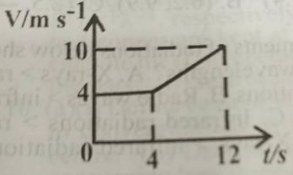
The diagram above illustrates the velocity-time graph of a body. Calculate the distance covered by the body during the motion
Attached Figure / Diagram
A
15m
B
84m
C
72m
D
48m
medium Difficulty
Verified Correct Answer: Option C
Physical Principles & Numerical Solution
Distance covered = Area under the graph
D = area of square + area of trapezium
D = L x L + 1/2(a+b)h
D = 4 x 4 + 1/2( 4+ 10)8
D = 16 + 1/2 x 14 x 8
D = 16 + 56
D = 72m.
Source: WAEC / JAMB / NECO Classroom Archive (Record #61903)
Physics
UTME / JAMB 2021
Equilibrium of Forces
Solution
A solid weighs 10.00N in air, 6N when forcefully immersed in water, and 7.0N when fully immersed in a liquid, X. Calculate the relative density of the liquid X.
A
\(\frac{5}{3}\)
B
\(\frac{4}{3}\)
C
\(\frac{3}{4}\)
D
\(\frac{7}{10}\)
medium Difficulty
Verified Correct Answer: Option C
Physical Principles & Numerical Solution
R.D = \(\frac{\text {weigh in air - weigh in liquid X}}{\text {weigh in air - weigh in water}}\)
= \(\frac{10 - 7}{10 - 6} = \frac{3}{4}\)
Source: WAEC / JAMB / NECO Classroom Archive (Record #60774)
Physics
WAEC / WASSCE 2021
Projectile Motion
Solution
A projectile is fired at an angle of 30° to the horizontal with a velocity of 40 m/s Calculate the velocity attained after 1 s. [g = 10 m/s\(^2\)]
medium Difficulty
Verified Correct Answer: Option
Physical Principles & Numerical Solution
Calculation of velocity: V = \sqrt[V\(^2\)x + V\(^2\)\(_y\)]
V\(_x\) = 40 Cos30 = 34.6 m/s
V\(_y\) = 40 sin30 - 10(1) = 10 m/s
V = \sqrt[34.6\(^2\) + 10\(^2\)]
V = 36.02m/s
Source: WAEC / JAMB / NECO Classroom Archive (Record #62320)
Physics
UTME / JAMB 2021
Momentum Impulse Newtons Law of Motion
Solution
A ball of mass 0.5kg moving at 10ms\(^{-1}\) collides with another ball of equal mass at rest. If the two balls move off together after the impact, calculate their common velocity.
A
0.2ms\(^{-1}\)
B
0.5ms\(^{-1}\)
C
5.0ms\(^{-1}\)
D
5.5ms\(^{-1}\)
medium Difficulty
Verified Correct Answer: Option C
Physical Principles & Numerical Solution
Using; \(m_1\) \(u_1\) + \(m_2\) \(u_2\) = (\(m_1\) + \(m_2\))v
\(m_1\) = 0.5kg, \(u_1\) = 10ms\(^{1}\), \(m_2\) = 0.5kg, \(u_1\) = 0
\(\therefore\) (0.5kg x 10) + (0.5 x 0) = (0.5 + 0.5)v
v = 5ms\(^{1}\)
Source: WAEC / JAMB / NECO Classroom Archive (Record #60597)
Physics
UTME / JAMB 2021
Momentum Impulse Newtons Law of Motion
Solution
A lead bullet of mass 0.05kg is fired with a velocity of 200ms\(^{-1}\) into a block of mass 0.95kg. Given that the lead block can move freely, the final kinetic energy after impact is?
A
50J
B
100J
C
150J
D
200J
medium Difficulty
Verified Correct Answer: Option A
Physical Principles & Numerical Solution
Given
\(m_1\) = 0.05kg, \(u_1\) = 200ms\(^{-1}\), \(m_2\) = 0.95kg
K.E = \(\frac{1}{2}\)\(m_r\)v\(^{2}\)
\(m_1\)\(u_1\) = v(\(m_1\) + \(m_2\)) [law of conversation of momentum]
v = \(\frac{0.05 \times 200}{0.05 + 95}\) = 10ms\(^{-1}\)
K.E = \(\frac{1}{2}\)(1)10\(^{2}\) = 50J
Source: WAEC / JAMB / NECO Classroom Archive (Record #60753)