Question Library
Browse, filter, and study verified past examination questions with step-by-step mathematical reasoning.
Searching 18,000+ Questions...
Sifting topics, KaTeX formulas & verified solutions
Showing 646–660 of 1462 verified questions
Sort by:
Mathematics
WAEC / WASSCE 2006
Geometry and Trigonometry
Solution
(a) A dealer sold a car to a man and made a profit of 15%. The man then sold it to a woman for N120,175.00 at a loss of 5%. How much did the dealer buy the car?
(b) The diameter of the wheel of a car is 36cm. How many revolutions, correct to three significant figures, will it make to cover a distance of 1.05 km? [Take \(\pi = \frac{22}{7}\)].
medium Difficulty
Verified Correct Answer: Option
Step-by-Step Mathematical Solution
(a) Let the cost of the car to the dealer be x.
Sales of car to a man with 15% profit : (115% of x = 1.15 x\)
Sale of the car to the woman by the man at 5% loss : (95% of 1.15x = N120,175.00)
\(0.95 \times 1.15x = N120,175.00\)
\(1.0925x = N120,175.00\)
\(x = \frac{120,175.00}{1.0925}\)
\(x = N110,000\)
The original cost of the car to the dealer = N110,000.00.
(b) Circumference of a circle = \(2\pi r\)
Distance covered by the wheel = 1.05 km
Radius of the wheel = 18cm
Circumference of the wheel = \(2 \times \frac{22}{7} \times 18\)
= \(113.14 cm\)
Note : 1.05 km = 105,000 cm
Number of revolution = \(\frac{105,000}{113.14}\)
= \(928.05 revs\)
\(\approxeq 928 revs\)
Source: Myschool Past Questions Archive (Record #53011)
Mathematics
WAEC / WASSCE 2006
Geometry and Trigonometry
Solution
In the diagram, ABCDEO is two- thirds of a circle centre O. The radius AO is 7cm and /AB/ = /BC/ = /CD/ = /DE/. Calculate, correct to the nearest whole number, the area of the shaded portion. [Take \(\pi = \frac{22}{7}\)].
medium Difficulty
Verified Correct Answer: Option
Step-by-Step Mathematical Solution
\(\stackrel\frown{AOB} = \stackrel\frown{BOC} = \stackrel\frown{COD} = \stackrel\frown{DOE} = 60^\circ\)
In \(\Delta AOB\), Area of sector = \(\frac{60}{360} \times \frac{22}{7} \times 7^{2}\)
= \(25.67 cm^{2}\)
Area of triangle AOB = \(\frac{1}{2} \times \7 \times 7 \times \sin 60\)
= \(24.5 \times 0.866\)
= \(21.22 cm^{2}\)
Area of the 4 sectors = \(4 \times 25.67 = 102.68 cm^{2}\)
Area of the 4 triangles = \(4 \times 21.22 = 84.88 cm^{2}\)
Area of the shaded portion = \((102.68 - 84.88)cm^{2}\)
= \(17.80 cm^{2}\)
\(\approxeq 18 cm^{2}\)
Source: Myschool Past Questions Archive (Record #53046)
Mathematics
WAEC / WASSCE 2006
Geometry and Trigonometry
Solution
(a) Using a ruler and a pair of compasses only, (i) construct \(\Delta\) XYZ such that |XY| = 8 cm and < YXZ = < ZYX = 45^\circ. (ii) locate a point P inside the triangle equidistant from XY and XZ and also equidistance from YX and YZ. (iii) construct a circle touching the three sides of the triangle (iv) measure the radius of the circle.
(b) The length of the sides of a hexagon are x - 5, 2x, 2x, 2x + 7, 2x and 2x - 1. If the perimeter is 144 cm, find the value of x.
medium Difficulty
Verified Correct Answer: Option
Step-by-Step Mathematical Solution
(a)
(b) \(x - 5 + 2x + 2x + 2x + 7 + 2x + 2x - 1 = 144\)
\(11x + 1 = 144\)
\(11x = 143\)
\(x = \frac{143}{11} = 13cm\)
Source: Myschool Past Questions Archive (Record #53047)
Mathematics
WAEC / WASSCE 2006
Geometry and Trigonometry
Solution
(a) Two lines AB and CD intersect at x such that \(\stackrel\frown{CAX}\) is equal to \(\stackrel\frown{BDX}\). If |AX| = 6 cm, |XB| = 4 cm and |CX| = 3 cm, find |XD|.
(b)
The diagram shows the positions of three points X, Y and Z on a horizontal plane. The bearing of Y from X is 312^\circ and that of Y from Z is 022^\circ. If |XY| = 32 km and |ZY| = 50 km, calculate, correct to one decimal place : (i) |XZ| ; (ii) the bearing of Z from X.
medium Difficulty
Verified Correct Answer: Option
Step-by-Step Mathematical Solution
(a)
Note that triangles AXC and BXD are similar.
\(\therefore \frac{6}{|XD|} = \frac{3}{4}\)
\(|XD| = \frac{6 \times 4}{3}\)
= \(8 cm\)
(b)(i)
From \(\Delta ZYX\),
\(\stackrel\frown{YZX} = 90^\circ - 22^\circ = 68^\circ\)
\(\stackrel\frown{YXZ} = 312^\circ - 270^\circ = 42^\circ\)
\(\stackrel\frown{ZYX} = 180^\circ - (68^\circ + 42^\circ)\)
= \(180^\circ - 110^\circ\)
= \(70^\circ\)
\(a^{2} = b^{2} + c^{2} - 2bc \cos A\)
\(|XZ|^{2} = 50^{2} + 32^{2} - 2(50)(32) \cos 70\)
= \(2500 +1024 - 3200 \times 0.342\)
= \(3524 - 1094.46\)
\(|XZ|^{2} = 2429.54\)
\(|XZ| = \sqrt{2429.54} = 49.29 km\)
\(\approxeq 49.3 km\) (to 1 d.p)
(ii)
\(\frac{a}{\sin A} = \frac{b}{\sin B} = \frac{c}{\sin C}\)
\(\frac{50}{\sin \theta} = \frac{49.3}{\sin 70}\)
\(\sin \theta = \frac{50 \times \sin 70}{49.3}\)
\(\sin \theta = 0.9530\)
\(\theta = \sin^{-1} (0.9530)\)
= \(72.37^\circ\)
\(\therefore\) The bearing of Z from X = \(312^\circ - 72.37^\circ\)
= \(239.63^\circ \approxeq 239.6^\circ\)
Source: Myschool Past Questions Archive (Record #53055)
Mathematics
UTME / JAMB 2005
Geometry and Trigonometry
Solution
If the interest on N150.00 for 2\(\frac{1}{2}\) years is N4.50, find the interest on N250.00 for 6 months at the same rate
A
N1.50
B
N7.50
C
N15.00
D
N18.00
medium Difficulty
Verified Correct Answer: Option A
Step-by-Step Mathematical Solution
To find the interest on \( N250.00 \) for \( 6 \) months at the same rate, we follow these steps:
Calculate the Interest Rate
Given: P = N150.00, T = 2\(\frac{1}{2}\) years and I = N4.50
Using the formula for simple interest:
\(I = P \times r \times T\)
Rearranging to find the interest rate \( r \):
\(r = \frac{I}{P \times T}\)
Substituting the values:
\(r = \frac{4.50}{150 \times 2.5}\)
Calculating \( P \times T \):
\(P \times T = 150 \times 2.5 = 375\)
Now, substituting back to find \( r \):
\(r = \frac{4.50}{375} = 0.012\)
Calculate the Interest for N250.00 \) for 6 Months
We need to calculate the interest for: P = N250.00, T = 6 months = 0.5yrs, r = 0.012
Using the interest formula again:
\(I = P \times r \times T\)
Substituting the values:
\(I = 250 \times 0.012 \times 0.5\)
\(I = 250 \times 0.012 = 3\)
Then: \(I = 3 \times 0.5 = 1.50\)
The interest on \( N250.00 \) for \( 6 \) months at the same rate is N1.5
Source: Myschool Past Questions Archive (Record #8219)
Mathematics
UTME / JAMB 2005
Geometry and Trigonometry
Diagram
Solution
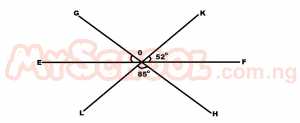
Three straight lines EF, GH and LK interest at O as shown above. If ∠KOF = 52o and ∠LOH = 85o, calculate the size of ∠EOG.
Attached Figure / Diagram
A
26o
B
43o
C
52o
D
85o
medium Difficulty
Verified Correct Answer: Option B
Step-by-Step Mathematical Solution
∠GOK = 85o (vertical opposite angle ∠s)
∠EOG + ∠GOK + ∠KOF = 180 (∠s on a straight line)
∠EOg + 85o + 52o = 180o
∠EOG + 137o = 180o
∠EOG = 43o
Source: Myschool Past Questions Archive (Record #8423)
Mathematics
UTME / JAMB 2005
Geometry and Trigonometry
Solution
The sum of the interior angle of a regular polygon is 1800o. Calculate the size of one exterior angle of the polygon
A
30o
B
24o
C
18o
D
12o
medium Difficulty
Verified Correct Answer: Option A
Step-by-Step Mathematical Solution
Sum of interior ∠s = 1800o
∴(n - 2) 180o = 1800o
180n -360o = 1800o
180n = 1800o + 360o
180n = 2160o
n = 2160o/180o
n = 12 sides
Each exterior ∠ = 360o/n
= 360o/12
= 30o
Source: Myschool Past Questions Archive (Record #8424)
Mathematics
UTME / JAMB 2005
Geometry and Trigonometry
Solution
A sector of a circle has an area of 55 cm2. If the radius of the circle is 10 cm, calculate the angle of the sector
[\pi = 22/7]
A
45o
B
63o
C
75o
D
90o
medium Difficulty
Verified Correct Answer: Option B
Step-by-Step Mathematical Solution
Area of a sector = \(\frac{\theta}{360}\times \pi r^2\)
55 = \(\frac{\theta}{360}\times \frac{22}{7}\times \frac{10\times 10}{1}\)
\(\theta = \frac{360 \times 55 \times 7}{22 \times 10 \times 10}\)
\(\theta = 63^{\circ}\)
Source: Myschool Past Questions Archive (Record #8426)
Mathematics
UTME / JAMB 2005
Geometry and Trigonometry
Solution
Two lines PQ and ST intersect at 75^\circ. The locus of points equidistant from PQ and ST lies on the
A
perpendicular bisector of PQ
B
perpendicular bisector of ST
C
bisector of the angles between lines PQ and ST
D
bisector of the angles between lines PT and QS
medium Difficulty
Verified Correct Answer: Option C
Step-by-Step Mathematical Solution
The locus of points equidistant from lines PQ and ST lies on the angle bisector of the angles formed by the intersection of those lines.
Source: Myschool Past Questions Archive (Record #8428)
Mathematics
UTME / JAMB 2005
Geometry and Trigonometry
Solution
A chord of a circle subtends an angle of 60o at the length of a circle of radius 14 cm. Find the length of the chord
A
7 cm
B
14 cm
C
21 cm
D
28 cm
medium Difficulty
Verified Correct Answer: Option B
Step-by-Step Mathematical Solution
Chord Length (L) = \(2 \times Radius \times (sin \frac{angle}{2})\)
= \(2 \times 14 \times (sin \frac{60}{2})\)
= \( 28 \times (sin 30)\)
= \(28 \times \frac{1}{2}\)
= \(14cm\)
Source: Myschool Past Questions Archive (Record #8462)
Mathematics
UTME / JAMB 2005
Geometry and Trigonometry
Solution
If sin θ = -1/2 for 0 o, the value of θ is
A
30o and 150o
B
150o and 210o
C
210o and 330o
D
150o and 330o
medium Difficulty
Verified Correct Answer: Option C
Step-by-Step Mathematical Solution
sin θ = -1/2
= -0.5
θ = sin-1 (0.5)
θ = 30o
Since θ is negative
θ = 180 + 30 = 210o
θ = 360 - 30 = 330o
∴θ = 210o and 330o
Source: Myschool Past Questions Archive (Record #8467)
Mathematics
UTME / JAMB 2005
Geometry and Trigonometry
Solution
Find the derivative of y = sin(2x\(^3\) + 3x - 4)
A
cos (2x3 + 3x - 4)
B
-cos (2x3 + 3x - 4)
C
(6x2 + 3) cos (2x3 + 3x - 4)
D
-(6x2 + 3) cos (2x3 + 3x - 4)
medium Difficulty
Verified Correct Answer: Option C
Step-by-Step Mathematical Solution
y = sin (2x\(^3\) + 3x - 4)
let u = 2x\(^3\) + 3x - 4
∴du/dx = 6x\(^2\)
y = sin u
dy/du = cos u
dy/dx = du/dx * dy/du
∴dy/dx = (6x\(^2\) + 3) cos u
= (6x\(^2\) + 3)cos(2x\(^3\) + 3x - 4)
Source: Myschool Past Questions Archive (Record #8483)
Mathematics
UTME / JAMB 2005
Geometry and Trigonometry
Solution
The radius r of a circular disc is increasing at the rate of 0.5cm/sec. At what rate is the area of the disc increasing when its radius is 6cm?
A
36 π cm2/sec
B
18 π cm2/sec
C
6 π cm2/sec
D
3 π cm2/sec
medium Difficulty
Verified Correct Answer: Option C
Step-by-Step Mathematical Solution
Increase in radius dr/dt = 0.5
Area of the circular disc = πr2
Increase in area: dA/dr = 2πr
Rate of increase in area: dA/dt = dA/dr * dr/dt
when r = 6cm
= 2πr * 0.5
= 2 * π * 6 * 0.5
2 * π * 6 * 1/2 = 6 π cm2/sec
Source: Myschool Past Questions Archive (Record #8489)
Mathematics
UTME / JAMB 2005
Geometry and Trigonometry
Solution
Evaluate \(\int_0^{\frac{\pi}{2}}sin2xdx\)
A
1
B
zero
C
-1/2
D
-1
medium Difficulty
Verified Correct Answer: Option A
Step-by-Step Mathematical Solution
\(\int_0^{\frac{\pi}{2}}\)sin 2x dx = [-1/2cos 2x + C]\(_0^{\frac{\pi}{2}}\)
=[-1/2 cos 2 * \pi/2 + C] - [-1/2 cos 2 * 0]
= [-1/2 cos \pi] - [-1/2 cos 0]
= [-1/2x - 1] - [-1/2 * 1]
= 1/2 -(-1/2) = 1/2 + 1/2 = 1
Source: Myschool Past Questions Archive (Record #8518)
Mathematics
UTME / JAMB 2005
Geometry and Trigonometry
Diagram
Solution
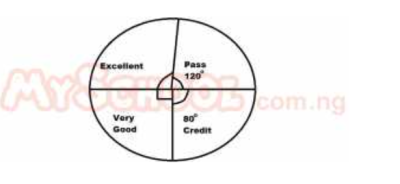
The grades of 36 students in a test are shown in the pie chart above. How many students had excellent?
Attached Figure / Diagram
A
7
B
8
C
9
D
12
medium Difficulty
Verified Correct Answer: Option A
Step-by-Step Mathematical Solution
Angle of Excellence
= 360 - (120+80+90)
= 360 - 290
= 70o
If 360o represents 36 students
1º will represent \(\frac{36}{360}\)
50^\circ will represent \(\frac{36}{360}\) * \(\frac{70}{1}\)
= 7
Source: Myschool Past Questions Archive (Record #8535)