Question Library
Browse, filter, and study verified past examination questions with step-by-step mathematical reasoning.
Searching 18,000+ Questions...
Sifting topics, KaTeX formulas & verified solutions
Showing 616–630 of 1709 verified questions
Sort by:
Physics
WAEC / WASSCE 2009
Mechanics and Properties of Matter
Solution
Explain why mercury does not wet glass while water does.
medium Difficulty
Verified Correct Answer: Option
Physical Principles & Numerical Solution
Mercury does not wet glass because (force of) cohesion/attraction of mercury molecules is greater than (force of) adhesion/attraction between glass and mercury molecules.
Water wets glass because (force of) adhesion/attraction between glass and water molecules is greater than (force of) cohesion/attraction of water molecules.
Source: Myschool Past Questions Archive (Record #53486)
Physics
WAEC / WASSCE 2009
Mechanics and Properties of Matter
Solution
Explain the following terms:
(a) tensile stress;
(b)Young’s modulus
medium Difficulty
Verified Correct Answer: Option
Physical Principles & Numerical Solution
(a) Tensile stress is the ratio of force to cross-sectional area of a wire/rod. It is expressed in Newton per metre squared (Nm\(^{-2}\))
(b) Young’s modulus is the ratio of tensile stress to tensile strain. It is expressed in Newton per metre squared. (Nm\(^{-2}\))
Source: Myschool Past Questions Archive (Record #53490)
Physics
WAEC / WASSCE 2009
Mechanics and Properties of Matter
Solution
a) List two properties of cathode rays.
(b) Explain how the intensity and energy of cathode rays may be increased
medium Difficulty
Verified Correct Answer: Option
Physical Principles & Numerical Solution
(a) Properties of cathode rays:
Cathode rays
are negatively charged.
travel in straight line in field free space.
are deflected by electric/magnetic field.
possess(kinetic) energy.
possess momentum.
(b)(i) The intensity of cathode rays may be increased by raising the temperature of the cathode/increasing the current through the heater.
(ii) The energy of cathode rays may be increased by raising the potential difference between the anode and the cathode/the anode potential.
Source: Myschool Past Questions Archive (Record #53493)
Physics
WAEC / WASSCE 2009
Mechanics and Properties of Matter
Solution
a) Given a retort stand and clamp, a stout pin, a simple pendulum and a pencil, describe how you would use these apparatus to determine the centre of gravity of an irregularly shaped piece of cardboard of a moderate size.
(b) Using a suitable diagram, explain how the following can be obtained from a velocity-time graph:
(i) acceleration;
(ii) total distance covered.
(c ) A body at rest is given an initial uniform acceleration of 6.0 ms\(^{-2}\) for 20s after which the acceleration is reduced to 4.0 ms\(^{-2}\) for the next 10s.
The body maintains the speed attained for 30s.
Draw the velocity-time graph of the motion using the information given above. From the graph, calculate the:
maximum speed attained during the motion;
total distance traveled during the first 30 s;
average speed during the same time interval as in (ii) above.
medium Difficulty
Verified Correct Answer: Option
Physical Principles & Numerical Solution
(a) PROCEDURE
Make at least 3 well-spaced pin holes round the edge of the cardboard. Clamp the pin horizontally and suspend the cardboard on it through one of the pin-holes such that the cardboard can swing freely
Hang the simple pendulum on the same pin and let its string be very close to the cardboard.
When the whole system is at rest (or in equilibrium) trace the plumbline on the cardboard. Repeat the procedure for each of the two other pin holes.
CONCLUSION
The point at which the (three) traced lines intersect is the centre of gravity of the cardboard.
PRECAUTIONS
- Repeat procedure
- Pin rigidly and firmly held by retort stand and clamp
- Allow the simple pendulum to rest before tracing the shadow of
the plumbline on the cardboard.
- The string to be close to the cardboard
b) Diagram:
Both axes correctly labelled
Any correct shape of graph showing acceleration segment
Acceleration = gradient of AB
Total distance covered = area under the graph
(c) Diagram
- At least one axis labelled
- correct shape of graph
Let V\(_1\) = maximum velocity after 20 sec.
V\(_2\) = maximum velocity after 30 sec.
(i) Then \(\frac{V_1}{20}\) = 6
∴ V\(_1\) = 120 ms\(^{-1}\)
Also V\(\frac{V_2 - V_1}{10}\) = 4
\(\frac{V_2 - 120}{10}\) = 4
V\(_2\) = 160 ms\(^{-1}\)
Maximum speed = V\(_2\) = 160ms\(^{-1}\)
(ii) Total distance covered = Area of \Delta + Area of trapezium after 1st 30 seconds
= ( ½ x 20 x 120) + ½ (120 + 160) x 10
= 1200 + 1400
= 2600m
(iii) Average speed = \(\frac{\text{Total distance}}{\text{ Total time}}\)
= \(\frac{ 2600}{30}\)
= 86.67 ms\(^{-1}\)
Source: Myschool Past Questions Archive (Record #53501)
Physics
WAEC / WASSCE 2009
Mechanics and Properties of Matter
Solution
(a) Explain why it is not advisable to sterilize a clinical thermometer in boiling water at normal atmospheric pressure.
(b) State the effect of an increase in pressure on the
(i) boiling point; and
(ii) melting point of water.
(c) Diagram:
The graph shown above is that of the saturated vapour pressure (s.v.p.) of water against temperature.
Pure water is known to boil at 100\(^o\)C and at an atmospheric pressure of 760 mmHg. What general conclusion can be drawn from the information given above?
d) A thread of mercury of length 20 cm is used to trap some air in a capillary tube with uniform cross-sectional area and closed at one end. With the tube vertical and the open end uppermost, the length of the trapped air column is 15cm. Calculate the length of the air column when the tube is held:
i) horizontally;
ii) vertically with the open end underneath. [Atmospheric pressure = 76 cmHg ]
medium Difficulty
Verified Correct Answer: Option
Physical Principles & Numerical Solution
(a) A clinical thermometer has small temperature range. The glass will crack/burst due to excessive pressure created by expansion of mercury.
(b) Increase in pressure
(i) increases the boiling point;
(ii) decreases the melting point.
(c) At the boiling point of pure water, the saturated vapour pressure (s.v.p) of the water is equal to the external atmospheric pressure.
(d) Diagram
Volume V is proportional to length Ɩ stated or implied
(i) P\(_1\)V\(_1\) = P\(_2\)V\(_2\) implies P\(_1\)P\(_1\) = P\(_2\)P\(_2\)
(76 + 20) 15 = 76 x L\(_2\)
Ɩ\(_2\) = 96 x 15
76
Ɩ\(_2\) = 18.95 cm
(ii) P\(_1\)L\(_1\) = P\(_3\) L\(_3\)
= (76 + 20) 15 = (76 – 20) x Ɩ\(_3\)
Ɩ\(_3\) = 96 x 15
56
Ɩ\(_3\) = 25.7l cm
Source: Myschool Past Questions Archive (Record #53502)
Physics
WAEC / WASSCE 2009
Mechanics and Properties of Matter
Solution
(a) State two differences between a sound wave and a radio wave.
(b) Explain why a vibrating tuning fork sounds louder when its stem is pressed against a table top than when held in air.
(c)State two conditions necessary for the:
production of stationary wave in a medium;
formation of interference wave patterns;
occurrence of total internal reflection of a wave.
(d) A ray of light is incident on one face of an equilateral glass prism.
Draw a ray diagram to show the path of the ray through the prism.
Calculate the refractive index of the glass if the angle of minimum deviation is 41\(^o\).
medium Difficulty
Verified Correct Answer: Option
Physical Principles & Numerical Solution
(a) Differences between a sound wave and a radiowave
Sound wave
Radio wave
is a mechanical wave
is an electromagnetic wave
is longitudinal
is transverse
has speed less than speed of light.
has speed equal to that of light
requires a material medium for propagation/cannot travel through vacuum.
does not require a material medium for propagation/can travel through vacuum.
(b) The vibrating tuning fork forces the table top to vibrate. The table top has a much larger area and is therefore in contact with a larger volume of air undergoing vibration. Hence, sound heard is amplified.
(c) Conditions necessary for:
(i) production of stationary wave
- Two waves must be traveling in opposite directions.
- Incident and reflected waves must have the same frequency/wavelength.
- Incident and reflected waves must have equal amplitude.
- There must be superimposition.
- There must be a barrier
(ii) formation of interference wave pattern
- Two sources must be involved.
- The two sources must be coherent/have a constant phase difference as well as the same frequency and amplitude.
- The waves that are interfering must have the same amplitude
- The distance between the sources must be of the order of the wavelengths of the waves.
(iii) total internal reflection
- The wave must be traveling from a denser medium to a less dense medium
- The angle of incidence of the wave in the denser medium must be greater than the critical angle for the medium.
(d)(i) Diagram
Correct diagram
(ii) \(\frac{ Sin (A + dm)}{2}\)
n =
Sin (A/2)
Sin (60 + 41)/2
Sin (60/2)
= 1.54
Source: Myschool Past Questions Archive (Record #53504)
Physics
WAEC / WASSCE 2009
Mechanics and Properties of Matter
Solution
(a) State two essential differences between a moving coil galvanometer and a d.c. generator.
(b) Explain the term eddy currents and state two devices in which the currents are applied.
(c) State the principle on which the potentiometer is based when it is functioning.
(d) A source of e.m.f. 110 V and frequency 60Hz is connected to a resistor, an inductor and a capacitor in series. When the current in the capacitor is 2A, the potential differences across the resistor is 80 V and that across the inductor is 40 V. Draw the vector diagram of the potential differences across the inductor, the capacitor and the resistor.
Calculate the:
(i) potential difference across the capacitor;
(ii) capacitance of the capacitor;
(iii) inductance of the inductor. [\pi = 3.14]
medium Difficulty
Verified Correct Answer: Option
Physical Principles & Numerical Solution
a) Differences between a d. c. generator and a moving coil galvanometer.
D. C. generator
moving coil galvanometer
converts mechanical energy to electrical energy
converts electrical energy to mechanical energy.
uses split rings or commutator
uses hair springs.
rotation of coil is continuous
rotation of coil is incomplete
uses carbon brushes (as terminals)
uses jeweled bearings (as terminals)
(b) Eddy currents are currents induced in a conductor when subjected to varying magnetic field.
Any valid additional information e.g.
eddy current flows in a circular path or closed loops;
eddy current generates heat;
eddy current cannot flow through gaps or slots;
The currents move in such a direction as to oppose the change producing them.
Devices in which eddy currents are applied
pointers of sensitive electric meters
sensitive mass balances
brakes in large electric motors
speedometers in automobiles
detection of cracks in railway tracks
detection of metals
(c) Principle on which a potentiometer is based
When a steady current is allowed to pass through a uniform wire, equal lengths of the wire will have equal potential differences.
OR
The p.d across a length of a wire is (directly) proportional to the length provided the wire has a uniform cross section.
(d)
Vector diagram showing
V\(_L\) with arrow
V\(_C\) with arrow
V\(_R\) with arrow
(i) V\(^2\) = V\(_R^2\) + (V\(_L\) - V\(_C\))\(^2\)
110\(^2\) = 80\(^2\) + (40 – V\(_C\))\(^2\)
(40 – V\(_C\)) = \(\sqrt{(110 + 80) (110 – 80)}\)
40 – V\(_C\) = + 75.5
V\(_C\) = 40 + 75.5
V\(_C\) = 115.5V
(ii) X\(_c\) \(\frac{V_c}{I} = \frac{1}{2 \pi f c}\)
C = \(\frac{1}{2 \pi fV_c}\)
C \(\frac{2}{2 \times 3.14 \times 60 \times 115.5} = 45.9\muF\)
(iii) \(V_L = IX_L = I \times 2 \pi fL}\)
L = \(\frac{V_l}{I \times 1 \times 2 \pifVc}\)
C = \(\frac{2}{2 \times 3.142 \times 60 \times 2}\)
= 0.053H
Source: Myschool Past Questions Archive (Record #53505)
Physics
WAEC / WASSCE 2009
Mechanics and Properties of Matter
Solution
(a) Briefly explain the following terms:
(i) emission line spectra;
(ii) line absorption spectra.
(b) Draw a labeled diagram showing the structure of a simple type of photocell and explain its mode of operation.
(c) State two
(i) reasons to show that x-rays are waves;
(ii) uses of x-rays other than in medicine.
(d) An electron jumps from an energy level of -1.6eV to one of -1.4 eV in an atom. Calculate the energy and wavelength of the emitted radiation. [ h = 6.6 x 10\(^{-34}\) Js; c = 3.00 x 10\(^8\) ms\(^{-1}\); eV = 1.6 x 10\(^{-19}\) J ]
medium Difficulty
Verified Correct Answer: Option
Physical Principles & Numerical Solution
(a)(i) Emission line spectra consist of distinct and separate bright lines of definite wavelengths on a dark background.
Any valid additional information e.g
- They are obtained when light from a luminous source undergoes dispersion and is observed directly.
- When an electron moves from one energy level to another energy level, line spectra are observed
- The colour of the spectra is a characteristic of the source.
(ii) Line absorption spectra are obtained when light passes through a cool gas and certain wavelengths of the light are absorbed. This gives series of dark lines, each corresponding to one of the wavelengths absorbed.
(b) Diagram
When radiation of appropriate frequency falls on the cathode (with photosensitive surface) electrons are emitted. Because the anode is positive with respect to the cathode, the electrons are attracted to the anode. The electrons flow completes the circuit and current flows.
(c)(i) Wave properties of X-rays
- diffraction
- interference
- reflection
- refraction
- polarization
(ii) Uses of X-rays other than in medicine
to study crystal structures
to detect presence of cracks in welded parts
in artistic works for determining the authenticity of such works
at security check points to scan
X-ray spectroscopy for identifying isotopes of elements.
(d)
\DeltaE = E\(_i\) - E\(_f\)
= - 1.6 – (- 10.4)
= 8.8 e V or 1.41 x 10\(^{-18}\) J
E = hf = hc/\lambda
or
\lambda = hc/E
= 6. 6 x 10\(^{-34}\) x 3 x10\(^{8}\)
8.8 x 1.6 x 10\(^{-19}\)
\lambda = 1.4 x 10\(^{-7}\) m
Source: Myschool Past Questions Archive (Record #53508)
Physics
WAEC / WASSCE 2009
Mechanics and Properties of Matter
Solution
You are provided with two meter rules and other necessary apparatus.
Place one of the rules on a knife edge and determine its centre of gravity C. Mark this pos with a piece of chalk.
Read and record the mass \(M_R\) of the metre rule written on the reverse side of it.
Attach the mass M= 100g firmly to the rule AB at C using sellotape.
Suspend the metre rule by two parallel threads of length h = 40 cm each at the 10 cm marks. Ensure that the graduated face to the metre rule is facing upwards.
Set the rule AB into a small angular oscillation about the vertical axis through its centre of gravity.
Determine the time, t for 20 complete oscillations. Evaluate the period T and T\(^{2}\)
Read and record the value of d in meters.
Keeping d constant throughout the experiment, repeat the procedure for other values of h = 50, 60, 70, and 80 cm. In each case determine the corresponding values of f T and T. Tabulate your reading. (x) Plot a graph of T on the vertical axis and h on the horizontal axis.
Determine the slope S, of the graph. Evaluate k =s, where Q =2 S, Q 250P
State two precautions taken to ensure accurate results.
(b)i. Define the term couple as it relates to rotational or oscillatory systems.
ii. Give two practical application of a couple in everyday life.
medium Difficulty
Verified Correct Answer: Option
Physical Principles & Numerical Solution
Center of gravity C = 49.5cm
Mass of metre rule (MR) = 135g, d = 80cm = 0.8m
h(cm)
d(m)
t(sec)
T=\(\frac{\text{t(sec)}}{20}\)
T\(^{2}\)(Sec\(^{2}\))
40
0.8
28.0
\(\frac{28.0}{20}\)=1.40
1.9600
50
0.8
29.0
\(\frac{29.0}{20}\)=1.45
2.1025
60
0.8
31.0
\(\frac{31.0}{20}\)=1.55
2.4025
70
0.8
34.0
\(\frac{34.0}{20}\)=1.70
2.8900
80
0.8
37.0
\(\frac{37.0}{20}\)=1.85
3.4225
Slope (s) = \(\frac{\bigtriangleup {T}^{2}}{\bigtriangleup {h(cm)}}\) = \(\frac{(3.42-0.40)sec^{2}}{(80-21)cm}\)
= \(\frac{3.02sec^{2}}{59cm}\)
= 0.0512sec\(^{2}\)cm\(^{-1}\)
K = \(\frac{S}{Q}\), Q = \(\frac{2}{25d^{2}}\)
K = \(\frac {\frac{S}{2}}{25d^{2}}\)
S = 0.0512sec\(^{2}\)cm\(^{-1}\), d = 50cm = 0.8cm
K = \(\frac{0.0512sec^{2}cm^{-1} \times 25 \times (0.80)^{2}}{2}\)
K = \(\frac{0.0512 \times 25 \times 0.6400sec^{2}cm^{-1}}{2}\) = 0.4096sec\(^{2}\)cm\(^{-1}\)m\(^{2}\)
Precautions: i
- ensured smooth and regular oscillations in a horizontal plane.
- ensured there was no error due to parallax when reading my stopwatch.
(b)i. Couple -This can be defined as two forces of the same magnitude acting in opposite directions but not on the same line.
ii. Practical application of couple include:
- Opening or closing taps.
- Turning a spanner.
- Setting a flywheel in motion about an axis through its center
- Motion of a spinning spindle.
- Riding/pedaling of bicycle
Source: Myschool Past Questions Archive (Record #60022)
Physics
WAEC / WASSCE 2009
Mechanics and Properties of Matter
Diagram
Solution
1. Connect the circuit as shown in the diagram above. PQ is a potentiometer wire 100 cm long and R is a standard resistor of 5\(\Omega\).
2. With the jockey J not making contact with PQ, close the switch. Read and record the ammeter reading I. Open the switch.
3. Use the jockey to make contact with PQ at the 20cm mark such that PJ = I = 20 cm. Close the switch, read and record the value \(I_i\) of the ammeter. Evaluate I\(^{-1}\).
4. Repeat the procedure for other values of I = 35, 50, 65, and 80 cm. In each case, determine the corresponding values of \(I_i\), and I\(^{-1}\). Tabulate your readings.
Plot a graph of I\(^{i}\) on the vertical axis and \(I_i\), on the horizontal axis, starting both axes from the origin (0, 0).
From your graph deduce the value, of \(I_o\) of \(I_i\), when I\(^{-1}\)= 0.
Evaluate \(I_o\)e
State two precautions taken to ensure accurate results.
(b)) Define the e. m.f. of a battery
ii. A cell X e.m.f. 1.00 V is balanced by a length of 40.0 cm on a potentiometer wire. Another cell Y is balanced by a length of 60.0 cm on the same wire. Calculate the e.m.f. of Y.
Attached Figure / Diagram
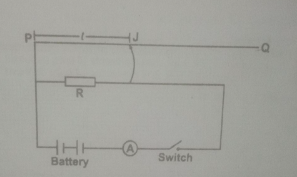
medium Difficulty
Verified Correct Answer: Option
Physical Principles & Numerical Solution
S/N
L(cm)
Ii(A)
L\(^{-1}\)(cm\(^{-1}\))
1
20
1.00
0.050
2
35
0.90
0.029
3
50
0.85
0.020
4
65
0.80
0.015
5
80
0.75
0.013
When L\(^{-1}\) = 0, Ii = 0.75A
\(I_o\) = 75A
\(\frac{I_{o}}{I}= \frac{0.75A}{0.20A}\) = 37.5
SEE THE GRAPH ABOVE...
Precautions: i
- ensured there was no error due to parallax when reading my ammeter.
- ensured that I removed the key after each reading.
(b)i. E.m.f is the total work done in pushing one coulomb of electricity round an external resistor and the internal resistor of the source, or the total energy obtained per coulomb from a cell or battery
ii. \(\frac{Ey}{Ex} = \frac{Iy}{Ix}\)
Iy = 60cm
Ex = 1.00v
Ix = 40.cm
Ey = ?
\(\frac{Ey}{1.00}=\frac{60}{40}\)
Ey = \(\frac{60 \times 1.00}{40}\) = 1.50.v
Source: Myschool Past Questions Archive (Record #60030)
Physics
UTME / JAMB 2008
Mechanics and Properties of Matter
Solution
I. Force (N)
II.Torque (Nm)
III. Current (A)
IV. Power (W)
Which of the above are the correct S. I: units of the quantities indicated?
A
I and II only
B
I and III only
C
I, II and III only
D
I, II, III and IV only
medium Difficulty
Verified Correct Answer: Option D
Physical Principles & Numerical Solution
∴i,ii, iii and iv have correct units.
Source: Myschool Past Questions Archive (Record #14015)
Physics
UTME / JAMB 2008
Mechanics and Properties of Matter
Solution
If a body mass 5kg is thrown vertically upwards with velocity u,at what height will the potential energy equal to the kinetic energy?
A
h =(u)2/g
B
h = (u)2/4g
C
h = (2u)2/g
D
h = (u)2/2g
medium Difficulty
Verified Correct Answer: Option B
Physical Principles & Numerical Solution
From V\(^2\) = U\(^2\) + 2as
O = U\(^2\) - 2gH, since at maximum height H, the final velocity, v = O.
when K.E = P.E
∴ H = \(\frac{(U)^2}{2g}\)
Halfway is the \(\frac{\text{height}}{2}\)
PE = KE at \(\frac{(1)}{2}\) H = \(\frac{(U)^2}{2g}\) x (\(\frac{1}{2}\)) = \(\frac{U^2}{4g}\)
Source: Myschool Past Questions Archive (Record #14022)
Physics
UTME / JAMB 2008
Mechanics and Properties of Matter
Solution
A motorcycle of mass 100kg moves round in a circle of radius 10m with a velocity of 5 ms\(^{-1}\). find the coefficient of friction between the road and the tyres.
A
25.00
B
2.50
C
0.50
D
0.25
medium Difficulty
Verified Correct Answer: Option D
Physical Principles & Numerical Solution
F = \(\frac{mv^2}{\text{r}}\) = \(\frac{100 \times 5^2}{10}\) = 250N
R = mg = 100 x 10 = 1000N
coefficient of friction,
µ = \(\frac{\text{F}}{\text{R}}\) = \(\frac{(250)}{1000}\) = 0.25.
Source: Myschool Past Questions Archive (Record #14027)
Physics
UTME / JAMB 2008
Mechanics and Properties of Matter
Solution
In the hare's apparatus, water rises to a height of 26.5 cm in one limb. if a liquid rises to a height of 20.4 cm in the other limb, what is the relative density of the liquid?
A
0.8
B
1.1
C
1.2
D
1.3
medium Difficulty
Verified Correct Answer: Option D
Physical Principles & Numerical Solution
hlpl = hwpw
where, L =liquid and W = water
(pl)/pw = (hw)/hl = (26.5)/20.4
= 1.299
Source: Myschool Past Questions Archive (Record #14031)
Physics
UTME / JAMB 2008
Mechanics and Properties of Matter
Solution
An empty density bottle weighs 2 N. if it weighs 5 N when filled with water and 4 N when filled with olive oil, the relative density of olive oil is?
A
(1)/3
B
(2)/3
C
(1)/5
D
(2)/5
medium Difficulty
Verified Correct Answer: Option B
Physical Principles & Numerical Solution
relative density = (weight of substance )/weight of equal volume of water = (4 - 2)/5 - 2 = (2)/3
Source: Myschool Past Questions Archive (Record #14037)