Question Library
Browse, filter, and study verified past examination questions with step-by-step mathematical reasoning.
Searching 18,000+ Questions...
Sifting topics, KaTeX formulas & verified solutions
Showing 586–600 of 1709 verified questions
Sort by:
Physics
WAEC / WASSCE 2010
Mechanics and Properties of Matter
Solution
(a)
When a positively charged conductor is placed near a candle flame, the flame spreads out as shown in the diagram above. Explain this observation.
(b) A proton moving with a speed of 5.0 x 10\(^{5}\) ms\(^{-1}\) enters a magnetic field of flux density 0.2 T at an angle of 30^\circ to the field. Calculate the magnitude of the magnetic fcrce exerted on the proton. [Proton charge = 1.6 x 10\(^{-19}\) C]
(c)
The diagram above illustrates a 9.0 V battery of internal resistance 0.5 \(\Omega\) connected to two resistors of values 2.0 \(\Omega\) and R \(\Omega\). A\(_1\) A\(_2\) and A\(_3\) are ammeters of negligible internal resistances. If Al reads 4.0 A, calculate the:
(i) equivalent resistance of the combined resistors 2.0 \(\Omega\) and R \(\Omega\);
(ii) currents through A\(_1\) and A\(_3\) ; (iii) value of R.
medium Difficulty
Verified Correct Answer: Option
Physical Principles & Numerical Solution
(a) The positively charged conductor attracts the negative charges in the air and repels the positive charges i.e. the candle flame ionizes the air around it.
= 1.6 x 10\(^{-19}\) X 5.0 X 10\(^5\) x 0.2 x Sin 30^\circ
= 0.8 x 10\(^{-1}\)
(c)(i)E = I (Rc + r)
9 = 4(Rc + 0.5)
R: = 9/4-0.5
= 1.75\Omega
(ii) Lost volt = Ir = 4.0 x 0.5 =2.0 V
V oltage across 2\Omega and R\Omega
V = 9.0 - 2.0 = 7.0V
Current in A\(_2\) = I\(_2\) = \(\frac{2}{VR}\) = 7/2 = 3.5A
Current in A\(_3\) = I\(_3\) = V/R = 7/14 = 0.5A
OR
A\(_3\) = A\(_1\) - A\(_2\)
= 4.0 - 3.5 = 0.5A
(iii) 1/RC = \(\frac{1}{R}\) + \(\frac{1}{R_2}\)
1/1.75 = \(\frac{1}{R}\) + \(\frac{1}{2}\)
\(\frac{1}{R}\) = 1/1.75 - \(\frac{1}{2}\)
R = 14\Omega
Source: Myschool Past Questions Archive (Record #53458)
Physics
WAEC / WASSCE 2010
Mechanics and Properties of Matter
Solution
(a) State three conclusions that can be drawn from Rutherford's experiment on the scattering of alpha particles by a thin metal foil in relation to the structure of the atom
The diagram above illustrates th3 energy levels of an electron in an atom. If an excited electron moves from n\(_2\) to n\(_\theta\), calculate the:
(i) frequency;
(ii) wavelength of the emitted radiation. [ h = 6.6 x 10\(^{-34}\) Js; le V = .6 x 10\(^{-19}\) J; C = 3.0 x 10\(^8\) ms\(^{-1}\)]
(c) The following nuclear equations represent two types of radioactivity.
\(^{226}_{88}R_a \to ^{222}_{86}R_n + ^a_2a\) (Equation A)
\(^{14}_7N + ^4_2a \to ^{17}_8O + ^1_1p\) (Equation B)
Identify each type and explain briefly the difference between them
medium Difficulty
Verified Correct Answer: Option
Physical Principles & Numerical Solution
(a) Conclusion from Rutherford's experiment;
- The nucleus is massive
- Most of the atom is empty space
- The nucleus is positively charged
- Electrons revolve round the nucleus
- It explains the periodicity of elements in the periodic table
b )(i) E\(_2\) = E\(_2\) - E\(_o\)
= - 2.0 - (-12.0)
= 10.0 e V
= 10 x 1.6 x 1O\(^{-19}\)J
= 1.6 x 10\(^{-18}\)J
E = hf
Or
f = E/h
= 1.6 x 10\(^{18}\)
= 6.6 x10\(^{-34}\)
= 2.424 x 10\(^{15}\) Hz
(ii) c = f\lambda
\lambda= c/f
= 3 x 10\(^8\)
2.424 x 10\(^{15}\) Hz
(c) A: Natural radioactivity
B: Artificial radioactivity
Any correct difference
Source: Myschool Past Questions Archive (Record #53459)
Physics
WAEC / WASSCE 2010
Mechanics and Properties of Matter
Diagram
Solution
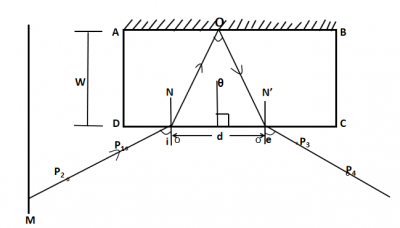
You are provided with a glass block, a plane mirror, and optical pins.
Place the glass block on a drawing sheet and trace its outline ABCD as shown in the diagram above.
Remove the block, measure, and record the width W of the block.
Draw a normal ON to DC at a point about one-quarter the length of DC.
Draw a line making an angle i = 10^\circ with the normal.
Replace the block on its outline and mount the plane mirror vertically behind the block such that it makes good contact with the face AB.
Stick two pins \(P_1\) and \(P_2\) on the line MO.
Looking through the face CD, stick two other pins \(P_3\) and \(P_4\) such that they appear to be in a straight line with the images of pins \(P_1\) and \(P_2\) seen through the block.
Join \(P_3\) and \(P_4\) with a straight line and extend it to touch the face CD at O.
Draw a perpendicular line from the midpoint of OO to meet AB at QD.
Draw lines OQ, O'Q, and normal O'N' produced.
Measure and record \(\theta\), e and d.
Evaluate m = sin e and n = cos(\(\frac{\theta}{2}\))
Repeat the procedure for i = 20^\circ, 30^\circ, 40^\circ and 50^\circ.
Tabulate your readings.
Plot a graph with m on the vertical axis and n on the horizontal axis.
Determine the slope, s, of the graph and evaluate q = 2Ws.
State two precautions taken to ensure accurate results. (Attach your traces to your answer booklet.)
(b)i. Explain the term refractive index and give a mathematical expression for it in terms of wavelength.
ii. State the conditions necessary for total internal reflection to occur for a given pair of media.
Attached Figure / Diagram
medium Difficulty
Verified Correct Answer: Option
Physical Principles & Numerical Solution
i/^\circ
\(\theta\)/^\circ
e/^\circ
d/cm
m = sine/^\circ
n = cos[\(\frac{\theta}{2}\)]/^\circ
10
10.4
10.0
3.00
0.174
0.996
20
19.0
20.4
3.90
0.349
0.986
30
20.0
30.0
6.00
0.500
0.985
40
30.0
40.0
7.00
0.643
0.966
50
30.0
50.0
7.50
0.766
0.965
Slope = \(\frac{0.766-0.174}{0.965-0.996} = \frac{0.592}{-0.031}\) = -19.097^\circ
q = 2Ws
Precautions;
- Neat traces
- Pins located vertically, Pins reasonably spaced
- Avoided parallax error while reading the protractor/ ruler
- zero error was avoided on the metre rule.
(b) Refractive index is the ratio of the velocity of light in air to the velocity of light in a medium when light waves pass from air to a material medium.
Mathematically,
n =\(\frac{\lambda_{1}}{\lambda_{2}}\). Where,
\(\lambda_{1}\) = wavelength in air
\(\lambda_{2}\) = wavelength in material
n = refractive index of the material.
ii. The light must be traveling from a denser medium to a less dense medium. The angle of incidence in the denser medium must be greater than the critical angle.
Source: Myschool Past Questions Archive (Record #60017)
Physics
UTME / JAMB 2009
Mechanics and Properties of Matter
Solution
An electric lamp marked 240v, 60 W is left to operate for an hour. How much energy is generated by the filament?
A
3.86 x 10⁵J
B
3.56 x 10⁵J
C
1.80 x 10⁴J
D
2.16 x 10⁵J
medium Difficulty
Verified Correct Answer: Option D
Physical Principles & Numerical Solution
Energy generated = power X time = 60w x 1h = 60 x 60 x 60 ws = 216000j = 2.16 x 10⁵J
Source: Myschool Past Questions Archive (Record #14258)
Physics
UTME / JAMB 2009
Mechanics and Properties of Matter
Solution
A band of 500 rectangular loops of wire of area 20 cm by 20 cm, encloses a region of magnetic field which charges from 1.0T to 0.4T within 5 seconds, calculate the induced e.m.f.
A
5.60 v
B
24.00 v
C
0.24 v
D
2.40 v
medium Difficulty
Verified Correct Answer: Option D
Physical Principles & Numerical Solution
Number of tunes, n = 500
Area, A = 0.2m + 0.2m = 0.4m2
change of flux density A B
= 1.0 - 0.4 = 0.6T
Tune, t = 5 su
Induced emf, ξ = (AB AN)/AT
(0.6 x 0. 04 x 500)/5
= 2.4v
Source: Myschool Past Questions Archive (Record #14262)
Physics
UTME / JAMB 2009
Mechanics and Properties of Matter
Solution
The pressure of two moles of an ideal gas at a temperature of 27 ^\circC and volume 10\(^-2\)m\(^3\) is?
[R = 8.313 J mol\(^{-1}\)K\(^{-1}\)]
A
4.99 x 10⁵ Nm-2
B
9.80 x 10³ Nm-2
C
4.98 x 10³ Nm-2
D
9.80 x 10⁵ Nm-2
medium Difficulty
Verified Correct Answer: Option A
Physical Principles & Numerical Solution
PV = nRT
∴ P = \(\frac{\text{nRT}}{\text{V}}\)
P = \(\frac{2 \times 8.313 \times 300}{10^{-2}}\)
= 4.987 x 10\(^5\) Nm\(^{-2}\)
Source: Myschool Past Questions Archive (Record #14500)
Physics
WAEC / WASSCE 2009
Mechanics and Properties of Matter
Solution
In a hydraulic press, a force of 40N is applied to the smaller priston of area 10cm2. If the area of the larger piston is 200cm2, calculate the force obtained
A
800N
B
500N
C
80N`
D
50N
medium Difficulty
Verified Correct Answer: Option A
Physical Principles & Numerical Solution
\(F_2 = \frac{F_1 \times A_2}{A_1} = \frac{40 \times 200}{10} = 800N\)
Source: Myschool Past Questions Archive (Record #35134)
Physics
WAEC / WASSCE 2009
Mechanics and Properties of Matter
Solution
A body of volume 0.046m3 is immersed in a liquid of density 980kgm-3 with \(\frac{3}{4}\) of its volume submerged. Calculate the upthrust on the body. [g = 10ms-2]
A
11.27N
B
33.81N
C
112.70N
D
338.10N
medium Difficulty
Verified Correct Answer: Option D
Physical Principles & Numerical Solution
M = D x V
= 980 x 0.046 x \(\frac{3}{4}\) = 33.81kg
upthrust = mg = 33.81 x 10
= 338.1N
Source: Myschool Past Questions Archive (Record #35135)
Physics
WAEC / WASSCE 2009
Mechanics and Properties of Matter
Which of the following types of types of motion will be produced when a pair of equal and opposite non-collinear parallel forces acts on a body?
A
vibrational motion
B
random motion
C
translational motion
D
rotational motion
medium Difficulty
Verified Correct Answer: Option D
Physical Principles & Numerical Solution
No expanded working has been attached for this question yet. The verified answer is Option D.
Source: Myschool Past Questions Archive (Record #35139)
Physics
WAEC / WASSCE 2009
Mechanics and Properties of Matter
Solution
A body moving in a circle at constant speed has i. a velocity tangent to the circle ii. a constant kinetic energy iii. an acceleration directed towards the circumference of the circle. Which of the statements above are correct?
A
i and ii only
B
ii and iii only
C
i and iii only
D
i, ii and iii
medium Difficulty
Verified Correct Answer: Option A
Physical Principles & Numerical Solution
A body moving along a circular path with constant speed such that it traverses equal arc-length in equal intervals of time. Displacement, velocity and acceleration changes at each point on the trajectory. Hence, the speed is uniform and consequently the kinetic energy is also constant throughout.
Source: Myschool Past Questions Archive (Record #35145)
Physics
WAEC / WASSCE 2009
Mechanics and Properties of Matter
The following properties of a solid are measured on earth i. weight ii. specific heat capacity iii. density. Which of the properties will hav a different value if measured in space?
A
i only
B
ii only
C
iii only
D
ii and iii only
medium Difficulty
Verified Correct Answer: Option A
Physical Principles & Numerical Solution
No expanded working has been attached for this question yet. The verified answer is Option A.
Source: Myschool Past Questions Archive (Record #35150)
Physics
WAEC / WASSCE 2009
Mechanics and Properties of Matter
Solution
Two forces 6N and 8N, act eastwards and northwards respectively on a body. Calculate the magnitude of their equilibrant
A
2N
B
7N
C
10N
D
14N
medium Difficulty
Verified Correct Answer: Option C
Physical Principles & Numerical Solution
R = \(\sqrt{A^2 + B^2} = \sqrt{6^2 + 8^2} = 10N\)
Source: Myschool Past Questions Archive (Record #35152)
Physics
WAEC / WASSCE 2009
Mechanics and Properties of Matter
Solution
A body of mass 5kg movimg with a velocity of 30ms-1 due east is suddenly hit by another body and changes its velocity to 50ms-1 in the same direction. Calculate the magnitude of the impulse received.
A
100Ns
B
150Ns
C
250Ns
D
400Ns
medium Difficulty
Verified Correct Answer: Option A
Physical Principles & Numerical Solution
I = Ft = m(v - u)
= 5(50 - 30) = 100
Source: Myschool Past Questions Archive (Record #35161)
Physics
WAEC / WASSCE 2009
Mechanics and Properties of Matter
Electric energy is measured in
A
ampere
B
coulomb
C
kilowatt-hour
D
kilowatt
medium Difficulty
Verified Correct Answer: Option C
Physical Principles & Numerical Solution
No expanded working has been attached for this question yet. The verified answer is Option C.
Source: Myschool Past Questions Archive (Record #35162)
Physics
WAEC / WASSCE 2009
Mechanics and Properties of Matter
Solution
A stone of mass 0.5kg is dropped from a height of 12m. Calculate its maximum kinetic energy. [g = 10ms-1]
A
3.0J
B
6.0J
C
30.0j
D
60.0J
medium Difficulty
Verified Correct Answer: Option D
Physical Principles & Numerical Solution
K.E = P.E = mgh
= 0.5 x 10 x 12 = 60J
Source: Myschool Past Questions Archive (Record #35164)