Question Library
Browse, filter, and study verified past examination questions with step-by-step mathematical reasoning.
Searching 18,000+ Questions...
Sifting topics, KaTeX formulas & verified solutions
Showing 541–555 of 5315 verified questions
Sort by:
Physics
WAEC / WASSCE 2022
Heat Energy & Temperature
Solution
The distance between the fixed points of a mercury-in-glass thermometer is 30 cm. Determine the temperature when the mercury level is 10.5 cm above the lower fixed point
A
28.6ºC
B
30.0 ºC
C
35.0 ºC
D
40.5 ºC
medium Difficulty
Verified Correct Answer: Option C
Physical Principles & Numerical Solution
\(\frac{10.5-0}{30-0}\) = \(\frac{c-0}{100-0}\)
\(\frac{10.5}{30}\) = \(\frac{c}{100}\)
cross multiply:
10.5 * 100 = 30c
35.0 ºC = c
Source: WAEC / JAMB / NECO Classroom Archive (Record #63391)
Physics
WAEC / WASSCE 2022
Heat Energy & Temperature
Solution
Which of the following concepts is a method of heat transfer that does not require a material medium?
A
Conduction
B
Diffusion
C
Convection
D
Radiation
medium Difficulty
Verified Correct Answer: Option D
Physical Principles & Numerical Solution
Radiation is energy that comes from a source and travels through space and may be able to penetrate various materials.
Light, radio, and microwaves are good examples
Source: WAEC / JAMB / NECO Classroom Archive (Record #63399)
Physics
WAEC / WASSCE 2022
Heat Energy & Temperature
Solution
A quantity of water at 0 °C is heated to 30 °C. For each degree rise in temperature, its density will---------
A
rise steadily
B
fall steadily
C
fall and then rises
D
rise and then falls
medium Difficulty
Verified Correct Answer: Option D
Physical Principles & Numerical Solution
When water is heated, the density rises and falls steadily, remember the anomalous expansion of water.
Source: WAEC / JAMB / NECO Classroom Archive (Record #63409)
Physics
UTME / JAMB 2022
Heat Energy & Temperature
Solution
The relationship between the coefficient of linear expansion \(\alpha\) and volumetric expansion (\(\gamma\)) is-----------------
A
\(\gamma\) = \(\alpha ^{-3}\)
B
\(\gamma\) = \(\alpha\)
C
3\(\alpha\)
D
\(\gamma\) = \(\alpha ^{3}\)
medium Difficulty
Verified Correct Answer: Option C
Physical Principles & Numerical Solution
volumetric expansion (γ) = 3x Linear expansion
Source: WAEC / JAMB / NECO Classroom Archive (Record #64919)
Physics
UTME / JAMB 2022
Heat Energy & Temperature
Solution
The amount of energy required to change a kilogram of ice block into water without a change in temperature is?
A
specific latent heat of fusion of ice
B
specific heat capacity of ice
C
heat capacity of ice
D
specific heat of vaporization of ice
medium Difficulty
Verified Correct Answer: Option A
Physical Principles & Numerical Solution
Specific latent heat of fusion of a substance is the quantity of heat required to convert the unit mass of the substance from the solid to the liquid state without change in temperature.
Source: WAEC / JAMB / NECO Classroom Archive (Record #64955)
Physics
WAEC / WASSCE 2022
Motion Force Circular Motion
Solution
The engine of a car provides a forward force of 1240 N and the total resistive force on the car is 800N. If the mass of the car is 1220 kg, determine the distance the car has to travel from the rest before acquiring a speed of 4 m s\(^{-1}\).
A
44.0 m
B
22.2 m
C
11.1 m
D
5.5 m
medium Difficulty
Verified Correct Answer: Option B
Physical Principles & Numerical Solution
Acceleration[a] = \(\frac{[forward - resistive]force}{mass}\)
a = \(\frac{1240-800}{1220}\) → \(\frac{440-800}{1220}\)
a = 0.36m/s\(^2\), v = 4m/s, s = ?
Second equation of motion:
s is distance
u is initial velocity
v is final velocity
a is acceleration
v\(^2\) = u\(^2\) + 2as
4\(^2\) = 0\(^2\) + 2 * 0.36 * s
16 = 0.72s
22.2m = s
Source: WAEC / JAMB / NECO Classroom Archive (Record #63405)
Physics
WAEC / WASSCE 2022
Work, Energy and Power
Solution
The joule is equivalent to?
A
Kg m\(^{2}\) s\(^{-1}\)
B
Kg\(^{2}\) m s\(^{-2}\)
C
Kg m\(^{2}\) s\(^{-2}\)
D
Kg m s\(^{-1}\)
medium Difficulty
Verified Correct Answer: Option C
Physical Principles & Numerical Solution
Joule as the unit of work done or energy used.
Force = mass \times acceleration
Work = Force \times Distance
Work = mass x acceleration x distance
Joule = kg \times \(\frac{m}{s^2}\) \times m
→ kg m\(^2\) s\(^{-2}\)
Source: WAEC / JAMB / NECO Classroom Archive (Record #63078)
Physics
UTME / JAMB 2022
Work, Energy and Power
Solution
A train of mass 1600 kg attains a speed of 25 ms\(^{-1}\) in 20 seconds. The power developed in the engine is?
A
2.5 KW
B
80 KW
C
25 KW
D
50 KW
medium Difficulty
Verified Correct Answer: Option D
Physical Principles & Numerical Solution
where force = f, mass = m, acceleration = a, velocity = v, time = t
Force = m * a → m * \(\frac{\Deltav}{t}\)
Power = f * v
P = m * \(\frac{v}{t}\) * v = m * \(\frac{v^2}{t}\)
p = \(\frac{1600 * 25^2}{20}\)
p = 50,000 or 50 KW
Source: WAEC / JAMB / NECO Classroom Archive (Record #65088)
Physics
WAEC / WASSCE 2022
Simple Machine
Solution
The efficiency of a wheel and axle is 100% and the ratio of their radii is 5:1. calculate the effort required to lift a load of mass 20kg using this machine, [g = 10 m s\(^{-2}\)]
A
20N
B
25N
C
40N
D
100N
medium Difficulty
Verified Correct Answer: Option C
Physical Principles & Numerical Solution
VR = 5:1 or 5
Load = 20kg or 200N
MA = \(\frac{200}{E}\)
Efficiency% = \(\frac{MA}{VR} * 100\)
100% = \(\frac{200}{5E} * 100\)
5E = 200
E = 40
Source: WAEC / JAMB / NECO Classroom Archive (Record #63094)
Physics
UTME / JAMB 2022
Simple Machine
Solution
Which of these is a second-class lever?
A
sugar tongs
B
claw hammer
C
plier
D
wheelbarrow
medium Difficulty
Verified Correct Answer: Option D
Physical Principles & Numerical Solution
Examples of first class levers are pliers, scissors, a crow bar, a claw hammer, a see-saw and a weighing balance.
A wheelbarrow, a bottle opener, and an oar are examples of second class levers
Source: WAEC / JAMB / NECO Classroom Archive (Record #64946)
Physics
WAEC / WASSCE 2022
Linear Motion & Kinematics
Solution
The correct relationship between the displacement, s, of a particle initially at rest in a linear motion and the time, t, is?
A
s \(\alpha\) t\(^{-2}\)
B
s \(\alpha\) t\(^{-1}\)
C
s \(\alpha\) t
D
s \(\alpha\) t\(^{2}\)
medium Difficulty
Verified Correct Answer: Option D
Physical Principles & Numerical Solution
Mathematically; S = vt + \(\frac{1}{2}\) at\(^2\)
: S ∝ t\(^2\)
Source: WAEC / JAMB / NECO Classroom Archive (Record #63076)
Physics
WAEC / WASSCE 2022
Linear Motion & Kinematics
Solution
A small object of mass 50 g is released from a point A. Determine the velocity of the object when it reaches a point B, a vertical distance of 30m below A. [g = 10 ms\(^{-2}\)
A
1.5 ms\(^{-1}\)
B
6.0 m s\(^{-1}\)
C
17.3 m s\(^{-1}\)
D
24.5 m s\(^{-1}\)
medium Difficulty
Verified Correct Answer: Option D
Physical Principles & Numerical Solution
v = ?, u = 0, a = 10, s = 30
V² = U²+2as
V² = 0 + 2 * 10 * 30
V² = 0 + 600
V = \sqrt600
V = 24.5m/s
Source: WAEC / JAMB / NECO Classroom Archive (Record #63410)
Physics
UTME / JAMB 2022
Linear Motion & Kinematics
Solution
A car starts from rest and covers a distance of 40 m in 10 s. Calculate the magnitude of its acceleration
A
3.20 ms\(^{-2}\)
B
0.25 ms\(^{-2}\)
C
0.80 ms\(^{-2}\)
D
4.00 ms\(^{-2}\)
medium Difficulty
Verified Correct Answer: Option C
Physical Principles & Numerical Solution
S = ut + \(\frac{1}{2}\)at\(^2\)
40 = 0 x 10 + \(\frac{1}{2}\)a x 10\(^2\)
50a = 40
a = \(\frac{40}{50}\)
= 0.8m/s\(^2\)
Source: WAEC / JAMB / NECO Classroom Archive (Record #64918)
Physics
WAEC / WASSCE 2022
Equilibrium of Forces
Diagram
Solution
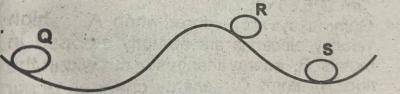
Suppose three identical steel balls Q, R, and S, are placed on an undulating ground as illustrated in the diagram above. Which of the balls is/are in neutral equilibrium?
Attached Figure / Diagram
A
S only
B
Q only
C
R only
D
Q and S only
medium Difficulty
Verified Correct Answer: Option C
Physical Principles & Numerical Solution
A body is in neutral equilibrium when, upon receiving a slight displacement, it tends to come to rest in its new position, e.g., a ball rolling on a horizontal surface, or a cone resting on its curved surface.
Ball R: Positioned in a trough between two crests. If displaced slightly, it will move to a new position and remain there, showing it is in neutral equilibrium
Source: WAEC / JAMB / NECO Classroom Archive (Record #63072)
Physics
WAEC / WASSCE 2022
Equilibrium of Forces
Solution
The basic principle of operation of a beam balance is------------------
A
Hooke's law
B
Archimedes principle
C
law of flotation
D
principle of moments
medium Difficulty
Verified Correct Answer: Option D
Physical Principles & Numerical Solution
Hooke's Law states that the extension of a spring is proportional to the load that is applied to it. A variety of materials obey this law as long as the load does not exceed the material's elastic limit.
Archimede's Principle states that a body immersed in a fluid experiences an upthrust equal to the weight of the fluid displaced, and this is fundamental to the equilibrium of a body floating in still water.
When a body floats in a liquid, the weight of the liquid displaced by its immersed part is equal to the total weight of the body. This is the law of floatation.
The Principle of Moments states that when a body is balanced, the total clockwise moment about a point equals the total anticlockwise moment about the same point.
Source: WAEC / JAMB / NECO Classroom Archive (Record #63418)