Question Library
Browse, filter, and study verified past examination questions with step-by-step mathematical reasoning.
Searching 18,000+ Questions...
Sifting topics, KaTeX formulas & verified solutions
Showing 526–540 of 1709 verified questions
Sort by:
Physics
UTME / JAMB 2011
Mechanics and Properties of Matter
Solution
Three similar cells each of e.m.f 2 v and internal resistance 2Ω are connected in parallel, the total e.m.f and total internal resistance are respectively
A
6 v, 6.0Ω
B
2 v, 0.7Ω
C
2 v, 6.0Ω
D
6 v, 0.7Ω
medium Difficulty
Verified Correct Answer: Option B
Physical Principles & Numerical Solution
Total energy in parred connection is equal to emt of one cell, = 2v but total internal resistance is given by
(1)/r = (1)/r1 + (1)/r2 + (1)/r3 = (1)/2 + (1)/2 + (1)/2 = (3)/2
∴ r = (2)/3 = 0.67Ω
Source: Myschool Past Questions Archive (Record #14443)
Physics
UTME / JAMB 2011
Mechanics and Properties of Matter
Solution
When the human eye loses its power of accomodation, the defect is known as
A
short sightedness
B
presbyopia
C
astigmatism
D
long sightedness
medium Difficulty
Verified Correct Answer: Option B
Physical Principles & Numerical Solution
presbyopia is loss of accommodation
Source: Myschool Past Questions Archive (Record #14453)
Physics
UTME / JAMB 2011
Mechanics and Properties of Matter
Solution
A certain far - sighted person cannot see object that are closer to the eye than 50 cm clearly. Determine the power of the converging lens which will enable him to see at 25 cm
A
0.06 D
B
0.02 D
C
0.03 D
D
0.04 D
E
no option is correct
medium Difficulty
Verified Correct Answer: Option B
Physical Principles & Numerical Solution
\(\frac{1}{\text{f}}\) = \(\frac{1}{\text{u}}\) + \(\frac{1}{\text{v}}\)
\(\frac{1}{\text{f}}\) = \(\frac{1}{25}\) + \(\frac{1}{-50}\)
u = 25cm, v = - 50cm
\(\frac{1}{\text{f}}\) = \(\frac{1}{u}\) - \(\frac{1}{50}\) = \(\frac{2 - 1}{50}\)
f = 50cm
P = \(\frac{1}{\text{f}}\) = \(\frac{1}{50}\) = 0.02cm. ( in dioptres = 2D)
1D = 1m\(^{-1}\)
Source: Myschool Past Questions Archive (Record #14459)
Physics
UTME / JAMB 2011
Mechanics and Properties of Matter
Solution
Two inductors of inductance 4 II and 8 II are arrange in series and a current of 10 A is passed through them. What is the energy stored in them?
A
600 J
B
50 J
C
133 J
D
250 J
medium Difficulty
Verified Correct Answer: Option A
Physical Principles & Numerical Solution
Inductance (L) in series: 4 + 8 = 12
Therefore Energy stored =
W = \(\frac{1}{2} LI^2\)
= \(\frac{1}{2} \times 12 \times 10^2\)
= 600J
Source: Myschool Past Questions Archive (Record #14465)
Physics
UTME / JAMB 2011
Mechanics and Properties of Matter
Solution
If the threshold frequency for tungsten is 1.3 x 10¹⁵Hz, what is its work function?
[H = 6.6 x 10⁻³⁴ Js]
A
8.58 x 10⁻¹⁹ J
B
8.50 x 10⁻¹⁵ J
C
8.58 x 10⁻¹⁷ J
D
8.85 x 10⁻¹⁸
medium Difficulty
Verified Correct Answer: Option A
Physical Principles & Numerical Solution
Work function, w = hfo 6.6 x 10-34 x 1.3 x 1015
= 8.58 x 10⁻¹⁹
Source: Myschool Past Questions Archive (Record #14471)
Physics
UTME / JAMB 2011
Mechanics and Properties of Matter
Diagram
Solution
The diagram above show the positions of a cone. The position which can be described as neutral equilibrium is represented as
Attached Figure / Diagram
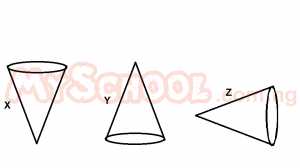
A
Z only
B
X only
C
Y and Z
D
Y and X
medium Difficulty
Verified Correct Answer: Option A
Physical Principles & Numerical Solution
Under neutral equilibrium, the body rolls and the position of the center of gravity , C. G is neither raised nor lowered
Source: Myschool Past Questions Archive (Record #14523)
Physics
UTME / JAMB 2011
Mechanics and Properties of Matter
Solution
The correct expression for the potential at a point distance r from a charge q in an electric field is?
A
_q24πεor2
B
_q24πεor
C
_q4πεor2
D
\(\frac{q}{4πε_or}\)
medium Difficulty
Verified Correct Answer: Option D
Physical Principles & Numerical Solution
Electric potential is work done in taking a unit mass or charge from infinity to that point
V = \(\frac{\text{W}}{\text{Q}}\) = \(\frac{\text{Fr}}{\text{Q}}\) = \(\frac{Q_1Q_2}{4\piεor^2}\) x \(\frac{\text{r}}{Q_1}\)
= \(\frac{- q}{4\piεor}\)
Source: Myschool Past Questions Archive (Record #14526)
Physics
UTME / JAMB 2011
Mechanics and Properties of Matter
Solution
A length of wire has a frequency of 225Hz when stretched by a force of 225N. If the force increased to 324N, what is the new frequency of vibration?
A
270 Hz
B
512 Hz
C
488 Hz
D
356 Hz
medium Difficulty
Verified Correct Answer: Option A
Physical Principles & Numerical Solution
f1 = 225Hz, T1 = 225N
f2 = ? T2 = 324N
But f ∝ \sqrtT => f = K\sqrtT
=> K = f/\sqrtT
∴ f1/\sqrtT1 = f2/\sqrtT2
225/\sqrt225 = f2/\sqrt324
f2 =
225\sqrt324
\sqrt225
f2 = 270Hz
Source: Myschool Past Questions Archive (Record #14536)
Physics
WAEC / WASSCE 2011
Mechanics and Properties of Matter
Solution
The density P of a spherical ball of diameter d and mass m is given by
A
P = \(\frac{3m}{4 \pi d^3}\)
B
p = 4\(\pi md^3\)
C
p = \(\frac{6m}{\pi d^3}\)
D
p = \(\frac{3m}{2 \pi d^3}\)
medium Difficulty
Verified Correct Answer: Option C
Physical Principles & Numerical Solution
p = \(\frac{M}{V} = \frac{M}{\frac{4}{3} \pi (\frac{d}{\pi})^3}\)
= \(\frac{6m}{\pi d^3}\)
Source: Myschool Past Questions Archive (Record #35382)
Physics
WAEC / WASSCE 2011
Mechanics and Properties of Matter
Solution
A metal rod of density 7000 kgm-3 and cross-sectional area of 0.001257m2 has a mass of 1.76kg. Calculate its length.
A
0.20m
B
0.25m
C
0.40m
D
0.50m
medium Difficulty
Verified Correct Answer: Option A
Physical Principles & Numerical Solution
P = \(\frac{M}{AL}\)
L = \(\frac{M}{CA}\)
= \(\frac{1.76}{7000 \times 0.001257}\)
= 0.2m
Source: Myschool Past Questions Archive (Record #35409)
Physics
WAEC / WASSCE 2011
Mechanics and Properties of Matter
The pressure in a liquid
A
is the same at all points in the liquid
B
decreases with depth
C
is the same in all directions at a given point
D
is equal to the atmospheric pressure
medium Difficulty
Verified Correct Answer: Option C
Physical Principles & Numerical Solution
No expanded working has been attached for this question yet. The verified answer is Option C.
Source: Myschool Past Questions Archive (Record #35410)
Physics
WAEC / WASSCE 2011
Mechanics and Properties of Matter
The area under a velocity-time graph represents
A
final velocity attained
B
distance covered
C
acceleration
D
workdone
medium Difficulty
Verified Correct Answer: Option B
Physical Principles & Numerical Solution
No expanded working has been attached for this question yet. The verified answer is Option B.
Source: Myschool Past Questions Archive (Record #35412)
Physics
WAEC / WASSCE 2011
Mechanics and Properties of Matter
In the absence of gravitational force, the weight of the body is
A
its mass
B
zero
C
its density
D
its volume
medium Difficulty
Verified Correct Answer: Option B
Physical Principles & Numerical Solution
No expanded working has been attached for this question yet. The verified answer is Option B.
Source: Myschool Past Questions Archive (Record #35413)
Physics
WAEC / WASSCE 2011
Mechanics and Properties of Matter
Solution
Which of the following propeties is not considered in choosing mercury as a thermomemetric liquid?
A
density
B
expansivity
C
conductivity
D
opacity
medium Difficulty
Verified Correct Answer: Option A
Physical Principles & Numerical Solution
Expansion and Contraction: The density of mercury affects how it expands and contracts with temperature changes. A liquid with a consistent and predictable expansion rate is essential for accurate temperature readings.
Calibration: The density of the liquid must be known to calibrate the thermometer accurately. This ensures that the scale on the thermometer corresponds correctly to temperature changes.
Thermal Conductivity: While conductivity can influence how quickly a liquid reaches thermal equilibrium with its surroundings, it is not as critical as density for the overall accuracy of the thermometer.
But in choosing mercury as a thermometric liquid, the density of mercury is not usually considered.
Source: Myschool Past Questions Archive (Record #35414)
Physics
WAEC / WASSCE 2011
Mechanics and Properties of Matter
Solution
A stone of mass 300g is released from rest from the top of a bulding of height 100m. Determine the kinetic energy gained by the stone when it is a quarter way down from the point of release.[g = 10 ms-2]
A
750.0J
B
225.0J
C
75.0J
D
22.5J
medium Difficulty
Verified Correct Answer: Option C
Physical Principles & Numerical Solution
K.E = P.E = mgh
= 0.3 x 10 x 100 - 0.3 x 10 x 75
= 75J
Source: Myschool Past Questions Archive (Record #35415)