Question Library
Browse, filter, and study verified past examination questions with step-by-step mathematical reasoning.
Searching 18,000+ Questions...
Sifting topics, KaTeX formulas & verified solutions
Showing 496–510 of 1709 verified questions
Sort by:
Physics
WAEC / WASSCE 2012
Mechanics and Properties of Matter
Solution
Which of the following factors decreases the rate of evaporation of a liquid?
A
increase in pressure over the liquid
B
lowering the boiling point
C
decreasing in humidity
D
wind
medium Difficulty
Verified Correct Answer: Option A
Physical Principles & Numerical Solution
higher pressure tends to inhibit the process of evaporation. Higher pressure "pushes" the vapor molecules back into the liquid, making it harder for them to evaporate.
Source: Myschool Past Questions Archive (Record #35585)
Physics
WAEC / WASSCE 2012
Mechanics and Properties of Matter
Solution
When two like charges are brought together, the potential energy of the system formed will
A
increase because work is done against the field
B
increase because work is done by the field
C
decrease because work is done by the field
D
decrease because work is done against the field
medium Difficulty
Verified Correct Answer: Option A
Physical Principles & Numerical Solution
if two like charges are close together, they repel each other. moving them closer together requires working against repulsive force which increases the potential energy of the system.
Source: Myschool Past Questions Archive (Record #35611)
Physics
WAEC / WASSCE 2012
Mechanics and Properties of Matter
Solution
A metal with a work function of 3.0ev is irradiated with ultraviolet light of energy 4.0 ev. The kinetic energy of the ejected electron is
A
1.0eV
B
3.0eV
C
4.0eV
D
7.0eV
medium Difficulty
Verified Correct Answer: Option A
Physical Principles & Numerical Solution
K.E = hf - Wo
= 4 - 3 = 1eV
Source: Myschool Past Questions Archive (Record #35643)
Physics
WAEC / WASSCE 2012
Mechanics and Properties of Matter
Solution
Which of the following arrangements of radiations is in the order of decreasing penetrating power?
A
\(\alpha\), \(\beta\), \(\gamma\)
B
\(\alpha\), \(\gamma\), \(\beta\)
C
\(\gamma\), \(\beta\), \(\alpha\)
D
\(\beta\), \(\gamma\), \(\alpha\)
medium Difficulty
Verified Correct Answer: Option C
Physical Principles & Numerical Solution
The alpha rays are the least penetrating, followed by beta rays, and gamma rays are the most penetrating.
in descending order \(\gamma, \beta, \alpha\)
Source: Myschool Past Questions Archive (Record #35646)
Physics
WAEC / WASSCE 2012
Mechanics and Properties of Matter
Solution
Which of the following radiations emitted in radioactive decay has momentum, a fairly high penetrating power and is deflected by a magnet?
A
alpha particles
B
beta particle
C
gamma radiation `
D
X-radiation
medium Difficulty
Verified Correct Answer: Option B
Physical Principles & Numerical Solution
\beta Particles are equivalent to electrons but arise from radioactive decay of unstable atoms. They are emitted with a continuous range of energies up to a maximum that is characteristic of each radionuclide. Electrons have a greater range and penetrating power, but much less ionizing potential compared with \alpha particles.
Beta particles are deflected by a magnetic field in an opposite direction to alpha particles confirming they must hold a charge opposite to alpha particles.
Source: Myschool Past Questions Archive (Record #35647)
Physics
WAEC / WASSCE 2012
Mechanics and Properties of Matter
Which of the following modes is the most economical method of transmitting electrical power over long distances?
A
alternating current at low voltage and high current
B
alternating current at high voltage and high current
C
alternating current at high voltage and low current
D
direct current at low voltage and high current
medium Difficulty
Verified Correct Answer: Option C
Physical Principles & Numerical Solution
No expanded working has been attached for this question yet. The verified answer is Option C.
Source: Myschool Past Questions Archive (Record #35629)
Physics
WAEC / WASSCE 2012
Mechanics and Properties of Matter
Diagram
Solution
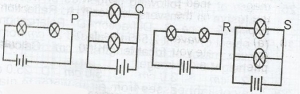
Two similar cells are used to light two similar lamps as illustrated in the diagrams above. In which of the circuit diagrams are the lamps brightest?
Attached Figure / Diagram
A
P
B
Q
C
R
D
S
medium Difficulty
Verified Correct Answer: Option B
Physical Principles & Numerical Solution
The determinant of the brightness of a bulb is the power (watts) of the circuit.
Recall that Power (P) = \(\frac{V^2}{R}\).
Since the resistance is to be used as a divisor, it means the smaller the resistance, the greater the power.
Source: Myschool Past Questions Archive (Record #35619)
Physics
WAEC / WASSCE 2012
Mechanics and Properties of Matter
Solution
a) Define surface tension.
(b) State two methods by which the surface tension of a liquid can be reduced.
medium Difficulty
Verified Correct Answer: Option
Physical Principles & Numerical Solution
(a) Surface tension is the force per unit length acting in the surface at right angles to one side of a line drawn in the surface of a liquid. It can be defined as the property of a liquid that makes it behave as if its surface is an elastic skin.
(b) Methods of reducing surface tension are by adding:
- Soap
- alcohol
- oil
- detergent
- increasing the temperature.
Source: Myschool Past Questions Archive (Record #53215)
Physics
WAEC / WASSCE 2012
Mechanics and Properties of Matter
Solution
(a) On what principle does lighting in a fluorescent tube operate?
(b) State two factors which determine the colour of light produced in a fluorescent tube.
medium Difficulty
Verified Correct Answer: Option
Physical Principles & Numerical Solution
(a) Fluorescent tube operate on the principle of electrical discharge through a gas at very low pressure and very high voltage.
(b) Factors which determine the colour of light in a fluorescent tube are: -voltage across the tube -nature of gas in the tube -nature of powder coating inside the tube.
Source: Myschool Past Questions Archive (Record #53218)
Physics
WAEC / WASSCE 2012
Mechanics and Properties of Matter
Solution
The diagram above illustrates an arrangement of a cathode ray from an electron gun and a bar magnet placed perpendicularly to the direction of the ray. Will the ray bend downward or upward? Explain.
medium Difficulty
Verified Correct Answer: Option
Physical Principles & Numerical Solution
The ray will bend upward. The direction of motion of the charge is due to the force acting on it which is mutually perpendicular to the direction of the magnetic field and the moving charge.
Source: Myschool Past Questions Archive (Record #53219)
Physics
WAEC / WASSCE 2012
Mechanics and Properties of Matter
Solution
(a) Explain wave-particle duality of light.
(b) Illustrate your answer in (a) with observable phenomena.
medium Difficulty
Verified Correct Answer: Option
Physical Principles & Numerical Solution
(a) Wave - particle duality of light means that light exists in two forms - wave and particle.
(b)(i) Wave nature - it has properties such as reflection, refraction, diffraction, polarization and interference.
(ii) Particle nature such as - Photo-electricity, momentum, radiation of energy from hot bodies and emission and absorption of light.
Source: Myschool Past Questions Archive (Record #53220)
Physics
WAEC / WASSCE 2012
Mechanics and Properties of Matter
Solution
(a) State the principle of conservation of linear momentum.
(b) Explain the mode of action of a propelled rocket.
(c) During a training session, two footballers pass a ball repeatedly between themselves. Give two reasons why the to and fro motion of the ball is not simple harmonic.
(d) A ball is dropped from a height, at the same time as another ball is projected horizontally from the same height.
(i) Would the balls hit the ground at the same time?
(ii) Explain your answer in (i).
(e) A ball of mass 0.10 kg is projected horizontally onto a vertical wall with a speed of 17 ms\(^{-1}\). The ball makes contact with the wall for 0.15 s and rebounds horizontally with a speed of 13 ms\(^{-1}\).
Calculate the:
(i) change in momentum of the ball;
(ii) average force exerted on the ball during its collision with the wall.
medium Difficulty
Verified Correct Answer: Option
Physical Principles & Numerical Solution
(a) Principle of conservation of linear momentum states that if two or more bodies collide in a closed system, the total momentum after the collision is equal to the total momentum before the collision.
(b) The principle of action of a propelled rocket is that gas burnt within the combustion chamber of the rocket engine is expelled downwards through the exhaust (tail nozzle) at very high speed, hence an equal and opposite momentum is given to the rocket which moves the rocket upward.
(c) The motion is not simple harmonic because:
-there is no equilibrium position
-acceleration of the ball is not directly proportional to displacement
-acceleration of the ball is not directed towards a fixed point.
(d)(i) Both balls will hit the ground at the same time.
(ii) All free falling objects fall at the same rate because they are pulled towards the earth by gravity and accelerate at a constant rate.
(e)(i) Charge in momentum = m(v-u)
= 0.10(13 - 17) = 3 kgms\(^{-1}\)
(ii) Average force F = \(\frac{\text{change in momentum}}{\text{time}}\) = \(\frac{3}{0.15} = 20N\)
Source: Myschool Past Questions Archive (Record #53223)
Physics
WAEC / WASSCE 2012
Mechanics and Properties of Matter
Solution
(a) (i) What is a machine?
(ii) State two uses of gears.
(iii) Define the velocity ratio for a pair of gear wheels.
(iv) How can the mechanical advantage of a gear system be increased?
The diagram above illustrates the gears system of a bicycle.
(i) Determine its velocity ratio.
(ii) If the bicycle has an efficiency of 90%, calculate the effort required to overcome a load of 70N.
(iii) Why is the calculated effort less than the actual effort required?
medium Difficulty
Verified Correct Answer: Option
Physical Principles & Numerical Solution
(a)(i) A machine is a device in which an effort applied at one end is used to overcome a load at another point. Machine makes work easier.
(ii) Uses of gears are: - to change speed to change direction of motion
- to magnify force.
(iii) Velocity ratio of a gear wheel is the ratio of number of teeth on driven wheel to number of teeth on driving wheel OR
Velocity ratio = \(\frac{\text{Time rate of revolution/speed/radius of driven wheel}}{\text{Time rate of revolution/speed/radius of driving wheel}}\)
(iv) To increase the mechanical advantage, the driving gear is made smaller with fewer teeth than the driven gear.
(b) Number of teeth on driven gear = 12.
Number of teeth on driving gear = 18.
(i) V.R. = \(\frac{\text{no. of teeth on driven gear}}{\text{no. of teeth on driving gear}}\)
= \(\frac{12}{8} = \frac{2}{3}\)
(ii) Efficiency - \(\frac{M.A}{V.R}\) x 100% = x 100%
= \(\frac{L/E}{V.R}\) x 100%
90 = \(\frac{70/E}{2/3}\) x 100%
(iii) This is due to: - Friction between the tyres and load.
- Friction between chain and gear.
Source: Myschool Past Questions Archive (Record #53226)
Physics
WAEC / WASSCE 2012
Mechanics and Properties of Matter
Solution
(a) Define magnetic line of force.
(b) A wire of length 10 cm carrying a current of 4.0 A is placed between the poles of a powerful electromagnet of magnetic flux density 2.0 T. Calculate the:
(i) force on the wire when it is parallel to the field;
(ii) maximum force on the wire;
(iii) force on the wire when it makes an angle of 60^\circ with the field.
(c) Describe how keepers can be used to preserve the magnetic strength of permanent bar magnets.
(d) A sailor observes that his mariners' compass reads N 10^\circ W at a place where the angle of declination is N15^\circ W. Calculate the true bearing of the place.
medium Difficulty
Verified Correct Answer: Option
Physical Principles & Numerical Solution
(a) Magnetic line of force is defined as an imaginary line in a mangetic field along which a free or isolated north pole would move. OR, it is an imaginary line in a magnetic field such that the targent to it at any point gives the direction of the field at that point.
(b) F = 1BL Sin\(\theta\)
(i) When wire is parallel to the field F = IBL = 4x 2 x 0.1 =0N
(ii) When force is maximum F = IBL Sin90^\circ = 4 x 2 x 0.1 x Sin90^\circ= 0.8N
(iii) When the wire is at 60^\circ to the field
F = IBL Sin\(\theta\) = 4 x 2 x 0.1 x Sin60^\circ = 0.693N
(c) Magnets are stored in pairs with their poles adjacent, placing soft iron pieces called keepers across their ends. The keepers become magnets by induction decreasing the reluctance of the air gap; hence both magnets and keepers form closed loops with no free poles preventing demagnetization
.
(d) True bearing = 15 + 10 = N25^\circW.
Source: Myschool Past Questions Archive (Record #53230)
Physics
WAEC / WASSCE 2012
Mechanics and Properties of Matter
Solution
(a) (i) Explain why x-rays can be used to produce photographs of fractures in bones.
(ii) List four uses of x-rays other than in medicine.
(b) State the energy transformations which takes place during the operation of an x-ray tube.
(c) (i) Explain three named dangers to which human beings may be exposed when subjected to large doses of x-rays.
(ii) State two precautions that must be taken by persons working with x-rays.
(d) In an x-ray tube, an electron is accelerated from rest towards a tungsten target biased at a potential of 33 kV. Calculate, for the electron, the
(i) kinetic energy;
(ii) velocity. [h = 6.6 x 10\(^{-14}\) Js; Me = 9.1 x10\(^{-31}\) kg; c = 3.0 x 10\(^4\) ms\(^{-1}\); e = 1.6 x 10\(^{-19}\) C.]
medium Difficulty
Verified Correct Answer: Option
Physical Principles & Numerical Solution
(a)(i) X-rays can produce photographs of fractures in bones; it can pass through fractures but cannot penetrate bones.
(ii) Uses of x-ray other than in medicine:
—detection of cracks in metallic products
—detection of alternations in art works
—detection of fake gems
—examination of bags and luggage
—identification of chemical elements and their isotopes.
(b) The energy transformations: Electrical energy
—> Heat energy
—> Kinetic energy
—> Electromagnetic energy
—> X-rays and Heat energy.
(c)(i) Dangers of over exposure to x-rays are:
— Cell mutation, i.e. change in cell genetic codes.
— Leukaemia: the destruction of living cells, tissues and organs.
— Skins harm, causes skin burn and tanning.
(ii) A person working on x-rays should take the following precautions:
— wear lead protective coats
— wear dosimeter
— wear protective goggles
— go for routine regular medical check-up.
(d)(i) K.E. = eV = 1.6x10\(^{-19}\) x 33 x 10\(^3\)
= 5.28 x 10\(^{-15}\)J
V = \(\sqrt{\frac{2K.E}{m}} = \sqrt{\frac{2 \times 5.28 \times 10^{-15}}{9.1 \times 10^{-31}}}\)
Source: Myschool Past Questions Archive (Record #53237)