Question Library
Browse, filter, and study verified past examination questions with step-by-step mathematical reasoning.
Searching 18,000+ Questions...
Sifting topics, KaTeX formulas & verified solutions
Showing 496–510 of 5315 verified questions
Sort by:
Physics
WAEC / WASSCE 2023
Mechanics and Properties of Matter
Solution
The following statements are observations made about a towing vehicle and a bus that is being towed
I. The force exerted on the bus by the towing vehicle is of the same magnitude as the force that the bus exerts on the road.
II. The force exerted on the bus by the towing vehicle is of the same magnitude as the force exerted on the towing vehicle by the bus.
III. The towing vehicle exerts a force on the bus greater than the force exerted by the bus on the towing vehicle.
IV. The towing vehicle exerts a force on the bus that is the same as the force the road exerts on the towing vehicle.
Which of the following statements is/are correct?
A
II, III and IV
B
II only
C
I, II and III only
D
I only
medium Difficulty
Verified Correct Answer: Option B
Physical Principles & Numerical Solution
According to Newton's third law of motion, the force exerted on the bus by the towing vehicle is of the same magnitude as the force exerted on the towing vehicle by the bus (Statement II). The other statements are not necessarily true.
Source: Myschool Past Questions Archive (Record #69379)
Physics
WAEC / WASSCE 2023
Electricity and Magnetism
Solution
Which of the following statements about a ferromagnetic material is correct? It
A
has a high susceptibility.
B
attracts non-magnetic materials.
C
has low relative permeability.
D
repels other magnetic materials.
medium Difficulty
Verified Correct Answer: Option A
Physical Principles & Numerical Solution
The correct statement about a ferromagnetic material is:
It has a high susceptibility.
Ferromagnetic materials are characterized by having a high susceptibility, which means they are strongly attracted to magnetic fields. When placed in a magnetic field, ferromagnetic materials become magnetized and can themselves exhibit strong magnetic properties, attracting other magnetic materials. Ferromagnetic materials, such as iron, nickel, and cobalt, are commonly used in the construction of permanent magnets and electromagnets due to their strong response to magnetic fields.
Source: Myschool Past Questions Archive (Record #69381)
Physics
WAEC / WASSCE 2023
Waves and Optics
Solution
The type of mirror used by dentists to inspect the teeth of patients is a
A
Plane mirror
B
cylindrical mirror
C
concave mirror
D
convex mirror
medium Difficulty
Verified Correct Answer: Option C
Physical Principles & Numerical Solution
The type of mirror used by dentists to inspect the teeth of patients is a concave mirror.
Concave mirrors are curved inwards and produce a magnified image of the object placed within its focus and pole. This is why dentists use concave mirrors to examine teeth, as it allows them to see the teeth in more detail.
Source: Myschool Past Questions Archive (Record #69382)
Physics
WAEC / WASSCE 2023
Waves and Optics
Solution
In an RLC series circuit at resonance, the voltages across the resistor and the inductor are 30 V and 40 V respectively. Determine the voltage across the capacitor.
A
50V
B
30V
C
70V
D
40V
medium Difficulty
Verified Correct Answer: Option D
Physical Principles & Numerical Solution
At resonance, the inductive reactance is equal to the capacitive reactance. This means that the voltage across the inductor is also equal to the voltage across the capacitor.
Therefore, the voltage across the capacitor is 40 V.
Source: Myschool Past Questions Archive (Record #69383)
Physics
WAEC / WASSCE 2023
Mechanics and Properties of Matter
Solution
An electron moves from an energy level of -8.6 eV to another level of -3.5 eV. Determine the frequency of the absorbed radiation. [1 eV = 1.6 \times \(10^{19}\) J, h = 6.6 \times \(10^{34}\) Js]
A
\( 2.93 \times 10^{15}\)Hz
B
\( 3.59 \times 10^{16}\)Hz
C
\( 5.39 \times 10^{15}\)Hz
D
\( 1.24 \times 10^{15}\)Hz
medium Difficulty
Verified Correct Answer: Option D
Physical Principles & Numerical Solution
h = \( 6.6 \times 10^{-34}\)Js, 1eV = \( 1.6 \times 10^{-19}\)J, \(E_1\) = - 8.6eV, \(E_2\) = - 3.5eV, f = ?
\DeltaE = hf
f = \(\frac{\DeltaE}{h}\)
\DeltaE = \(E_2\) - \(E_1\) = - 3.5eV - (- 8.6eV) = 5.1eV
but 5.1eV = 5.1 X \( 1.6 \times 10^{-19}\) = \( 8.16 \times 10^{-19}\)J
f = \(\frac{8.16 \times 10^{-19}}{ 6.6 \times 10^{-34}}\)
Therefore, f = \( 1.24 \times 10^{15}\)Hz
Source: Myschool Past Questions Archive (Record #69398)
Physics
WAEC / WASSCE 2023
Mechanics and Properties of Matter
Solution
A liquid is left in an open dish. After several days, there is less liquid in the dish. Which of the following statements explains this observation? The
A
most energetic molecules leave the surface and escape into the air.
B
least energetic molecules leave the surface and escape into air.
C
most energetic molecules leave the surface and return.
D
least energetic molecules leave the surface and return.
medium Difficulty
Verified Correct Answer: Option A
Physical Principles & Numerical Solution
The statement that explains the observation is:
The most energetic molecules leave the surface and escape into the air.
This phenomenon is known as evaporation. In a liquid, molecules have varying energies, and the molecules with higher kinetic energies (the most energetic ones) are more likely to overcome the attractive forces within the liquid and transition into the gaseous phase. These molecules escape from the surface of the liquid into the air, gradually reducing the amount of liquid in the open dish. Evaporation is a process that occurs continuously as long as there is a liquid exposed to the air.
Source: Myschool Past Questions Archive (Record #69401)
Physics
WAEC / WASSCE 2023
Mechanics and Properties of Matter
Solution
The specific latent heat of vapourization of lead is 8.7 \times \(10^5 Jkg_1\). This means that 8.7 \times \(10^5\) J of thermal energy is required to change
A
a given mass of molten lead to vapour at constant temperature and pressure.
B
1 kg of molten lead to vapour at constant temperature and pressure.
C
1 kg of solid lead to vapour at constant temperature and pressure.
D
1 kg of molten lead to vapour for every degree rise in temperature.
medium Difficulty
Verified Correct Answer: Option B
Physical Principles & Numerical Solution
The specific latent heat of vaporization of lead is the amount of thermal energy required to change 1 kg of molten lead to vapor at constant temperature and pressure.
Source: Myschool Past Questions Archive (Record #69402)
Physics
WAEC / WASSCE 2023
Mechanics and Properties of Matter
Solution
A car, P, with a velocity of 30 m/s is traveling in the same direction as a car, Q, with a velocity of 20 m/s. The velocity of P relative to Q is
A
\(50ms^1\)
B
\(45ms^1\)
C
\(20ms^1\)
D
\(10ms^1\)
medium Difficulty
Verified Correct Answer: Option D
Physical Principles & Numerical Solution
\(v_P = 30 ms^{-1}\), \(v_Q = 20 ms^{-1}\)
\(v_P = v_Q + v_{P/Q}\)
\(v_{P/Q} = v_P - v_Q\) = 30 - 20
∴ \(v_{P/Q} = 10 ms^{-1}\)
Source: Myschool Past Questions Archive (Record #69403)
Physics
WAEC / WASSCE 2023
Mechanics and Properties of Matter
Solution
When a light-weight body and a massive body are acted upon by the same force for the same period of time, the
A
massive body has a higher momentum.
B
massive body builds up a higher velocity.
C
lighter body has a higher momentum.
D
momenta of both bodies remain the same.
medium Difficulty
Verified Correct Answer: Option D
Physical Principles & Numerical Solution
When a lightweight body and a massive body are acted upon by the same force for the same time, the momenta of both bodies remain the same.
Given that the momenta of both the heavy and light bodies are the same, it follows that the light body possesses a higher velocity compared to the heavy body.
Source: Myschool Past Questions Archive (Record #69404)
Physics
WAEC / WASSCE 2023
Mechanics and Properties of Matter
Diagram
Solution
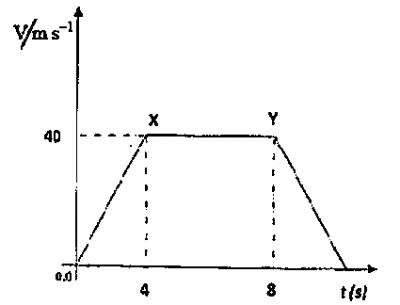
The diagram above illustrates a velocity-time graph. Determine the distance between X and Y.
Attached Figure / Diagram
A
80.0m
B
160.0m
C
40.0m
D
10.0m
medium Difficulty
Verified Correct Answer: Option B
Physical Principles & Numerical Solution
Distance between X and Y is the area of rectangular portion of the velocity-time graph.
XY = 40 \times (8 - 4) = 40 \times 4
∴ XY = 160 m
Source: Myschool Past Questions Archive (Record #69384)
Physics
WAEC / WASSCE 2023
Waves and Optics
Solution
A sound of frequency 512 Hz reaches a listener 100 m away. If the sound travels in air at s.t.p., what is its wavelength?
[speed of sound in air = 331 m/s]
A
1.550m
B
0,646m
C
5.120m
D
0.195m
medium Difficulty
Verified Correct Answer: Option B
Physical Principles & Numerical Solution
f = 512Hz, V = 331m/s \lambda = ?
V = f \lambda
\lambda = \(\frac{v}{f} = \frac{331}{512}\)
\lambda = 0.646m.
Source: Myschool Past Questions Archive (Record #69385)
Physics
WAEC / WASSCE 2023
Mechanics and Properties of Matter
Solution
A charge of 10 C is transferred across a potential difference of 220 V. Determine the work done.
A
22J
B
2200J
C
210J
D
230J
medium Difficulty
Verified Correct Answer: Option B
Physical Principles & Numerical Solution
The work done in moving a charge across a potential difference is given by the formula W = QV, where W is the work done, Q is the charge and V is the potential difference. Substituting the given values, we get W = 10 C * 220 V = 2200 J. Hence, the work done is 2200 J.
Source: Myschool Past Questions Archive (Record #69386)
Physics
WAEC / WASSCE 2023
Heat Energy & Temperature
Solution
The ratio of maximum range to maximum height of a projectile is 4. Determine the angle of projection.
A
\(30^0\)
B
\(60^0\)
C
\(45^0\)
D
\(0^0\)
medium Difficulty
Verified Correct Answer: Option C
Physical Principles & Numerical Solution
Maximum Range R = \(\frac{u^2sin2\theta}{g}\)
maximum height H = \(\frac{u^2sin^2\theta}{2g}\)
But R : H = 4
\(\frac{u^2sin2\theta}{g}\) : \(\frac{u^2sin^2\theta}{2g}\) = 4
\(\frac{u^2sin2\theta}{g} \times\frac{2g}{u^2sin^2\theta}\) = 4
\(\frac{2sin2\theta}{sin^2\theta}\) = 4
since 2sinΘ = 2sinΘcosΘ
\(\frac{2 \times 2sin\theta cos\theta}{sin^2\theta}\) = 4
\(\frac{4sin\theta cos\theta}{sin^2\theta}\) = 4
\(\frac{sin\theta cos\theta}{sin^2\theta}\) = 1
\(\frac{cos\theta}{sin\theta}\) = 1
\(\frac{sin\theta}{cos\theta}\) = 1
\(tan \theta\) = 1
\(\theta = tan^{-1}1\) = 45^\circ
Source: Myschool Past Questions Archive (Record #69391)
Physics
WAEC / WASSCE 2023
Thermal Physics
Solution
The range of wavelengths of the infrared waves in an electromagnetic spectrum is \(10^{-3}\) m to \(10^{-6}\)m. The wavelength of the radiation is
A
longer than \(10^{-6} m\).
B
shorter than \(10^{-6} m\).
C
shorter than \(10^{3} m\).
D
longer than \(10^{3} m\).
medium Difficulty
Verified Correct Answer: Option A
Physical Principles & Numerical Solution
The range of wavelengths for infrared waves is given as \(10^{-3}\) m to \(10^{-6}\)m. This means that the wavelength of the radiation is longer than \(10^{-6} m\) but shorter than \{10^{-3} m\). Therefore, the only correct option is that the wavelength is longer than \(10^{-6} m\).
Source: Myschool Past Questions Archive (Record #69394)
Physics
WAEC / WASSCE 2023
Electricity and Magnetism
Solution
A cell of emf 2 V has an internal resistance of 0.5 \Omega. A current of 0.4 A passes through an external resistor, P. Determine the resistance of P.
A
4.5Ω
B
5Ω
C
1Ω
D
4Ω
medium Difficulty
Verified Correct Answer: Option A
Physical Principles & Numerical Solution
E = 2V, r = 0.5\Omega, I = 0.4A, P = ?
E = I( R + r )
R = \(\frac{ E}{I} - r \)
R = \(\frac{ 2}{0.4} - 0.5\)
R = 5 - 0.5 = 4.5\Omega
Source: Myschool Past Questions Archive (Record #69406)