Question Library
Browse, filter, and study verified past examination questions with step-by-step mathematical reasoning.
Searching 18,000+ Questions...
Sifting topics, KaTeX formulas & verified solutions
Showing 451–465 of 1709 verified questions
Sort by:
Physics
WAEC / WASSCE 2013
Mechanics and Properties of Matter
Solution
Solid friction, like viscosity is
A
independent of the surface area in contact
B
independent of the relative motion between layers
C
dependent on normal reaction
D
in opposition to motion
medium Difficulty
Verified Correct Answer: Option D
Physical Principles & Numerical Solution
The force acting on a body due to the viscous resistance of the surrounding fluid is called the drag force and it acts in the direction opposite to the direction of motion. So also does friction.
Source: Myschool Past Questions Archive (Record #35651)
Physics
WAEC / WASSCE 2013
Mechanics and Properties of Matter
Solution
From Newton's first law of motion,
A
a body can only undergo translational motion
B
once a body remains at rest no force acts on it
C
the net force acting in uniform linear motion is zero
D
a body's inertia is its weight
medium Difficulty
Verified Correct Answer: Option C
Physical Principles & Numerical Solution
The key point of this law is that if there is no net force resulting from unbalanced forces acting on an object. If all the external forces cancel each other out, then the object will maintain a constant velocity.
Source: Myschool Past Questions Archive (Record #35662)
Physics
WAEC / WASSCE 2013
Mechanics and Properties of Matter
Solution
A body of mass 11kg is suspended from a ceiling fan by an aluminum wire of length 2m and diameter 2mm. Calculate the elastic energy stored in the wire [Young's modulus of aluminum is 7.0 x \(10^10Nm^{-2}\), g = 10m\(s^{-2}\), \(\pi\) = 3.142]`
A
1.1 x 10⁻¹J
B
5.5 x 10⁻²J
C
1.1 x 10⁻⁴J
D
5.5 x 10⁻⁸J
medium Difficulty
Verified Correct Answer: Option B
Physical Principles & Numerical Solution
e = \(\frac{4FI}{Y \pi d^2} = \frac{4 \times 11 \times 10 \times 2}{7 \times 10^{10} \times 3.14(2 \times 10^{-3})^2}\)
= 0.001m
E = \(\frac{1}{2} Fe = \frac{1}{2} \times 110 \times 0.001\)
= 5.5 x \(10^{-2}\)J
Source: Myschool Past Questions Archive (Record #35663)
Physics
WAEC / WASSCE 2013
Mechanics and Properties of Matter
Solution
The velocity ratio of an inclined plane
A
increases with increase in the angle of inclination
B
increases with decrease in the angle of inclination
C
decreases with decrease in the angle of inclination
D
is independent of the angle of inclination
medium Difficulty
Verified Correct Answer: Option B
Physical Principles & Numerical Solution
In general, the V.R and hence the M. A increases when the inclination angle decreases.
Source: Myschool Past Questions Archive (Record #35664)
Physics
WAEC / WASSCE 2013
Mechanics and Properties of Matter
Solution
A charge of 2.0 x 10\(^{-5}\) C experiences a force of 80N in a uniform electric field. Calculate the magnitude of the electric field intensity
A
8.0 x 10⁶ NC-1
B
4.0 x 10⁶ NC-1
C
4.0 x 10⁴ NC-1
D
2.0 x 10⁴ NC-1
medium Difficulty
Verified Correct Answer: Option B
Physical Principles & Numerical Solution
E = \(\frac{F}{Q} = \frac{80}{2 \times 10^{-5}}\)
= 4 x 10\(^6\) NC\(^{-1}\)
Source: Myschool Past Questions Archive (Record #35691)
Physics
WAEC / WASSCE 2013
Mechanics and Properties of Matter
Which of the following instruments is used to determine the accurate value of the electromotive force of a cell?
A
voltmeter
B
meterbridge
C
voltameter
D
potentiometer
medium Difficulty
Verified Correct Answer: Option D
Physical Principles & Numerical Solution
No expanded working has been attached for this question yet. The verified answer is Option D.
Source: Myschool Past Questions Archive (Record #35696)
Physics
WAEC / WASSCE 2013
Mechanics and Properties of Matter
Solution
The work function of a metal is 2.56 x 10⁻¹⁹J. Calculate the frequency of a photon whose energy is required to eject from the metal an electron with kinetic energy of 3.0ev. [1 eV = 1.6 x 10⁻¹⁹J, h = 6.6 x 10⁻³⁴Js]
A
5.56 x 10¹⁹Hz
B
1.66 x 10¹⁹Hz
C
1.12 x 10¹⁵Hz
D
8.42 x 10¹⁴Hz
medium Difficulty
Verified Correct Answer: Option C
Physical Principles & Numerical Solution
F = \(\frac{K.E + Wo}{h}\)
= \(\frac{3.0 \times 1.6 \times 10^{-19} + 2.56 \times 106{-19}}{6.6 \times 106{-34}}\)
- 1.12 x 10⁻¹⁵HZ
Source: Myschool Past Questions Archive (Record #35719)
Physics
WAEC / WASSCE 2013
Mechanics and Properties of Matter
The minimum energy required to cause photoelectric emission when the surface of a metal is irradiated with electromagnetic radiation of suitable frequency is called
A
critical energy
B
ionization energy
C
work function
D
planck's constant
medium Difficulty
Verified Correct Answer: Option C
Physical Principles & Numerical Solution
No expanded working has been attached for this question yet. The verified answer is Option C.
Source: Myschool Past Questions Archive (Record #35722)
Physics
WAEC / WASSCE 2013
Mechanics and Properties of Matter
Diagram
Solution
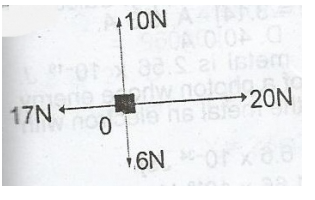
Four co-planar forces of magnitudes 10N, 17N, 6N and 20N act at point O as shown in the above diagram. Determine the magnitude of the resultant force
Attached Figure / Diagram
A
53.N
B
21.0N
C
7.0N
D
5.0N
medium Difficulty
Verified Correct Answer: Option D
Physical Principles & Numerical Solution
Vertical resultant = 10 - 6 = 4N
Horizontal resultant = 20 - 17 = 3N
R = \(\sqrt{3^2 + 4^2}\)
= 5N
Source: Myschool Past Questions Archive (Record #35730)
Physics
WAEC / WASSCE 2013
Mechanics and Properties of Matter
Diagram
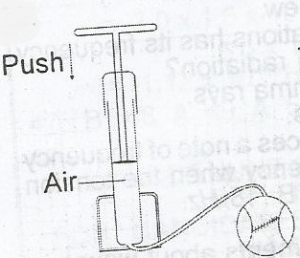
The outlet of a bicycle pump is used to inflate a football as illustrated in the diagram above. Why does the pressure of the air inside the pump increases as the pump handle is slowly pushed downward at constant temperature?
Attached Figure / Diagram
A
momentum of the air molecules are increased
B
volume occupied by the molecules are increased
C
frequency of collision of the air molecules with the walls of the pump is increased
D
more air molecules are collidin with one another in the system
medium Difficulty
Verified Correct Answer: Option C
Physical Principles & Numerical Solution
No expanded working has been attached for this question yet. The verified answer is Option C.
Source: Myschool Past Questions Archive (Record #35731)
Physics
WAEC / WASSCE 2013
Mechanics and Properties of Matter
Solution
A projectile is released with a speed u at an angle \(\theta\) to the horizontal. With the aid of a diagram, show that the time of flight is equal to \(\frac{2uSin\theta}{g}\), where g is the acceleration of free fall.
medium Difficulty
Verified Correct Answer: Option
Physical Principles & Numerical Solution
SEE DIAGRAM ABOVE
Vertical component velocity Vy = Usin\(\theta\)
Time to reach maximium height = t
V = USin\(\theta\) — gt
But V at maximum height = O
.-. O = Usin\(\theta\) - gt
Hence, t = \(\frac{U sin \theta}{g}\)
But time for a projectile to reach maximum he is equal to time to return to projection plane
Time of flight T = \(\frac{2Usin \theta}{g}\)
Source: Myschool Past Questions Archive (Record #53123)
Physics
WAEC / WASSCE 2013
Mechanics and Properties of Matter
Solution
The horizontal component of the initial speed of a particle projected at 30^\circ to the horizontal is 50 ms\(^{-1}\). If the acceleration cf free fall due to gravity is 10ms\(^{-2}\), determine its: (a) initial speed; (b) speed at maximum height reached.
medium Difficulty
Verified Correct Answer: Option
Physical Principles & Numerical Solution
(a) If initial velocity = U Then horizontal component
\(U_x = Ucos\theta\)
Ucos\(\theta\) = 50
U = \(\frac{50}{cos \theta} = \frac{50}{cos 30^o}\) = 57.7m/s
(b) But at maximum height V = O
V\(_y\) = O
V\(_x\) = U\(_x\) = 50m/s
Source: Myschool Past Questions Archive (Record #53124)
Physics
WAEC / WASSCE 2013
Mechanics and Properties of Matter
Solution
A mass of 11.0 kg is suspended from a rigid support by an aluminum wire of length 2.0 m, diameter 2.0 mm and Young's modulus 7.0 x 10\(^{11}\) Nm\(^{-2}\). Determine the extension produced. [g = 10 ms\(^{-2}\); \(\pi\) = 3.142]
medium Difficulty
Verified Correct Answer: Option
Physical Principles & Numerical Solution
E = \(\frac{Fl}{Ae}\)
E = 7.0 x 10\(^{-11}\) Nm\(^{-2}\);
F = mass x acceleration due to gravity
= 11 x 10 = 110N
l = 2.0m
A = \(\pi\) r\(^2\)
d = 2.0 mm \(\implies\) r = 1.0 mm
A = 3.142 x \((\frac{10}{1000})^2\)
e = \(\frac{Fl}{EA} = \frac{110 \times 20}{7.0 \times 10^{11} \times 3.142(\frac{10}{1000})^2}\)
= 1.0 x 10\(^{-5}\)m
Source: Myschool Past Questions Archive (Record #53126)
Physics
WAEC / WASSCE 2013
Mechanics and Properties of Matter
Solution
(a) State the triangle law of vector addition.
(b) Name the four physical quantities that are associated with the equationq of linear motion.
(c) Using the same set of axes, sketch and label two graphs to illustrate the variation of potential energy and kinetic energy with time for a body in simple harmonic motion.
(d)
A light spiral spring of force constant K lies on a horizontal frictionless surface and has one end fixed to a vertical wall. A block P of mass 2.0 kg placed against the free end of the spring is pushed a distance 5 cm towards the wall with 10J of energy as illustrated in the diagram above. The block is released and after 0.25s, it collides inelastically with a stationary block Q of mass 4.0 kg. Calculate the:
(i) value of k;
(ii) force used to compress the spring;
(iii) acceleration of the block p after release;
(iv) common speed after collision of the blocks.
medium Difficulty
Verified Correct Answer: Option
Physical Principles & Numerical Solution
(a) Triangle law of vector addition states that if three forces are in equilibrium, they can be represented in magnitude and direction by the three sides of a triangle taken in order.
(b) Physical quantities associated with equations of motion are:
- time
- speed/ velocity
- distance or displacement and acceleration.
(c)
(d)
W = \(\frac{1}{2}Ke^2\)
K = \(\frac{2W}{e^2} = \frac{2 \times 10}{\frac{5}{100}} = 8000 NM^{-1}\)
(ii) F = Ke = 800 x \(\frac{5}{100}\)
= 400N
(iii) F = Ma
a = \(\frac{F}{M} = \frac{400}{2}\) = 200 ms\(^{-2}\)
(iv) Initial velocity U\(_p\) of the block
P = 200 x 0.25
= 50 ms\(^{-1}\)
but \(M_pU_p + M_qU_q = (M_p + M_Q)\)
2 x 50 + 4 x 0 = V(2 + 4)
V = \(\frac{100}{6} = 16.7 ms^{-1}\)
Source: Myschool Past Questions Archive (Record #53138)
Physics
WAEC / WASSCE 2013
Mechanics and Properties of Matter
Solution
(a) On which day would sound wave travel faster: on a hot or cold day? Explain.
(b) Why are megaphones shaped like funnels?
(c) A ray of light is incident on a surface of a ectangular glass prism of refractive index 1.5 illustrated in the diagram below.
(i) Copy the diagram a label the angles of: (\(\alpha\)) Incidence (x); (\(\beta\)) Reflection (y); (\(\gamma\)) refraction (z); with t glass letters indicated.
(ii) Calculate the angle refraction to the nearest whole number.
(d) A sonomesr wire vibrates in simple harmoi motion with a maximum amplitude of 1.0 cm. Calculate the frequency of vibration of the wire, giv that the magnitade of the maximum acceleration of the wire is 980ms\(^{-2}\). [\(\pi \frac{22}{7}\)]
medium Difficulty
Verified Correct Answer: Option
Physical Principles & Numerical Solution
(a) Sound wave travels faster on a hot day because the speed of sound is proportional to the square root of absolute temperature (V \(\alpha \sqrt{T}\)), hence the higher the greater the speed of sound wave.
(b) Megap:iones are shaped like a funnels because at the smaller end of the cone, the sound energy comes into contact will a small mass of air producing greater intensity. As it comes out of the larger open end, the energy sets a larger air mass into vibration, hence the final sound is louder.
(c) (i)
(ii) n = \(\frac{sini}{sinr}\)
sinr = \(\frac{sini}{n} = \frac{sin60}{1.5}\)
= \(\frac{0.8660}{1.5} = 0.5774\)
r = sin\(^{-1}\)0.5774 = 35\(^{o}\)
(d) a = \(\Omega^2r\) but \(\Omega = 2 \pi f\)
a = (2\(\pi f)^2\)r
f = \(\sqrt{\frac{9}{4 \pi^2 r}} = \sqrt{\frac{988}{4(\frac{22}{7})^2} \times \frac{1}{100}}\)
= 50Hz
Source: Myschool Past Questions Archive (Record #53140)