Question Library
Browse, filter, and study verified past examination questions with step-by-step mathematical reasoning.
Searching 18,000+ Questions...
Sifting topics, KaTeX formulas & verified solutions
Showing 421–435 of 5315 verified questions
Sort by:
Physics
UTME / JAMB 2023
Equilibrium of Forces
Diagram
Solution
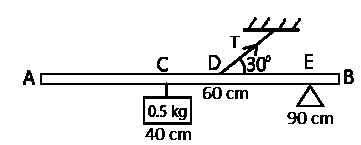
A block of mass 0.5 kg is suspended at the 40 cm mark of a light metre rule AB that is pivoted at point E, the 90 cm mark, and is kept at equilibrium by a string attached at point D, the 60 cm mark, as shown in the figure above. Find the tension T in the string.
[Take g = \(10 ms-2\) ]
Attached Figure / Diagram
A
16.67N
B
15.67N
C
14.67N
D
18.67N
medium Difficulty
Verified Correct Answer: Option A
Physical Principles & Numerical Solution
W = mg = 0.5 x 10 = 5 N
Since it's light, neglect the weight of the metre rule.
The effective tension T acting in the vertical direction = T sin 30^\circ
From the second condition of equilibrium, sum of clockwise moments equal sum of anticlockwise moments
Taking moment at E
⇒ T sin 30^\circ x 30 = 5 x 50
⇒ ∴T=250
T = \(\frac{250}{15}\) = 16.67N
Source: WAEC / JAMB / NECO Classroom Archive (Record #68009)
Physics
UTME / JAMB 2023
Equilibrium of Forces
Solution
The working of the beam balance is based on the principle of
A
moments
B
conservation of energy
C
equivalence
D
floatation
medium Difficulty
Verified Correct Answer: Option A
Physical Principles & Numerical Solution
The working of the beam balance is based on the principle of moments. The principle of moments states that the sum of the clockwise moments on a beam must be equal to the sum of the counterclockwise moments on the beam. This means that the weight of the object on the left side of the beam must be multiplied by the distance from the fulcrum to the left side of the beam, and the weight of the object on the right side of the beam must be multiplied by the distance from the fulcrum to the right side of the beam. If these two products are equal, then the beam will be in equilibrium.
Source: WAEC / JAMB / NECO Classroom Archive (Record #68567)
Physics
UTME / JAMB 2023
Equilibrium of Forces
Solution
Which of the following is an example of a couple?
A
All of the above.
B
The forces that are applied to the handle of a screwdriver when you twist it.
C
The forces that are applied to a cross wench to loosen or tighten the lug nuts on a wheel of a car.
D
The forces that are applied to the steering wheel of a car when you turn it.
medium Difficulty
Verified Correct Answer: Option A
Physical Principles & Numerical Solution
A couple is a pair of forces that are equal in magnitude but opposite in direction, and that are applied to a body at different points. The forces of a couple do not produce any translation, but they do produce a rotation.
Source: WAEC / JAMB / NECO Classroom Archive (Record #68579)
Physics
UTME / JAMB 2023
Projectile Motion
Solution
A missile is launched with a speed of 75 ms-1 at an angle of 22° above the surface of a warship. Find the horizontal range achieved by the missile. Ignore the effects of air resistance.
[Take g = 10 ms-2]
A
195
B
271 m
C
391 m
D
136 m
medium Difficulty
Verified Correct Answer: Option C
Physical Principles & Numerical Solution
U= 75 \(ms^-1\) =22º, g= 10 \(ms^-2\) , R=?
R= \(\frac{U^2sin2\theta}{g}\)
⇒R= \(\frac{75^2\timessin2(22)}{10}\)
⇒R= \(\frac{5625\timesSin44}{10}\)
⇒R= \(\frac{5625\times0.6947}{10}\)
⇒R= \(\frac{3907.69}{10}\)
⇒ 391m
Source: WAEC / JAMB / NECO Classroom Archive (Record #67268)
Physics
UTME / JAMB 2023
Momentum Impulse Newtons Law of Motion
Diagram
Solution
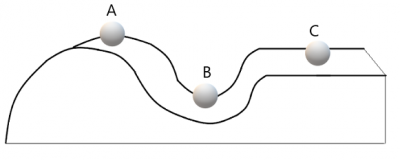
Name the type of equilibrium for each position of the ball
Attached Figure / Diagram
A
A - unstable, B - neutral, C - stable
B
A - stable, B - neutral, C - unstable
C
A - stable, B - unstable, C - neutral
D
A - unstable, B - stable, C - neutral
medium Difficulty
Verified Correct Answer: Option D
Physical Principles & Numerical Solution
Object A will undergo unstable equilibrium as it can move farther from its original position
Object B will undergo stable equilibrium as it can return to its original position
Object C will undergo neutral equilibrium as it can remain in a new position
Source: WAEC / JAMB / NECO Classroom Archive (Record #67430)
Physics
UTME / JAMB 2023
Simple Harmonic Motion
Solution
A man swung an object of mass 2 kg in a circular path with a rope 1.2 m long. If the object was swung at 120 rev/min, find the tension in the rope.
medium Difficulty
Verified Correct Answer: Option
Physical Principles & Numerical Solution
m=2kg, r=1.2m, f=120rev/min ; T=?
f= \(\frac{120rev}{1min}\) × \(\frac{1min}{60s}\) = 2rev\s
w=2πf= 2×π×2= 4πrad\s
T= \(\frac{mv^2}{r}\), but v = wr
⇒ T = \(\frac{(m)(wr)^2}{r}\)
⇒ T = \(mw^2r\)
= T = 2× (4π)^2 × 1.2
T = 379N ( to 3 s.f)
Source: WAEC / JAMB / NECO Classroom Archive (Record #67825)
Physics
UTME / JAMB 2023
Simple Harmonic Motion
Solution
A simple pendulum, has a period of 5.77 seconds. When the pendulum is shortened by 3 m, the period is 4.60 seconds. Calculate the new length of the pendulum
A
5.23 m
B
6.42 m
C
4.87 m
D
7.26 m
medium Difficulty
Verified Correct Answer: Option A
Physical Principles & Numerical Solution
Let the original length L=xm
;New length =( x -3 ) m
\(T_1\) = 5.77s; \(T_2\) = 4.60s,
\(T^2\) \alpha L
⇒\(T^2\) = kL where K is constant
⇒ K = \(\frac{T^2_1}{L_1} = \frac{T^2_2}{L_2}\)
⇒\(\frac{5.77^2}{x}\) = \(\frac{4.60^2}{x-3}\)
⇒ \(\frac{33.29}{x}\) = \(\frac{4.60^2}{x-3}\)
⇒ 33.29(x-3) = 21.16x
⇒ 33.29x - 99.87 =21.16x
⇒12.13x = 99.87
;x =\(\frac{99.87}{12.13}\) = 8.23m
The new length of the pendulum
=x-3 = 8.23-3
=5.23m
Source: WAEC / JAMB / NECO Classroom Archive (Record #67913)
Physics
UTME / JAMB 2023
Friction
Diagram
Solution
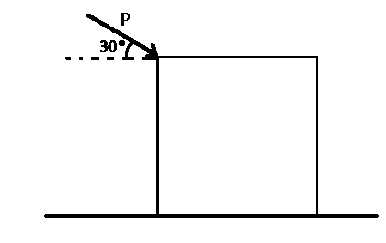
A 400 N box is being pushed across a level floor at a constant speed by a force P of 100 N at an angle of 30.0° to the horizontal, as shown in the the diagram below. What is the coefficient of kinetic friction between the box and the floor?
Attached Figure / Diagram
A
0.19
B
0.24
C
0.40
D
0.22
medium Difficulty
Verified Correct Answer: Option A
Physical Principles & Numerical Solution
W = 400 N; P = 100 N; \theta = 30o; \mu = ?
Frictional force (Fr) = \muR (where R is the normal reaction)
The forces acting along the horizontal direction are Fr and Px
∴ Pcos 30^\circ - Fr = ma (Pcos 30^\circ is acting in the +ve x-axis while Fr in the -ve x-axis)
⇒ 100cos 30^\circ - \muR = ma
Since the box is moving at constant speed, its acceleration is zero
⇒ 100cos 30^\circ - \muR = 0
⇒ 100cos 30o = \muR ----- (i)
The forces acting in the vertical direction are W, Py and R
∴ R - Psin 30^\circ - W = 0 (R is acting upward (+ve) while Py and W are acting downward (-ve) and they are at equilibrium)
⇒ R - 100sin 30^\circ - 400 = 0
⇒ R = 100sin 30^\circ + 400
⇒ R = 50 + 400 = 450 N
From equation (i)
⇒ 100cos 30^\circ = 450\mu
⇒\mu=100cos30^\circ
N = \(\frac{100cos30^\circ}{450}\)
= \mu = 0.19
Source: WAEC / JAMB / NECO Classroom Archive (Record #67893)
Physics
UTME / JAMB 2023
Simple Structure of Matter
Solution
Which of the following liquids has the highest surface tension?
A
Soapy water
B
Water
C
Mercury
D
Oil
medium Difficulty
Verified Correct Answer: Option C
Physical Principles & Numerical Solution
Surface tension is the force that acts on the surface of a liquid, tending to minimize the surface area. It is caused by the cohesive forces between the molecules of the liquid. The stronger the cohesive forces, the higher the surface tension.
Mercury has the highest surface tension of all the liquids listed. This is because the atoms of mercury are very close together, and they have a strong attraction for each other. This strong cohesive force results in a high surface tension.
Source: WAEC / JAMB / NECO Classroom Archive (Record #68573)
Physics
UTME / JAMB 2023
Simple Structure of Matter
Solution
When a water droplet is placed on a freshly cut piece of wood, it spreads out to form a thin layer because the wood is
A
not at equilibrium with the water
B
cohesive to water
C
at equilibrium with the water
D
adhesive to water
medium Difficulty
Verified Correct Answer: Option D
Physical Principles & Numerical Solution
Adhesive surfaces are surfaces that are wetted by water. This means that the water molecules are attracted to the wood surface, and they spread out to form a thin layer in order to maximize their contact with the surface. The adhesive forces between the water molecules and the wood surface are stronger than the cohesive forces between the water molecules, resulting in a thin layer.
Source: WAEC / JAMB / NECO Classroom Archive (Record #68581)
Physics
UTME / JAMB 2023
Density and Relative Density
Solution
A relative density bottle has a mass of 19 g when empty. When it is completely filled with water, its mass is 66 g. What will be its mass if completely filled with alcohol of relative density 0.8?
A
47 g
B
52.8 g
C
37.6 g
D
56.6 g
medium Difficulty
Verified Correct Answer: Option D
Physical Principles & Numerical Solution
Let mb=mass of empty bottle,
\(m_w\)=mass of water only and
\(m_a\)= mass of alcohol only
given; \(m_b\)=19g
\(m_b\) + \(m_w\) = 66g
\(m_b\) + \(m_a\) = ?
R.d=0.8
R.d=mass of alcohol
⇒\(\frac{mass of alcohol}{mass of equal volume of water}\)
⇒ mass of equal volume of water = \(m_w\)=66-19=47g
⇒0.8 = \(\frac{m_a}{47}\)
⇒\(m_a\)=0.8\times47 =37.6g
; \(m_b\) + \(m_a\) = 19+37.6=56.6g
Source: WAEC / JAMB / NECO Classroom Archive (Record #68070)
Physics
UTME / JAMB 2023
Deformation of Solids
Solution
A wire of radius 0.2 mm is extended by 0.5% of its length when supported by a load of 1.5 kg. Determine the Young's modulus for the material of the wire.
[Take g = 10 ms\(^{-2}\)]
A
\(2.4×10^{10}(Nm^{-2})\)
B
\(1.5×10^{10}(Nm^{-2})\)
C
\(2.4×10^9(Nm^{-2})\)
D
\(1.3×10^{10}(Nm^{-2})\)
medium Difficulty
Verified Correct Answer: Option A
Physical Principles & Numerical Solution
r=0.2mm = \(2 \times {10^{-4}}\) e= 0.05% of L,=0.005L, m=1.5kgg=\(10 ms^{-2}\) , y=?,
(1000 mm = 1m)
Y = \(\frac{FL}{Ae}\)
w = mg = 1.5 \times 10 = 15
A = \(\pi r^2\) = \(\frac{22}{7}\times(2\times10^{-4})^2\) = \(1.26\times10^{-7}(m^2)\)
⇒ Y = \(\frac{15L}{1.26\times10^{-7}\times0.005L}\)
⇒ Y = \(\frac{15}{1.26\times10^{-7}\times0.005}\)
⇒ Y = \(\frac{15}{6.29\times10^{-10}}\)
Y = \(2.4\times10^{10}(Nm^{-2})\)
Source: WAEC / JAMB / NECO Classroom Archive (Record #67743)
Physics
UTME / JAMB 2023
Heat and Temperature
Diagram
Solution
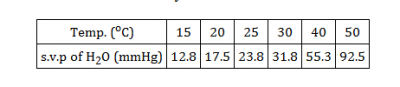
On a particular hot day, the temperature is 40°C and the partial pressure of water vapor in the air is 38.8 mmHg. What is the relative humidity?
Attached Figure / Diagram
A
70
B
62
C
80
D
42
medium Difficulty
Verified Correct Answer: Option A
Physical Principles & Numerical Solution
Relative Humidity= \(\frac {partial pressure of H2O}{saturated vapor pressure of H2O}\)\times100%
S.v.p. of water at 40^\circc = 55.3
⇒ Relative Humidity= \(\frac{38.8}{55.3}\)\times100%
Relative Humidity= 70%
Source: WAEC / JAMB / NECO Classroom Archive (Record #67275)
Physics
UTME / JAMB 2023
Heat and Temperature
Solution
Calculate the absolute pressure at the bottom of a lake at a depth of 32.8 m. Assume the density of the water is 1 x 10^3 kgm-3 and the air above is at a pressure of 101.3 kPa.
[Take g = 9.8 ms-2]
A
422.7
B
220.14
C
464.53
D
321.74
medium Difficulty
Verified Correct Answer: Option A
Physical Principles & Numerical Solution
h=32·8m, p= \(1\times10^3kgm^-3\)
g=9·8 \(ms^-2\) , \(P_a\)=101·3KPa
\(P_T\)= ?
P=hpg
⇒\(32·8\times1\times10^3 \times 9·8\)=321440 \(P_a\)
⇒321·44KPa
⇒ \(P_T\) =321.44+101.3
;\(P_T\)=422·7KPa
Source: WAEC / JAMB / NECO Classroom Archive (Record #67280)
Physics
UTME / JAMB 2023
Heat and Temperature
Solution
An air bubble of radius 4.5 cm initially at a depth of 12 m below the water surface rises to the surface. If the atmospheric pressure is equal to 10.34 m of water, the radius of the bubble just before it reaches the water surface is
A
6.43 cm
B
8.24 cm
C
4.26 cm
D
5.82 cm
medium Difficulty
Verified Correct Answer: Option D
Physical Principles & Numerical Solution
\(r_1\) = 4.5cm , \( P_1\) =is the total pressure on the bubble at a depth of 12m from the surface.
\(P_1\) = 12 + 10.34 =22.34m
\(V_1\) = \(\frac{4}{3}\)\pi\times \(r^3_1\)
= \(\frac{4}{3}\times \pi\times{4.5^3cm^3}\)
\(P_2\) = 10.34m
\(V_2\) = \(\frac{4}{3} {\pi}{r^3_2}\)
from boyles law:
\(P_1V_1\) = \(P_2V_2\)
⇒ 22.34\times \(\frac{4}{3}\times \pi\times{4.5^3}\) = 10.34 \times \(\frac{4}{3}\times\pi\times{r^3_2}\)
⇒ 22.34 \times \(4.5^3\) = 10.34 \times \(r^3_2\)
⇒ \(r^3_2 = \sqrt[3]{196.88}\)
⇒ \(r_2\) = 5.82cm
Source: WAEC / JAMB / NECO Classroom Archive (Record #67831)