Question Library
Browse, filter, and study verified past examination questions with step-by-step mathematical reasoning.
Searching 18,000+ Questions...
Sifting topics, KaTeX formulas & verified solutions
Showing 406–420 of 5315 verified questions
Sort by:
Physics
WAEC / WASSCE 2024
Electricity and Magnetism
Solution
State three uses of ferromagnetic materials
medium Difficulty
Verified Correct Answer: Option
Physical Principles & Numerical Solution
The uses of ferromagnetic materials are:
(i) Electromagnets
(ii) Magnetic Storage
(iii) Magnetic Sensors
(iv) Magnetic Shielding
(v) Permanent Magnets
(vi) Inductive Components, others are transformers, electric bells, electric generators, etc.
Source: Myschool Past Questions Archive (Record #72088)
Physics
WAEC / WASSCE 2024
Mechanics and Properties of Matter
Solution
PART2
(a) State the effect of increasing temperature on the viscosity of a: (i) liquid, (ii) gas
(b) State two factors that determine the magnitude of a moment of a force
(c) A uniform stick AB of length, L, and mass, m, is balanced horizontally on a knife edge 10.0cm from A when an object of 400 g is suspended at A. When the knife edge is moved 5 cm further, the object has to be moved to a point 9.00 cm from A for the stick to balance.
(i) Represent the balance system with a suitable diagram
(ii) Determine the: I. mass, m of the stick; II. length, L.
(d) Explain in terms of air molecules why pressure at the top of a high mountain is less than at sea level.
(e) Mercury of density 13.6 x 10\(^3\)kgm\(^{-3}\) is poured in a container of uniform cross-sectional area 40cm \(^2\) to a height of 20 cm. The total pressure exerted on the base of the container is 1.42 x 10\(^5\)P. Calculate the: (i) mass of the mercury in the container and (ii) pressure exerted at the surface of the mercury. [g = 10ms\(^{-2}\)
medium Difficulty
Verified Correct Answer: Option
Physical Principles & Numerical Solution
(ai) Increasing the temperature of a liquid decreases the viscosity of the liquid. (aii) Increasing the temperature of a gas increases the viscosity of the gas
(b) Factors that determine the magnitude of the moment of a force about a point are: 1. Angle between the distance from the turning point and the line of action of the force. 2. magnitude of the applied force. 3. perpendicular distance from the pivot to the line of action of the applied force.
(c) SEE THE DIAGRAM ABOVE.
(ii) Taking a moment about the support: clockwise moment = anti-clockwise moment
400 x 10 = m x (\(\frac{L}{2}\) - 10) -- ------- from figure 1 above
4000 = m x (\(\frac{L}{2}\) - 10) - - - -- - - (i)
400 x 6 = m x (\(\frac{L}{2}\) - 15) - - - - -- - - -(ii)
divide eqn i by ii
\(\frac{4000}{2400}\) = \(\frac{m \times \frac{L}{2} - 10)}{m \times \frac{L}{2} - 15)}\)
\(\frac{5}{3}\) = \(\frac{\frac{L}{2} - 10)}{\frac{L}{2} - 15)}\)
3 x (\(\frac{L}{2}\) - 10) = 5 x (\(\frac{L}{2}\) - 15)
\(\frac{3L}{2}\) - 30) = \(\frac{5L}{2}\) - 75)
\(\frac{5L}{2}\) - \(\frac{3L}{2}\) = 75 - 30 = 45
L = \(\frac{2L}{2}\) = 45 cm
From equation (ii) 400 x 6 = m x (\(\frac{L}{2}\) - 15)
2400 = m x (\(\frac{45}{2}\) - 15)
2400 = m x 7.5
m = \(\frac{2400}{7.5}\) = 320 g
Therefore, I. m = 320g and II. L = 45 cm
(d) Reasons for less pressure at the top of a mountain:
The lower pressure at the top of a mountain is due to the reduced number of air molecules in the atmosphere above that elevation, resulting in a lighter air column and fewer molecular collisions, which together create lower atmospheric pressure compared to sea level.
(e)(i) Density = \(\rho\) = \(\frac{m}{v}\)
m = v x \(\rho\), but v = A x h
m = A x h x \(\rho\) = 13.6 x 10\(^3\) x 40 x 20 x 10\(^{-6}\) = 10.88kg
(e)(ii) pressure exerted by the surface of the mercury
P\(_t\) = P\(_{atm}\) + pressure of mercury
P\(_{atm}\) = P\(_t\) - \(\rho\) x h x g = 1.42 x 10\(^5\) - 13.6 x 10\(^3\) x 0.2 x 10 = 1.148 x 10\(^5\)Pa
Source: Myschool Past Questions Archive (Record #72091)
Physics
WAEC / WASSCE 2024
Mechanics and Properties of Matter
Solution
(a)i State the condition for a charged particle to experience a force in magnetic field
(ii) State the expression for the magnetic force, F acting on a charged particle, Q in a magnetic field of flux density, \(\beta\) with speed, V
(iii) Prove quantitatively that there is no magnetic force moving along the direction of a magnetic field.
(b)i Mention the main parts of an electrical transformer.
(ii) Explain how an alternating potential difference applied to the primary coil gives rise to an induced e.m.f in the secondary coil of a transformer.
(c) Proton of mass 1.7 x 10(^{-27}\) kg enters a magnetic field of flux density 0.207 normally and followed a quarter circle path before existing with a constant speed of 4.5 x 10\(^6\)m/s
(i) Explain why the speed of the proton remains constant.
(ii) Calculate the
I. radius of the circular path
II. time taken by the proton to move through the magnetic field [e = 1.6 x 10\(^{-19}\) C, \(\pi\) = 3.14]
medium Difficulty
Verified Correct Answer: Option
Physical Principles & Numerical Solution
(a)i The charged particle must be in motion or have velocity and the particle's velocity must be inclined to the magnetic field at an angle \(\theta\)
(ii) F = Qv\(\beta\)sin\(\theta\)
(iii) for a charged particle moving parallel to the magnetic field,
\(\theta\) = 0 and F = Qv\(\beta\)sin\(\theta\)
F = Qv\(\beta\)sin 0 = 0
Thus, F = 0
(b)The main parts of an electrical transformer are the coil, Soft iron core
(ii) An alternating current in the primary coil produces a changing magnetic field in the primary coil. The changing magnetic field around the core gives rise to a changing magnetic flux linking the secondary coil thereby inducing an alternating e.m.f in the secondary coil as stated in Faraday's law.
c(i) Why the speed of the proton remains constant: The speed of the proton remains constant because the magnetic force acts perpendicular to its velocity, providing centripetal acceleration without doing work on it. This means the force changes the direction of the proton's motion but not its speed, resulting in constant kinetic energy and a uniform speed throughout its circular path.
(ii) I. radius of curved path
qv\(\beta\) = \(\frac{mv^2}{r}\)
r = \(\frac{mv}{q\beta}\)
r = \(\frac{1.7 \times 10^{-27}}{1.6 \times 10^{-19}}\) = 0.24 m.
II. time taken by the proton to move through the magnetic field,
t = \(\frac{\pi r}{2v}\) = \(\frac{3.14 \times 0.24}{2 \times 4.5 \times 10^6}\) = 8.37 x 10\(^{-8}\)s
Source: Myschool Past Questions Archive (Record #72094)
Physics
WAEC / WASSCE 2024
Mechanics and Properties of Matter
Diagram
Solution
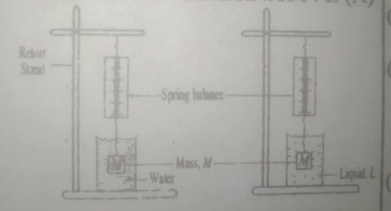
(a) You are provided a retort stand, a spring balance, masses, a beaker containing water, another beaker containing a liquid labelled, L, and other necessary apparatus.
(i) Suspend the mass, m = 20 g on the spring balance and measure the weight in air, W\(_A\) in Newton.
(ii) Immerse the suspended mass completely in water and measure weight in water, W\(_W\) in Newton. Evaluate U\(_1\) = W\(_A\) - W\(_W\).
(iii) Immerse the suspended mass completely in the liquid L of the same volume with water and measure the weight in liquid W\(_L\). Evaluate U\(_2\) = W\(_A\) - W\(_L\).
(iv) Repeat the procedure for m = 40g, 60g, 80g, and 100g respectively. In each case, evaluate \(W_A\), W\(_W\), U\(_1\), W\(_L\), U\(_2\).
(v) Tabulate the readings.
(vi) Plot a graph of U\(_1\) on the vertical axis and U\(_2\) on the horizontal axis starting both axes from the origin (0, 0).
(vii) Determine the slope s of the graph
(viii) Evaluate K = \(\frac{1}{\text{s}}\)
(ix) State two precautions taken to ensure accurate results.
b(i) State the Archimedes' principle,
(ii) State two differences between density and relative density
Attached Figure / Diagram
medium Difficulty
Verified Correct Answer: Option
Physical Principles & Numerical Solution
(v)
M(g)
W\(_A\)(N)
W\(_W\)(N)
U\(_1\) = W\(_A\) - W\(_W\).
W\(_L\)(N)
U\(_2\) = W\(_A\) - W\(_L\)
20.0
0.20
0.16
0.04
0.18
0.02
40.0
0.40
0.33
0.07
0.36
0.04
60.0
0.60
0.49
0.11
0.54
0.06
80.0
0.80
0.66
0.14
0.72
0.08
100.0
1.00
0.82
0.18
0.90
0.10
(vi) SEE THE GRAPH ABOVE
(vii) s = \(\frac{\Delta U_1}{\Delta U_1}\) = \(\frac{0.162 - 0.2}{0.09 - 0.067}\) = \(\frac{0.042}{0.023}\) = 1.826
(viii) K = \(\frac{1}{\text{s}}\) = \(\frac{1}{1.826}\) = 0.5476
(ix)(I) I avoided errors due to parallax when reading the spring balance. (II) I cleared the mass thoroughly before immersing it in liquid L
b(i) Archimedes's principle states that when a body is completely or partially immersed in a fluid, it experiences an upthrust which is equal to the weight of fluid displaced.
(ii) Density has a unit whereas relative density has none. (II) The value of density is different in different systems of measurement, whereas relative density is the same in all systems of measurement.
Source: Myschool Past Questions Archive (Record #72107)
Physics
WAEC / WASSCE 2024
Electricity and Magnetism
Diagram
Solution
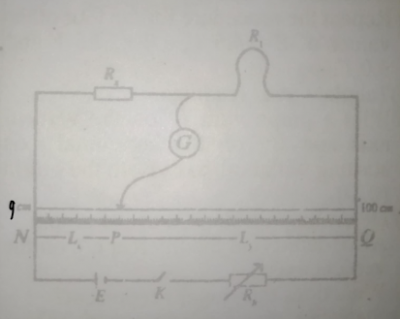
(a) You are provided with two resistance wires labelled: A and B, standard resistor, R\(_x\) = 1 \(\Omega\), metre bridge, cell of emf,E, Rheostat R\(_h\), galvanometer and apparatus as shown.
Use the circuit diagram above as a guide to perform the experiment.
(i) Connect R\(_x\) in the left-hand gap of the metre bridge, a length L = 100 cm of the wire in the right-hand gap and the other apparatus shown.
(ii) Determine and record the balance point P on the metre bridge wire NQ
(iii) Measure and record L\(_x\) = NP and L\(_y\) = PQ
(iv) Evaluate R\(_1\) = \(\frac{L_y}{L_x}R_x\)
(v) Repeat the procedure for four other values of L = 90cm, 80cm, 70cm, and 60cm. In each case, determine and record the balance point, P and evaluate R\(_1\)
(vi) Repeat the experiment with the second wire B. Obtain the balance point P and evaluate R\(_2\) in each case
(vii) Tabulate the readings
(viii) Plot a graph of R\(_2\) on the vertical axis and R\(_1\) on the horizontal axis
(ix) Determine the slope, s, of the graph
(x) Evaluate K = \(\sqrt{s}\)
(xi) State two precautions taken to ensure accurate results.
b(i) State two advantages of potentiometer over voltmeter for measuring potential difference
(ii) Define internal resistance of a cell.
Attached Figure / Diagram
medium Difficulty
Verified Correct Answer: Option
Physical Principles & Numerical Solution
(vii)
L(cm)
L\(_x\)(cm)
L\(_y\)(cm)
R\(_1\) = (\(\frac{L_y}{L_x})R_x\)\(\Omega\)
L\(_{x2}\)
L\(_{y2}\)
R\(_2\) = \(\frac{L_{y2}}{L_{x2}}R_x\)\(\Omega\)
100.0
5.2
94.8
18.2
21.5
78.5
3.6
90.0
6.0
94.0
15.7
22.5
77.5
3.4
80.0
6.8
93.2
13.7
23.4
76.6
3.3
70.0
7.6
92.4
12.2
24.5
75.5
3.1
60.0
8.4
91.6
10.9
25.6
74.4
2.9
(viii) SEE THE GRAPH ABOVE
(ix) Slope = \(\frac{\Delta R_2}{\Delta R_1}\) = \(\frac{3.5 - 3.3}{17.0 - 14.6}\) = \(\frac{0.2}{2.4}\) = 0.083
(x) K = \(\sqrt{0.083}\) = 0.2881
(xi) I Tight connection/clean terminal was ensured II. Key removed when readings were not being taken.
b(i) I. A potentiometer can be used for measuring the internal resistance of a cell and also to compare the e.m.f. of two cells. II. A potentiometer gives the exact value of potential difference across any two points in a circuit.
(ii) It refers to the opposition to the flow of current offered by the cells and batteries themselves resulting in the generation of heat.
Source: Myschool Past Questions Archive (Record #72108)
Physics
UTME / JAMB 2024
Heat Energy & Temperature
Solution
An example of a non-rechargeable cell is
A
nickel iron
B
mercury cadmium
C
dry leclanche
D
lead-acid
medium Difficulty
Verified Correct Answer: Option C
Physical Principles & Numerical Solution
Dry Leclanché: This is a common non-rechargeable cell.
Source: Official Exam / Past Question Archive
Physics
WAEC / WASSCE 2024
Heat Energy & Temperature
Solution
(a) You are provided with two metre rules, two retort stands, a mass, m = 100g, thread, and other necessary apparatus
(i) Place one of the metre rules on a knife edge and determine the centre of gravity, C
(ii) Measure and record the mass, M\(_R\) of the metre rule
(iii) Attach the mass = 100g firmly to the metre rule AB at C using paper tape
(iv) Suspend the metre rule by two parallel threads of length, h = 40cm each at 10 cm and 90cm mark. Ensure that the graduated face of the metre rule is facing upwards.
(v) Set the metre rule into small angular oscillation about the vertical axis through the centre of gravity.
(vi) Determine the time, t for 20 complete oscillations. Evaluate the period T and T\(^2\).
(vii) Read and record the value of d in metres.
(viii) Keeping d, constant, repeat the procedure for four other values of h = 50, 60, 70, and 80 cm. In each case, determine t and evaluate T and T\(^2\).
(ix) Tabulate the readings
(x) Plot a graph of T\(^2\) on the vertical axis and h on the horizontal.
(xi) Determine the slope, s of the graph
(xii) Evaluate K = \(\frac{\text{S}}{\text{Q}}\) where Q = \(\frac{2}{25d^2}\)
(xiii) State two precautions taken to ensure accurate results
b(i) Define couple as it relates to oscillatory motion
(ii) Give two practical applications of a couple in everyday life.
A
the variation of the volume of a gas with increasing temperature
B
expansion curve of mercury
C
expansion curve of liquid oxygen
D
anomalous expansion of water
medium Difficulty
Verified Correct Answer: Option D
Physical Principles & Numerical Solution
(a)i c = 50.0cm
(ii) M\(_R\) = 90.0 g
(vii) d = 0.8m
(ix)
S/N
h(cm)
t(s)
T= \(\frac{t}{20}\)s
T\(^2\)s\(^2\)
1
40.0
26.12
1.306
1.7056
2
50.0
27.80
1.390
1.9321
3
60.0
30.68
1.534
2.3532
4
70.0
34.60
1.730
2.9929
5
80.0
35.80
1.790
3.2041
(x) SEE THE GRAPH ABOVE
(xi) Slope, s = \(\frac{\DeltaT^2}{\Delta h}\) = \(\frac{3.0 - 1.75}{75 - 46}\) = \(\frac{1.25}{29}\) = 0.431s\(^2\)cm\(^{-1}\)
(xii) K = \(\frac{\text{S}}{\text{Q}}\)
where, Q = \(\frac{2}{25d^2}\) = \(\frac{2}{25 \times (0.8)^2}\) = 0.125
K = \(\frac{\text{S}}{\text{Q}}\) = \(\frac{0.431}{0.125}\) = 0.3448
b(i) A couple, as related to oscillatory motion, refers to a pair of forces that are equal in magnitude but opposite in direction, and act on opposite sides of a pivot or fulcrum, causing rotation or torsion.
b(ii) I. Wrenches: When using a wrench to tighten or loosen a bolt, the force applied creates a couple that produces rotational motion. II. Steering Wheels: Turning the steering wheel of a car applies a couple that rotates the front wheels, allowing for directional change. III. Door Handles: When pushing or pulling on one side of a door handle, a couple is created that rotates the door about its hinges. IV. Bicycle Pedals: When pedaling a bicycle, the force applied to the pedals generates a couple that turns the crankshaft, propelling the bike forward.
Source: Official Exam / Past Question Archive
Physics
UTME / JAMB 2023
Light & Geometrical Optics
Solution
The near point of a patient's eye is 50.0 cm. What power (in diopters) must a corrective lens have to enable the eye to see clearly an object 25.0 cm away?
A
2 diopters
B
2.5 diopters
C
0.5 diopters
D
3 diopters
medium Difficulty
Verified Correct Answer: Option A
Physical Principles & Numerical Solution
The patient cannot see clearly an object closer than 50 cm
Therefore, the patient needs a lens that would enable him see clearly, objects placed 25 cm from the lens
So, we take the object to a distance of 25 cm from the lens so that the image forms at 50 cm in front of the lens
u=25cm ;v=-50cm (virtual image); p=
\(\frac{1}{f}\)=\(\frac{1}{u}\) + \(\frac{1}{v}\)
⇒\(\frac{1}{f}\) =\(\frac{1}{50}\)
⇒\(\frac{1}{f}\) = \(\frac{1}{25}\)-\(\frac{1}{50}\)
⇒\(\frac{1}{f}\) = f = 50cm =0.5m
⇒\(\frac{1}{f}\) = \(\frac{2-1}{50}\)
p = \(\frac{1}{f}\)
p = \(\frac{1}{0.5}\)
p = 2 diopters
; The patient needs a converging lens with a power of 2 diopters
Source: WAEC / JAMB / NECO Classroom Archive (Record #67977)
Physics
UTME / JAMB 2023
Motion Force Circular Motion
Solution
The branch of physics that deals with the motion of objects and the forces acting on them is called:
A
Electromagnetism
B
Thermodynamics
C
Mechanics
D
Quantum mechanics
medium Difficulty
Verified Correct Answer: Option C
Physical Principles & Numerical Solution
Mechanics is the branch of physics that deals with the motion of objects and the forces acting on them. It is the foundation of all other branches of physics, and it is used to study everything from the motion of planets to the motion of electrons.
Source: WAEC / JAMB / NECO Classroom Archive (Record #68566)
Physics
UTME / JAMB 2023
Work, Energy and Power
Solution
How much net work is required to accelerate a 1200 kg car from 10\(ms^{-1}\) to 15\(ms^{-1}\)
A
1.95×\(10^5 j\)
B
1.35×\(10^4 j\)
C
7.5×\(10^4 j\)
D
6.0×\(10^4 j\)
medium Difficulty
Verified Correct Answer: Option C
Physical Principles & Numerical Solution
m=1200kg, \(V_1\)= \(10ms^{-1}\) \(V_2\) = \(15ms^{-1}\), w= ?
work=►K.E = \( K.E_2\) = \(K.E_2\) - \(K.E_1\)
⇒work= \(\frac{1}{2}{mv^2_2}-\frac{1}{2}{mv^2_1}\)
⇒work= \(\frac{1}{2}m({v^2_2}-{v^2_1}\))
⇒work= \(\frac{1}{2}\times 1200\times (15^2-10^2)\)
⇒work = 600 \times (225 -100)
⇒work= 600 \times 125
⇒work= 7.5\times\(10^4 j\)
Source: WAEC / JAMB / NECO Classroom Archive (Record #67686)
Physics
UTME / JAMB 2023
Work, Energy and Power
Solution
How much work is done against the gravitational force on a 3.0 kg object when it is carried from the ground floor to the roof of a building, a vertical climb of 240 m?
A
7.2 kJ
B
4.6 kJ
C
6.8 kJ
D
8.4 kJ
medium Difficulty
Verified Correct Answer: Option A
Physical Principles & Numerical Solution
The work done against the gravitational force is calculated using the formula W = mgh, where m is the mass of the object, g is the acceleration due to gravity (approximately \(9.8 ms^2\) on Earth), and h is the height. Substituting the given values, we get W = 3.0 kg * \(9.8 m/s^2\) * 240 m = 7.2 kJ. Therefore, the correct answer is '7.2 kJ'.
Source: WAEC / JAMB / NECO Classroom Archive (Record #68116)
Physics
UTME / JAMB 2023
Simple Machine
Diagram
Solution
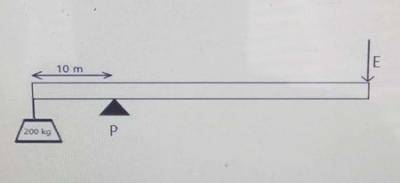
A 200 kg load is raised using a 110 m long lever as shown in the diagram above. The load is 10m from the pivot P. If the efficiency of the the lever is 80%, find the effort E required to lift the load.
[Take g = 10ms-2]
Attached Figure / Diagram
A
250
B
300
C
450
D
200
medium Difficulty
Verified Correct Answer: Option A
Physical Principles & Numerical Solution
ε= 80%, L=200\times 10 = 2000N, \(d_L\)=10m
\(d_E\)= 110-10 = 100m, E=?
ε = \(\frac{work done on the load}{work done by the effort}\) \times 100%
⇒ work done on load = 2000 \times10 =20,000 j
⇒ work done by effort = E \times 100 = 100E
⇒ 80 = \(\frac{20,000}{100E}\) \times 100%
⇒ 80 = \(\frac{20,000}{E}\)
⇒ E = \(\frac{20,000}{80}\)
⇒ E = 250N
Source: WAEC / JAMB / NECO Classroom Archive (Record #67830)
Physics
UTME / JAMB 2023
Linear Motion & Kinematics
Solution
A lorry accelerates uniformly in a straight line with acceleration of \(4ms^-2\) and covers a distance of 250 m in a time interval of 10 s. How far will it travel in the next 10 s?
A
650
B
900
C
800
D
250
medium Difficulty
Verified Correct Answer: Option A
Physical Principles & Numerical Solution
We first find the lorry's initial velocity
a = \(4ms^-2\), s= 250m, t= 10, u=?
⇒ ut + \(\frac{1}{2}\times4\times(10^2)
⇒250= 10u + 200
⇒ 250-200 = 10u
⇒ 50 = 10u
⇒U =\frac{50}{10}\) = \(5ms^-1\)
For the next 10s, we set t=20s
= s = (5 \times 20) + \(\frac{1}{2}\times4\times{20^2}\)
= s = 100 + 800
⇒ 900 m
;Distance covered:900-250 =650m
Source: WAEC / JAMB / NECO Classroom Archive (Record #67375)
Physics
UTME / JAMB 2023
Equilibrium of Forces
Diagram
Solution
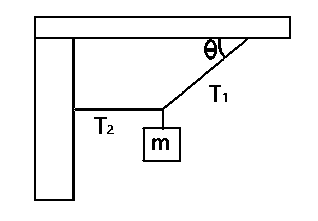
Find the tension in the two cords shown in the figure above. Neglect the mass of the cords, and assume that the angle is 38° and the mass m is 220 kg
[Take g = 9.8 ms-2]
Attached Figure / Diagram
A
\(T_1\) = 2864 N, \(T_2\)= 3612 N
B
\(T_1\)= 3612 N, \(T_2\) = 2864 N
C
\(T_1\)= 3502 N, \(T_2\)= 2760 N
D
\(T_1\) = 2760 N, \(T_2\) = 3502 N
medium Difficulty
Verified Correct Answer: Option C
Physical Principles & Numerical Solution
W = mg = 220 x 9.8 = 2156 N
⇒Sin 38º = \(\frac{2156}{T_1}\)
⇒ \(T_1\) = \(\frac{2156}{Sin 38}\)
⇒ \(T_1\) = 3502 N
Cos 38º = \(\frac{T_2}{T_1}\)
⇒ \(T_2\) = 3502 x Cos 38º
⇒ \(T_2\) = 2760 N
; \(T_1\) = 3502 N, \(T_2\) = 2760 N.
Source: WAEC / JAMB / NECO Classroom Archive (Record #67267)
Physics
UTME / JAMB 2023
Equilibrium of Forces
Diagram
Solution
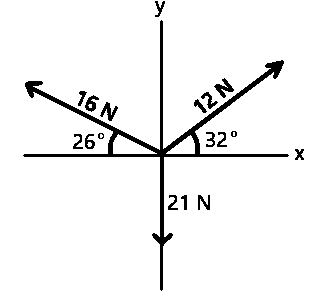
Three forces with magnitudes 16 N, 12 N and 21 N are shown in the diagram below. Determine the magnitude of their resultant force and angle with the x-axis
Attached Figure / Diagram
A
7.63N,61°
B
8.71N,61°
C
7.63N,29°
D
8.71N,29°
medium Difficulty
Verified Correct Answer: Option B
Physical Principles & Numerical Solution
Fx= 12cos32^\circ-16cos26^\circ = -4.20N (right is taken +ve and left is taken -ve)
Fy=12sin32^\circ+16sin26^\circ-21 = -7.63N (up is taken +ve and down is taken -ve)
\(R^2\)= 4.202+7.632
⇒\(R^2\) = 75.86
⇒ R=\sqrt75.86
∴R = 8.71 N
tan \theta=\(\frac{opp}{adj}\)
⇒tan \theta=\(\frac{7.63}{4.20}\)
⇒tan \theta =1.8095
⇒ \theta = \(tan^-1\) (1.8095)
\theta = 61^\circ
∴The angle of the resultant force with the x-axis is 61^\circ
Source: WAEC / JAMB / NECO Classroom Archive (Record #67919)