Question Library
Browse, filter, and study verified past examination questions with step-by-step mathematical reasoning.
Searching 18,000+ Questions...
Sifting topics, KaTeX formulas & verified solutions
Showing 391–405 of 5315 verified questions
Sort by:
Physics
WAEC / WASSCE 2024
Sound Wave
Solution
Which of the following factors does not affect the speed of sound?
A
Loudness.
B
Wind direction
C
Temperature
D
Material density
medium Difficulty
Verified Correct Answer: Option A
Physical Principles & Numerical Solution
Loudness does not affect the speed of sound.
Source: WAEC / JAMB / NECO Classroom Archive (Record #72078)
Physics
UTME / JAMB 2024
Vibration in Springs and Pipes
Solution
The fourth overtone of a closed pipes is 900Hz, its fundamental frequency is
A
50Hz
B
100Hz
C
200Hz
D
400Hz
medium Difficulty
Verified Correct Answer: Option B
Physical Principles & Numerical Solution
For a closed pipe, only odd harmonics are present. first overtone frequency is 3f\(_o\), 2\(^{nd}\) overtone frequency is 5f\(_o\) etc.
4\(^{th}\) overtone frequency = 9f\(_o\)
900 = 9f\(_o\)
f\(_o\) = \(\frac{900}{9}\) = 100Hz
Source: WAEC / JAMB / NECO Classroom Archive (Record #70425)
Physics
UTME / JAMB 2024
Application of Lens
Solution
The defect of the eye lens which occurs when the ciliary muscles are weak is
A
Spherical aberration
B
Astigmatism
C
Presbyopia
D
Myopia
medium Difficulty
Verified Correct Answer: Option C
Physical Principles & Numerical Solution
Presbyopia: Caused by aging and weakened ciliary muscles, making it hard to focus on nearby objects.
Source: WAEC / JAMB / NECO Classroom Archive (Record #70517)
Physics
UTME / JAMB 2024
Application of Lens
Solution
Bifocal lens is used to correct the eye defect of
A
astigmatism
B
hypermatropia
C
myopia
D
presbyopia
medium Difficulty
Verified Correct Answer: Option D
Physical Principles & Numerical Solution
Presbyopia is the condition where the eye's ability to focus on close objects decreases with age, and bifocal lenses provide two different optical powers for distance and near vision.
Source: WAEC / JAMB / NECO Classroom Archive (Record #70670)
Physics
UTME / JAMB 2024
Fundamental and Derived Quantities
Solution
The dimension of power is
A
ML\(^2\)T\(^{-3}\)
B
ML\(^1\)T\(^2\)
C
ML\(^2\)T\(^{-2}\)
D
MLT\(^2\)
medium Difficulty
Verified Correct Answer: Option A
Physical Principles & Numerical Solution
POWER = \(\frac{\text{workdone}}{\text{time}}\)
Dimension of work done ( F x S = M x A x S ) = MLT\(^{-2}\) L = ML\(^2\)T\(^{-2}\)
Dimension of time = T
Therefore, the dimension of power = \(\frac{ML^2T^{-2}}{T}\) = ML\(^2\)T\(^{-3}\)
Source: WAEC / JAMB / NECO Classroom Archive (Record #71619)
Physics
UTME / JAMB 2024
Measurement
Solution
The degree of precision of a vernier caliper is
A
0.005cm
B
0.01cm
C
0.1cm
D
1.0cm
medium Difficulty
Verified Correct Answer: Option B
Physical Principles & Numerical Solution
A standard vernier caliper usually has the least count (its degree of accuracy) of 0.01 cm, meaning it can make measurements to the nearest hundredth of a centimeter. This level of precision allows for accurate readings in various applications.
Source: WAEC / JAMB / NECO Classroom Archive (Record #70438)
Physics
UTME / JAMB 2024
Measurement
Solution
What is the least possible error encountered when taking measurement with a metre rule?
A
1.1mm
B
0.5mm
C
0.2mm
D
0.1mm
medium Difficulty
Verified Correct Answer: Option B
Physical Principles & Numerical Solution
A standard meter rule has markings that are usually every millimeter (1 mm). The least count, which is the smallest measurement that can be accurately read, is often 1 mm.
The least possible error is generally considered to be half of the smallest division, so it is \pm0.05cm (or \pm0.5mm).
Source: WAEC / JAMB / NECO Classroom Archive (Record #70472)
Physics
UTME / JAMB 2024
Heat Energy & Temperature
Diagram
Solution
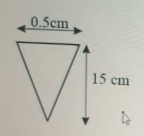
The mechanical advantage of the machine shown above
Attached Figure / Diagram
A
7.5
B
15.5
C
30.0
D
60.0
medium Difficulty
Verified Correct Answer: Option C
Physical Principles & Numerical Solution
Mechanical advantage of a machine = \(\frac{\text{LOAD}}{\text{EFFORT}}\)
In this case of a wedge, we can consider the dimensions given:
Load distance (height of the machine): 15 cm
Effort distance (movement of the effort): 0.5 cm
M.A = \(\frac{15}{0.5}\) = 30.0
Source: Myschool Past Questions Archive (Record #70353)
Physics
UTME / JAMB 2024
Mechanics and Properties of Matter
Solution
Calculate the power of an object which moves through a distance of 500cm in 1s on a frictionless surface by a horizontal force of 50N
A
200W
B
300W
C
350W
D
250W
medium Difficulty
Verified Correct Answer: Option D
Physical Principles & Numerical Solution
Power = \(\frac{w}{t}\)
Given: F = 50N, s = 500cm → 5m and t = 1s
W = f x s = 50 x 5 = 250J
Power = \(\frac{250}{1}\) = 250W
Source: Myschool Past Questions Archive (Record #70512)
Physics
UTME / JAMB 2024
Thermal Physics
Solution
The land and sea breeze is attributed to
A
conduction and radiation
B
conduction
C
radiation
D
convection
medium Difficulty
Verified Correct Answer: Option D
Physical Principles & Numerical Solution
Convection: The movement of air due to temperature differences between land and water, leading to the formation of breezes.
Source: Myschool Past Questions Archive (Record #70522)
Physics
UTME / JAMB 2024
Mechanics and Properties of Matter
Diagram
Solution
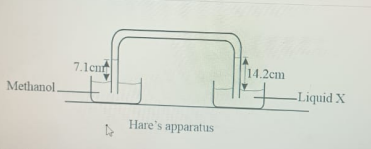
Using the diagram above, calculate the relative density of x, if the density of methanol is 800kgm\(^{-3}\)
Attached Figure / Diagram
A
0.8
B
0.5
C
1.5
D
2.5
medium Difficulty
Verified Correct Answer: Option B
Physical Principles & Numerical Solution
At equilibrium, the pressures at the bottom of both columns are equal:
ρ\(_m\) \times h\(_m\) \times g = ρ\(_x\) \times h\(_x\) \times g
g cancels out, so:
ρ\(_m\) \times h\(_m\) = ρ\(_x\) \times h\(_x\)
\(\rho_x = \rho_m \times \frac{h_m}{h_x} = 800 \times \frac{7.1}{14.2}\)
\(\frac{7.1}{14.2} = 0.5\)
\(\rho_x = 800 \times 0.5 = 400 \, \text{kg/m³}\)
Relative density of X (with respect to methanol) =
\(\frac{\rho_x}{\rho_m} = \frac{400}{800} = \mathbf{0.5}\)
Source: Myschool Past Questions Archive (Record #70665)
Physics
UTME / JAMB 2024
Electricity and Magnetism
Solution
One of these is not the use of an electroscope
A
testing the type of charge on a charge body
B
measuring ionization current in air
C
detecting the pressure of charge on a charged body
D
producing electric charge in a body
medium Difficulty
Verified Correct Answer: Option D
Physical Principles & Numerical Solution
An electroscope is a passive device used to detect and measure charges, not to produce or generate electric charge in a body.
Source: Myschool Past Questions Archive (Record #70690)
Physics
UTME / JAMB 2024
Electricity and Magnetism
Diagram
Solution
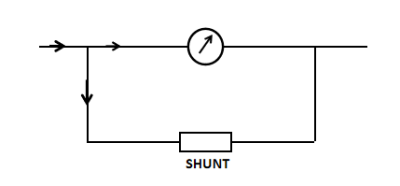
In the diagram above, the galvanometer is converted to
Attached Figure / Diagram
A
Voltmeter
B
Ammeter
C
Voltameter
D
Hypsometer
medium Difficulty
Verified Correct Answer: Option B
Physical Principles & Numerical Solution
When a galvanometer is connected to a shunt resistor, it is converted into an ammeter.
By connecting a shunt in parallel with a galvanometer, it can measure larger currents without getting damaged, turning it into an ammeter
Source: Myschool Past Questions Archive (Record #70685)
Physics
UTME / JAMB 2024
Waves and Optics
Solution
A boy standing 408m from a wall blew a trumpet and heard the echo 2.4s later. Calculate the speed of the sound
A
310m/s
B
320m/s
C
330m/s
D
340m/s
medium Difficulty
Verified Correct Answer: Option D
Physical Principles & Numerical Solution
The distance to the wall is 408m, so the total distance (D) traveled by the sound is: D = 2 \times 408m = 816m
But v = \(\frac{d}{t}\) = \(\frac{816}{2.4}\) = 340m/s
Source: Myschool Past Questions Archive (Record #71633)
Physics
UTME / JAMB 2024
Mechanics and Properties of Matter
Solution
The acceleration of a free fall due to gravity is not a constant everywhere on the Earth's surface because
A
mass of the earth
B
elliptical shape of the earth
C
variation in the density of the earth
D
rotation of the earth about its axis
medium Difficulty
Verified Correct Answer: Option B
Physical Principles & Numerical Solution
The elliptical shape of the Earth: The Earth is not a perfect sphere; it is slightly flattened at the poles and bulging at the equator. This shape causes variations in gravitational acceleration.
Source: Myschool Past Questions Archive (Record #70696)