Question Library
Browse, filter, and study verified past examination questions with step-by-step mathematical reasoning.
Searching 18,000+ Questions...
Sifting topics, KaTeX formulas & verified solutions
Showing 391–405 of 1462 verified questions
Sort by:
Mathematics
UTME / JAMB 2012
Geometry and Trigonometry
Solution
The gradient of the straight line joining the points P(5, -7) and Q(-2, -3) is
A
\(\frac{1}{2}\)
B
\(\frac{2}{5}\)
C
\(-\frac{4}{7}\)
D
\(-\frac{2}{3}\)
medium Difficulty
Verified Correct Answer: Option C
Step-by-Step Mathematical Solution
PQ = \(\frac{y_1 - y_0}{x_1 - x_0}\) = \(\frac{-3 - (-7)}{-2 - 5}\) = \(\frac{-3 + 7}{-2 - 5}\) = \(\frac{4}{-7}\)
Source: Myschool Past Questions Archive (Record #27337)
Mathematics
UTME / JAMB 2012
Geometry and Trigonometry
Solution
The distance between the point (4, 3) and the intersection of y = 2x + 4 and y = 7 - x is
A
\(\sqrt{13}\)
B
\(3\sqrt{2}\)
C
\(\sqrt{26}\)
D
\(10\sqrt{5}\)
medium Difficulty
Verified Correct Answer: Option B
Step-by-Step Mathematical Solution
P1 (4, 3), P2 (x, y)
y = 2x + 4 .....(1)
y = 7 - x .....(2)
Substitute (2) in (1)
7 - x = 2x + 4
7 - 4 = 2x + x
3 = 3x
x = 1
Substitute in eqn (2)
y = 7 - x
y = 7 - 1
y = 6
P2 (1, 6)
Distance between 2 points is given as
D = \(\sqrt{(x_2 - x_1)^2 + (y_2 - y_1)^2}\)
D = \(\sqrt{(1 - 4)^2 + (6 - 3)^2}\)
D = \(\sqrt{(-3)^2 + (3)^2}\)
D = \(\sqrt{9 + 9}\)
D = \(\sqrt{18}\)
D = \(\sqrt{9 \times 2}\)
D = \(3\sqrt{2}\)
Source: Myschool Past Questions Archive (Record #27338)
Mathematics
UTME / JAMB 2012
Geometry and Trigonometry
Solution
If angle \(\theta\) is 135o, evaluate cos\(\theta\)
A
\(\frac{1}{2}\)
B
\(\frac{\sqrt{2}}{2}\)
C
\(-\frac{\sqrt{2}}{2}\)
D
\(-\frac{1}{2}\)
medium Difficulty
Verified Correct Answer: Option C
Step-by-Step Mathematical Solution
\(\theta\) = 135o
Cos 135o = Cos(90 + 45)o
= cos90ocos45o - sin90osin45o
= 0cos45o - (1 x \(\frac{\sqrt{2}}{2}\))
= \(-\frac{\sqrt{2}}{2}\)
Source: Myschool Past Questions Archive (Record #27340)
Mathematics
UTME / JAMB 2012
Geometry and Trigonometry
Solution
Evaluate \(\int^{\frac{\pi}{4}}_0sec^2 \theta d \theta\)
A
1
B
2
C
3
D
4
medium Difficulty
Verified Correct Answer: Option A
Step-by-Step Mathematical Solution
\(\int^{\frac{\pi}{4}}_0sec^2 \theta d \theta\)
= \([\tan \theta]_{0} ^{\frac{\pi}{4}}\)
= \(\tan \frac{\pi}{4} - \tan 0\)
= \(1 - 0\)
= 1.
Source: Myschool Past Questions Archive (Record #27343)
Mathematics
UTME / JAMB 2012
Geometry and Trigonometry
Solution
Find the standard deviation of 2,3,8,10 and 12
A
3.9
B
4.9
C
5.9
D
6.9
medium Difficulty
Verified Correct Answer: Option A
Step-by-Step Mathematical Solution
\(\begin{array}{c|c} x & (x - \varkappa) & (x - \varkappa)^2 \\ \hline 2 & -5 & 25 \\ \hline 3 & -4 & 16 \\ \hline 8 & 1 & 1 \\ \hline 10 & 3 & 9 \\ \hline 12 & 5 & 25 \\ \hline & & 76
\end{array}\)
S.D = \(\sqrt{\frac{(x - \varkappa)^2}{n}}\)
S.D = \(\sqrt{\frac{76}{5}}\)
S.D = 3.9
Source: Myschool Past Questions Archive (Record #27381)
Mathematics
UTME / JAMB 2012
Geometry and Trigonometry
Solution
Evaluate n+1Cn-2 If n =15
A
3630
B
3360
C
1120
D
560
medium Difficulty
Verified Correct Answer: Option D
Step-by-Step Mathematical Solution
\(\frac{n + 1 (n - 2)}{(n + 1)!}\)
\(\frac{(n + 1) + (n - 2)!(n - 2)!}{(n + 1)!}\)
\(\frac{(n + 1)(n + 1 -1)(n+1-2)(n+1-3)!}{3!(n-2)!}\)
\(\frac{(n + 1)(n)(n-1)(n-2)!}{3!(n-2)!}\)
\(\frac{(n + 1)(n)(n-1)}{3!}\)
Since n = 15
\(\frac{(15 + 1)(15)(15-1)}{3!}\)
\(\frac{16 \times 15 \times 14}{3 \times 2 \times 1}\)
= 560
Source: Myschool Past Questions Archive (Record #27391)
Mathematics
UTME / JAMB 2012
Geometry and Trigonometry
Diagram
Solution
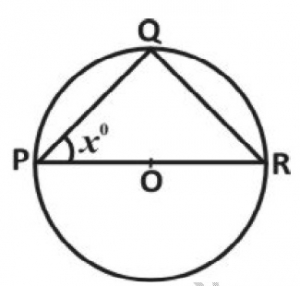
In the diagram above, PQR is a circle centre O. If < QPR is x^\circ, find < QRP.
Attached Figure / Diagram
A
x°
B
(90 – x)°
C
(90 + x)°
D
(180 – x)°
medium Difficulty
Verified Correct Answer: Option B
Step-by-Step Mathematical Solution
< PQR = 90^\circ (angle in a semi-circle)
< QRP = (90 - x)^\circ
Source: Myschool Past Questions Archive (Record #33164)
Mathematics
WAEC / WASSCE 2012
Geometry and Trigonometry
Solution
Mr. Manu travelled from Accra to Pamfokromb a distance of 720km in 8 hours. What will be his speed in m/s?
A
25m/s
B
150m/s
C
250m/s
D
500m/s
medium Difficulty
Verified Correct Answer: Option A
Step-by-Step Mathematical Solution
\(\frac{720 \times 1000}{8 \times 60 \times 60}\) = \(\frac{20 \times 10}{8}\)
= \(\frac{200}{8}\)
= 25 m/s
Source: Myschool Past Questions Archive (Record #36741)
Mathematics
WAEC / WASSCE 2012
Geometry and Trigonometry
Solution
The lengths of the minor and major arcs 54cm and 126cm respectively. Calculate the angle of the major sector
A
360o
B
252o
C
246o
D
234o
medium Difficulty
Verified Correct Answer: Option B
Step-by-Step Mathematical Solution
Let 0 = angle of the minor sector
angle of the major sector = 360 - \(\theta\)(angle at a point)
2 \(\pi r\) = 54 + 126(i.e circumference of minor and major arc)
2\(\pi r = 180^o\)
r = \(\frac{180}{2\pi}\) = \(\frac{90}{\pi}\)
Lenght of ninor arc
= \(\frac{\theta}{360} \times 2 \pi r\)
54 = \(\frac{\theta}{360} \times 3 \pi r\)
\(\theta = \frac{360 \times 54}{2 \pi r}\)
but r = \(\frac{90}{\pi}\) substituting \(\frac{90}{\pi}\) for r
\(\theta = \frac{360 \times 54 \times \pi}{2 \times \pi \times 90}\)
\(\theta = 2 \times 54 = 108^o\)
angle of the major sector = 360 - 108o
= 252o
Source: Myschool Past Questions Archive (Record #36764)
Mathematics
WAEC / WASSCE 2012
Geometry and Trigonometry
Solution
In \(\bigtriangleup\) XYZ, /XY/ = 8cm, /YZ/ = 10cm and /XZ/ = 6cm. Which of these relation is true?
A
/XY/ + /YZ/ = /XZ/
B
/XY/ - /YZ/ = /XZ/
C
/XY/2 = /Y/2 - /XY/2
D
/YZ/2 = /XZ/2 + /XY/2
medium Difficulty
Verified Correct Answer: Option D
Step-by-Step Mathematical Solution
/YZ/\(^2\) = /XZ/\(^2\) + /XY/\(^2\)
(Verify using Pythagoras' theorem)
Source: Myschool Past Questions Archive (Record #36767)
Mathematics
WAEC / WASSCE 2012
Geometry and Trigonometry
Solution
If cos(x + 40)o = 0.0872, what is the value of x?
A
85o
B
75o
C
65o
D
45o
medium Difficulty
Verified Correct Answer: Option D
Step-by-Step Mathematical Solution
cos(x + 40)o = 0.0872
x + 40 = cos-10.0872
x + 40o = 84.99o
x = 84.99o - 40o
x = 44.99
x = 45o
Source: Myschool Past Questions Archive (Record #36772)
Mathematics
WAEC / WASSCE 2012
Geometry and Trigonometry
Solution
A kite flies on a taut string of length 50m inclined at tan angle 54o to the horizontal ground. The height of the kite above the ground is
A
50 tan 30o
B
50 sin 54o
C
50 tan 54o
D
50 sin 36o
medium Difficulty
Verified Correct Answer: Option B
Step-by-Step Mathematical Solution
From the diagram above,
Sin 54º = \(\frac{\text{OPP}}{\text{HYP}}\)
Sin 54º = \(\frac{\text{x}}{50}\)
x = 50 Sin 54º
Source: Myschool Past Questions Archive (Record #36773)
Mathematics
WAEC / WASSCE 2012
Geometry and Trigonometry
Solution
Given that the mean of the scores 15, 21, 17, 26, 18 and 29 is 21, calculate the standard deviation of the scores
A
\(\sqrt{10}\)
B
4
C
5
D
\(\sqrt{30}\)
medium Difficulty
Verified Correct Answer: Option C
Step-by-Step Mathematical Solution
\(\begin{array}{c|c} x & x - x & (x - \bar{x})^2\\ \hline 15 & -6 & 36\\21 & 0 & 0\\17 & -4 & 16\\ 26 & 5 & 25 \\ 18 & -3 &9 \\ 29 & 8 & 64 \end{array}\)
\(E(x - \bar{x})^2\) = 150
N = 6
S.D = \(\sqrt{\frac{(x - x)^2}{N}}\)
S.D = \(\sqrt{\frac{150}{6}}\) = 5
Source: Myschool Past Questions Archive (Record #36775)
Mathematics
WAEC / WASSCE 2012
Geometry and Trigonometry
Solution
If x + 0.4y = 3 and y = \(\frac{1}{2}\)x, find the value of (x + y)
A
1\(\frac{1}{4}\)
B
2\(\frac{1}{2}\)
C
3\(\frac{3}{4}\)
D
5
medium Difficulty
Verified Correct Answer: Option C
Step-by-Step Mathematical Solution
x + 0.4y = 3...(i)
y = \(\frac{1}{2}\)x
x = 2y
x - 2y = 0....(ii)
solve simultaneously; x + 0.4y
= 3 - x - 2y = 0
2.4 = 3
y = \(\frac{3 \times 10}{2.4 \times 10} \)
= \(\frac{30}{24} = \frac{5}{4}\)
x - 2(\(\frac{5}{4}\)) = 0
x - \(\frac{5}{2}\) = 0
x = \(\frac{5}{2}\)
x + y = \(\frac{5}{2} + \frac{5}{4}\)
\(\frac{10 + 5}{4} = \frac{15}{4}\)
= 3\(\frac{3}{4}\)
Source: Myschool Past Questions Archive (Record #36784)
Mathematics
WAEC / WASSCE 2012
Geometry and Trigonometry
Solution
The sum of the interior angles of regular polygon is 1800o. How many sides has the polygon?
A
16
B
12
C
10
D
8
medium Difficulty
Verified Correct Answer: Option B
Step-by-Step Mathematical Solution
Sum = (n - 2)180
1800 = (n - 2)180
divide both sides by 180o
\(\frac{1800}{180}\) = (n - 2)\(\frac{180}{180}\)
10 = n - 2
10 + 2 = n
n = 12
Source: Myschool Past Questions Archive (Record #36794)