Question Library
Browse, filter, and study verified past examination questions with step-by-step mathematical reasoning.
Searching 18,000+ Questions...
Sifting topics, KaTeX formulas & verified solutions
Showing 376–390 of 5315 verified questions
Sort by:
Physics
UTME / JAMB 2024
Reflection of Light
Solution
I clear II sharp III poor IV dark
Which of the above happens when the hole of a pinhole camera is diminished?
A
I only
B
II only
C
I and II only
D
III and IV only
medium Difficulty
Verified Correct Answer: Option B
Physical Principles & Numerical Solution
When the hole of a pinhole camera is diminished, the image becomes II sharp. A smaller aperture reduces the amount of light entering, leading to a sharper image, but it also requires more light for proper exposure.
Source: WAEC / JAMB / NECO Classroom Archive (Record #70543)
Physics
UTME / JAMB 2024
Reflection of Light
Solution
What is the colour of red rose under a blue light?
A
Green
B
Blue
C
Yellow
D
Black
medium Difficulty
Verified Correct Answer: Option D
Physical Principles & Numerical Solution
Under blue light, a red rose will appear black or very dark. This is because the red pigments in the rose reflect red light and absorb other colors. Since blue light does not contain red wavelengths, no light is reflected back to the observer, causing the rose to appear dark.
Source: WAEC / JAMB / NECO Classroom Archive (Record #70679)
Physics
WAEC / WASSCE 2024
Reflection of Light
Solution
An object is placed 1.5 m from a plane mirror. How far is the image from the object?
A
3.0 m
B
1.3 m
C
1.0 m
D
0.3 m
medium Difficulty
Verified Correct Answer: Option A
Physical Principles & Numerical Solution
When an object is placed in front of a plane mirror, the image formed is at the same distance from the mirror as the object but on the opposite side.
Thus, the total distance between the object and the image is 1.5 m + 1.5 m = 3.0m
Source: WAEC / JAMB / NECO Classroom Archive (Record #72039)
Physics
WAEC / WASSCE 2024
Reflection of Light
Solution
An object 2.0 cm high is placed at the radius of curvature of a concave mirror such that it is perpendicular to the principal axis of the mirror. Determine the height of the image.
A
0.5 cm
B
1.0 cm
C
1.5 cm
D
2.0 cm
medium Difficulty
Verified Correct Answer: Option D
Physical Principles & Numerical Solution
When an object is placed at the centre of curvature of a concave mirror, an image that is the same as the object will be formed. Therefore, the height of the image is 2.0 cm.
Source: WAEC / JAMB / NECO Classroom Archive (Record #72059)
Physics
WAEC / WASSCE 2024
Reflection of Light
Solution
A convex mirror is used as a driving mirror; however, a disadvantage in this regard is that the image
A
it produces is virtual
B
it produces is real
C
is not as bright as we would like
D
appears farther away from the driver
medium Difficulty
Verified Correct Answer: Option D
Physical Principles & Numerical Solution
The main disadvantage of a convex mirror as a driving mirror is that it distorts the perception of distance, making them appear farther away than they are.
Source: WAEC / JAMB / NECO Classroom Archive (Record #72079)
Physics
WAEC / WASSCE 2024
Reflection of Light
Diagram
Solution
(a) State the condition for light ray incident on a concave mirror to reflect through the principal focus of the mirror.
(b) Explain spherical aberration as a defect of curved mirrors
(c) The diagram above illustrates an image formed when an object is placed in front of a particular lens. Redraw the diagram and indicate the center of curvature, C, principal focus, F, and the principal axis. ( SEE THE DIAGRAM ABOVE)
(d) What is meant by accommodation in connection to the human?
(e) State quantitatively, the (i) values of the near and far point of a normal eye. (ii) Use the answer in 10c(i) to determine the change in optical power of the normal human eye when reading a book and viewing the sky.[lens-to-retina distance = 2.5 cm].
Attached Figure / Diagram
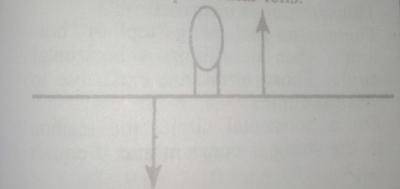
medium Difficulty
Verified Correct Answer: Option
Physical Principles & Numerical Solution
(a) The incident light rays must be parallel and close to the principal axis
(b) Spherical aberration as a defect of curved mirrors: When a wide parallel beam is incident on a spherical mirror, it is not brought to the same focus. This makes the image distorted.
(c) SEE THE DIAGRAM ABOVE
(d) Accommodation is the ability of the eyes to alter its focal length to form a clear image
(e) Quantitatively, (i) far point = infinity, Near point = 25 cm
P\(_{near point}\) = \(\frac{1}{f}\) = \(\frac{1}{u}\) + \(\frac{1}{v}\)
(ii) for near point, u = 0.25 m
P\(_{near point}\) = \(\frac{1}{f}\) = \(\frac{1}{0.25}\) + \(\frac{1}{v}\)
similarly, for far point, u = infinity(\infty)
P\(_{far point}\) = \(\frac{1}{f}\) = \(\frac{1}{u}\) + \(\frac{1}{v}\)
P\(_{far point}\) = \(\frac{1}{\infty}\) + \(\frac{1}{v}\)
= 0 + \(\frac{1}{v}\)
So, change in optical power
\DeltaP = P\(_{near point}\) - P\(_{far point}\)
\DeltaP = 4 + \(\frac{1}{v}\) - \(\frac{1}{v}\)
\DeltaP = 4 dioptres.
Source: WAEC / JAMB / NECO Classroom Archive (Record #72093)
Physics
UTME / JAMB 2024
Refraction of Light
Solution
Calculate the depth of a swimming pool if the apparent depth is 10cm. ( Refractive index of water = 1.33 )
A
7.5cm
B
10.0cm
C
13.3cm
D
6.87cm
medium Difficulty
Verified Correct Answer: Option C
Physical Principles & Numerical Solution
Refractive index = \(\frac{\text{real depth}}{\text{apparent depth}}\)
Real depth = refractive index x apparent depth
Apparent depth = 10cm
Refractive index = 1.33
Real depth = 1.33 x 10 = 13.3cm.
Source: WAEC / JAMB / NECO Classroom Archive (Record #70484)
Physics
WAEC / WASSCE 2024
Refraction of Light
Solution
A ray of light travels from a less dense medium to a denser medium. How are the speed and frequency of the light affected? The speed
A
Increases and the frequency increases
B
decreases and the frequency decreases
C
increases and the frequency remains the same
D
decreases and the frequency remains the same
medium Difficulty
Verified Correct Answer: Option D
Physical Principles & Numerical Solution
When light travels from a less dense medium (like air) to a denser medium (like glass or water), its speed decreases due to the higher optical density of the new medium.
The frequency of light remains constant when it passes from one medium to another. Although the speed changes, the frequency is determined by the source of the light and does not change with the medium.
Source: WAEC / JAMB / NECO Classroom Archive (Record #72026)
Physics
WAEC / WASSCE 2024
Refraction of Light
Solution
Chromatic aberration in lenses can be corrected by using a combination of
A
diverging and converging lenses.
B
an opaque material to cover the rims of lenses.
C
wide parallel beams on the lenses' surface.
D
a thin convex lens.
medium Difficulty
Verified Correct Answer: Option A
Physical Principles & Numerical Solution
Chromatic aberration occurs because different wavelengths of light are refracted by different amounts when passing through a lens.
Chromatic aberration can be corrected by using a combination of diverging (concave) and converging (convex) lenses, which help focus different colors of light to the same point.
Source: WAEC / JAMB / NECO Classroom Archive (Record #72040)
Physics
WAEC / WASSCE 2024
Refraction of Light
Solution
For a convex lens to form a real image, the distance between the object and the screen will be:
A
equal to the focal length of the lens
B
less than the focal length of the lens
C
twice the focal length of the lens
D
four times the focal length of the lens
medium Difficulty
Verified Correct Answer: Option C
Physical Principles & Numerical Solution
Twice the focal length of the lens: this is because, for a real image to be formed, the object must be placed outside the focal length of the lens, typically at a distance greater than twice the focal length.
Source: WAEC / JAMB / NECO Classroom Archive (Record #72052)
Physics
WAEC / WASSCE 2024
Refraction of Light
Solution
The inside portion of a hollow metal sphere of diameter 20 cm is polished. The portion will therefore form a
A
Concave mirror of focal length 5cm.
B
Concave mirror of focal length 10 cm.
C
Convex mirror of focal length 10 cm
D
Convex mirror of focal length 5cm
medium Difficulty
Verified Correct Answer: Option A
Physical Principles & Numerical Solution
Diameter = 20cm
The radius of curvature, R = 10cm
But, focal length, f = \(\frac{R}{2} = \frac{10}{2}\) = 5 cm.
Because the inside portion is polished, light reflects off the hollow, caved-in interior. A mirror that reflects light from its inner surface is concave.
Source: WAEC / JAMB / NECO Classroom Archive (Record #72066)
Physics
WAEC / WASSCE 2024
Refraction of Light
Solution
The phenomenon used for explaining the formation of a rainbow in the sky is
A
interference.
B
refraction.
C
reflection.
D
dispersion.
medium Difficulty
Verified Correct Answer: Option D
Physical Principles & Numerical Solution
The formation of a rainbow is primarily due to dispersion, as it involves the separation of light into its constituent colors when it passes through water droplets in the atmosphere, it is refracted and dispersed due to varying wavelengths.
Source: WAEC / JAMB / NECO Classroom Archive (Record #72070)
Physics
UTME / JAMB 2024
Waves
Solution
The distance between two successive crests of a water wave is 0.25m. If a particle on the surface of the water makes four complete vertical oscillations in one second. Calculate the speed of the wave.
A
4ms\(^{-1}\)
B
3ms\(^{-1}\)
C
2ms\(^{-1}\)
D
1ms\(^{-1}\)
medium Difficulty
Verified Correct Answer: Option D
Physical Principles & Numerical Solution
distance between two successive crests of a water wave = \(\lambda\) = 0.25m
Frequency (f) is defined as the number of cycles or oscillations that occur in one second = four complete vertical oscillations in one second = 4Hz
Speed of wave (v) = f x \(\lambda\) = 0.25 x 4 = 1m/s
Source: WAEC / JAMB / NECO Classroom Archive (Record #70410)
Physics
UTME / JAMB 2024
Sound Wave
Solution
A sonometer's fundamental note is 50Hz, what is the new frequency when the tension is four times the original?
A
25Hz
B
100Hz
C
200Hz
D
250Hz
medium Difficulty
Verified Correct Answer: Option B
Physical Principles & Numerical Solution
For a sonometer, F \(\propto\) \(\sqrt{T}\)
F = k \(\sqrt{T}\)
F\(_1\) = 50Hz, F\(_2\) = ?
T\(_1\) = T, T\(_2\) = 4T
\(\frac{F_1}{\sqrt{T_1}} = \frac{F_2}{\sqrt{T_2}}\)
\(\frac{50}{\sqrt{T}} = \frac{F_2}{\sqrt{4T}}\)
F\(_2\) = \(\frac{50 \times 2 \times\sqrt{T}}{\sqrt{T}}\)
F\(_2\) = 100Hz
Source: WAEC / JAMB / NECO Classroom Archive (Record #70404)
Physics
UTME / JAMB 2024
Sound Wave
Solution
Two tuning forks of frequencies 6Hz and 4Hz respectively are sounded together. The beat frequency is
A
2Hz
B
5Hz
C
8Hz
D
10Hz
medium Difficulty
Verified Correct Answer: Option A
Physical Principles & Numerical Solution
Beat frequency = f\(_1\) - f\(_2\)
f\(_1\) = 6Hz
f\(_2\) = 4Hz
Beat frequency = f\(_1\) - f\(_2\) = 6 - 4 = 2Hz
Source: WAEC / JAMB / NECO Classroom Archive (Record #70490)