Question Library
Browse, filter, and study verified past examination questions with step-by-step mathematical reasoning.
Searching 18,000+ Questions...
Sifting topics, KaTeX formulas & verified solutions
Showing 376–390 of 1462 verified questions
Sort by:
Mathematics
WAEC / WASSCE 2013
Geometry and Trigonometry
Solution
The area of a circle is \(154cm^{2}\). It is divided into three sectors such that two of the sectors are equal in size and the third sector is three times the size of the other two put together. Calculate the perimeter of the third sector. [Take \(\pi = \frac{22}{7}\)].
medium Difficulty
Verified Correct Answer: Option
Step-by-Step Mathematical Solution
Since it is divided into 3 sectors
then \(8x^\circ = 360^\circ\)
\(x^\circ = 45^\circ\)The 3rd sector = 3 times the size of the other two sectors put together
= \(3(45 + 45) = 3(90) = 270^\circ\)
Perimeter of a sector = \(2r + l\)
where r = radius of the circle ; l = length of arc = \(\frac{\theta}{360^\circ} \times 2\pi r\)
Area of circle = \(\frac{22}{7} \times r^{2} = 154 cm^{2}\)
\(r^{2} = \frac{154 \times 7}{22} = 49\)
\(r = 7 cm\)
\(l = \frac{270}{360} \times 2 \times \frac{22}{7} \times 7 = 33 cm\)
Perimeter of sector = \(2(7) + 33 = 14 + 33 = 47 cm\).
Source: Myschool Past Questions Archive (Record #52649)
Mathematics
WAEC / WASSCE 2013
Geometry and Trigonometry
Solution
A boy 1.2m tall, stands 6m away from the foot of a vertical lamp pole 4.2m long. If the lamp is at the tip of the pole,
(a) represent this information in a diagram ;
(b) calculate the (i) length of the shadow of the boy cast by the lamp ; (ii) angle of elevation of the lamp from the boy, correct to the nearest degree.
medium Difficulty
Verified Correct Answer: Option
Step-by-Step Mathematical Solution
(a)
(b) \(\tan \theta = \frac{4.2}{6 + x} ; \tan \theta = \frac{1.2}{x}\)
\(\tan \theta = \tan \theta\)
\(\implies \frac{4.2}{6 + x} = \frac{1.2}{x}\)
\(4.2 x = 1.2(6 + x) \)
\(4.2 x = 7.2 + 1.2 x \implies 4.2x - 1.2x = 7.2\)
\(3x = 7.2 \implies x = 2.4 m\) (length of the shadow cast by the lamp)
(ii) \(\tan \theta = \frac{1.2}{2.4} = 0.5\)
\(\theta = \tan^{-1} (0.5) \)
= \(27^\circ\) (angle of elevation)
Source: Myschool Past Questions Archive (Record #52652)
Mathematics
WAEC / WASSCE 2013
Geometry and Trigonometry
Solution
(a) Using ruler and a pair of compasses only, construct : (i) a trapezium WXYZ such that |WX| = 10.2 cm, |XY| = 5.6 cm, |YZ| = 5.8 cm, < WXY = 60^\circ and WX is parallel to YZ (ii) a perpendicular from Z to meet \(\overline{WX}\) at N.
(b) Measure : (i) |WZ| ; (ii) |ZN| .
medium Difficulty
Verified Correct Answer: Option
Step-by-Step Mathematical Solution
(a) diagram above.
(b) From the figure above,
(i) |WZ| = 5.25 cm ; (ii) |ZN| = 4.86 cm.
Source: Myschool Past Questions Archive (Record #52665)
Mathematics
WAEC / WASSCE 2013
Geometry and Trigonometry
Diagram
Solution
(a)
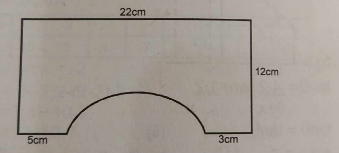
A segment of a circle is cut off from a rectangular board as shown in the diagram. If the radius of the circle is \(1\frac{1}{2}\) times the length of the chord; calculate, correct to 2 decimal places, the perimeter of the remaining portion. [Take \(\pi = \frac{22}{7}\)]
(b) Evaluate without using calculators or tables, \(\frac{3}{\sqrt{3}}(\frac{2}{\sqrt{3}} - \frac{\sqrt{12}}{6})\).
Attached Figure / Diagram
medium Difficulty
Verified Correct Answer: Option
Step-by-Step Mathematical Solution
(a) Length of the chord = 14 cm
Radius = \(\frac{3}{2} \times 14 cm = 21 cm\)
The chord AB = \(2r \sin \frac{\theta}{2}\)
\(14 = 2(21) \sin \frac{\theta}{2}\)
\(\sin \frac{\theta}{2} = \frac{14}{42} = 0.333\)
\(\frac{\theta}{2} = \sin^{-1} (0.333)\)
\(\frac{\theta}{2} = 19.469^\circ\)
\(\theta = 19.469^\circ \times 2 = 38.938^\circ\)
Length of the arc = \(\frac{\theta}{360^\circ} \times 2\pi r\)
\(\frac{38.938}{360} \times 2 \times \frac{22}{7} \times 21\)
= \(14.277 cm\)
Perimeter of the remaining portion = 22 + 12 + 12 + 5 + 3 + 14.277
= 68.277 cm
\(\approxeq\) 68.28 cm (2 decimal places).
(b) \(\frac{3}{\sqrt{3}}(\frac{2}{\sqrt{3}} - \frac{\sqrt{12}}{6}\)
= \(\frac{3}{\sqrt{3}}(\frac{12 - \sqrt{36}}{6\sqrt{3}}\)
= \(\frac{3}{\sqrt{3}}(\frac{12 - 6}{6\sqrt{3}}\)
= \(\frac{3}{\sqrt{3}}(\frac{6}{6\sqrt{3}}\)
= \(\frac{18}{6\sqrt{9}}\)
= \(\frac{18}{18}\)
= 1.
Source: Myschool Past Questions Archive (Record #52667)
Mathematics
WAEC / WASSCE 2013
Geometry and Trigonometry
Solution
An aeroplane flies due North from a town T on the equator at a speed of 950km per hour for 4 hours to another town P. It then flies eastwards to town Q on longitude 65^\circE. If the longitude of T is 15^\circE,
(a) represent this information in a diagram ;
(b) calculate the : (i) latitude of P, correct to the nearest degree ; (ii) distance between P and Q, correct to four significant figures. [Take \(\pi = \frac{22}{7}\); Radius of the earth = 6400km].
medium Difficulty
Verified Correct Answer: Option
Step-by-Step Mathematical Solution
(a) see diagram above.
(b)(i) \(Speed = \frac{distance}{time}\)
\(950 = \frac{d}{4} \implies d = 950 \times 4\)
\(d = 3800km\)
\(d = \frac{\theta}{360} \times 2\pi r\)
\(3800 = \frac{\theta}{360} \times 2 \times \frac{22}{7} \times 6400\)
\(3800 = \frac{\theta \times 281600}{2520}\)
\(\theta = \frac{2520 \times 3800}{281600}\)
\(\theta = 34.01^\circ\)
\(\theta = 34^\circN\) (to the nearest degree)
(ii) Distance between P and Q, correct to four significant figures.
Longitude difference = 65^\circ - 15^\circ = 50^\circ
Using, \(d = \frac{\theta}{360} \times 2 \pi r\)
where \(r = R \cos \theta\)
\(d = \frac{\theta}{360} \times 2 \pi R \cos \theta\)
= \(\frac{50}{360} \times 2 \times \frac{22}{7} \times 6400 \cos 34.01^\circ\)
= \(4631.53 km\)
\(\approxeq 4632km\) (to 4 significant figures).
Source: Myschool Past Questions Archive (Record #52678)
Mathematics
WAEC / WASSCE 2013
Geometry and Trigonometry
Solution
When one end of a ladder, LM, is placed against a vertical wall at a point 5 metres above the ground, the ladder makes an angle of 37^\circ with the horizontal ground.
(a) Represent this information in a diagram ;
(b) Calculate, correct to 3 significant figures, the length of the ladder ;
(c) If the foot of the ladder is pushed towards the wall by 2 metres, calculate,correct to the nearest degree, the angle which the ladder nows makes with the ground.
medium Difficulty
Verified Correct Answer: Option
Step-by-Step Mathematical Solution
(a) see diagram above
(b) From the above diagram,
\(\sin 37^\circ = \frac{5}{|LM|}\)
\(|LM| = \frac{5}{\sin 37}\)
\(|LM| = \frac{5}{0.6018}\)
= \(8.308 m\)
\(\approxeq 8.31 m\)
\(\cos 37 = \frac{|AM|}{|LM|}\)
\(|AM| = 8.308 \times \cos 37\)
\(|AM| = 8.308 \times 0.7986\)
\(|AM| = 6.6348 m\)
(c) The new |AM| = 6.6348 m - 2 = 4.6348 m
\(\cos y = \frac{4.6348}{8.308}\)
\(\cos y = 0.5579\)
\(y = \cos^{-1} (0.5579)\)
\(y = 56.089^\circ\)
\(y = 56^\circ\) (to the nearest degree).
Source: Myschool Past Questions Archive (Record #52679)
Mathematics
UTME / JAMB 2013
Geometry and Trigonometry
Solution
If the angles of a quadrilateral are (3y + 10)^\circ, (2y + 30)^\circ, (y + 20)^\circ and 4y^\circ. Find the value of y.
A
66°
B
12°
C
30°
D
42°
medium Difficulty
Verified Correct Answer: Option C
Step-by-Step Mathematical Solution
Sum of angles in a quadrilateral = 360^\circ
\(\therefore\) (3y + 10) + (2y + 30) + (y + 20) + 4y = 360
10y + 60 = 360 \(\implies\) 10y = 300
y = 30^\circ
Source: Myschool Past Questions Archive (Record #54917)
Mathematics
UTME / JAMB 2013
Geometry and Trigonometry
Solution
A square tile has side 30 cm. How many of these tiles will cover a rectangular floor of length 7.2m and width 4.2m?
A
720
B
336
C
420
D
576
medium Difficulty
Verified Correct Answer: Option B
Step-by-Step Mathematical Solution
Length of the tile = 30 cm = 0.3m
Area of the tile = 0.3 \(\times\) 0,3 = 0.09 m\(^2\)
Area of the room = (7.2 \(\times\) 4.2)m\(^2\)
Number of tiles = \(\frac{7.2 \times 4.2}{0.09}\)
= 336
Source: Myschool Past Questions Archive (Record #54918)
Mathematics
UTME / JAMB 2013
Geometry and Trigonometry
Solution
Find the length of a chord which subtends an angle of 90^\circ at the centre of a circle whose radius is 8 cm.
A
\(8\sqrt{3}\) cm
B
4 cm
C
8 cm
D
\(8\sqrt{2}\) cm
medium Difficulty
Verified Correct Answer: Option D
Step-by-Step Mathematical Solution
Length of chord = \(2r \sin (\frac{\theta}{2})\)
= \(2 \times 8 \times \sin (\frac{90}{2})\)
= \(16 \times \frac{\sqrt{2}}{2}\)
= \(8\sqrt{2} cm\)
Source: Myschool Past Questions Archive (Record #54919)
Mathematics
UTME / JAMB 2013
Geometry and Trigonometry
Solution
A chord of a circle subtends an angle of 120^\circ at the centre of a circle of diameter \(4\sqrt{3} cm\). Calculate the area of the major sector.
A
32\(\pi\) cm\(^2\)
B
4\(\pi\) cm\(^2\)
C
8\(\pi\) cm\(^2\)
D
16\(\pi\) cm\(^2\)
medium Difficulty
Verified Correct Answer: Option C
Step-by-Step Mathematical Solution
Angle of major sector = 360^\circ - 120^\circ = 240^\circ
Area of major sector : \(\frac{\theta}{360} \times \pi r^{2}\)
r = \(\frac{4\sqrt{3}}{2} = 2\sqrt{3} cm\)
Area : \(\frac{240}{360} \times \pi \times (2\sqrt{3})^{2}\)
= \(8\pi cm^{2}\)
Source: Myschool Past Questions Archive (Record #54920)
Mathematics
UTME / JAMB 2013
Geometry and Trigonometry
Solution
The locus of the points which is equidistant from the line PQ forms a
A
perpendicular line to PQ
B
circle centre P
C
circle centre Q
D
pair of parallel lines to PQ
medium Difficulty
Verified Correct Answer: Option D
Step-by-Step Mathematical Solution
If you take any point that is equidistant from the line PQ, it lies at a constant distance above and below the line.
Therefore, the correct answer is: a pair of parallel lines to PQ.
Source: Myschool Past Questions Archive (Record #54921)
Mathematics
UTME / JAMB 2013
Geometry and Trigonometry
Solution
In triangle PQR, q = 8 cm, r = 6 cm and cos P = \(\frac{1}{12}\). Calculate the value of p.
A
\(\sqrt{108}\) cm
B
9 cm
C
\(\sqrt{92}\) cm
D
10 cm
medium Difficulty
Verified Correct Answer: Option C
Step-by-Step Mathematical Solution
Using the cosine rule, we have
\(p^{2} = q^{2} + r^{2} - 2qr \cos P\)
\(p^{2} = 8^{2} + 6^{2} - 2(8)(6)(\frac{1}{12})\)
= \(64 + 36 - 8\)
\(p^{2} = 92 \therefore p = \sqrt{92} cm\)
Source: Myschool Past Questions Archive (Record #54924)
Mathematics
UTME / JAMB 2013
Geometry and Trigonometry
Solution
If \(\tan \theta = \frac{3}{4}\), find the value of \(\sin \theta + \cos \theta\).
A
\(1\frac{1}{3}\)
B
\(1\frac{2}{3}\)
C
\(1\frac{3}{5}\)
D
\(1\frac{2}{5}\)
medium Difficulty
Verified Correct Answer: Option D
Step-by-Step Mathematical Solution
\(\tan \theta = \frac{opp}{adj} = \frac{3}{4}\)
\(hyp^{2} = opp^{2} + adj^{2}\)
\(hyp = \sqrt{3^{2} + 4^{2}}\)
= 5
\(\sin \theta = \frac{3}{5}; \cos \theta = \frac{4}{5}\)
\(\sin \theta + \cos \theta = \frac{3}{5} + \frac{4}{5}\)
= \(\frac{7}{5} = 1\frac{2}{5}\)
Source: Myschool Past Questions Archive (Record #54925)
Mathematics
UTME / JAMB 2013
Geometry and Trigonometry
Solution
Evaluate \(\int_{0} ^{\frac{\pi}{2}} \sin x \mathrm d x\)
A
-2
B
2
C
1
D
-1
medium Difficulty
Verified Correct Answer: Option C
Step-by-Step Mathematical Solution
\(\int_{0} ^{\frac{\pi}{2}} \sin x \mathrm d x\)
= \(- \cos x |_{0} ^{\frac{\pi}{2}\)
= \(- \cos (\frac{\pi}{2}) - (- \cos 0)\)
= \(0 + 1\)
= 1
Source: Myschool Past Questions Archive (Record #54927)
Mathematics
UTME / JAMB 2012
Geometry and Trigonometry
Solution
The angles of a polygon are given by x, 2x, 3x, 4x and 5x respectively. Find the value of x.
A
24o
B
30o
C
33o
D
36o
medium Difficulty
Verified Correct Answer: Option D
Step-by-Step Mathematical Solution
Since there are 5 angles given, the polygon is a pentagon.
Sum of interior angles of a pentagon = (2(5) - 4) x 90^\circ = 540^\circ
\(\therefore\) x + 2x + 3x + 4x + 5x = 15x
15x = 540^\circ
\(x = \frac{540}{15} = 36^\circ\)
Source: Myschool Past Questions Archive (Record #27334)