Question Library
Browse, filter, and study verified past examination questions with step-by-step mathematical reasoning.
Searching 18,000+ Questions...
Sifting topics, KaTeX formulas & verified solutions
Showing 346–360 of 1462 verified questions
Sort by:
Mathematics
WAEC / WASSCE 2014
Geometry and Trigonometry
Solution
(a) Without using tables or calculator, simplify : \(\frac{0.6 \times 32 \times 0.004}{1.2 \times 0.008 \times 0.16}\), leaving the answer in standard form (scientific notation).
(b)
In the diagram, \(\overline{EF}\) is parallel to \(\overline{GH}\). If \(< AEF = 3x^\circ, < ABC = 120^\circ\) and \(< CHG = 7x^\circ\), find the value of \(< GHB\).
medium Difficulty
Verified Correct Answer: Option
Step-by-Step Mathematical Solution
(a) \(\frac{0.6 \times 32 \times 0.004}{1.2 \times 0.008 \times 0.16}\)
= \(\frac{6 \times 10^{-1} \times 32 \times 4 \times 10^{-3}}{12 \times 10^{-1} \times 8 \times 10^{-3} \times 16 \times 10^{-2}}\)
= \(\frac{4}{2 \times 4 \times 10^{-2}}\)
= \(\frac{1}{2} \times \frac{1}{10^{-2}\)
= \(0.5 \times 10^{2} \)
= \(5 \times 10^{1}\)
(b)
In the diagram above, \(< GHB = 180 - 7x^\circ\) (angles on a straight line)
\(< HBN = 180 - 7x^\circ\) (alternate angles)
\(< EBN = 3x^\circ\) (corresponding angles)
Then \(3x^\circ + (180 - 7x)^\circ = 120^\circ\)
\(\implies 3x^\circ - 7x^\circ + 180^\circ = 120^\circ\)
\(\implies 180^\circ - 120^\circ = 7x^\circ - 3x^\circ\)
\(60^\circ = 4x^\circ\)
\(x = 15^\circ\)
Hence, \(< GHB = 180^\circ - (7 \times 15^\circ) = 180^\circ - 105^\circ\)
= \(75^\circ\).
Source: Myschool Past Questions Archive (Record #52594)
Mathematics
WAEC / WASSCE 2014
Geometry and Trigonometry
Solution
(a) Copy and complete the table of values for the relation \(y = 2 \sin x + 1\)
x
0^\circ
30^\circ
60^\circ
90^\circ
120^\circ
150^\circ
180^\circ
210^\circ
240^\circ
270^\circ
y
1.0
2.7
0.0
-0.7
(b) Using scales of 2 cm to 30^\circ on the x- axis and 2 cm to 1 unit on the y- axis, draw the graph of \(y = 2 \sin x + 1, 0^\circ \leq x \leq 270^\circ\).
(c) Use the graph to find the values of x for which \(\sin x = \frac{1}{4}\).
medium Difficulty
Verified Correct Answer: Option
Step-by-Step Mathematical Solution
(a)
x
0^\circ
30^\circ
60^\circ
90^\circ
120^\circ
150^\circ
180^\circ
210^\circ
240^\circ
270^\circ
y
1.0
2.0
2.7
3.0
2.7
2.0
1.0
0.0
-0.7
-1.0
(b)
(c) \(\sin x = \frac{1}{4}\) (Given)
Multiply through by 2 ; \(2 \sin x = 2 \times \frac{1}{4} = \frac{1}{2}\)
\(2 \sin x = \frac{1}{2} \implies 2 \sin x - \frac{1}{2} = 0\)
Add \(1\frac{1}{2}\) to both sides ;
\(2 \sin x - \frac{1}{2} + 1\frac{1}{2} = 0 + 1\frac{1}{2}\)
\(\implies 2 \sin x + 1 = 1\frac{1}{2}\)
Draw the line \(y = 1\frac{1}{2}\) on the same axis as \(y = 2 \sin x + 1\). The line \(y = 1\frac{1}{2}\) cuts the curve at points P and Q where x = 15^\circ and x = 168^\circ. Hence, the values of x for which \(\sin x = \frac{1}{4}\)are 15^\circ and 168^\circ.
Source: Myschool Past Questions Archive (Record #52606)
Mathematics
WAEC / WASSCE 2014
Geometry and Trigonometry
Diagram
Solution
(a) Solve : \((x - 2)(x - 3) = 12\).
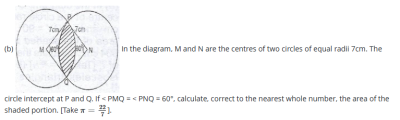
(b) In the diagram, M and N are the centres of two circles of equal radii 7cm. The circle intercept at P and Q. If < PMQ = < PNQ = 60^\circ, calculate, correct to the nearest whole number, the area of the shaded portion. [Take \(\pi = \frac{22}{7}\)].
Attached Figure / Diagram
medium Difficulty
Verified Correct Answer: Option
Step-by-Step Mathematical Solution
(a) \((x - 2)(x - 3) = 12\)
\(x^{2} - 3x - 2x + 6 = 12 \implies x^{2} - 5x + 6 - 12 = 0\)
\(x^{2} - 5x - 6 = 0\)
\(x^{2} - 6x + x - 6 = 0 \implies x(x - 6) + 1(x - 6) = 0\)
\( (x - 6)(x + 1) = 0 \implies \text{x = 6 or -1}\)
(b) The shaded portion comprises two shaded segments labelled A and B.
Area of segment A = \(\frac{60^\circ}{360^\circ} \times \pi r^{2} - \frac{1}{2} r^{2} \sin 60^\circ\)
\(\frac{1}{6} \times \frac{22}{7} \times 7 \times 7 - \frac{1}{2} \times 7 \times 7 \times 0.8660\)
= \(25.667 - 21.217\)
= \(4.45 cm^{2}\)
Also, the area of the segment B = \(4.45 cm^{2}\).
Hence, the area of the shaded portion = \(4.45 cm^{2} + 4.45 cm^{2}\)
= \(8.9 cm^{2}\)
\(\approxeq 9 cm^{2}\) (to the nearest whole number).
Source: Myschool Past Questions Archive (Record #52633)
Mathematics
WAEC / WASSCE 2014
Geometry and Trigonometry
Solution
(a) Given that \(5 \cos (x + 8.5)^\circ - 1 = 0, 0^\circ \leq x \leq 90^\circ\), calculate, correct to the nearest degree, the value of x.
(b) The bearing of Q from P is 0150^\circ and the bearing of P from R is 015^\circ. If Q and R are 24km and 32km respectively from P : (i) represent this information in a diagram;
(ii) calculate the distance between Q and R, correct to two decimal places ; (iii) find the bearing of R from Q, correct to the nearest degree.
medium Difficulty
Verified Correct Answer: Option
Step-by-Step Mathematical Solution
(a) \(5 \cos (x + 8.5)^\circ - 1 = 0\)
\(5 \cos (x + 8.5)^\circ = 1\)
\(\cos (x + 8.5)^\circ = \frac{1}{5} = 0.2\)
\((x + 8.5)^\circ = \cos^{-1}(0.2) = 78.463^\circ\)
\(x = 78.463^\circ - 8.5 = 69.963^\circ\)
\(\approxeq 70^\circ\) (to the nearest degree).
(b)(i)
(ii) By the cosine rule,
\(|QR|^{2} = 32^{2} + 24^{2} - 2 \times 32 \times 24 \times \cos 45\)
\(|QR|^{2} = 1024 + 576 - 1536 \cos 45\)
= \(1600 - 1086.1056\)
\(|QR|^{2} = 513.8944\)
\(|QR| = \sqrt{513.8944} = 22.669 km\)
\(\approxeq 22.67 km\) ( 2 decimal place)
(iii) By the sine rule,
\(\frac{32}{\sin \alpha} = \frac{22.67}{\sin 45}\)
\(\sin \alpha = \frac{32 \times \sin 45}{22.67}\)
= \(0.9981\)
\(\alpha = \sin^{-1} (0.9981) = 86.4787^\circ\)
The diagram below shows all the angles at Q;
The bearing of R from Q is given by the reflex angle NQR. Thus
reflex < NQR = 360^\circ - (86.47^\circ + 30^\circ) = 360^\circ - 116.47^\circ
= 243.53^\circ
Hence, the bearing of R from Q = 244^\circ (to the nearest degree).
Source: Myschool Past Questions Archive (Record #52641)
Mathematics
UTME / JAMB 2014
Geometry and Trigonometry
Solution
If the angle of a sector of a circle with radius 10.5 cm is 120^\circ, find the perimeter of the sector. [Take \(\pi = \frac{22}{7}\)]
A
48 cm
B
40 cm
C
43 cm
D
45 cm
medium Difficulty
Verified Correct Answer: Option C
Step-by-Step Mathematical Solution
Perimeter of the sector = \(2r + \frac{\theta}{360^\circ} \times 2\pi r\)
= \(2(10.5) + \frac{120}{360} \times 2 \times \frac{22}{7} \times 10.5\)
= \(21 + 22\)
= 43 cm
Source: Myschool Past Questions Archive (Record #54929)
Mathematics
WAEC / WASSCE 2013
Geometry and Trigonometry
Diagram
Solution
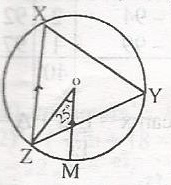
In the diagram, O is the centre of the circle. OM||XZ and < ZOM = 25º. Calculate ∠XYZ
Attached Figure / Diagram
A
50o
B
55o
C
60o
D
65o
medium Difficulty
Verified Correct Answer: Option D
Step-by-Step Mathematical Solution
Angle in a semi-circle is 90º when OM is subtended
: (90 - 25)º
= 65º
Source: WAEC / JAMB / NECO Classroom Archive (Record #36922)
Mathematics
WAEC / WASSCE 2013
Geometry and Trigonometry
Diagram
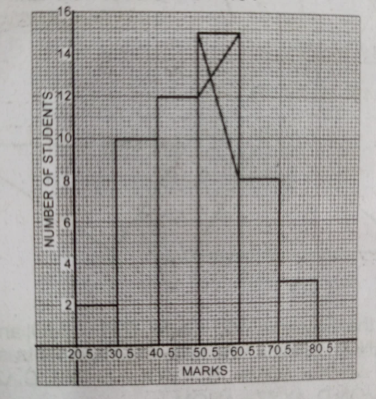
Using the histogram, what is the median class?
Attached Figure / Diagram
A
60.5 - 70.5
B
50.5 - 60.5
C
40.5 - 50.5
D
30.5 - 40.5
medium Difficulty
Verified Correct Answer: Option C
Step-by-Step Mathematical Solution
No expanded working has been attached for this question yet. The verified answer is Option C.
Source: WAEC / JAMB / NECO Classroom Archive (Record #36924)
Mathematics
UTME / JAMB 2013
Geometry and Trigonometry
Solution
Calculate the time taken for N3000 to earn N600 if invested at 8% simple interest
A
2\(\frac{1}{2}\) years
B
3 years
C
3\(\frac{1}{2}\) years
D
1\(\frac{1}{2}\) years
medium Difficulty
Verified Correct Answer: Option A
Step-by-Step Mathematical Solution
Using \(S.I =\frac{P \times T \times R}{100}\)
\(600 =\frac{3000 \times T \times 8}{100}\)
\(T =\frac{600 \times 100}{3000 \times 8}\)
\(\frac{20}{8}\)
= 2\(\frac{1}{2}\) years
Source: Myschool Past Questions Archive (Record #27041)
Mathematics
UTME / JAMB 2013
Geometry and Trigonometry
Solution
If S = \(\sqrt{t^2 - 4t + 4}\), find t in terms of S
A
S2 - 2
B
S + 2
C
S - 2
D
S2 + 2
medium Difficulty
Verified Correct Answer: Option B
Step-by-Step Mathematical Solution
S = \(\sqrt{t^2 - 4t + 4}\)
S2 = t2 - 4t + 4
t2 - 4t + 4 - S2 = 0
Using \(t = \frac{-b \pm \sqrt{b^2 - 4ac}}{2a}\)
Substituting, we have;
Using \(t = \frac{-(-4) \pm \sqrt{(-4)^2 - 4(1)(4 - S^2)}}{2(1)}\)
\(t = \frac{4 \pm \sqrt{16 - 4(4 - S^2)}}{2}\)
\(t = \frac{4 \pm \sqrt{16 - 16 + 4S^2}}{2}\)
\(t = \frac{4 \pm \sqrt{4S^2}}{2}\)
\(t = \frac{2(2 \pm S)}{2}\)
Hence t = 2 + S or t = 2 - S
Source: Myschool Past Questions Archive (Record #27046)
Mathematics
UTME / JAMB 2013
Geometry and Trigonometry
Solution
If y = x sin x, find \(\frac{\delta y}{\delta x}\)
A
sin x - cos x
B
cos x - x sin x
C
cos x + x sin x
D
sin x + x cos x
medium Difficulty
Verified Correct Answer: Option D
Step-by-Step Mathematical Solution
y = x sin x
Where u = x and v = sin x
Then \(\frac{\delta u}{\delta x}\) = 1 and \(\frac{\delta v}{\delta x}\) = cos x
By the chain rule, \(\frac{\delta y}{\delta x} = v\frac{\delta u}{\delta x} + u\frac{\delta v}{\delta x}\)
= (sin x)1 + x cos x
= sin x + x cos x
Source: Myschool Past Questions Archive (Record #27058)
Mathematics
UTME / JAMB 2013
Geometry and Trigonometry
Solution
The radius of a circle is increasing at the rate of 0.02cms-1. Find the rate at which the area is increasing when the radius of the circle is 7cm.
A
0.75cm2S-1
B
0.53cm2S-1
C
0.35cm2S-1
D
0.88cm2S-1
medium Difficulty
Verified Correct Answer: Option D
Step-by-Step Mathematical Solution
A = \(\pi\)r2, \(\frac{\delta A}{\delta r}\) = 2πr
So, using \(\frac{\delta A}{\delta t}\) = \(\frac {\delta A}{\delta r}\) x \(\frac {\delta A}{\delta t}\)
= 2\(\pi\)r x 0.02
= 2\(\pi\) x 7 x 0.02
= 2 x \(\frac{22}{7}\) x 0.02
= 0.88cm2s-1
Source: Myschool Past Questions Archive (Record #27084)
Mathematics
UTME / JAMB 2013
Geometry and Trigonometry
Solution
The mean of seven numbers is 10. If six of the numbers are 2, 4, 8, 14, 16 and 18, find the mode.
A
6
B
8
C
14
D
2
medium Difficulty
Verified Correct Answer: Option B
Step-by-Step Mathematical Solution
Using x = \(\frac{\sum x}{N}\) in each case, we get;
\(\sum_{6}^{i=1} x_i\) = 10 x 7 = 70
\(\sum_{7}^{i=1} x_i\) = 2 + 4 + 8 + 14 + 16 + 18 = 62
Hence the missing number can be obtained from
\(\sum_{6}^{i=1} x_i - \sum_{7}^{i=1} x_i\) = 70 - 62 = 8
So, all the seven numbers are 2, 4, 8, 8, 14, 16, 18
Mode = 8
Source: Myschool Past Questions Archive (Record #27108)
Mathematics
UTME / JAMB 2013
Geometry and Trigonometry
Solution
If the variance of 3+x, 6, 4, x and 7-x is 4 and the mean is 5, find the standard deviation
A
\(\sqrt{3}\)
B
2
C
3
D
\(\sqrt{2}\)
medium Difficulty
Verified Correct Answer: Option B
Step-by-Step Mathematical Solution
Let \(\delta^2\) and \(\delta\) denote the variance and standard deviation of the distribution respectively.
But \(\delta^2\) = 4 (given)
Hence \(\delta\) = \(\sqrt{4}\) = 2
Source: Myschool Past Questions Archive (Record #27116)
Mathematics
UTME / JAMB 2013
Geometry and Trigonometry
Diagram
Solution
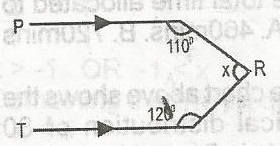
The value x in the figure given is
Attached Figure / Diagram
A
110o
B
100o
C
70o
D
130o
medium Difficulty
Verified Correct Answer: Option D
Step-by-Step Mathematical Solution
Sum of the angles in a triangle = 180^\circ
180^\circ - x + 60 + 70 = 180
130^\circ - x = 180^\circ - 180^\circ = 0^\circ
x = 130^\circ
Source: Myschool Past Questions Archive (Record #33153)
Mathematics
UTME / JAMB 2013
Geometry and Trigonometry
Diagram
Solution
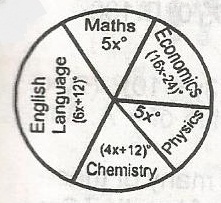
The pie chart above shows the statistical distribution of 80 students in five subjects in an examination. Calculate how many student offer Mathematics.
Attached Figure / Diagram
A
30
B
11
C
50
D
20
medium Difficulty
Verified Correct Answer: Option B
Step-by-Step Mathematical Solution
5x^\circ + (16x - 24)^\circ + 5x^\circ + (4x + 12)^\circ + (6x + 12)^\circ = 360^\circ
36x^\circ - 24 + 12 + 12 = 360^\circ
36x^\circ = 360^\circ
x^\circ = \(\frac{360^\circ}{36}\)
= 10^\circ
Thus, the angle of sector representing Mathematics is 5 x 10^\circ = 50^\circ. Hence the number of students who offer mathematics is
\(\frac{50}{360} \times 80 \approx 11\)
Source: Myschool Past Questions Archive (Record #33155)