Question Library
Browse, filter, and study verified past examination questions with step-by-step mathematical reasoning.
Searching 18,000+ Questions...
Sifting topics, KaTeX formulas & verified solutions
Showing 346–360 of 573 verified questions
Sort by:
Mathematics
UTME / JAMB 1999
Algebra
Solution
Given that Q = \(\begin{pmatrix} 6 & 0 \\ 4 & 5 \end{pmatrix}\) and Q + P = \(\begin{pmatrix} 7 & -2 \\ 6 & 8 \end{pmatrix}\). Evaluate | Q + 2P|.
A
90
B
96
C
102
D
120
medium Difficulty
Verified Correct Answer: Option D
Step-by-Step Mathematical Solution
Q + 2P = Q + 2(Q + P - Q) = 2(Q + P) - Q
Q + P = \(\begin{pmatrix} 7 & -2 \\ 6 & 8 \end{pmatrix}\)
2(Q + P) = \(\begin{pmatrix} 14 & -4 \\ 12 & 16 \end{pmatrix}\)
Q + 2P = 2(Q + P) - Q = \(\begin{pmatrix} 14-6 & -4-0 \\ 12-4 & 16-5 \end{pmatrix} = \begin{pmatrix} 8 & -4 \\ 8 & 11 \end{pmatrix}\)
Determinant: |Q + 2P| = 8 \(\times\) 11 - (-4)\(\times\) 8 = 88 + 32 = 120.
Source: Myschool Past Questions Archive (Record #10416)
Mathematics
WAEC / WASSCE 1999
Algebra
Solution
Amina had m mangoes. She ate 3 and shared the remainder equally with her brother Uche. Each had at least 10. Which of the following inequalities represents the statements above.
A
\(\frac{m}{2}-3\le 10\)
B
\(\frac{m}{2}-3\ge 10\)
C
\(\frac{m-3}{2}\ge10\)
D
\(\frac{m-3}{2}\le10\)
medium Difficulty
Verified Correct Answer: Option C
Step-by-Step Mathematical Solution
Total number of mangoes = m
Amina ate 3 mangoes \(\implies\) Remainder = m - 3
Shared equally with Uche \(\implies \frac{m - 3}{2}\)
\(\frac{m - 3}{2} \geq 10\)
Source: Myschool Past Questions Archive (Record #26411)
Mathematics
WAEC / WASSCE 1999
Algebra
Diagram
Solution
Which of the following pairs of inequalities is represented on the number line?
Attached Figure / Diagram

A
\(x<-2 and x\ge1\)
B
\(x\ge -2 and x>1\)
C
\(x\le -2 and x\ge1\)
D
\(x1\)
medium Difficulty
Verified Correct Answer: Option C
Step-by-Step Mathematical Solution
the line graph shows that \(x\le -2\) and \(x\ge1\)
Source: Myschool Past Questions Archive (Record #26412)
Mathematics
WAEC / WASSCE 1999
Algebra
Solution
The root of a quadratic equation in x, are -m and 2n. Find the equation
A
\(x^2 + x(m - 2n)-2mn=0\)
B
\(x^2 - x(m - 2n)-2mn=0\)
C
\(x^2 - x(m - 2n)+2mn=0\)
D
\(x^2 + x(m - 2n)+2mn=0\)
medium Difficulty
Verified Correct Answer: Option A
Step-by-Step Mathematical Solution
x = -m \(\implies\) x + m = 0;
x = 2n \(\implies\) x - 2n = 0.
\(\implies (x + m)(x - 2n) = 0\)
\(x^2 + mx - 2nx - 2mn = 0\)
\(x^2 + x(m - 2n) - 2mn = 0\)
Source: Myschool Past Questions Archive (Record #26414)
Mathematics
WAEC / WASSCE 1999
Algebra
Solution
Solve the inequality 2x + 3 < 5x
A
\(x>1\)
B
\(x<\frac{3}{7}\)
C
\(x>\frac{3}{7}\)
D
\(x>-1\)
medium Difficulty
Verified Correct Answer: Option A
Step-by-Step Mathematical Solution
2x + 3 < 5x
3 < 3x
\(\frac{3}{3}\) < x
1 < x
x > 1
Source: Myschool Past Questions Archive (Record #26416)
Mathematics
UTME / JAMB 1999
Algebra
Diagram
Solution
In the figure, TZ is tangent to the circle QPZ. Find x if TZ = 6 units and PQ = 9 units
Attached Figure / Diagram
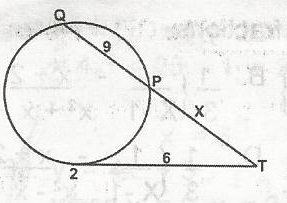
A
3
B
4
C
5
D
6
medium Difficulty
Verified Correct Answer: Option A
Step-by-Step Mathematical Solution
In \(\bigtriangleup\)WOP, b2 = r2 - (4.502...........(i)
In \(\bigtriangleup\)WOT, b\(\bigtriangleup\) + (4.5 + x)2 = a2...........(ii)
In \(\bigtriangleup\)ZOT, a2 = 62 + r2 ..........(iii)
subst. equation (iii) and (i) in eqn (ii)
r2 - (4.5)2 + (4.5 + x)2 = 36 = 20.25
= (4.5 + x)2 = \(\sqrt{56.25}\) = (4.5 + x)
= 56.25
= 4.5 + x = 7.5
x = 3.0m
x =
Source: Myschool Past Questions Archive (Record #33087)
Mathematics
WAEC / WASSCE 1999
Algebra
Solution
(a) Solve the simultaneous equations 3y - 2x = 21 ; 4y + 5x = 5.
(b) Six identical cards numbered 1 - 6 are placed face down. A card is to be picked at random. A person wins $60.00 if he picks the card numbered 6. If he picks any of the other cards, he loses $10.00 times the number on the card. Calculate the probability of (i) losing ; (ii) losing $20.00 after two picks.
medium Difficulty
Verified Correct Answer: Option
Step-by-Step Mathematical Solution
(a) \(3y - 2x = 21 ... (1)\)
\(4y + 5x = 5 .... (2)\)
Multiply (1) by 4 and (2) by 3 so we have,
\(12y - 8x = 84 ... (3)\)
\(12y + 15x = 15 ... (4)\)
(3) - (4) : \(-8x - 15x = 69 \implies -23x = 69\)
\(x = \frac{69}{-23} = -3\)
Put x = -3 in (1),
\(3y - 2(-3) = 21\)
\(3y + 6 = 21 \implies 3y = 21 - 6 = 15\)
\(y = \frac{15}{3} = 5\)
\(x, y = -3, 5\).
(b)(i) Probability of losing
Probability of winning = \(\frac{1}{6}\)
\(\therefore\) Probability of losing = \(1 - \frac{1}{6} = \frac{5}{6}\).
(ii) Losing $20.00 after two picks = picking the card numbered 1 twice.
= \(\frac{1}{6} \times \frac{1}{6} = \frac{1}{36}\)
Source: Myschool Past Questions Archive (Record #54420)
Mathematics
WAEC / WASSCE 1999
Algebra
Solution
(a) Copy and complete the following table of values for \(y = 9 \cos x + 5 \sin x\) to one decimal place.
x
0^\circ
30^\circ
60^\circ
90^\circ
120^\circ
150^\circ
180^\circ
210^\circ
y
10.3
-0.2
-5.3
-10.3
(b) Using a scale of 2cm to 30^\circ on the x- axis and 2 cm to 1 unit on the y- axis, draw the graph of \(y = 9 \cos x + 5 \sin x\) for \(0^\circ \leq x \leq 210^\circ\).
(c) Use your graph to solve the equation: (i) \(9\cos x + 5\sin x = 0\); (ii) \(9\cos x+ 5\sin x = 3.5\), correct to the nearest degree.
(d) Find the maximum value of y correct to one decimal place.
medium Difficulty
Verified Correct Answer: Option
Step-by-Step Mathematical Solution
x
0^\circ
30^\circ
60^\circ
90^\circ
120^\circ
150^\circ
180^\circ
210^\circ
y
9
10.3
8.8
5
-0.2
-5.3
-9
-10.3
(b)
(c)(i) From the graph, \(9\cos x + 5\sin x = 0 \implies x = 119^\circ\)
(d) Maximum value of y = 10.3.
Source: Myschool Past Questions Archive (Record #54428)
Mathematics
UTME / JAMB 1999
Algebra
Solution
If \(\frac{^6C_r}{^6P_r}\) = \(\frac{1}{6}\), find the value of r.
A
1
B
3
C
5
D
6
medium Difficulty
Verified Correct Answer: Option B
Step-by-Step Mathematical Solution
Given: \(\frac{^6C_r}{^6P_r} = \frac{1}{6}\)
Recall the formulas:
\(^nC_r = \frac{n!}{r!(n-r)!}, \quad ^nP_r = \frac{n!}{r!}\)
Substitute \( n = 6 \):
\(\frac{^6C_r}{^6P_r} = \frac{\dfrac{6!}{r!(6-r)!}}{\dfrac{6!}{r!}} = \frac{6!}{r!(6-r)!} \times \frac{r!}{6!} = \frac{1}{(6-r)!}\)
So the equation simplifies to:
\(\frac{1}{(6-r)!} = \frac{1}{6}\)
Therefore: (6-r)! = 6
We know that 3! = 6, so:
6 - r = 3 \(\implies\) r = 3
Source: Myschool Past Questions Archive (Record #77196)
Mathematics
WAEC / WASSCE 1998
Algebra
Solution
Find the root of the equation 2x\(^2\) - 3x - 2 = 0
A
x = -2 or 1/2
B
x = -2 or1
C
x = -2 or 2
D
x = -1 or 2
E
x = -1/2 or 2
medium Difficulty
Verified Correct Answer: Option E
Step-by-Step Mathematical Solution
2x\(^2\) - 3x - 2 = 0
2x\(^2\) - 4x + x - 2 = 0
2x(x - 2) + 1(x - 2) = 0
(2x + 1)(x - 2) = 0
x = \(\frac{-1}{2}\) or x = 2
Source: Myschool Past Questions Archive (Record #22093)
Mathematics
WAEC / WASSCE 1998
Algebra
Solution
Find the equation whose roots are \(\frac{2}{3}and \frac{-1}{4}\)
A
\(12x^2-5x+2=0\)
B
\(12x^2-11x+2=0\)
C
\(x^2-\frac{11}{12}x+2=0\)
D
\(x^2+\frac{11}{12}x-2=0\)
E
\(12x^2+11x+2=0\)
medium Difficulty
Verified Correct Answer: Option A
Step-by-Step Mathematical Solution
x\(^2\) - (sum of given roots)x + (product of given roots ) = 0
x\(^2\) - (\(\frac{2}{3} + \frac{-1}{4}\))x + (\(\frac{2}{3} * \frac{-1}{4}\)) = 0
x\(^2\) - (\(\frac{8 - 3}{12}\))x + (\(\frac{- 2}{12}\))
x\(^2\) - \(\frac{5}{12}\)x + \(\frac{- 2}{12}\)
multiply through by the LCM 12
12 * x\(^2\) - 12 * \(\frac{5}{12}\)x + 12 * \(\frac{- 2}{12}\)
12x\(^2\) - 5x - 2 = 0
Source: WAEC / JAMB / NECO Classroom Archive (Record #26334)
Mathematics
WAEC / WASSCE 1998
Algebra
Solution
The nth term of a sequence is represented by 3 x 2(2-n). Write down the first three terms of the sequence
A
3/2, 3, 6
B
6, 3, 3/2
C
3/2, 3, 1/3
D
2/3, 3, 8/3
E
3/2, 0, 6
medium Difficulty
Verified Correct Answer: Option B
Step-by-Step Mathematical Solution
When n = 1, n = 2, n = 3
3 x 22 - 1 = 6
3 x 22 - 2 = 3
3 x 22 - 3 = 3/2
Source: Myschool Past Questions Archive (Record #23996)
Mathematics
WAEC / WASSCE 1998
Algebra
Solution
Solve the equation 5x2 - 4x - 1 = 0
A
-1, 1/5
B
-1, -1/5
C
1, 1/5
D
1, -1/5
E
-1, 5
medium Difficulty
Verified Correct Answer: Option D
Step-by-Step Mathematical Solution
5x2 - 4x - 1 = 0
5x2 5x + x -1 = 0
5x(x - 1) + (x - 1) = 0
(5x + 1)(x -1) = 0
x = -1/5 or 1 = 0
Source: Myschool Past Questions Archive (Record #24004)
Mathematics
WAEC / WASSCE 1998
Algebra
Solution
Make S the subject of the formula: \(V = \frac{K}{\sqrt{T-S}}\)
A
\(T-\frac{K^2}{V^2} = S\)
B
\(T+\frac{K^2}{V^2} = S\)
C
\(T-\frac{K^2}{V} = S\)
D
\(T-\frac{K}{V} = S\)
E
\(T-\frac{K}{V^2} = S\)
medium Difficulty
Verified Correct Answer: Option A
Step-by-Step Mathematical Solution
\(V = \frac{K}{\sqrt{T-S}}\)
square both sides of the equation
\(V^2 = \frac{K^2}{T-S}\)
cross multiply
\(V^2 (T - S) = K^2\)
\(T - S = \frac{K^2}{V^2}\)
\(T = \frac{K^2}{V^2} + S\)
\(T = \frac{K^2}{V^2} + S\)
Source: Myschool Past Questions Archive (Record #24079)
Mathematics
WAEC / WASSCE 1998
Algebra
Solution
Find (X-Y) if 4x - 3y = 7 and 3x - 2y = 5
A
4
B
3
C
2
D
-2
E
-3
medium Difficulty
Verified Correct Answer: Option C
Step-by-Step Mathematical Solution
We are given the following simultaneous equations:
\(4x - 3y = 7 \quad \text{(Equation 1)}\)
\(3x - 2y = 5 \quad \text{(Equation 2)}\)
To eliminate \(y\), we multiply Equation 1 by 2 and Equation 2 by 3:
\(2(4x - 3y) = 2(7) \implies 8x - 6y = 14 \quad \text{(Equation 3)}\)
\(3(3x - 2y) = 3(5) \implies 9x - 6y = 15 \quad \text{(Equation 4)}\)
Now we subtract Equation 3 from Equation 4:
\((9x - 6y) - (8x - 6y) = 15 - 14\)
\(x = 1\)
Substituting \(x = 1\) into Equation 2:
\(3(1) - 2y = 5\)
\(3 - 2y = 5\)
\(-2y = 2 \implies y = -1\)
Now we have \(x = 1\) and \(y = -1\). Thus,
\(X - Y = x - y = 1 - (-1) = 1 + 1 = 2\)
Therefore, the value of \(X - Y\) is: 2.
Source: Myschool Past Questions Archive (Record #26335)