Question Library
Browse, filter, and study verified past examination questions with step-by-step mathematical reasoning.
Searching 18,000+ Questions...
Sifting topics, KaTeX formulas & verified solutions
Showing 346–360 of 4910 verified questions
Sort by:
Mathematics
UTME / JAMB 2023
Areas of Plane Figures
Solution
Find the area, to the nearest cm\(^2\), of the triangle whose sides are in the ratio 2 : 3 : 4 and whose perimeter is 180 cm.
A
1162 cm\(^2\)
B
1163 cm\(^2\)
C
1160 cm\(^2\)
D
1161 cm\(^2\)
medium Difficulty
Verified Correct Answer: Option A
Step-by-Step Mathematical Solution
Let the length of the sides of triangle be 2x, 3x and 4x.
Perimeter of triangle = 180cm
⇒ \(2x +3x + 4x = 180\)
⇒ \(9x = 180\)
⇒ \(x = \frac{180}{9}\) = 20cm
Then the sides of the triangle are:
\(2x = 2\times20 = 40cm; 3x = 3\times20\) = 60cm and \(4x\) = 4\(\times20 \)= 80cm
Using Heron's formula
Area of triangle = \(\sqrt s(s-a)(s-b)(s-c)\)
Where s = \(\frac{a + b + c}{2}\)
Let a = 40cm, b = 60cm, c = 80cm and s = \(\frac{40 + 60 + 80}{2} = \frac{180}{2}\) = 90cm
⇒ A = \(\sqrt90 (90 - 40) (90 - 60) (90 - 80) = \sqrt90 \times 50 \times 30 \times 10 = \sqrt1350000\)
∴ A =1162cm\(^2\) (to the nearest cm\(^2)\)
Source: WAEC / JAMB / NECO Classroom Archive (Record #67366)
Mathematics
WAEC / WASSCE 2023
Areas of Plane Figures
Solution
The radius and height of a solid cylinder is 8 cm and 14 cm respectively. Find, correct to two d.p the total surface area.
(Take \(\pi = \frac{22}{7})\)
A
\(1,106.29cm^2\)
B
\(1,016.29cm^2\)
C
\(1,106.89cm^2\)
D
\(1,206.27cm^2\)
medium Difficulty
Verified Correct Answer: Option A
Step-by-Step Mathematical Solution
radius = 8cm , height = 14cm and \(\pi = \frac{22}{7}\)
total surface area of a solid cylinder =\( 2\pirh+2\pir^2\) = 2\pir( h + r )
\( 2 \times \frac{22}{7} \times 8( 8 + 14)\)
\( 2 \times \frac{22}{7} \times 8 \times 22\)
\(\frac{7744}{7}\)
= \(1,106.29cm^2\)
Source: WAEC / JAMB / NECO Classroom Archive (Record #69101)
Mathematics
UTME / JAMB 2023
Volumes of Solids
Diagram
Solution
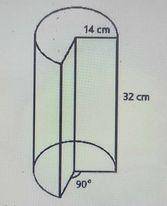
Find the volume of the cylinder above
[Take \(\pi= ^{22}/_7\)]
Attached Figure / Diagram
A
9,856 cm\(^3\)
B
14,784 cm\(^3\)
C
4,928 cm\(^3\)
D
19,712 cm\(^3\)
medium Difficulty
Verified Correct Answer: Option B
Step-by-Step Mathematical Solution
Volume of the cylinder = \(\frac{\theta}{360} \times \pi r^2h\)
\theta = 360\(^o\) - 90\(^o\) = 270\(^o\)
∴ Volume of the cylinder = \(\frac{270}{360} \times \frac{22}{7} \times \frac{14^2}{1} \times \frac{32}{1} = \frac{37,255,680}{2520} = 14,784cm^3\)
Source: WAEC / JAMB / NECO Classroom Archive (Record #67368)
Mathematics
UTME / JAMB 2023
Volumes of Solids
Diagram
Solution
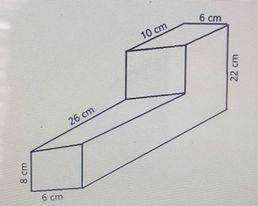
Find the volume of the composite solid above.
Attached Figure / Diagram
A
2048 cm\(^3\)
B
2568 cm\(^3\)
C
2672 cm\(^3\)
D
1320 cm\(^3\)
medium Difficulty
Verified Correct Answer: Option B
Step-by-Step Mathematical Solution
Volume of the composite solid = Volume of A + Volume of B
Volume of a cuboid = length x breadth x height
Volume of A = 6 x 26 x 8 = 1248 cm\(^3\)
Volume of B = 6 x 10 x 22 = 1320 cm\(^3\)
∴ Volume of the composite solid = 1248 + 1320 = 2568 cm\(^3\)
Source: WAEC / JAMB / NECO Classroom Archive (Record #67379)
Mathematics
UTME / JAMB 2023
Volumes of Solids
Solution
Find the volume of a cone which has a base radius of 5 cm and slant height of 13 cm.
A
\(300\pi\) cm\(^3\)
B
\(325\pi\) cm\(^3\)
C
\(\frac{325}{3}\pi\) cm\(^3\)
D
\(100\pi\) cm\(^3\)
medium Difficulty
Verified Correct Answer: Option D
Step-by-Step Mathematical Solution
Volume of a cone = \(\frac{1}{3}\pi r^2 h\)
r = 5 cm
l = 13 cm
Using Pythagoras theorem
⇒ \(13^2 = 5^2 + h^2\)
⇒ \(169 = 25 + h^2\)
⇒ \(169 - 25 = h^2\)
⇒ \(h^2 = 144\)
⇒ \(h = \sqrt144 = 12 cm\)
∴ Volume of the cone = \(\frac{1}{3} \times\pi\times 5^2 x 12 = 100\pi\) cm\(^3\)
Source: WAEC / JAMB / NECO Classroom Archive (Record #67392)
Mathematics
WAEC / WASSCE 2023
Volumes of Solids
Solution
The radius of a sphere is 3 cm. Find, in terms of π, its volume.
A
\(30\pi cm^3\)
B
\(108\pi cm^3\)
C
\(27\pi cm^3\)
D
\(36\pi cm^3\)
medium Difficulty
Verified Correct Answer: Option D
Step-by-Step Mathematical Solution
Given that radius = 3cm.
volume of sphere = \(\frac{4}{3}\times\pi\times r^3\)
= \(\frac{4}{3}\times\pi\times 3^3\)
= \(\frac{4}{3}\times\pi\times 27\)
= \(4\times\pi\times9\)
= \(36\pi cm^3\)
Source: WAEC / JAMB / NECO Classroom Archive (Record #69106)
Mathematics
WAEC / WASSCE 2023
Volumes of Solids
Solution
An empty cylindrical tank is 140 cm in diameter. If 200 litres of water was poured into the tank. Calculate, correct to the nearest centimeter, the height of the water in the tank. (\(Take \pi = \frac{22}{7})\)
A
91cm
B
7cm
C
13cm
D
57cm
medium Difficulty
Verified Correct Answer: Option C
Step-by-Step Mathematical Solution
given that diameter = 140cm ⇒radius = 70cm, volume of cylinder = 200litres = \(200,000cm^3\)
volume of cylinder = base area times height = \(\pi r^2h\)
\( 200,000cm^3 = \frac{22}{7} \times 70 \times 70 \times h\)
\(200,000 = \frac{107,800h}{7}\)
cross multiply
1,400,000 = 107,800h
\( h = \frac{1,400,000}{107,800}\)
= 13cm (to the nearest cm).
Source: WAEC / JAMB / NECO Classroom Archive (Record #69120)
Mathematics
UTME / JAMB 2023
Angles & Parallel Lines
Solution
The interior angle of a regular polygon is five times the size of its exterior angle. Identify the polygon.
A
dodecagon
B
enneadecagon
C
icosagon
D
hendecagon
medium Difficulty
Verified Correct Answer: Option A
Step-by-Step Mathematical Solution
An interior angle of a regular polygon = \(\frac{(2n-4)\times 90}{n}\)
An exterior angle of a regular polygon = \(\frac{360}{n}\)
\(\frac{(2n-4)\times 90}{n}\) =5 \(\times\) \(\frac{360}{n}\) (Given)
= (2n-4) x 90 = 5 x 360
= 180n - 360 = 1800
= 180n = 1800 + 360
= 180n = 2160
= n = \(\frac{2160}{180}\) = 12
The polygon has 12 sides which is dodecagon
Source: WAEC / JAMB / NECO Classroom Archive (Record #67253)
Mathematics
WAEC / WASSCE 2023
Angles & Parallel Lines
Diagram
Solution
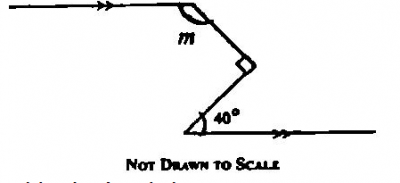
Find the value of m in the diagram above.
Attached Figure / Diagram
A
\(40^0\)
B
\(50^0\)
C
\(130^0\)
D
\(140^0\)
medium Difficulty
Verified Correct Answer: Option C
Step-by-Step Mathematical Solution
∠EHI = ∠DEH = 40^\circ (alternate angles are equal)
∠BEH = 90^\circ (given)
∠BED = 90^\circ - 40^\circ = 50^\circ
∠BEF = 180^\circ - 50^\circ = 130^\circ (sum of angles on a straight line is 180o)
∠BEF = ∠ABE = 130^\circ (alternate angles are equal)
∴ m = 130^\circ
Source: WAEC / JAMB / NECO Classroom Archive (Record #69172)
Mathematics
WAEC / WASSCE 2023
Triangles and Polygons
Solution
The interior angle of a regular polygon is 6 times its exterior angle find the number of sides of the polygon.
A
12
B
15
C
10
D
14
medium Difficulty
Verified Correct Answer: Option D
Step-by-Step Mathematical Solution
each interior angle of a polygon = \(\frac{(n - 2)\times 180}{n}\) where n = no of side of a polygon
each exterior angle of a polygon = \(\frac{360}{n}\)
then \(\frac{(n - 2)\times 180}{n}\) = 6\(\times\) \(\frac{360}{n}\)
= (n - 2) 180 = 2160
= 180n - 360 = 2160
= 180n = 2160 + 360
= 180n = 2520
therefore, n = \(\frac{2520}{180}\) = 14.
Source: WAEC / JAMB / NECO Classroom Archive (Record #69037)
Mathematics
UTME / JAMB 2023
Geometric Construction
Solution
The locus of a point equidistant from two intersecting lines is
A
where the sum of the distances of two focal points is fixed
B
the collection of points that are equally distant from a fixed point and a line
C
the perpendicular bisector of the lines
D
pair of bisectors of the angles between the two lines
medium Difficulty
Verified Correct Answer: Option D
Step-by-Step Mathematical Solution
The locus of a point equidistant from two intersecting lines is pair of bisectors of the angles between the two lines.
Source: WAEC / JAMB / NECO Classroom Archive (Record #67332)
Mathematics
UTME / JAMB 2023
Coordinate Geometry
Solution
Find the value of t, if the distance between the points P(–3, –14) and Q(t, –5) is 9 units.
A
3
B
2
C
- 3
D
- 2
medium Difficulty
Verified Correct Answer: Option C
Step-by-Step Mathematical Solution
Let the given points be:
P(-3, -14) = (x\(_1\), y\(_1\))
Q(t, -5) = (x\(_2\), y\(_2\))
PQ = 9 units (given)
Using the distance formula,
d = \sqrt [ \((x_2 - x_1)^2 + (y_2 - y_1)^2\)]
PQ = \sqrt [ \((t - (-3))^2 + (-5 + 14)^2\)]
\(\implies\) \sqrt [ \((t + 3)^2 + 81\)] = 9
Squaring on both sides,
⇒ (t + 3)\(^2\) + 81 = 81
⇒ (t + 3)\(^2\) = 0
⇒ t + 3 = 0
∴ t = -3
Source: WAEC / JAMB / NECO Classroom Archive (Record #67263)
Mathematics
UTME / JAMB 2023
Coordinate Geometry
Solution
Find the equation of straight line passing through (2, 3) and perpendicular to the line \(3x + 2y + 4 = 0\)
A
3y = 5x - 2
B
y = \(\frac {5}{3} \times - 2\)
C
None of these
D
3y = 2x + 5
medium Difficulty
Verified Correct Answer: Option D
Step-by-Step Mathematical Solution
\(3x + 2y + 4 = 0\)
Rearrange:
\(2y = -3x - 4\)
Divide both sides by 2
y = \(\frac {-3 \times - 4}{2}\)
y = \(\frac {-3}{2} \times - 2\)
∴ the gradient of the line 3x + 2y + 4 = 0 is \(\frac {-3}{2}\)
If two lines are perpendicular to each other ∴ \(m_1 x m_2\) = -1
Let \(m_1 = \frac {-3}{2} \therefore m_2 = \frac {-1}{m_1} = \frac {-1}{-3/2} = \frac {2}{3}\)
From the equation of a line which is given as m = \(\frac {y - y_1}{x - x_1} where (x_1, y_1) = (2,3)\)
\(\therefore \frac {2}{3} = \frac {y - 3}{x - 2}\)
=3(y - 3) = 2(x - 2)
=3y - 9 = 2 x -4
=3y = 2 x -4 + 9
∴ 3y = 2x + 5
Source: WAEC / JAMB / NECO Classroom Archive (Record #67273)
Mathematics
UTME / JAMB 2023
Coordinate Geometry
Solution
The line \(3y + 6x\) = 48 passes through the points A(-2, k) and B(4, 8). Find the value of k.
A
16
B
20
C
8
D
-2
medium Difficulty
Verified Correct Answer: Option B
Step-by-Step Mathematical Solution
The line: \(3y + 6x\) = 48
Divide through by 3
⇒ y + 2\(x\) = 16
⇒ y = -2\(x\) + 16
∴ The gradient of the line = -2
The points: A(-2, k) and B (4, 8)
m =\(\frac{y2 - y1}{x2 - x1} = \frac{8 - k}{4 - (-2)}\)
⇒ m =\(\frac[8 - k}{4 + 2} = {8 - k}{6}\)
Since the line passes through the points
∴ -2 = \(\frac{8 - k}{6}\)
⇒ \(\frac{-2}[1} = \frac{8 - k]{6}\)
⇒ 8 - k = -12
⇒ k = 8 + 12
∴ k = 20
Source: WAEC / JAMB / NECO Classroom Archive (Record #67386)
Mathematics
WAEC / WASSCE 2023
Coordinate Geometry
Solution
A line L passing through the point (6, -13) is parallel to the line which passes through (7, 4) and (-3, 9). Find the equation of the line L.
A
y = \(\frac{1}{2}x - 10\)
B
y = \(\frac{-1}{2}x + 10\)
C
y = \(\frac{-1}{2}x - 10\)
D
y = \(\frac{1}{2}x +10\)
medium Difficulty
Verified Correct Answer: Option C
Step-by-Step Mathematical Solution
(7, 4) and (-3, 9) = (\( y_1 , x_1)(y_2 , x_2)\)
slope\( m_1\) of the points(7, 4) and (-3, 9) = \(\frac{ y_2 - y_1}{ x_2 - x_1}\)
\( m_1 = \frac{ 9 - 4}{ -3 - 7} = \frac{5}{-10} = \frac{-1}{2}\)
\( m_1 = m_2\) ( condition for parallelism)
Since the line L passes through the point (6, -13) and is parallel to the points (7, 4) and (-3, 9)
\(\frac{-1}{2} = \frac{ y - (- 13)}{x - 6}\)
= \(\frac{-1}{2} = \frac{ y + 13}{x - 6}\)
= \(\frac{-1}{2}( x - 6) = y + 13\)
\(\frac{-1}{2}x + 3 = y + 13\)
= \(\frac{-1}{2}x + 3 - 13 = y\)
∴ y = \(\frac{-1}{2}x - 10\)
Source: WAEC / JAMB / NECO Classroom Archive (Record #69141)