Question Library
Browse, filter, and study verified past examination questions with step-by-step mathematical reasoning.
Searching 18,000+ Questions...
Sifting topics, KaTeX formulas & verified solutions
Showing 331–345 of 1709 verified questions
Sort by:
Physics
WAEC / WASSCE 2016
Mechanics and Properties of Matter
The electricity meters in houses measure energy unit consumed in
A
kilowatt-hour
B
volt
C
ampere
D
coulomb
medium Difficulty
Verified Correct Answer: Option A
Physical Principles & Numerical Solution
No expanded working has been attached for this question yet. The verified answer is Option A.
Source: Myschool Past Questions Archive (Record #45659)
Physics
WAEC / WASSCE 2016
Mechanics and Properties of Matter
Solution
A man and his friend have masses 70kg and 60kg respectively. If they are seated 1.0m apart, calculate the gravitational force of attraction between them. (G = 6.67 x 10⁻¹¹ Nm2 kg-2)
A
1.59 x 10⁻¹⁴ N
B
2.80 x 10⁻⁷ N
C
1.30 x 10⁻² N
D
6.30 x 10¹³ N
medium Difficulty
Verified Correct Answer: Option B
Physical Principles & Numerical Solution
F = \(\frac{GM_1M_}{r^2}\)
= \(\6.67 \times 10^{-11} \times 70 \times 60}{1^2}\)
= 2.8014 x 10⁻⁷ N
Source: Myschool Past Questions Archive (Record #45662)
Physics
WAEC / WASSCE 2016
Mechanics and Properties of Matter
Solution
A 10\(\mu\)C charge moves with a velocity of 1.0 x 10⁵ ms-1 at right angle to a uniform magnetic field of flux density 5.0 x 10⁻⁴T. Calculate the force on the charge
A
5.0 x 10⁻⁵N
B
5.0 x 10⁻⁴N
C
5.0 x 10⁵N
D
5.0 x 10⁶N
medium Difficulty
Verified Correct Answer: Option B
Physical Principles & Numerical Solution
F = qvB
= 10 x 10-6 x 1.0 x 105 x 10-4
= 5.0 x 10⁻⁴N
Source: Myschool Past Questions Archive (Record #45678)
Physics
WAEC / WASSCE 2016
Mechanics and Properties of Matter
The phenomenon by which two light atomic nuclear combine to form a heavy nuclide with the release of energy is known as
A
radioactivity
B
nuclear fusion
C
nuclear fission
D
chain reaction
medium Difficulty
Verified Correct Answer: Option B
Physical Principles & Numerical Solution
No expanded working has been attached for this question yet. The verified answer is Option B.
Source: Myschool Past Questions Archive (Record #45691)
Physics
WAEC / WASSCE 2016
Mechanics and Properties of Matter
Let \(\Delta\)x be the uncertainty in the measurements of position and \(\Delta\)p the uncertainty in measurement of momentum. The uncertainty principle relation is given as
A
\(\Delta\)x . \(\Delta\)p = h
B
\(\Delta\)x . \(\Delta\)p \(\leq\) = h
C
\(\Delta\)x . \(\Delta\)p \(\geq\) = h
D
\(\Delta\)x . \(\Delta\)p > h
medium Difficulty
Verified Correct Answer: Option C
Physical Principles & Numerical Solution
No expanded working has been attached for this question yet. The verified answer is Option C.
Source: Myschool Past Questions Archive (Record #45693)
Physics
WAEC / WASSCE 2016
Mechanics and Properties of Matter
Solution
State the dimension of; (a) impulse; (ii) acceleration; (iii) work
medium Difficulty
Verified Correct Answer: Option
Physical Principles & Numerical Solution
Quality
Dimensions
a) Impulse
b) Acceleration
c) Work
MLT\(^{-1}\)
LT\(^{-2}\)
ML\(^2\)T\(^{-2}\)
Source: Myschool Past Questions Archive (Record #52943)
Physics
WAEC / WASSCE 2016
Mechanics and Properties of Matter
Solution
A projectile is fired with a velocity of 20 ms\(^{-1}\) at an angle of 40^\circ to the horizontal. Determine the components of the velocity of the projectile at its maximum height.
medium Difficulty
Verified Correct Answer: Option
Physical Principles & Numerical Solution
The components of velocity at maximum height are:
Vy = 0
Vx = UCos \(\theta\) = 20 Cos 40^\circ
=15.32ms\(^{-1}\)
Source: Myschool Past Questions Archive (Record #52946)
Physics
WAEC / WASSCE 2016
Mechanics and Properties of Matter
Solution
An electron enters perpendicularly into a uniform magnetic field which has a flux density of 0.12 T This results in a magnetic force of 9.6 x 10\(^{-2}\) N on the electron. Calculate the speed of the electron as it enters the magnetic field. (e =1.6 x \(10^{19}\) C)
medium Difficulty
Verified Correct Answer: Option
Physical Principles & Numerical Solution
F = evB sin \(\theta\)
V = \(\frac{F}{evB sin \theta} = \frac{9.6 \times 10^{12}}{1.6 \times 10^{-19} \times 0.12 sin 90^o}\)
= \(\frac{9.6 \times 10^{-12}}{1.6 x 10^{-19} \times 0.12 \times 1}\)
= 5.0 x 10\(^8 ms{-1}\)
Source: Myschool Past Questions Archive (Record #52948)
Physics
WAEC / WASSCE 2016
Mechanics and Properties of Matter
Solution
List three uses of rockets.
medium Difficulty
Verified Correct Answer: Option
Physical Principles & Numerical Solution
Uses rockets are:
— for space travel
— for space exploration
— for warfare
— for launching of artificial satellites into orbits
— for entertainment, that is fireworks
Source: Myschool Past Questions Archive (Record #52949)
Physics
WAEC / WASSCE 2016
Mechanics and Properties of Matter
Solution
(a) Explain the term net force.
(b) Define the principle of conservation of linear momentum and state one example of it.
(c) A ball of mass 200 g released from a height of 2.0 m hits a horizontal floor and rebounds to a height of 1.8 in. Calculate the impulse received by the floor. (g = 10 ms\(^{-2}\)).
(d) A body of mass 20 g performs a simple harmonic motion at a frequency of 5 Hz. At a distance of 10 cm from the mean position, its velocity is 200 cms\(^{-1}\). Calculate its:
(i) maximum displacement from the mean position;
(ii) maximum velocity;
(iii) maximum potential energy. (g = 10 ms\(^{-2}\) \(\pi\) = 3.14)
medium Difficulty
Verified Correct Answer: Option
Physical Principles & Numerical Solution
(a) Net force is the effective or resultant force resulting from the actions of a system of forces on a body.
(b) The principle ofconservation of linear momentum explains that in an isolated or closed system of colliding bodies the total linear momentum in a fixed direction remains constant, e.g. the recoil of gun, colliding trolleys, rocket propulsion, etc.
(c) V\(_1^2\) = \(U_1^2 + 2gh_1\) = 0 + 2 x 10 x 2
= 40
\(V_1 = \sqrt{40}\) = 6.325m/s
\(v_2^2 = u_2^2 - 2gh_2\)
O = \(U^2_2\) - 2 x 10 x 1.8
u = \(\sqrt{36}\)
= 6ms\(^{-1}\)
Impulse Change in momentun
mv\(_1\) - (-mu\(_2\)) = m (v\(_1\) + u\(_2\))
= 0.2(6.325 + 6.000)
= 2.46 Ns
(d) v = \(\omega \sqrt{r^2 - y^2}\)
2\(\pi\)f\(\sqrt{r^2 - y^2}\)
2 = 2 x 3.14 x 5 x \(\sqrt{r^2 - 0.1^2}\)
r = 0.12m
(ii) Vmax = \(\omega\)r = 2\(\pi\)fr
= 2 x 3.142 x 5 x 0.12
= 3,77 m/s
(iii) P.E = \(\frac{1}{2}m \omega^2e^2 = \times \frac{1}{2}m(2 \pi f)^2r^2\)
= \(\frac{1}{2} \times 0.02(2 \times 3.142 \times 5)^2 \times (0.12)^2\)
= 1.42 x 10\(^{-1}J\)
Source: Myschool Past Questions Archive (Record #52952)
Physics
WAEC / WASSCE 2016
Mechanics and Properties of Matter
Solution
(a) Explain the terms:
(i) thermal equilibrium;
(ii) fundamental interval.
(b) List two uses of the hydraulic press.
(c) Name the material used to reset the steel index in the Six's maximum and minimum thermometer.
(d)(i) A nursing mother prepared her baby's milk mixture at 85^\circC, in a feeding bottle. In order to cool it to 40^\circC, she immersed the bottle in an aluminium bowl of heat capacity 90 JK\(^{-1}\) containing 500 g of water at 26^\circC. If the mass of the mixture is 300g, calculate the specific heat capacity of the mixture. [Neglect heat losses and heat capacity of the bottle; specific heat capacity of water = 4200 J kg\(^{-1}\) K\(^{-1}\)]
(ii) (\(\alpha\)) Name two ways through which the bottle losses heat.
(\(\beta\)) Name two industrial processes in which heat exchanger is used.
medium Difficulty
Verified Correct Answer: Option
Physical Principles & Numerical Solution
(a)(i) Thermal equilibrium is a condition in which two bodies in contact have no net flow of heat between them.
(ii) Fundamental interval is the difference in temperature between the lower fixed point, i.e. temperature of melting ice at standard atmospheric pressure and that upper fixed point, i.e. temperature of steam at standard atmospheric pressure.
(b) Uses of hydraulic press are:-
-Compressing metal sheets;
-Compressing soft materials into bales;
-Compressing paper in printing industries;
-Lifting of objects.
(c) The material used to reset the steel index in the six's maximum and minimum thermometer is magnet.
(d)(i) Heat lost by mixture = Heat gained by water + Heat gained by aluminium.
M\(_mC_w\Delta \theta_m\) + C\(_a\Delta\theta_a\)
0.3 x C\(_m\) x (85 - 40) = 0.5 x 4200 (40 - 26) + 90 (40 - 26)
13.5 C\(_m\) = 29400 + 1260
C\(_m\) = \(\frac{30660}{13.5}\)
= 2271.1 Jkg\(^{-1}\)K\(^{-1}\)
(ii) (\(\alpha\)) The bottle losses heat through conduction and convection. (\(\beta\)) Heat exchanger in: Incubation, refriaeration, air-conditioning, sewage treatment, cooling byradiators, generation of electricity, etc.
Source: Myschool Past Questions Archive (Record #52953)
Physics
WAEC / WASSCE 2016
Mechanics and Properties of Matter
Solution
(a) Explain the following terms:
(i) mass defect;
(ii) binding energy of a nucleus.
(b)(i) Assuming the wave nature of an electron, what is the effect of decreasing the speed of a photoelectron on its; (\(\alpha\)) wavelength? (\(\beta\)) energy?
(ii) A particle of friasS 4.4 x 10\(^{-23}\) kg moves with a velocity of 10\(^5\)ms\(^{-1}\). Calculate its wavelength. (h = 6.6 x 10\(^{-34}\) Js)
The diagram above shows part of a radioactive decay series. Use it to answer the following questions.
(i) Name a pair of isotopes.
(ii) Name the isotopes with which the series starts.
(iii) Write down a nuclear equation for two ekgmples of each of: (\(\alpha\)) alpha decay; (\(\beta\)) beta decay.
medium Difficulty
Verified Correct Answer: Option
Physical Principles & Numerical Solution
(a)(i) Mass defect is the difference between the mass of a nucleus and the total mass of its nucleons. It expressed in atomic mass unit (a.m.u.). It is also a measure of binding energy.
Mass defect = total mass of nucleus
– mass of nucleons.
(ii) Binding energy is the work done or energy needed to separate the nucleons in a nucleus. It is measured in eV or Joules (J).
(b)(i) The effect of decreasing the speed of a photoelectron on: (\(\alpha\)) wavelength --> wavelength increases. (\(\beta\)) energy ---> energy decreases.
(ii) \(\lambda = \frac{h}{mv}\)
= \(\frac{6.6 \times 10^{-34}}{4.4 \times 10^{-2} \times 10^{-16}}\)m
(c) Pairs of isotopes in the figure are;
\(^{208}_{82}Pb\) and \(^{212}_{82}Pb\) or \(^{212}_{84}Po\) and \(^{216}_{84}Po\) or
\(^{224}_{88}Ra\) and \(^{288}_{88}Ra\) or \(^{288}_{90}Th\) and \(^{232}_{90}Th\)
(ii) The series started with isotopes \(^{232}_{90}Th\)
(iii) Nuclear equation for;
\(\alpha\)Alpha decay
\(^{232}_{90}Th\) \(\to\) \(^{228}_{88}Ra\) + \(^{4}_{2}He\) + Energy;
\(^{228}_{90}Th\) \(\to\) \(^{22}_{88}Ra\) + \(^{4}_{2}He\) + Energy;
\(^{224}_{88}Ra\) \(\to\) \(^{220}_{86}Rn\) + \(^{4}_{2}He\) + Energy;
\(^{212}_{84}Po\) \(\to\) \(^{208}_{82}Pb\) + \(^{4}_{2}He\) + Energy;
\(^{216}_{84}Po\) \(\to\) \(^{212}_{82}Pb\) + \(^{4}_{2}He\) + Energy;
\(^{212}_{84}Rn\) \(\to\) \(^{208}_{82}Po\) + \(^{4}_{2}He\) + Energy;
\(^{220}_{84}Rn\) \(\to\) \(^{216}_{84}Po\) + \(^{4}_{2}He\) + Energy;
\(^{216}_{84}Rn\) \(\to\) \(^{212}_{82}Pb\) + \(^{4}_{2}He\) + Energy;
(\(\beta\)) Beta decay
\(^{224}_{88}Ra\) \(\to\) \(^{224}_{89}Ac\) + \(^{o}_{-1}e\) + Energy;
\(^{228}_{88}Ac\) \(\to\) \(^{228}_{90}Ac\) + \(^{o}_{-1}e\) + Energy;
\(^{212}_{82}Pb\) \(\to\) \(^{212}_{83}Bi\) + \(^{o}_{-1}e\) + Energy;
\(^{212}_{83}Ra\) \(\to\) \(^{212}_{84}Ac\) + \(^{o}_{-1}e\) + Energy;
Source: Myschool Past Questions Archive (Record #52956)
Physics
WAEC / WASSCE 2016
Mechanics and Properties of Matter
Diagram
Solution
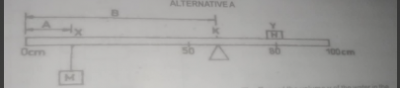
You are provided with a uniform metre rule, a knife-edge, some masses and other necessary materials.
i. Determine and record the centre of gravity of the metre rule.
ii. Fix the 100g mass marked N at a point Y, the 80cm mark of the rule using a sellotape.
iii. Suspend another 50g mass marked M at X, a distance A = 1Ocm from the 0cm mark of the rule.
iv. Balance the arrangement horizontally on the knife edge as illustrated in the diagram above.
v. Measure and record the distance B of a knife-edge from the 0cm mark of the rule.
vi. Repeat the procedure for four other values of A =15cm, 20cm, 25cm and 30cm.
vii. Tabulate your readings.
viii. Plot a graph with B on the vertical axis and A on the horizontal axis.
ix. Determine the slope, s, of the graph.
x. Also determine the intercept, c, on the vertical axis.
xi. Evaluate:
\(\propto\)) = \(k_1\) = (\(\frac{1 - 2s}{s}\))100
(\(\beta\)) = \(k_2\) = \(\frac{2c}{s}\) = 160
xii. State two precautions taken to obtain accurate results.
(b)i. Define the moment of a force about a point.
ii. State two conditions under which a rigid body at rest remains in equilibrium when acted upon by non-parallel coplanar forces.
Attached Figure / Diagram
medium Difficulty
Verified Correct Answer: Option
Physical Principles & Numerical Solution
S/N
A/cm
B/cm
1.0
10.0
54.00
2.0
15.0
55.00
3.0
20.0
56.00
4.0
25.0
57.00
5.0
30.0
57.00
6.0
35.0
58.00
Slope (s) = \(\frac{\bigtriangleup {B}}{\bigtriangleup {A}}\) = \(\frac{B_{2} - B_{1}}{A_{2} - A_{1}}\)
= \(\frac{59 - 53}{30 - 0} = \frac{6}{30}\) = \(\frac{1}{6}\)
= 0.2
Intercept C on the vertical axis
C = 53
Evaluate (a) \(k_1\) = [\(\frac{1 - 2S}{S}\)]100
= (\(\frac{1 - 2 \times 0.2}{0.2}\)) 100
= (\(\frac{1 - 0.4}{0.2}\))100
\(k_1\) = \(\frac{0.6}{0.2}\) 100
= 300
\(k_2\) = \(\frac{2C}{S}\) - 160
= \(\frac{2 \times 52}{0.2}\) - 160
= \(\frac{106}{0.2}= \frac{1060}{2}\) = 530 - 160
= 370
Precautions;
- Avoided draught
- Ensured mass did not touch/rest on the table.
- Avoided error due to parallax on the metre rule.
- Noted zero error on metre rule.
- Repeated readings (shown on the table).
(b)i. The moment of a force about a point is defined as the product of the force and the perpendicular distance from the point to the line of action of the force.
ii. Conditions of rigid bodies in equilibrium;
1. The resultant of the forces in a given direction must be zero/the algebraic sum of resolved components in a given direction must be zero/the vector sum of all the points must = 0
2. The algebraic sum of the moments about any point is zero.
3. The forces must be concurrent or meet at a point.
Source: Myschool Past Questions Archive (Record #59939)
Physics
WAEC / WASSCE 2016
Mechanics and Properties of Matter
Solution
You are provided with a variable d.c. power supply E, a 2\(\propto\) standard resistor, a key, an ammeter, a voltmeter and other necessary materials.
i. Set up a circuit as shown in the diagram above with E= 1.5V
ii. Close the key k.
iii. Take and record the voltmeter reading V.
iv. Take and record the corresponding ammeter reading l.
v. Evaluate V\(^{-1}\) and l\(^{-1}\)
vi. Repeat the procedure for four other values of E= 3.0V, 4.5V, 6.0V, and 7.4V.
vii. Tabulate your readings.
viii. Plot a graph with V\(^{-1}\) on the vertical axis and l\(^{-1}\) on the horizontal axis starting both axes from the origin (0, 0).
ix. Determine the slope, s, of the graph.
x. Also determine the intercept, e, on the vertical axis.
xi. State two precautions taken to obtain accurate results.
(b)i. State two methods by which an electric current can be produced.
ii
Calculate the value of R in the circuit diagram shown above, given that the effective resistance of the circuit is 4.0\(\Omega\) and the internal resistance of the cell is negligible.
medium Difficulty
Verified Correct Answer: Option
Physical Principles & Numerical Solution
S/N
E/v
I/A
V/V
\(\frac{1}{V}\)/V\(^{1}\)
l\(^{-1}\)/A\(^{-1}\)
1
1.5
0.30
0.80
1.250
3.333
2
3.0
0.50
0.40
0.717
2.000
3
4.5
0.70
2.00
0.500
1.429
4
6.0
0.90
2.50
0.400
1.111
5
7.5
1.10
3.00
0.333
0.909
Slope = \(\frac{\bigtriangleup {V}^{-1}}{\bigtriangleup {I}^{-1}}\) = \(\frac{V_{2}^{-1} - V_{1}^{-1}}{I_{2}^{-1} - I_{1}^{-1}}\)
= \(\frac{3.333 - 0.800}{1.24 - 0.26}\)
= \(\frac{2.53}{0.98}\) = 2.6
Intercept C = 0.04
Precaution;
- Ensured clean terminals/tight connections
- Key removed after taking each reading/key removed
- when reading was not being taken.
- Avoided parallax error on Voltmeter/Ammeter Noted/corrected zero error on voltmeter/ammeter
- Repeated readings (shown on the table)
(b) Production of electric current e.g. use of
- Cells (accumulators/simple cells) fuel cells (chemical energy)
- Generators/dynamos/electromagnetic induction (mechanical)
- Solar cells/photocells
- Windmills
- Tidal waves
- Geothemal/thermal
- Gas turbines
- Hydro power
- Nuclear power
- Thermocouple/thermopile/themionic (heat energy)
- Piezo electric generators
- Electrostatic generator (e.g Van de graff generator)
ii. \(\frac{1}{Re}\) = \(\frac{1}{R1} + \frac{1}{R2}\)
= \(\frac{1}{R} + \frac{1}{R} = \frac{2}{R}\)
Re = \(\frac{R}{2}\)
RT = \(\frac{R}{2}\) + 2 = 4
\(\frac{R}{2}\) = 4 - 2 = 2
R = 4\(\Omega\)
Source: Myschool Past Questions Archive (Record #59950)
Physics
UTME / JAMB 2015
Mechanics and Properties of Matter
Solution
If the volume of a gas is recorded as 76cm3 at a temperature of 27^\circC with a pressure of 800mmHg. What will be the volume of the gas at S.T.P?
A
36.2cm3
B
25.7cm3
C
72.8cm3
D
24.3cm3
medium Difficulty
Verified Correct Answer: Option C
Physical Principles & Numerical Solution
Using the general gas laws:
\(\frac{P_1V_1}{T_1} = \frac{P_2V_2}{T_2}\)
P\(_1\) = 800mmHg, V\(_1\) = 76cm\(^3\), T\(_1\) = 273 + 27 = 300k
P\(_2\) = 760mmHg, V\(_2\) = ? T\(_2\) = 273 + 0 = 273 (@ STP)
\(\frac{800 \times 76}{300} = \frac{760 \times V_2}{273}\)
V\(_2 = \frac{800 \times 76 \times 273}{300 \times 760}\) = 72.8cm\(^3\)
Therefore, the volume of gas at S.T.P = 72.8 cm\(^3\)
Source: Myschool Past Questions Archive (Record #40761)