Question Library
Browse, filter, and study verified past examination questions with step-by-step mathematical reasoning.
Searching 18,000+ Questions...
Sifting topics, KaTeX formulas & verified solutions
Showing 331–345 of 5315 verified questions
Sort by:
Physics
UTME / JAMB 2024
Current Electricity
Solution
A cell of internal resistance of 2\(\Omega\) supplies current through a resistor, X if the efficiency of the cell is 75%, find the value of X.
A
2\(\Omega\)
B
4\(\Omega\)
C
6\(\Omega\)
D
8\(\Omega\)
medium Difficulty
Verified Correct Answer: Option C
Physical Principles & Numerical Solution
The efficiency of a cell = \(\frac{\text{Ext. R}}{\text{Ext.R + int. r}}\) x 100
Ext. R = X
int. r = 2\(\Omega\)
Efficiency = 75% = 0.75
0.75 = \(\frac{\text{X}}{\text{X} + 2}\)
0.75( X + 2 ) = X
0.75x + 1.5 = X
0.25X = 1.5
X = \(\frac{1.5}{0.25}\) = 6\(\Omega\)
Source: WAEC / JAMB / NECO Classroom Archive (Record #70426)
Physics
UTME / JAMB 2024
Current Electricity
Solution
In electrolysis, when same quantity of electricity is passed through different electrolytes, mass of substances deposited is proportional to
A
Molecular weight
B
Chemical equivalent
C
Atomic number
D
Chemical equivalent per valency
medium Difficulty
Verified Correct Answer: Option B
Physical Principles & Numerical Solution
Faraday's second law states that the masses of different substances deposited or liberated by the same quantity of electricity are directly proportional to the chemical equivalents of the substances.
Source: WAEC / JAMB / NECO Classroom Archive (Record #70436)
Physics
UTME / JAMB 2024
Current Electricity
Solution
The capacitance of a capacitor, C, is inversely proportional to
A
area of the plate
B
dielectric substance
C
distance between plate
D
direction of the plate
medium Difficulty
Verified Correct Answer: Option C
Physical Principles & Numerical Solution
The capacitance of a capacitor, C, is inversely proportional to:
Distance between plates: Capacitance decreases as the distance increases.
Source: WAEC / JAMB / NECO Classroom Archive (Record #70492)
Physics
UTME / JAMB 2024
Current Electricity
Diagram
Solution
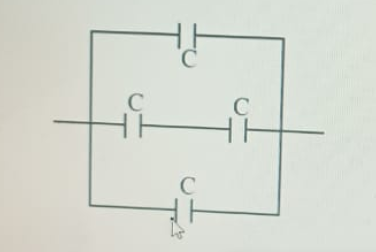
The equivalent capacitance of the capacitors in the circuit above
Attached Figure / Diagram
A
\(\frac{5}{2}\)C
B
4C
C
\(\frac{3}{2}\)C
D
2C
medium Difficulty
Verified Correct Answer: Option A
Physical Principles & Numerical Solution
Capacitance in parallel = one at the top + one under = 2C
The two in the middle are in series = \(\frac{C}{2}\)
The equivalent capacitance of the capacitors in the circuit above = \(\frac{C}{2}\) + 2C = \(\frac{5}{2}\)C
Source: WAEC / JAMB / NECO Classroom Archive (Record #70664)
Physics
UTME / JAMB 2024
Current Electricity
Solution
The simple form of the lead acid accumulator often has a negative pole of
A
Zinc perioxide
B
Lead peroxide
C
Sulphuric acid
D
lead plate
medium Difficulty
Verified Correct Answer: Option D
Physical Principles & Numerical Solution
The simple form of the lead-acid accumulator typically has a negative pole made of lead (Pb). In this type of battery, the negative electrode is composed of spongy lead, while the positive electrode is made of lead dioxide (PbO\(_2\))
Source: WAEC / JAMB / NECO Classroom Archive (Record #70668)
Physics
UTME / JAMB 2024
Current Electricity
The efficiency of a cell with internal resistance of 2\(\Omega\) supply current to a 6\(\Omega\) resistor is
A
25%
B
50%
C
65%
D
75%
medium Difficulty
Verified Correct Answer: Option D
Physical Principles & Numerical Solution
No expanded working has been attached for this question yet. The verified answer is Option D.
Source: WAEC / JAMB / NECO Classroom Archive (Record #70673)
Physics
UTME / JAMB 2024
Current Electricity
Solution
An accumulator is 90% efficient. If it gives out 2700J of energy while discharging, how much energy does it take in?
A
3600J
B
3000J
C
3200J
D
2430J
medium Difficulty
Verified Correct Answer: Option B
Physical Principles & Numerical Solution
Efficiency = \(\frac{\text{ Output energy}}{\text{input energy}}\) x 100
Efficiency = 90% = 0.9, Output energy = 2700J
Input energy = \(\frac{2700}{0.9}\) = 3000J
Source: WAEC / JAMB / NECO Classroom Archive (Record #70681)
Physics
UTME / JAMB 2024
Current Electricity
Diagram
Solution
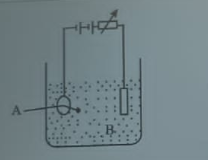
Find the amount of current required to deposit 0.02kg of metal in a given electrolysis for 120 seconds. [electro chemical equivalent of the metal = 1.3 x 10\(^{-7}\)kgC\(^{-1}\)]
Attached Figure / Diagram
A
7.8 x 10\(^{-4}\)A
B
7.8 x 10\(^{-2}\)A
C
1.3 x 10\(^3\)A
D
1.3 x 10\(^5\)A
medium Difficulty
Verified Correct Answer: Option C
Physical Principles & Numerical Solution
mass of metal deposited during electrolysis = Zit
Given: mass = 0.02kg, i, t = 120s and Z = 1.3 x 10\(^{-7}\)kgC\(^{-1}\)]
i = \(\frac{\text{m}}{\text{Zt}}\)
i = \(\frac{0.02}{1.3 \times 10^{-7} \times 120}\) = 1282.05 ≈ 1.3 x 10\(^3\)A
Source: WAEC / JAMB / NECO Classroom Archive (Record #70695)
Physics
UTME / JAMB 2024
Current Electricity
Solution
An example of a non-rechargeable cell is
A
nickel iron
B
mercury cadmium
C
dry leclanche
D
lead-acid
medium Difficulty
Verified Correct Answer: Option C
Physical Principles & Numerical Solution
Dry Leclanché: This is a common non-rechargeable cell.
Source: WAEC / JAMB / NECO Classroom Archive (Record #70697)
Physics
WAEC / WASSCE 2024
Current Electricity
Solution
The capacitance of a parallel plate capacitor
A
decreases when the temperature between the plates decreases
B
increases when the potential difference between the plates is increased
C
is greater without a dielectric between the plates than with dielectric
D
is greater with dielectric between the plates than without dielectric.
medium Difficulty
Verified Correct Answer: Option D
Physical Principles & Numerical Solution
When a dielectric is placed between the plates, it increases the capacitance by reducing the electric field and allowing more charge to be stored.
Source: WAEC / JAMB / NECO Classroom Archive (Record #72015)
Physics
WAEC / WASSCE 2024
Current Electricity
Solution
The function of a fuse in an electric circuit is to
A
break the circuit when the current exceeds a certain value
B
save energy by reducing voltage
C
ensure that the current in the circuit exceeds a certain value
D
save energy by reducing the current
medium Difficulty
Verified Correct Answer: Option A
Physical Principles & Numerical Solution
When the current flowing through the fuse exceeds its rated value, the fuse element melts, breaking the circuit and preventing further flow of electricity. This helps prevent overheating and potential fires.
Source: WAEC / JAMB / NECO Classroom Archive (Record #72027)
Physics
WAEC / WASSCE 2024
Current Electricity
Solution
To convert a milli-ammeter to an ammeter, a resistor of low value is necessary to connect a resistor of
A
low value in series with it
B
high value in series with it
C
low value in parallel with it
D
high value in parallel with it
medium Difficulty
Verified Correct Answer: Option C
Physical Principles & Numerical Solution
To change a milliammeter to an ammeter, a low resistance known as shunt must be connected to it in parallel.
Source: WAEC / JAMB / NECO Classroom Archive (Record #72038)
Physics
WAEC / WASSCE 2024
Current Electricity
Solution
The depolarizing agent in a Leclanché cell is
A
powdered carbon.
B
manganese (IV) oxide.
C
carbon rod.
D
ammonium.
medium Difficulty
Verified Correct Answer: Option B
Physical Principles & Numerical Solution
The depolarizing agent in a Leclanché cell is manganese dioxide (MnO\(_2\)). This compound helps to reduce the polarization effect and improves the efficiency of the cell during operation.
Source: WAEC / JAMB / NECO Classroom Archive (Record #72062)
Physics
WAEC / WASSCE 2024
Current Electricity
Diagram
Solution
ALTERNATIVE B
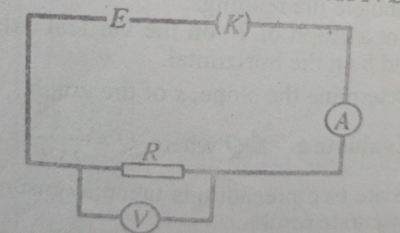
(a) You are provided with a variable DC power supply E, a key, an ammeter, a voltmeter and other necessary materials
(i) Set up a circuit as shown in the diagram above with E = 3.0V
(ii) Close the key.
(iii) Record the voltmeter reading, V
(iv) Read the corresponding ammeter reading, I
(v) Evaluate V\(^{-1}\) and I\(^{-1}\)
(vi) Repeat the procedure for the four other values of E = 4.5V, 6.0V, 7.5V and 9.0V.
(vii) Tabulate your readings.
(viii) Plot a graph with I\(^{-1}\) on the vertical axis and V\(^{-1}\) on the horizontal axis starting with both axes from the origin. (0, 0)
(ix) Determine the slope, s of the graph.
(x) Also, determine the intercept, c on the vertical axis
(xi) What does the slope, s represent?
(xii) State two precautions taken to ensure accurate results.
(b) State two methods by which an electric current can be produced
(i) State Ohm's law.
Attached Figure / Diagram
medium Difficulty
Verified Correct Answer: Option
Physical Principles & Numerical Solution
(vii)
E(V)
V(V)
I(A)
V\(^{-1}\)(V\(^{-1}\))
I\(^{-1}\)(I\(^{-1}\))
3.00
2.86
1.43
0.350
0.699
4.50
4.28
2.14
0.234
0.467
6.00
5.70
2.86
0.175
0.350
7.50
7.14
3.57
0.140
0.280
9.00
8.57
4.28
0.117
0.234
(viii) SEE THE GRAPH ABOVE
(ix) Slope = \(\frac{\Delta I^{-1}}{\Delta V^{-1}}\) = \(\frac{0.6 - 0.3}{0.3 - 0.15}\) = \(\frac{0.3}{0.15}\) = 2
(x) Intercept, c = 0.01
(xi) Slope, s represents external resistance of the circuit
(xii) I. I ensured tight connections II. I avoided error due to parallax on the ammeter/voltmeter
b(i) I. Use of cell II. hydropower
(ii) Ohm's law states that the current passing through a metallic conductor is directly proportional to the potential difference applied at both ends provided temperature remains constant.
Source: WAEC / JAMB / NECO Classroom Archive (Record #72109)
Physics
UTME / JAMB 2024
Energy and Power
Diagram
Solution
The value of R required to make the galvanometer measure voltage up to 40V in the diagram above
Attached Figure / Diagram

A
1885\(\Omega\)
B
1990\(\Omega\)
C
1995\(\Omega\)
D
1100\(\Omega\)
medium Difficulty
Verified Correct Answer: Option B
Physical Principles & Numerical Solution
To find the value of R required to make the galvanometer measure up to 40 V, we can use the following formula for a series circuit involving a galvanometer
V = I ( R + r )
R = \(\frac{\text{V}}{\text{I}}\) - r
where R = resistance in series = ?, V = total voltage = 40V, I = current through galvanometer = 20Am = 0.02A and r = internal resistance = 10\(\Omega\)
R = \(\frac{40}{0.02}\) - 10
R = 2000 - 10 = 1990\(\Omega\)
Source: WAEC / JAMB / NECO Classroom Archive (Record #70364)