Question Library
Browse, filter, and study verified past examination questions with step-by-step mathematical reasoning.
Searching 18,000+ Questions...
Sifting topics, KaTeX formulas & verified solutions
Showing 331–345 of 4910 verified questions
Sort by:
Mathematics
UTME / JAMB 2023
Binary Operations
Solution
Let '*' and '^' be two binary operations such that a * b = a\(^2\)b and a ^ b = 2a + b. Find (-4 * 2) ^ (7 * -1).
A
-49
B
64
C
113
D
15
medium Difficulty
Verified Correct Answer: Option D
Step-by-Step Mathematical Solution
Given that, a * b = a\(^2\)b and a ^ b = 2a + b
(-4 * 2) = (-4)\(^2\) x 2 = 16 x 2 = 32
(7 * -1) = 7\(^2\) x (-1) = 49 x (-1) = -49
∴ (-4 * 2) ^ (7 * -1) = 2(32) + (-49) = 64 - 49 = 15
Source: WAEC / JAMB / NECO Classroom Archive (Record #67245)
Mathematics
UTME / JAMB 2023
Binary Operations
Solution
Let a binary operation '*' be defined on a set A. The operation will be commutative if
A
a*b = b*a
B
(a*b)*c = a*(b*c)
C
(b ο c)*a = (b*a) ο (c*a)
D
None of the above
medium Difficulty
Verified Correct Answer: Option A
Step-by-Step Mathematical Solution
A binary operation '*' defined on a set A is said to be commutative only if a*b=b*a, ∀a, b∈A.
If (a*b)*c=a*(b*c), then the operation is said to associative ∀ a, b∈ A.
If (b ο c)*a=(b*a) ο (c*a), then the operation is said to be distributive ∀ a, b, c ∈ A.
Source: WAEC / JAMB / NECO Classroom Archive (Record #67302)
Mathematics
UTME / JAMB 2023
Mensuration
Solution
A rectangle has one side that is 6 cm shorter than the other. The area of the rectangle will increase by 68 cm\(^2\) if we add 2 cm to each side of the rectangle. Find the length of the shorter side.
A
15 cm
B
19 cm
C
13 cm
D
21 cm
medium Difficulty
Verified Correct Answer: Option C
Step-by-Step Mathematical Solution
Let the length of the longer side = \(x\) cm
∴ The length of the shorter side = (\(x\) - 6) cm
If we increase each side's length by 2 cm, it becomes
(\(x\) + 2) cm and (\(x\) - 4) cm respectively
Area of a rectangle = L x B
\(A_1 = x(x - 6) = x^2 - 6x\)
\(A_2 = (x + 2)(x - 4) = x^2 - 4x + 2x - 8 = x^2 - 2x - 8\)
\(A_1 + 68 = A_2\) (Given)
⇒ \(x^2 - 6x + 68 = x^2 - 2x - 8\)
⇒ \(x^2 - x^2 - 6x + 2x\) = -8 - 68
⇒ -4\(x\) = -76
⇒ \(x\) = \(\frac{-76}{-4}\) = 19cm
∴ The length of the shorter side = \(x\) - 6 = 19 - 6 = 13 cm
Source: WAEC / JAMB / NECO Classroom Archive (Record #67383)
Mathematics
UTME / JAMB 2023
Mensuration
Diagram
Solution
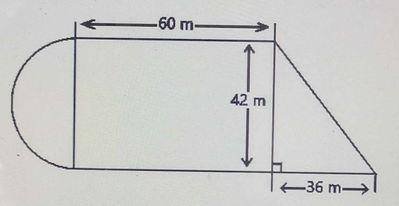
Calculate the area of the composite figure above.
Attached Figure / Diagram
A
6048 m\(^2\)
B
3969 m\(^2\)
C
4628 m\(^2\)
D
5834 m\(^2\)
medium Difficulty
Verified Correct Answer: Option B
Step-by-Step Mathematical Solution
Area of the composite figure = Area of semi circle + Area of rectangle + Area of triangle
Area of semi circle = \(\frac{1}{2}\pi r^2 = \frac{1}{2}\times\pi\times\frac{d^2}{4} = \frac{1}{2}\times\frac{22}{7}\times\frac{42^2}{4} = 693 m^2\)
Area of rectangle = l x b = 42 x 60 =2520 m\(^2\)
Area of triangle = \(\frac{1}{2}\times b \times h = \frac{1}{2}\times 36 \times 42 = 756 m^2\)
∴ Area of the composite figure = 693 + 2520 + 756 = 3969 m\(^2\)
Source: WAEC / JAMB / NECO Classroom Archive (Record #67389)
Mathematics
UTME / JAMB 2023
Mensuration
Solution
The area of a trapezium is 200 cm\(^2\). Its parallel sides are in the ratio 2 : 3 and the perpendicular distance between them is 16 cm. Find the length of each of the parallel sides.
A
10 cm and 15 cm
B
8 cm and 12 cm
C
6 cm and 9 cm
D
12 cm and 18 cm
medium Difficulty
Verified Correct Answer: Option A
Step-by-Step Mathematical Solution
Area of trapezium = \(\frac{1}{2}(a + b) h\)
⇒ \(\frac{1}{2} (a + b)\times 16 = 200\)
⇒ 8(a + b) = 200
⇒ a + b = \(\frac{200}{8}\) = 25 -----(i)
⇒ a : b = 2 : 3
⇒ \(\frac{a}{b} = \frac{2}{3}\)
⇒ 3a = 2b
⇒ a = \(\frac{2b}{3}\) -------(ii)
Substitute \(\frac{2b}{3}\) for a in equation (i)
⇒ \(\frac{2b}{3}\) + b = 25
\(\frac{5b}{3}\) = 25
⇒ b = 25 \div \(\frac{5}{3} = 25\times\frac{3}{5} = 15cm\)
From equation (ii)
⇒ a = \(\frac{2 \times 15}{3} = 2\times5 = 10cm\)
∴ Lengths of each parallel sides are 10cm and 15cm
Source: WAEC / JAMB / NECO Classroom Archive (Record #67394)
Mathematics
UTME / JAMB 2023
Mensuration
Solution
The perimeter of an isosceles right-angled triangle is 2 meters. Find the length of its longer side.
A
2 - \(\sqrt2\)
B
-4 + 3\(\sqrt2\)
C
It cannot be determined
D
-2 + 2\(\sqrt2\) m
medium Difficulty
Verified Correct Answer: Option D
Step-by-Step Mathematical Solution
Perimeter of a triangle = sum of all sides
⇒ \(P = y + x + x = 2\)
⇒ \(y + 2x = 2\)
⇒ \(y= 2 - 2x\)-----(i)
Using Pythagoras theorem
\(y^2 = x^2 + x^2\)
⇒ \(y^2 = 2x^2\)
⇒ \(y = \sqrt2x^2\)
⇒ \(y = x\sqrt2\)-----(ii)
Equate \(y\)
⇒ \(2 - 2x = x\sqrt2\)
Square both sides
⇒ \((2 -2x) ^2 = (x\sqrt2)^2\)
⇒ \(4 - 8x + 4x^2 = 2x^2\)
⇒ \(4 - 8x + 4x^2 - 2x^2 = 0\)
⇒ \(2x^2 - 8x + 4 = 0\)
⇒ \(x = \frac{-(-8)\pm\sqrt(-8)^2 - 4\times2\times4}{2\times2}\)
⇒ \(x = \frac{8\pm\sqrt32}{4}\)
⇒ \(x = \frac{8\pm4\sqrt2}{4}\)
⇒ \(x = 2\pm\sqrt2\)
⇒ \(x = 2 + \sqrt2\) or \(2 - \sqrt2\)
∴ \(x = 2 - \sqrt2\) (for \(x\) has to be less than its perimeter)
∴ \(y = 2 - 2x = 2 - 2(2 - \sqrt2) = -2 + 2 \sqrt2\)
∴ The length of the longer side = -2 + 2\(\sqrt2\)m
Source: WAEC / JAMB / NECO Classroom Archive (Record #67397)
Mathematics
WAEC / WASSCE 2023
Mensuration
Solution
The angle of a sector of a circle of radius 3.4 cm is 115°. Find the area of the sector.
\((Take \pi = \frac{22}{7})\)
A
\(11.6cm^2\)
B
\(12.7cm^2\)
C
\(10.2cm^2\)
D
\(9.4cm^2\)
medium Difficulty
Verified Correct Answer: Option A
Step-by-Step Mathematical Solution
\(\theta = 115^\circ , radius = 3.4cm^2\)
Area of a sector = \(\frac{\theta}{360} \times \pi r^2\)
= \(\frac{115}{360} \times \frac{22}{7} \times 3.4\times 3.4\)
= \(\frac{29246.4}{2520}\)
= \(11.6cm^2\)
Source: WAEC / JAMB / NECO Classroom Archive (Record #68921)
Mathematics
WAEC / WASSCE 2023
Mensuration
Diagram
Solution
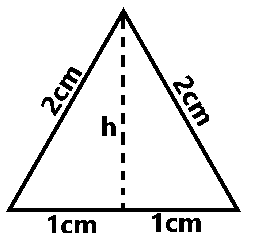
An equilateral triangle has a side 2 cm. Calculate the height of the triangle.
Attached Figure / Diagram
A
5cm
B
\(\sqrt5\)cm
C
3cm
D
\(\sqrt{ 3}\)cm
medium Difficulty
Verified Correct Answer: Option D
Step-by-Step Mathematical Solution
using Pythagoras theorem
H = \(\sqrt{ 2^2 - 1^2}\)
= \(\sqrt{ 4 - 1}\)
= \(\sqrt3\)cm
Source: WAEC / JAMB / NECO Classroom Archive (Record #69159)
Mathematics
WAEC / WASSCE 2023
Mensuration
Solution
The length of the diagonal of a square is 12 cm. Calculate the area of the square.
A
\(36 cm^2\)
B
\(48 cm^2\)
C
\(72 cm^2\)
D
\(18 cm^2\)
medium Difficulty
Verified Correct Answer: Option C
Step-by-Step Mathematical Solution
Let each side be l, then area = \(l^2\)
Using Pythagoras theorem
\(l^2 + l^2 = 12^2\)
\(2l^2 = 144\)
divide both sides by 2
\(l^2 = 72\)
Therefore, the Area of the square is \(72 cm^2\)
Source: WAEC / JAMB / NECO Classroom Archive (Record #69170)
Mathematics
WAEC / WASSCE 2023
Mensuration
Solution
The diagonals of a rhombus are 16 cm and 12 cm find the length of the side.
A
20cm
C
8cm
medium Difficulty
Verified Correct Answer: Option
Step-by-Step Mathematical Solution
In a rhombus, the diagonals are perpendicular bisectors of each other, and they bisect the angles of the rhombus. This means that a rhombus is essentially made up of four congruent right-angled triangles.
We can use the Pythagorean theorem to find the length of one side of the rhombus (s)
\(s^2 = 8^2 + 6^2\)
\(s^2 = 64 + 36\)
\(s^2 = 100\)
s = \(\sqrt{100}\)
s =10 cm
So, the length of each side of the rhombus is 10 cm.
Source: WAEC / JAMB / NECO Classroom Archive (Record #69176)
Mathematics
WAEC / WASSCE 2023
Mensuration
Diagram
Solution
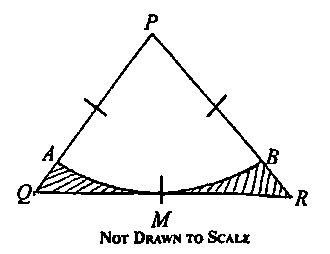
a. In the diagram above, PQR is an equilateral triangle of side 18 cm. M is the midpoint of QR. An arc of a circle with center P touches QR at M and meets PQ at A and PR at B. Calculate, correct to two decimal places, the area of the shaded region. (take \(\pi = \frac{22}{7})\)
Attached Figure / Diagram
medium Difficulty
Verified Correct Answer: Option
Step-by-Step Mathematical Solution
∆PQR is an equilateral triangle and M is the midpoint of Line QR. Hence, PM is the radius of the circle likewise Line PA and Line PB
Using Pythagoras theorem to find Line PM :
\( 18^2 = PM^2 + 9^2\)
\( PM^2 = 324 - 81 = 243\)
PM = \(\sqrt{243} = 9\sqrt{3}\)
∠QPR = \(\frac{180^0}{3} = 60^0\) ( each ∠ of an equilateral △ are equal)
Area of △,PQR = \(\frac{1}{2}absin\theta\), but \theta = 60^\circ
= \(\frac{1}{2}\times18\times18sin60 = 81\sqrt{3} = 140.30 cm^2\)
Area of PAB = \(\frac{\theta}{360} \times\pi r^2\)
= \(\frac{60}{360}\times \frac{22}{7} \times(9\sqrt{3})^2\)
= \(\frac{1}{6} \times \frac{22}{7} \times243\) = \(127.29cm^2\)
therefore, the Area of the shaded portion = area of △ PQR - area of sector PAB
= 140. 30 - 127.29 = \(13.01cm^2\) (to 2 d.p)
Source: WAEC / JAMB / NECO Classroom Archive (Record #69259)
Mathematics
WAEC / WASSCE 2023
Mensuration
Solution
a. Two regular polygons P and Q are such that the number of sides of P is twice the number of sides of Q. The difference between the exterior angle of P and Q is 45°.find the number of sides of p.
b. The area of a semi-circle is 32π \(cm^2\). Find, in terms of π, the circumference of the semi-circle.
medium Difficulty
Verified Correct Answer: Option
Step-by-Step Mathematical Solution
a. Let the number of sides of polygon Q be x
therefore, No. of sides of polygon P = 2x
then, \(\frac{360}{x} - \frac{360}{2x}\) = 45,
\(\frac{360}{x} - \frac{180}{x}\) = 45
L. C. M = x
360 - 180 = 45x
x = \(\frac{180}{4}\) = 4
therefore, the number of P polygon = 2x = 2 x 4 = 8
b. Area of semi-circle = \(\frac{\pi r^2}{2}\)
but Area of the semi-circle = 32\pi
\(\frac{\pi r^2}{2}\) = 32\pi
\(r^2 = 32\times2 = 64\)
\(r^2 = \sqrt{64}\) = 8cm.
Circumference of semi-circle = \pir + 2r
= \pi(8) + 2(8)
= 8\pi + 16
= 8(\pi + 2 ) cm
Source: WAEC / JAMB / NECO Classroom Archive (Record #69348)
Mathematics
WAEC / WASSCE 2023
Mensuration
Diagram
Solution
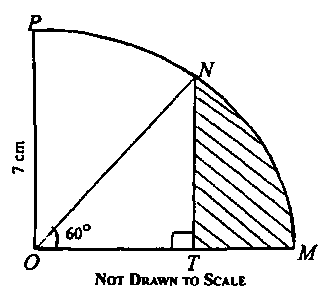
a. In the diagram above, the radius of the sector of circle centre O is 7 cm and ∠MON is 60°. Find, correct to one decimal place, the area of the shaded portion. (take \(\pi = \frac{22}{7})\)
b. The x and y intercepts of a straight line are \(\frac{-3}{4} and \frac{2}{7}\) respectively. Find the equation of the line.
Attached Figure / Diagram
medium Difficulty
Verified Correct Answer: Option
Step-by-Step Mathematical Solution
a. Area of sector MON = \(\frac{MON}{360} \times\pi r^2\)
= \(\frac{60}{360}\times\frac{22}{7}\times7^2\)
= \(\frac{77}{3}cm^2\)
\(\frac{NT}{7}\) = sin60^\circ
NT = 7sin60^\circ = \(7\times\frac{\sqrt{3}}{2}\) = \(7\times\frac{\sqrt{3}}{2}\)cm.
\(\frac{OT}{9} = cos60^0\)
OT = 7cos60^\circ = \(7\frac{1}{2}\)cm
Area of △ONT = \(\frac{1}{2}\times OT\times NT\)
= \(\frac{1}{2}\times\frac{7}{2}\times\frac{7\sqrt{3}}{2} = 49\sqrt{3}{8}cm^2\)
Area of shaded portion = Area of sector MON - Area of △ONT
= \(\frac{77}{3} - \frac{49\sqrt{3}}{8}\) = 25.67 - 10.61 = \(15.06cm^2\) = 15.1\(cm^2\)
b. Given : y = mx + c; hence ; x = \(\frac{ y - c }{ m } = \frac{ y }{ m } - \frac{ c }{ m }\)
x-intercept = \(\frac{ - c }{ m } = \frac{ - 3 }{ 4 }\)
Therefore, m = \(\frac{4}{3}\)c ....................... (1)
But y-intercept, c = \(\frac{2}{7}\)
Therefore, m = \(\frac{4}{3}\times\frac{2}{7} = \frac{8}{21}\)
Equation of straight: y = mx + c
y = \(\frac{8}{21}x + \frac{2}{7}\) OR 21y = 8x + 6 = 8x - 21y = - 6
Source: WAEC / JAMB / NECO Classroom Archive (Record #69350)
Mathematics
UTME / JAMB 2023
Lengths and Perimeters
Solution
Find the area and perimeter of a square whose length of diagonals is 20\(\sqrt2\) cm.
A
800 cm\(^2\), 80 cm
B
400 cm, 80 cm\(^2\)
C
80 cm, 800 cm\(^2\)
D
400 cm\(^2\), 80 cm
medium Difficulty
Verified Correct Answer: Option D
Step-by-Step Mathematical Solution
Using Pythagoras theorem
⇒ \((20\sqrt2)2 = x^2 + x^2\)
⇒ 800 = \(2x^2\)
⇒ 400 = \(x^2\)
⇒ x = \(\sqrt400\) = 20 cm
∴ Area of a square = \(x^2 = 20^2 = 400 cm^2\)
∴ Perimeter of a square = 4x = 4 x 20 = 80 cm
Source: WAEC / JAMB / NECO Classroom Archive (Record #67380)
Mathematics
UTME / JAMB 2023
Areas of Plane Figures
Solution
A rectangular plot of land has sides with lengths of 38 m and 52 m corrected to the nearest m. Find the range of the possible values of the area of the rectangle
A
1931.25 m\(^2\) ≤ A < 2021.25 m\(^2\)
B
1950 m\(^2\) ≤ A < 2002 m\(^2\)
C
1957 m\(^2\) ≤ A < 1995 m\(^2\)
D
1931.25 m\(^2\) ≥ A > 2021.25 m\(^2\)
medium Difficulty
Verified Correct Answer: Option A
Step-by-Step Mathematical Solution
The sides have been given to the nearest meter, so
51.5 m \le length < 52.5
37.5 m \le width < 38.5
Minimum area = 37.5 x 51.5 = 1931.25 m\(^2\)
Maximum area = 38.5 x 52.5 = 2021.25 m\(^2\)
∴ The range of the area = 1931.25 m\(^2\) \le A < 2021.25 m\(^2\)
Source: WAEC / JAMB / NECO Classroom Archive (Record #67364)