Question Library
Browse, filter, and study verified past examination questions with step-by-step mathematical reasoning.
Searching 18,000+ Questions...
Sifting topics, KaTeX formulas & verified solutions
Showing 331–345 of 29811 verified questions
Sort by:
Physics
UTME / JAMB 2025
Energy and Power
Solution
A refrigerator uses 150W. If it is kept on for 336 hours nonstop. What is the energy consumed in Kwh?
A
60.20Kwh
B
25.01Kwh
C
50.40Kwh
D
30.20Kwh
medium Difficulty
Verified Correct Answer: Option C
Physical Principles & Numerical Solution
C. 50.40Kwh
Convert power to kW (150 W = 0.15 kW), then multiply by time in hours: energy = 0.15 kW \times 336 h = 50.4 kWh.
Source: WAEC / JAMB / NECO Classroom Archive (Record #74555)
Physics
UTME / JAMB 2025
Energy and Power
Diagram
Solution
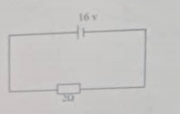
The electrical power developed in the resistor above is
Attached Figure / Diagram
A
8W
B
64W
C
128W
D
256W
medium Difficulty
Verified Correct Answer: Option C
Physical Principles & Numerical Solution
The circuit is a simple series circuit with a 16 V battery (or voltage source) directly connected across a 2 \Omega resistor.
The power (\(P\)) dissipated (developed) in the resistor is given by: \(P = \frac{V^2}{R}\)
where \(V = 16 \, \text{V}\) and \(R = 2 \, \Omega\).
Calculating the power: \(P = \frac{16^2}{2} = \frac{256}{2} = 128 \, \text{W}\)
Source: WAEC / JAMB / NECO Classroom Archive (Record #74679)
Physics
UTME / JAMB 2025
Simple Ac Circuit
Solution
In an A.C circuit, the instantaneous current is 7A. What is the root mean square(r.m.s) value of the current I\(_{r.m.s}\)
A
5A
B
6A
C
3A
D
4A
medium Difficulty
Verified Correct Answer: Option A
Physical Principles & Numerical Solution
For an A.C. current,
\(I_{\text{r.m.s}} = \frac{I_0}{\sqrt{2}}\)
where (I_0) is the maximum (peak) current.
Given (I_0 = 7,\text{A}),
\(I_{\text{r.m.s}} = \frac{7}{\sqrt{2}} \approx 4.95,\text{A}\)
Answer: \(4.95 \text{A}\ \ (\approx 5\ \text{A})\)
Source: WAEC / JAMB / NECO Classroom Archive (Record #74485)
Physics
UTME / JAMB 2025
Simple Ac Circuit
Diagram
Solution
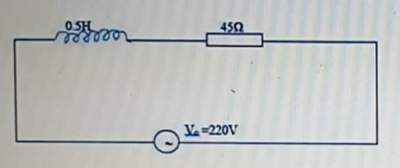
From the above circuit, calculate the impedance ((\(\pi\) = \(\frac{22}{7}\), f = 50Hz)
Attached Figure / Diagram
A
86.7\(\Omega\)
B
163.5\(\Omega\)
C
204.8\(\Omega\)
D
16.3\(\Omega\)
medium Difficulty
Verified Correct Answer: Option B
Physical Principles & Numerical Solution
Given: Inductance: \( L = 0.5 \, \text{H} \), Resistance: \( R = 45 \, \Omega \), Frequency: \( f = 50 \, \text{Hz} \)
inductive reactance \( X_L \): \(X_L = 2 \pi f L = 2 \times \frac{22}{7} \times 50 \times 0.5 = \frac{1100}{7} \approx 157.14 \, \Omega\)
The impedance \( Z \):
\(Z = \sqrt{R^2 + X_L^2} = \sqrt{(45)^2 + (157.14)^2} = \sqrt{2025 + 24642.82} \approx \sqrt{26667.82} \approx 163.5 \, \Omega\).
Source: WAEC / JAMB / NECO Classroom Archive (Record #74489)
Physics
WAEC / WASSCE 2025
Simple Ac Circuit
Solution
An alternating voltage with a frequency of 50 Hz has a period of
A
0.02 s
B
0.20 s
C
0.05 s
D
0.50 s
medium Difficulty
Verified Correct Answer: Option A
Physical Principles & Numerical Solution
The period of a wave is the reciprocal of its frequency.
Therefore, period = \(\frac{1}{\text{frequency}}\)
Substituting the given frequency,
we get period = \(\frac{1}{ 50}\) Hz = 0.02 s.
Source: WAEC / JAMB / NECO Classroom Archive (Record #76384)
Physics
WAEC / WASSCE 2025
Simple Ac Circuit
Diagram
Solution
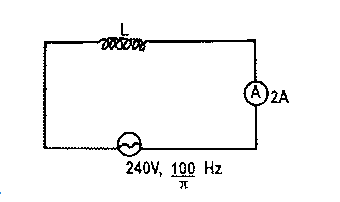
Calculate the inductance L of the COIL in the circuit shown above
Attached Figure / Diagram
A
3.8 H
B
0.4 H
C
0.6 H
D
14.4 H
medium Difficulty
Verified Correct Answer: Option C
Physical Principles & Numerical Solution
V = I X\(_L\)
X\(_L\) = \(\frac{\text{V }}{\text{I}}\) = \(\frac{240}{2}\) = 120 \Omega
But X\(_L\) = 2\(\pi\)fL
120 = 2 x 2\(\pi\) x \(\frac{100}{\pi}\) x L
120 = 2 x 100 x L = 200L
L = \(\frac{120}{200}\) = 0.6H
Source: WAEC / JAMB / NECO Classroom Archive (Record #76389)
Physics
WAEC / WASSCE 2025
Simple Ac Circuit
Diagram
Solution
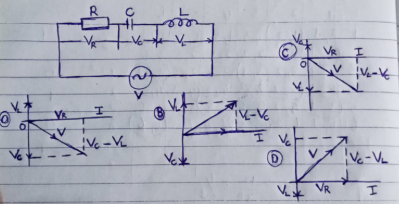
A series R - L - C circuit is shown in the diagram above. Which of the following vector diagrams correctly represents the phase relationship among I, V, V\(_F\), V\(_C\), and V\(_L\), if V\(_C\) is greater than V\(_L\) and the symbols have their usual meaning?
Attached Figure / Diagram
A
A
B
B
C
C
D
D
medium Difficulty
Verified Correct Answer: Option A
Physical Principles & Numerical Solution
i.e V\(_L\) - V\(_C\) = -ve (V\(_C\) - V\(_L\) = +ve)
From Tan \(\phi\) = \(\frac{V_L - V_C}{\text{R}}\)
It shows that V\(_L\) - V\(_C\) will be inverted on the y-axis V\(_C\) > V\(_L\)
Source: WAEC / JAMB / NECO Classroom Archive (Record #76398)
Physics
WAEC / WASSCE 2025
Simple Ac Circuit
Diagram
Solution
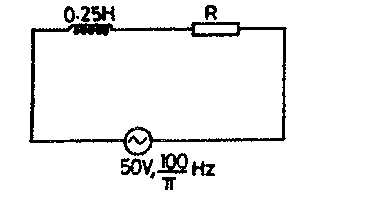
If the current in the resistor R is 0.05 A, calculate the p.d across the inductor.
Attached Figure / Diagram
A
2.5 V
B
49.0 V
C
25.0 V
D
50.0 V
medium Difficulty
Verified Correct Answer: Option A
Physical Principles & Numerical Solution
I = 0.05 A, p.d across R\(_L\) = V\(_L\) = I R\(_L\) = 0.05 \times 50
V\(_L\) = 2.5 V
Source: WAEC / JAMB / NECO Classroom Archive (Record #76399)
Physics
WAEC / WASSCE 2025
Simple Ac Circuit
Solution
A capacitor of capacitance 25μF is connected to an a.c power source of frequency \(\frac{200}{π}\) Hz. Calculate the reactance of the capacitor.
A
100.00 Ω
B
0.02 Ω
C
0.01 Ω
D
50.00 Ω
medium Difficulty
Verified Correct Answer: Option A
Physical Principles & Numerical Solution
X\(_C\) = \(\frac{1}{(2\pifC)}\) = \(\frac{1}{(2\pi \times (\frac{200}{\pi}) \times 25 \times 10^{-6})}\)
= \(\frac{1}{(2 \times 200 \times 25 \times 10^{-6})}\) = \(\frac{1}{10^{-2}}\) = 10\(^2\) = 100 \Omega
\(\therefore\) X\(_C\) = 100 \Omega
Source: WAEC / JAMB / NECO Classroom Archive (Record #76400)
Physics
WAEC / WASSCE 2025
Simple Ac Circuit
Diagram
Solution
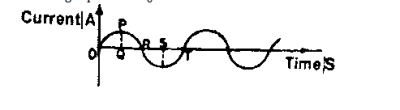
An alternating current, having a waveform shown in the diagram above, is represented by the equation X = X\(_o\) sinωt. Which of the following represents X\(_o\)?
Attached Figure / Diagram
A
OS
B
PQ
C
RT
D
OR
medium Difficulty
Verified Correct Answer: Option B
Physical Principles & Numerical Solution
X\(_o\) equals PQ because it is the amplitude or maximum current.
Source: WAEC / JAMB / NECO Classroom Archive (Record #76405)
Physics
WAEC / WASSCE 2025
Simple Ac Circuit
Diagram
Solution
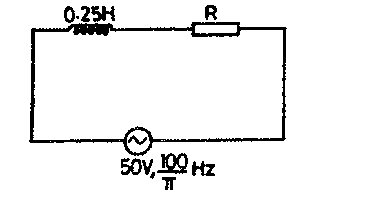
Calculate the inductive reactance of the circuit shown above
Attached Figure / Diagram
A
50.0\(\Omega\)
B
0.50\(\Omega\)
C
5.00\(\Omega\)
D
0.05\(\Omega\)
medium Difficulty
Verified Correct Answer: Option A
Physical Principles & Numerical Solution
R\(_L\) = 2\(\pi\)fL = 2 \(\pi\) x \(\frac{100}{\pi}\) x 0.25 = 50.0\(\Omega\)
Source: WAEC / JAMB / NECO Classroom Archive (Record #76441)
Physics
UTME / JAMB 2025
Semi Conductor
Solution
Charge carriers in doped semiconductors are
A
electrons and protons
B
electrons and neutrons
C
anions and cations
D
electrons and holes
medium Difficulty
Verified Correct Answer: Option D
Physical Principles & Numerical Solution
Electrical conduction in semiconductors occurs via electrons and holes.
Source: WAEC / JAMB / NECO Classroom Archive (Record #74370)
Physics
UTME / JAMB 2025
Structure of the Nucleus
Solution
Calculate the decay constant of a radioactive isotope of half-life 138.5 s.
A
5.0 × 10\(^{-3}\) s\(^{-1}\)
B
5.1 × 10\(^{-3}\) s\(^{-1}\)
C
4.9 × 10\(^{-3}\) s\(^{-1}\)
D
5.2 × 10\(^{-3}\) s\(^{-1}\)
medium Difficulty
Verified Correct Answer: Option A
Physical Principles & Numerical Solution
Answer: A
\lambda = \(\frac{ln2}{T½ }\) ⇒ \(\frac{0.693}{138.5}\) ≈ 5.0 \times 10\(^{-3}\) s\(^{-1}\).
Source: WAEC / JAMB / NECO Classroom Archive (Record #74374)
Physics
UTME / JAMB 2025
Structure of the Nucleus
Solution
One of the following is not a radiation detector
A
Electrophorus
B
Scintillation chamber
C
Geiger muller counter
D
Film badge
medium Difficulty
Verified Correct Answer: Option A
Physical Principles & Numerical Solution
A. Electrophorus. It generates static electricity via induction and is not a radiation detector. The others are:
Scintillation chamber: Detects radiation via light flashes.
Geiger-Muller counter: A gas-filled detector for ionizing radiation.
Film badge: Records cumulative radiation exposure on photographic film.
Source: WAEC / JAMB / NECO Classroom Archive (Record #74557)
Physics
UTME / JAMB 2025
Reflection of Light
Solution
A concave mirror of focal length 20cm produces an erect image that is four times the object, the object distance from the mirror is
A
less than 20cm
B
Between 20cm and30cm
C
Between 30cm and 40cm
D
Greater than 40cm
medium Difficulty
Verified Correct Answer: Option A
Physical Principles & Numerical Solution
A. Less than 20 cm
For a concave mirror, an erect image is virtual (behind the mirror) and forms when the object is placed between the pole and focus (\( u < f \)).
Magnification:
\(m = +4 \quad (\text{erect, so positive})\)
Using the mirror formula:
\(\frac{1}{v} + \frac{1}{u} = \frac{1}{f}\)
Given \( f = -20 \, \text{cm} \) (concave), \( u \) is negative.
Since \( m = -\frac{v}{u} \):
\(v = -m u = -(+4)u = -4u\)
Substituting into the mirror formula:
\(\frac{1}{-4u} + \frac{1}{u} = \frac{1}{-20}\)
Combining the fractions:
\(\frac{3}{4u} = \frac{1}{-20}\)
Thus, solving for \( u \):
\(3 \cdot -20 = 4u \quad \Rightarrow \quad u = -15 \, \text{cm}\)
Object distance \( |u| = 15 \, \text{cm} < 20 \, \text{cm} \).
Thus, it is less than 20 cm.
OR
A concave mirror only gives an erect, magnified image when the object is placed between the mirror and its focal point. Since the focal length is 20 cm, the object must be closer than 20 cm to the mirror.
Source: WAEC / JAMB / NECO Classroom Archive (Record #74541)