Question Library
Browse, filter, and study verified past examination questions with step-by-step mathematical reasoning.
Searching 18,000+ Questions...
Sifting topics, KaTeX formulas & verified solutions
Showing 316–330 of 573 verified questions
Sort by:
Mathematics
UTME / JAMB 2001
Algebra
Solution
A straight line makes an angle of 30^\circ with the positive x-axis and cuts the y-axis at y = 5. Find the equation of the straight line.
A
y = (x/10) + 5
B
y = x + 5
C
√3y = - x + 5√3
D
√3y = x + 5√3
medium Difficulty
Verified Correct Answer: Option D
Step-by-Step Mathematical Solution
Cos 30 = \(\frac{5}{\text{x}}\)
x cos 30 = 5, => x = 5\(\sqrt{3}\)
Coordinates of P = - 5\(\sqrt{3}\), 0
Coordinates of Q = 0, 5
Gradient of PQ = (y\(_2\) - y\(_1\)) (X\(_2\) - X\(_1\)) = \(\frac{(5 - 0)}{(0 - 5\sqrt{3}}\))
= \(\frac{5}{5\sqrt{3}}\) = \(\frac{1}{\sqrt{3}}\)
Equation of PQ = y - y\(_1\) = m (x -x\(_1\))
y - 0 = \(\frac{1}{\sqrt{3}}\) (x -( -5\(\sqrt{3}\)))
Thus: \(\sqrt{3}\)y = x + 5\(\sqrt{3}\)
Source: Myschool Past Questions Archive (Record #1515)
Mathematics
NECO SSCE 2001
Algebra
Solution
Find the 19th term of the A.P. \(\frac{5}{6}\), \(\frac{8}{6}\), \(\frac{11}{6}\).................
A
7\(\frac{1}{2}\)
B
9
C
9\(\frac{1}{2}\)
D
9\(\frac{5}{6}\)
E
10
medium Difficulty
Verified Correct Answer: Option D
Step-by-Step Mathematical Solution
first term (a) = \(\frac{5}{6}\)
common difference = \(\frac{8}{6}\) - \(\frac{5}{6}\) → \(\frac{3}{6}\) or \(\frac{1}{2}\)
A.P formula → T\(_n\) = a + (n - 1)d
T\(_n\) = \(\frac{5}{6}\) + (19 - 1)\(\frac{1}{2}\)
T\(_n\) = \(\frac{5}{6}\) + 9
→ 9\(\frac{5}{6}\)
Source: WAEC / JAMB / NECO Classroom Archive (Record #41776)
Mathematics
UTME / JAMB 2001
Algebra
Diagram
Solution
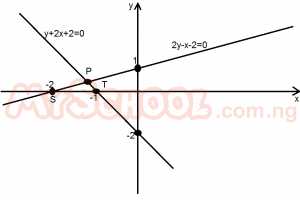
Triangle SPT is the solution of the linear inequalities
Attached Figure / Diagram
A
2y - x - 2 ≤ 0, y + 2x + 2 ≥ 0, -2 ≤ x ≤ - 1
B
-2 ≤ x ≤ 2, y ≥ 0, y + 2x + 2 ≤ 0, x ≤ 0
C
2y - x - 2 ≤ 0, y + 2x + 2 ≤ 0, y ≥ 0, x ≤ 0
D
2y - x - 2 ≥ 0, y + 2x + 2 ≤ 0, x ≤ 0
medium Difficulty
Verified Correct Answer: Option C
Step-by-Step Mathematical Solution
The two major lines have their lower portions involved. Since there are no broken lines here,\(\leq\) will hold for the two major lines
that is, 2y - x - 2 = 0 becomes 2y - x - 2 \(\leq\) 0
y + 2x + 2 = 0 becomes y + 2x + 2 \(\leq\) 0
Triangle SPT is located at the positive side of the y-axis, so y \(\geq\) 0, and the negative side of the x-axis so, x \(\leq\)
Therefore, OPTION C is correct.
Source: Myschool Past Questions Archive (Record #10766)
Mathematics
UTME / JAMB 2001
Algebra
Solution
⊗
k
l
m
k
l
m
k
l
m
k
l
m
k
l
m
The identity element with respect to the multiplication shown in the table above is
A
o
B
m
C
l
D
k
medium Difficulty
Verified Correct Answer: Option B
Step-by-Step Mathematical Solution
An element e of the binary expression * is said to be the identity if for any a * e = a
from the given table the identity element is m
i.e K ⨁ m = k
k ⨁ m = k.
Source: Myschool Past Questions Archive (Record #10767)
Mathematics
WAEC / WASSCE 2001
Algebra
Solution
The nth term of a sequence is \(2^{2n-1}\). Which term of the sequence is \(2^9?\)
A
3rd
B
4th
C
5th
D
6th
medium Difficulty
Verified Correct Answer: Option C
Step-by-Step Mathematical Solution
\(T_{n} = 2^{2n - 1}\)
\(2^{2n - 1} = 2^9\)
\(2n - 1 = 9 \implies 2n = 9 + 1\)
\(2n = 10 \implies n = 5\)
The 5th term = 2\(^9\)
Source: Myschool Past Questions Archive (Record #26481)
Mathematics
WAEC / WASSCE 2001
Algebra
Solution
which of the following is not quadratic expression?
A
\(y = 2x^2 - 5x\)
B
\(y=x(x-5)\)
C
\(y = x^2 - 5\)
D
y = 5(x-1)
medium Difficulty
Verified Correct Answer: Option D
Step-by-Step Mathematical Solution
A quadratic equation is an equation of the second order. The highest power in the equation is 2.
Source: Myschool Past Questions Archive (Record #26492)
Mathematics
WAEC / WASSCE 2001
Algebra
Solution
The graph of the curve \(y = 2x^2 - 5x - 1\) and a straight line PQ were drawn to solve the equation \(2x^2 - 5x + 2 = 0\)
What is the equation of the straight line PQ?
A
y = -1
B
y = 1
C
y = 3
D
y = -3
medium Difficulty
Verified Correct Answer: Option D
Step-by-Step Mathematical Solution
Let the straight line PQ = y
2x\(^2\) - 5x - 1 - y = 2x\(^2\) - 5x + 2
y = 2x\(^2\) - 5x - 1 - 2x\(^2\) + 5x - 2
y = -3
Source: Myschool Past Questions Archive (Record #26493)
Mathematics
NECO SSCE 2001
Algebra
Solution
Find the value of k such that \(t^2\) + kt + \(\frac{25}{4}\) is a perfect square
A
5
B
3
C
\(\frac{5}{2}\)
D
\(\frac{5}{4}\)
E
\(\frac{1}{5}\)
medium Difficulty
Verified Correct Answer: Option A
Step-by-Step Mathematical Solution
\(t^2\) + kt + \(\frac{25}{4}\)
The general form of quadratic expression = ax\(^2\) + bx + c
comparing \(t^2\) + kt + \(\frac{25}{4}\) and the general form
a = 1, b = k and c = \(\frac{25}{4}\)
using: b\(^2\) = 4ac we can find the value of k. ( note: there is/are another way(s) to find the value of k)
k\(^2\) = 4 x 1 x \(\frac{25}{4}\)
k\(^2\) = 25
taking the square root of both sides
k = 5
Source: Myschool Past Questions Archive (Record #41822)
Mathematics
NECO SSCE 2001
Algebra
Solution
Find the value of x in the equation: 9\(^x\) = 729
A
81
B
27
C
18
D
9
E
3
medium Difficulty
Verified Correct Answer: Option E
Step-by-Step Mathematical Solution
9\(^x\) = 729
3\(^2\)\(^x\) = 3\(^6\)
2x = 6
x = 3
Source: Myschool Past Questions Archive (Record #41873)
Mathematics
NECO SSCE 2001
Algebra
Solution
Solve the equation x\(^2\) - 3x - 10 = 0
A
-2 or -5
B
-3 or -10
C
5 or -2
D
2 or 5
E
3 or 10
medium Difficulty
Verified Correct Answer: Option C
Step-by-Step Mathematical Solution
x\(^2\) - 3x - 10 = 0
Using factorisation method: x\(^2\) - 3x - 10 = 0 becomes
x\(^2\) - 5x + 2x - 10 = 0
(x\(^2\) - 5x) + (2x - 10) = 0
x(x - 5) + 2(x -5) = 0
x - 5 = 0 or x + 2 = 0
\(\therefore\) x = 5 or -2
Source: Myschool Past Questions Archive (Record #41922)
Mathematics
WAEC / WASSCE 2001
Algebra
Solution
(a) Draw the table of values for the relation \(y = x^{2}\) for the interval \(-3 \leq x \leq 4\).
(b) Using a scale of 2 cm to 1 unit on the x- axis and 2 cm to 2 units on the y- axis, draw the graphs of : (i) \(y = x^{2}\) ; (ii) \(y = 2x + 3\) for \(-3 \leq x \leq 4\).
(c) Use your graph to find : (i) the roots of the equation \(x^{2} = 2x + 3\) ; (ii) the gradient of \(y = x^{2}\) at x = -2.
medium Difficulty
Verified Correct Answer: Option
Step-by-Step Mathematical Solution
(a)
x
-3
-2
-1
0
1
2
3
4
\(y = x^{2}\)
9
4
1
0
1
4
9
16
(b) \(y = 2x + 3\)
x
-3
-2
-1
0
1
2
3
4
2x
-6
-4
-2
0
2
4
6
8
3
3
3
3
3
3
3
3
3
y
-3
-1
1
3
5
7
9
11
see graph above
(c)(i) The roots of the equation are -1 and 3, from the graph.
(ii) The gradient of \(y = x^{2}\) at x = -2 : \(\frac{8}{-2.5} = -3.2\)
Source: Myschool Past Questions Archive (Record #53388)
Mathematics
WAEC / WASSCE 2001
Algebra
Solution
(a) The roots of the equation \(2x^{2} + (p + 1)x + 9 = 0\), are 1 and 3, where p and q are constants. Find the values of p and q.
(b) The weight of an object varies inversely as the square of its distance from the centre of the earth. A small satellite weighs 80kg on the earth's surface. Calculate, correct to the nearest whole number, the weight of the satellite when it is 800km above the surface of the earth. [Take the radius of the earth as 6,400km].
medium Difficulty
Verified Correct Answer: Option
Step-by-Step Mathematical Solution
(a) \(2x^{2} + (p + 1)x + q = 0\)
The roots of the equation are 1 and 3, therefore (x - 1)(x - 3) = 0.
Equation : \(x^{2} - 3x - x + 3 = 0\)
\(x^{2} - 4x + 3 = 0\)
\(\therefore 2x^{2} + (p + 1)x + q \equiv x^{2} - 4x + 3\)
\(\frac{2x^{2} + (p + 1)x + q}{2} = x^{2} + \frac{(p + 1)}{2} x + \frac{q}{2}\)
\(\implies \frac{q}{2} = 3\)
\(q = 6\)
\(\frac{p + 1}{2} = -4 \implies p + 1 = -8\)
\(p = -9\)
(p, q) = (-9, 6).
(b) \(W \propto \frac{1}{d^{2}} \)
\(W = \frac{k}{d^{2}}\)
\(k = Wd^{2}\)
\(W = \frac{80 \times (6400)^{2}}{d^{2}}\) (equation of variation).
\(W = \frac{80 \times (6400)^{2}}{(6400 + 800)^{2}}\)
\(W = \frac{80 \times (6400)^{2}}{(7200)^{2}}\)
= 63.21 kg
Source: Myschool Past Questions Archive (Record #53402)
Mathematics
UTME / JAMB 2001
Algebra
Solution
Find the integral values of x and y satisfying the inequality 3y + 5x \(\leq\) 15, given that y > 0, y < 3, and x > 0.
A
( 1, 1), (1, 2), (2, 1)
B
( 1, 1), (1, 3), (2, 2)
C
( 1, 1), (1, 2) (1, 3)
D
( 1, 1), (1, 3), (2, 1)
medium Difficulty
Verified Correct Answer: Option A
Step-by-Step Mathematical Solution
From the constraint y < 3 and y > 0, the possible values for y are 1 and 2
When y = 1, 3y + 5x \(\leq\) 15
3 + 5x \(\leq\) 15 ⇒ 5x \(\leq\) 12 ⇒ 2.4
since x must be an integer greater than 0 but less than or equal to 2.4, the possible values of x are 1 and 2
When y = 2, 3y + 5x \(\leq\) 15 ⇒ 6 + 5x \(\leq\) 15 ⇒ 6 \(\leq\) 15 - 6 = 11 ⇒ x = 2.2
Again, Since x must be an integer greater than 0 and less than or equal to 2.2, the only possible integer value of x is 1
So, the pairs (x, y) that satisfy all the conditions are ( 1, 1), (1, 2) and (2, 1).
Source: Myschool Past Questions Archive (Record #69977)
Mathematics
UTME / JAMB 2001
Algebra
Solution
Evaluate \(\begin{vmatrix}-1 & -1 & -1\\3 & 1 & -1\\1 & 2 & 1\end{vmatrix}\)
A
-4
B
-12
C
4
D
-2
medium Difficulty
Verified Correct Answer: Option A
Step-by-Step Mathematical Solution
\(\begin{vmatrix}-1 & -1 & -1\\3 & 1 & -1\\1 & 2 & 1\end{vmatrix}\) = -\(\begin{vmatrix}1 & -1 \\2 & 1\end{vmatrix}\) + \(\begin{vmatrix}3 & -1\\1 & 1\end{vmatrix}\) - \(\begin{vmatrix}3 & 1\\1 & 2\end{vmatrix}\)
= -( 1 + 2) + (3 + 1) - ( 6 - 1) = -3 + 4 - 5 = 4 - 8 = -4.
Source: Myschool Past Questions Archive (Record #70073)
Mathematics
UTME / JAMB 2001
Algebra
Solution
Given the matrix K = \(\begin{pmatrix}2 & 1\\3 & 4\end{pmatrix}\), the matrix K\(^2\) + K + I, where I is the 2 x 2 identity matrix, is
A
\(\begin{pmatrix}6 & 3\\3 & 20\end{pmatrix}\)
B
\(\begin{pmatrix}9 & 8\\22 & 23\end{pmatrix}\)
C
\(\begin{pmatrix}10 & 7\\21 & 24\end{pmatrix}\)
D
\(\begin{pmatrix}7 & 2\\12 & 21\end{pmatrix}\)
medium Difficulty
Verified Correct Answer: Option C
Step-by-Step Mathematical Solution
K = \(\begin{pmatrix}2 & 1\\3 & 4\end{pmatrix}\)
K\(^2\) = K = \(\begin{pmatrix}2 & 1\\3 & 4\end{pmatrix}\) x K = \(\begin{pmatrix}2 & 1\\3 & 4\end{pmatrix}\) = \(\begin{pmatrix}7 & 6\\18 & 19\end{pmatrix}\)
I = \(\begin{pmatrix}1 & 0\\0 & 1\end{pmatrix}\)
K\(^2\) + K + I = \(\begin{pmatrix}7 & 6\\18 & 19\end{pmatrix}\) + \(\begin{pmatrix}2 & 1\\3 & 4\end{pmatrix}\) + \(\begin{pmatrix}1 & 0\\0 & 1\end{pmatrix}\)
= \(\begin{pmatrix}10 & 7\\21 & 24\end{pmatrix}\)
Source: Myschool Past Questions Archive (Record #70080)