Question Library
Browse, filter, and study verified past examination questions with step-by-step mathematical reasoning.
Searching 18,000+ Questions...
Sifting topics, KaTeX formulas & verified solutions
Showing 316–330 of 4910 verified questions
Sort by:
Mathematics
UTME / JAMB 2023
Change of Subject of Formula
Solution
Make x the subject of the formula: y = \(\frac {3x - 9c}{4x + 5d}\)
A
x = \(\frac {-(9c - 5dy)}{4y - 3}\)
B
x = \(\frac {9c + 5dy}{4y - 3}\)
C
x = \(\frac {9c - 5dy}{4y - 3}\)
D
x = \(\frac {-(9c + 5dy)}{4y - 3}\)
medium Difficulty
Verified Correct Answer: Option D
Step-by-Step Mathematical Solution
y = \(\frac {3x - 9c}{4x + 5d}\)
\(\frac {y}{1} = \frac {3x - 9c}{4x + 5d}\)
= y(4x + 5d) = 3x - 9c
= 4xy + 5dy = 3x - 9c
= 4xy - 3x = -9c - 5dy
= (4y - 3)x = -9c - 5dy
= x = \(\frac {-9c - 5dy}{4y - 3}\)
x = \(\frac {-(9c + 5dy)}{4y - 3}\)
Source: WAEC / JAMB / NECO Classroom Archive (Record #67257)
Mathematics
WAEC / WASSCE 2023
Change of Subject of Formula
Solution
make x the subject of the relation \(y = \frac{ax^3 - b}{3z}\)
A
x = \(\sqrt[3] \frac{ax^3 - b}{3z}\)
B
x = \(\sqrt[3] \frac{3yz - b}{a}\)
C
x = \(\sqrt[3] \frac{3yz + b}{a}\)
D
x = \(\sqrt[3] \frac{3yzb}{a}\)
medium Difficulty
Verified Correct Answer: Option C
Step-by-Step Mathematical Solution
\(y = \frac{ax^3 - b}{3z}\)
cross multiply
\(ax^3 - b\) = 3yz
\(ax^3\) = 3yz + b
divide both sides by a
\(x^3 = \frac{3yz + b}{a}\)
take cube root of both sides
therefore, x = \(\sqrt[3] \frac{3yz + b}{a}\)
Source: WAEC / JAMB / NECO Classroom Archive (Record #69114)
Mathematics
WAEC / WASSCE 2023
Quadratic Equations
Solution
Find the roots of the equations: 3m\(^2\) - 2m - 65 = 0
A
\(( -5, \frac{-13}{3})\)
B
\(( 5, \frac{-13}{3})\)
C
\(( 5, \frac{13}{3})\)
D
\(( -5, \frac{13}{3})\)
medium Difficulty
Verified Correct Answer: Option B
Step-by-Step Mathematical Solution
Find the roots of the equations: \(3m^2 - 2m - 65 = 0\)
= \( m^2 - 15m + 13m - 65 = 0\)
= 3m(m - 5) + 13( m - 5) = 0
( m - 5)(3m + 13) = 0
m-5 = 0 or 3m + 13 = 0
therefore, m = 5 or \(\frac{-13}{3}\)
therefore the roots of the quadratic equation = ( 5, \(\frac{-13}{3})\)
Source: WAEC / JAMB / NECO Classroom Archive (Record #69069)
Mathematics
WAEC / WASSCE 2023
Quadratic Equations
Solution
Factorize completely: \(x^2 - (y + z)^2\)
A
(x - y - z)(x - y - z)
B
(x + y + z)(x - y - z)
C
(x + y + z)(x + y - z)
D
(x + y - z)(x - y + z)
medium Difficulty
Verified Correct Answer: Option B
Step-by-Step Mathematical Solution
\(x^2 - (y + z)^2\)
Using difference of two squares (\(a^2 - b^2 = (a + b)(a - b)|)
⇒ (x + (y + z))(x - (y + z))
⇒ (x + y + z)(x - y - z)
Source: WAEC / JAMB / NECO Classroom Archive (Record #69155)
Mathematics
WAEC / WASSCE 2023
Quadratic Equations
Solution
Find the quadratic equation whose roots are \(\frac{2}{3} and \frac{- 3}{4}\)
A
\(12y^2 - y - 6 = 0\)
B
\(12y^2 - y + 6 = 0\)
C
\(12y^2 + y - 6 = 0\)
D
\(y^2 + y - 6 = 0\)
medium Difficulty
Verified Correct Answer: Option C
Step-by-Step Mathematical Solution
Let p = \(\frac{2}{3}\) and q = \(\frac{- 3}{4}\)
using (y - p)(y - q) = 0
= ( y - \(\frac{2}{3})\)( y - (\(\frac{- 3}{4})) = 0\)
= (\( y - \frac{2}{3})( y + \frac{3}{4})\) = 0
\( y^2 + \frac{3}{4}y - \frac{2}{3}y - \frac{6}{12} = 0 \)
\( y^2 + \frac{1}{12}y - \frac{1}{2}\) = 0
= multiply through by the l. c. m of 3 and 4 = 12
∴ the quadratic equation is \(12y^2 + y - 6 = 0\)
Source: WAEC / JAMB / NECO Classroom Archive (Record #69169)
Mathematics
WAEC / WASSCE 2023
Graphs of Linear & Quadratic Functions
Solution
a. Copy and complete the tables of values of y = \(2x^2 - x - 4\) for -3 ≤ x ≤ 3
x
-3
-2
-1
0
1
2
3
y
17
-4
b. Using a scale of 2 cm to 1 unit on the x-axis and 2 cm to 2 unit on the y-axis, draw the graph of y = \(2x^2 - x - 4\) for -3 ≤ x ≤ 3.
ci. Use the graph to find: the roots of the equation \(2x^2 - x - 4\)
ii. Use the graph to find the: values of x for which y increases as x increases;
iii. Use the graph to find the: minimum point of y.
medium Difficulty
Verified Correct Answer: Option
Step-by-Step Mathematical Solution
a.
x
-3
-2
-1
0
1
2
3
\(2x^2\)
18
8
2
0
2
8
-18
- x
3
2
1
0
- 1
- 2
- 3
- 4
- 4
- 4
- 4
-4
-4
-4
-4
y
17
6
-1
-4
-3
2
11
b. the graph above, solution to question 8b.
ci. The roots of the equation from the graph are -1.2 and 1.7.
ii. Let y = \(2x^2 - x - 4\)
\(\frac{dy}{dx}\) = 4x - 1
At critical point \(\frac{dy}{dx}\) = 0
so that 4x - 1 = 0;
x = \(\frac{1}{4}\)
Using test points:
1. we use a test point less than \(\frac{1}{4}\), e.g x = 0
\(\frac{dy}{dx}\)(0) = 4(0) - 1 = -1
at this point, y = \(2x^2 - x - 4\) is decreasing
2. we use a test point greater than \(\frac{1}{4}\) e.g x = 1
\(\frac{dy}{dx}\)(1) = 4(1) - 1 = 4 - 1 = 3.
at this point, y = \(2x^2 - x - 4\) is increasing.
so, the function y = \(2x^2 - x - 4\) increases as x increases when x is greater than \(\frac{1}{4}\)
Therefore, the value of x for which y increases are x is greater than \(\frac{1}{4}\)
iii. The minimum point of y = -4.1.
Source: WAEC / JAMB / NECO Classroom Archive (Record #69337)
Mathematics
UTME / JAMB 2023
Linear Inequalities
Solution
Solve for x: 3(x – 1) ≤ 2 (x – 3)
A
x ≤ -3
B
x ≥ -3
C
x ≤ 3
D
x ≥ 3
medium Difficulty
Verified Correct Answer: Option A
Step-by-Step Mathematical Solution
3(x – 1) \le 2 (x – 3)
= 3x – 3 \le 2x – 6
Add 3 to both sides
= 3x – 3+ 3 \le 2x – 6+ 3
= 3x \le 2x – 3
Subtract 2x from both the sides
= 3x – 2x \le 2x – 3 – 2x
∴ x \le -3
Source: WAEC / JAMB / NECO Classroom Archive (Record #67258)
Mathematics
UTME / JAMB 2023
Linear Inequalities
Solution
Solve the following quadratic inequality: \(x^2 - x\) - 4 ≤ 2
A
\(-3 < x < 2\)
B
\(-2 ≤ x ≤ 3\)
C
\(x ≤ -2, x ≤ 3\)
D
\(-2 < x < 3\)
medium Difficulty
Verified Correct Answer: Option B
Step-by-Step Mathematical Solution
\(x^2 - x - 4 \le 2\)
Subtract two from both sides to rewrite it in the quadratic standard form:
= \(x^2 - x - 4 - 2 \le 2 - 2\)
= \(x^2 - x - 6 \le 0\)
Now set it = 0 and factor and solve like normal.
= \(x^2 - x\) - 6=0
= \((x - 3)(x + 2)\)=0
\(x\) + 2 = 0 or \(x\) - 3 = 0
\(x\) = -2 or \(x\) = 3
So the two zeros are -2 and 3, and will mark the boundaries of our answer interval. To find out if the interval is between -2 and 3, or on either side, we simply take a test point between -2 and 3 (for instance, \(x\) = 0) and evaluate the original inequality.
= \(x2 - x - 4 \le 2\)
= \((0)^2 - (0) - 4 \le 2\)
= \(0 - 0 - 4 \le 2\)
\(−4 \le 2\)
Since the above is a true statement, we know that the solution interval is between -2 and 3, the same region where we picked our test point. Since the original inequality was less than or equal, we include the endpoints.
∴ \(-2 \le x \le 3.\)
Source: WAEC / JAMB / NECO Classroom Archive (Record #67309)
Mathematics
UTME / JAMB 2023
Linear Inequalities
Diagram
Solution
Which inequality describes the graph above?
Attached Figure / Diagram
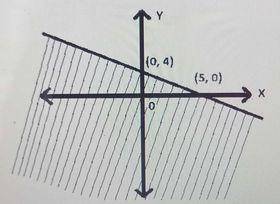
A
\(4y + 5x ≥ 20\)
B
\(5y + 4x ≤ 20\)
C
\(4y + 5x ≤ 20\)
D
\(5y + 4x ≥ 20\)
medium Difficulty
Verified Correct Answer: Option B
Step-by-Step Mathematical Solution
First, we find the equation of the boundary line using the two intercepts.The slope is
m = \(\frac{4 - 0}{0 - 5} = {4}{5}\)
The y-intercept is 4
The slope-intercept form of the equation is therefore
y = -\(\frac{4}{5} x + 4\)
\(\implies y + \frac{4}{5} x = 4\)
Multiply both sides by \(\frac{5}{4}\)
\(\implies\frac{5}{4}(y +\frac{4}{5} x) = 4\times\frac{5}{4}\)
\(\implies\frac{5}{4} y + x = 5\)
Multiply both sides by 4
⇒ \(5y + 4x = 20\)
The inequality is therefore either \(5y + 4x \le 20\) or \(5y + 4x \ge 20.\)
Using the test point (0, 0) -The origin
⇒ 5(0) + 4(0) \le 20
⇒ 0 \le 20 (True)
∴ The inequality is \(5y + 4x \le 20\)
Source: WAEC / JAMB / NECO Classroom Archive (Record #67391)
Mathematics
WAEC / WASSCE 2023
Algebraic Fractions
Solution
For what value of x is \(\frac{ x^2 + 2 }{ 10x^2 - 13x - 3}\) is undefined?.
A
\(\frac{1}{5}, \frac{3}{2}\)
B
\(\frac{-1}{5}, \frac{3}{2}\)
C
\(\frac{1}{5}, \frac{-3}{2}\)
D
\(\frac{-1}{5}, \frac{-3}{2}\)
medium Difficulty
Verified Correct Answer: Option B
Step-by-Step Mathematical Solution
The fraction \(\frac{ x^2 + 2 }{ 10x^2 - 13x - 3}\) is undefined when the denominator is equal to zero
\(then 10x^2 - 13x - 3 = 0\)
by factorisation, \(10x^2 - 13x - 3\) = 0 becomes \( 10x^2 - 15x +2x -3\) = 0
\(5x(2x - 3) + 1(2x - 3) = 0\)
\((5x + 1)(2x - 3) = 0\)
\(then, x = \frac{-1}{5}\) or \(\frac{3}{2}\)
Source: WAEC / JAMB / NECO Classroom Archive (Record #68999)
Mathematics
UTME / JAMB 2023
Polynomials
Solution
Factorize: \(16x^4 - y^4\)
A
\((2x - y)(2x + y)(4x^2 + y^2)\)
B
\((2x + y)(2x + y)(4x^2 + y^2)\)
C
\((2x - y)(2x - y)(4x^2 + y^2)\)
D
\((2x - y)(2x + y)(4x^2 - y^2)\)
medium Difficulty
Verified Correct Answer: Option A
Step-by-Step Mathematical Solution
16\(x^4 - y^4\)
= 2\(^4x^4 - y^4\)
= \((2x)^4 - y^4\)
= \(((2x)^2)^2 - (y^2)^2\)
Using a\(^2 - b^2\) = (a - b)(a + b) identity
= ((2x)\(^2 - y^2)((2x)^2 + y^2)\)
Using the identity one more time
= \((2x - y)(2x + y)((2x)^2 + y^2)\)
∴ \((2x - y)(2x + y)(4x^2 + y^2)\)
Source: WAEC / JAMB / NECO Classroom Archive (Record #67282)
Mathematics
UTME / JAMB 2023
Polynomials
Solution
If \(-2x^3 + 6x^2 + 17x\) - 21 is divided by \((x + 1)\), then the remainder is
A
32
B
30
C
-30
D
-32
medium Difficulty
Verified Correct Answer: Option C
Step-by-Step Mathematical Solution
Let \(p(x) = -2x^3 + 6x^2 + 17x - 21\)
Using the remainder theorem
Let \(x + 1 = 0\)
∴ \(x = -1\)
Since, \((x + 1)\) divides \(p(x)\), then, remainder will be p(-1)
⇒ p(-1) = -2(-1)\(^3 + 6(-1)^2\) + 17(-1) - 21
∴ p(-1) = -30
Source: WAEC / JAMB / NECO Classroom Archive (Record #67301)
Mathematics
UTME / JAMB 2023
Progressions (AP & GP)
Solution
What is the general term of the sequence 3, 8, 13, 18, ...?
A
5n - 2
B
5n + 2
C
5
D
5n
medium Difficulty
Verified Correct Answer: Option A
Step-by-Step Mathematical Solution
Given the sequence 3, 8, 13, 18, ... which is an arithmetic sequence
a = 3
d = T\(_2\) - T\(_1\) = 8 - 3 = 5
The general term of an A.P is:
T\(_n\) = a + (n - 1)d
⇒ T\(_n\) = 3 + (n - 1)5
= T\(_n\) = 3 + 5n - 5
∴ T\(_n\) = 5n - 2
Source: WAEC / JAMB / NECO Classroom Archive (Record #67329)
Mathematics
UTME / JAMB 2023
Progressions (AP & GP)
Solution
The third term of an A.P is 6 and the fifth term is 12. Find the sum of its first twelve terms
A
201
B
144
C
198
D
72
medium Difficulty
Verified Correct Answer: Option C
Step-by-Step Mathematical Solution
T\(_3\) = 6
T\(_5\) = 12
S\(_{12}\) = ?
T\(_n\) = a + (n - 1)d
⇒ T\(_3\) = a + 2d = 6 ----- (i)
⇒ T\(_5\) = a + 4d = 12 ----- (ii)
Subtract equation (ii) from (i)
⇒ -2d = -6
⇒ d\(\frac{-6}{-2}\) = 3
Substitute 3 for d in equation (i)
⇒ a + 2(3) = 6
⇒ a + 6 = 6
⇒ a = 6 - 6 = 0
S\(_n\) = \(\frac{n(2a + (n - 1)d)}{2}\)
⇒ S\(_{12}\) = \(\frac{12(2 \times 0 + (12 - 1)3)}{2}\)
⇒ S\(_{12}\) = 6(0 + 11 x 3)
⇒ S\(_{12}\) = 6(33)
∴ S\(_{12}\) = 198
Source: WAEC / JAMB / NECO Classroom Archive (Record #67369)
Mathematics
UTME / JAMB 2023
Progressions (AP & GP)
Solution
The second term of a geometric series is \(^{-2}/_3\) and its sum to infinity is \(^3/_2\). Find its common ratio.
A
\(^{-1}/_3\)
B
2
C
\(^{4}/_3\)
D
\(^{2}/_9\)
medium Difficulty
Verified Correct Answer: Option A
Step-by-Step Mathematical Solution
\(T_2 = \frac{-2}{3};S_\infty \frac {3}{2}\)
\(T_n = ar^n - 1\)
∴ \(T_2 = ar = \frac{-2}{3}\)---eqn.(i)
\(S_\infty = \frac{a}{1 - r} = \frac{3}{2}\)---eqn.(ii)
= 2a = 3(1 - r)
= 2a = 3 - 3r
∴ a = \(\frac{3 - 3r}{2}\)
Substitute \(\frac{3 - 3r}{2}\) for a in eqn.(i)
= \(\frac{3 - 3r}{2} \times r = \frac{-2}{3}\)
= \(\frac{3r - 3r^2}{2} = \frac{-2}{3}\)
= 3(3r - 3r\(^2\)) = -4
= 9r - 9r\(^2\) = -4
= 9r\(^2\) - 9r - 4 = 0
= 9r\(^2\) - 12r + 3r - 4 = 0
= 3r(3r - 4) + 1(3r - 4) = 0
= (3r - 4)(3r + 1) = 0
∴ r = \(\frac{4}{3} or - \frac{1}{3}\)
For a geometric series to go to infinity, the absolute value of its common ratio must be less than 1 i.e. |r| < 1.
∴ r = -\(^1/_3\) (since |-\(^1/_3\)| < 1)
Source: WAEC / JAMB / NECO Classroom Archive (Record #67384)