Question Library
Browse, filter, and study verified past examination questions with step-by-step mathematical reasoning.
Searching 18,000+ Questions...
Sifting topics, KaTeX formulas & verified solutions
Showing 316–330 of 29811 verified questions
Sort by:
Physics
UTME / JAMB 2025
Electric Field
Solution
A circular parallel plate capacitor with radius 6cm is separated by 0.12cm. Calculate the capacitance of the capacitor [\(\pi\) = 3.142, ε\(_0\) = 8.85 x 10\(^{-12}\)Nm\(^2\)C\(^2\)]
A
4.3 x 10\(^{-11}\)F
B
5.1 x 10\(^{11}\)F
C
8.3 x 10\(^{-11}\)F
D
9.6 x 10\(^{-11}\)F
medium Difficulty
Verified Correct Answer: Option C
Physical Principles & Numerical Solution
The capacitance \( C \) of a parallel-plate capacitor is calculated using the formula:
\(C = \epsilon_0 \frac{A}{d}\)
where: \(\epsilon_0 = 8.85 \times 10^{-12} \, \text{F/m},\)
\(A = \pi r^2 \quad \text{(area of one plate)},\)
and \( d \) is the separation between plates. \(r = 6 \, \text{cm} = 0.06 \, \text{m},\)
\(d = 0.12 \, \text{cm} = 0.0012 \, \text{m}\)
Calculate the area: \(A = \pi r^2 = 3.142 \times (0.06)^2 = 3.142 \times 0.0036 = 0.0113112 \, \text{m}^2\)
Calculate the capacitance: \(C = 8.85 \times 10^{-12} \times \frac{0.0113112}{0.0012} = 8.85 \times 10^{-12} \times 9426 \approx 8.34 \times 10^{-11} \, \text{F}\)
Source: WAEC / JAMB / NECO Classroom Archive (Record #74543)
Physics
UTME / JAMB 2025
Electric Field
Solution
When capacitors are connected in series across a potential difference, there is a loss in their stored energy because:
A
Increase in the internal resistance of the voltage
B
Unequal charges being deposited on the capacitors
C
a charge flows between the capacitors
D
decrease in the overall capacitance of the capacitors
medium Difficulty
Verified Correct Answer: Option D
Physical Principles & Numerical Solution
When capacitors are connected in series across a potential difference, there is a loss in their stored energy primarily due to the decrease in overall capacitance, which limits the amount of energy they can store, rather than due to charge flowing between the capacitors.
Source: WAEC / JAMB / NECO Classroom Archive (Record #74565)
Physics
WAEC / WASSCE 2025
Electric Field
Solution
A charge of 1.6 × 10\(^{-10}\) C is placed in a uniform electric field of intensity 2.0 × 10\(^5\) NC\(^{-1}\). What is the magnitude of the electric force exerted on the charge?
A
3.2 × 10\(^{-5}\) N.
B
3.2 × 10\(^5\) N.
C
1.8 × 10\(^{-5}\) N.
D
1.8 × 10\(^5\) N.
medium Difficulty
Verified Correct Answer: Option A
Physical Principles & Numerical Solution
The force exerted on a charge in an electric field is given by the formula F = qE, where F is the force, q is the charge, and E is the electric field intensity.
Given: the charge q is 1.6 \times 10\(^{-10}\) C, and the electric field intensity E is 2.0 \times 10\(^5\) NC\(^{-1}\).
Substituting these values into the formula gives F = (1.6 \times 10\(^{-10}\) C) \times (2.0 \times 10\(^5\) NC\(^{-1}\)) = 3.2 \times 10\(^{-5}\) N.
Source: WAEC / JAMB / NECO Classroom Archive (Record #76387)
Physics
WAEC / WASSCE 2025
Electric Field
Solution
Calculate the electric potential at a distance of 20.0cm from a point charge of 0.015 C placed in air of permittivity. [ take \(\frac{1}{4\pi ε₀}\) = 9.0 x 10\(^9\)Nm\(^2\)C\(^{-2}\)]
A
6.75 x 10\(^6\)V
B
3.40 x 10\(^5\)V
C
3.40 x 10\(^9\)V
D
6.75 x 10\(^8\)V
medium Difficulty
Verified Correct Answer: Option D
Physical Principles & Numerical Solution
Given: r = 20cm ⇒ 0.20m, K = \(\frac{1}{4\pi ε₀}\) = 9.0 x 10\(^9\)Nm\(^2\)C\(^{-2}\), q = 0.015C
The electrical potential V = \(\frac{\text{kq}}{\text{r}}\)
V = \(\frac{ 9.0 x 10^9 \times 0.015}{0.20}\) = \(\frac{1.35 \times 10^8}{0.20}\) = 6.75 x 10\(^8\)V
Source: WAEC / JAMB / NECO Classroom Archive (Record #76394)
Physics
WAEC / WASSCE 2025
Electric Field
Diagram
Solution
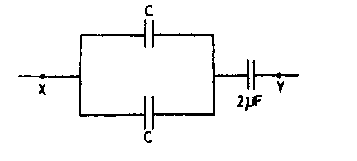
The effective capacitance between points X and Y in the diagram above is 1.0\(\mu\) F. What is the value of the capacitance?
Attached Figure / Diagram
A
5.0 μ
B
4.0 μ
C
3.0 μ
D
1.0 μ
medium Difficulty
Verified Correct Answer: Option D
Physical Principles & Numerical Solution
Effective capacitance across the parallel = C + C = 2C
Effective capacitance across the circuit = \(\frac{1}{2C} + \frac{1}{2}\) = \(\frac{1 + C}{2C}\)
∴ Effective capacitance across the circuit = \(\frac{1 + C }{2C}\) = \(\frac{1}{1}\)
1 + C = 2C;
2C – C = 1
∴ C = 1.0 \mu
Source: WAEC / JAMB / NECO Classroom Archive (Record #76403)
Physics
UTME / JAMB 2025
Current Electricity
Solution
Which of the following is better for measuring a very small resistance?
A
Voltmeter
B
Wheatstone bridge
C
rheostat
D
Potentiometer
medium Difficulty
Verified Correct Answer: Option B
Physical Principles & Numerical Solution
A Wheatstone bridge is specifically designed for the accurate measurement of small and unknown resistances. It operates on the principle of balancing two legs of a bridge circuit, enabling precise determination of resistance values.
Potentiometer: Used to measure potential difference or electromotive force (emf), not to measure resistance directly.
Rheostat: A variable resistor utilized to control current, rather than for measuring resistance.
Wheatstone Bridge: The most effective method for measuring very small resistances.
Source: WAEC / JAMB / NECO Classroom Archive (Record #74484)
Physics
UTME / JAMB 2025
Current Electricity
Solution
What is the electrolyte used in wet Leclanche cell
A
Nickle hydroxide
B
Lead dioxide
C
Ammonium chloride
D
Carbon
medium Difficulty
Verified Correct Answer: Option C
Physical Principles & Numerical Solution
C. Ammonium chloride.
It is the electrolyte in the wet Leclanché cell (aqueous solution).Others:
Nickel hydroxide: In Ni-Cd/Ni-MH batteries.
Lead dioxide: Cathode in lead-acid batteries.
Carbon: Conductivity enhancer, not electrolyte.
Source: WAEC / JAMB / NECO Classroom Archive (Record #74558)
Physics
UTME / JAMB 2025
Current Electricity
Diagram
Solution
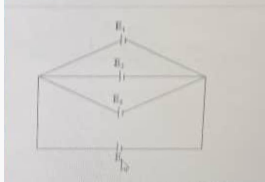
Assuming E\(_1\), E\(_2\), and E\(_3\), are equal, then the total e.m.f of the arrangement will be given by
Attached Figure / Diagram
A
\(\frac{1}{\text{E}}\) = (\(\frac{1}{E_1}\) +\(\frac{1}{E_2}\)) + E\(_3\)
B
E = \(E_1\) + \(E_2\) + \(E_3\)
C
\(\frac{1}{\text{E}}\) = \(\frac{1}{E_1}\) + \(\frac{1}{E_2}\) + \(\frac{1}{E_3}\)
D
E = \(E_1\) = \(E_2\) = \(E_3\)
medium Difficulty
Verified Correct Answer: Option D
Physical Principles & Numerical Solution
Parallel connection does not add the voltages; it only increases the current capacity. Thus, total e.m.f. E = E\(_1\) = E\(_2\) = E\(_3\).
Source: WAEC / JAMB / NECO Classroom Archive (Record #74659)
Physics
WAEC / WASSCE 2025
Current Electricity
Solution
The energy stored in a capacitor of capacitance 5μF is 40 J. Calculate the voltage applied across its terminals.
A
6 V
B
200 V
C
16 V
D
4000 V
medium Difficulty
Verified Correct Answer: Option D
Physical Principles & Numerical Solution
E = \(\frac{1}{2}\)QV;
But, Q = CV
∴ E = \(\frac{1}{2}\)CV\(^2\);
40 = \(\frac{1}{2}\) \times 5 \times 10\(^{-6}\) \times V\(^2\)
V\(^2\) = \(\frac{(2 \times 40)}{5 \times 10^{-6}}\)
V\(^2\) = 16 \times 10\(^6\)
∴ V = \(\sqrt{(16 \times 10^6)}\) = 4000 V
Source: WAEC / JAMB / NECO Classroom Archive (Record #76401)
Physics
WAEC / WASSCE 2025
Current Electricity
Solution
Calculate the quantity of charge flowing through a conductor if a current of 10 A passes through the conductor for 10 s.
A
10 C
B
15 C
C
100 C
D
20 C
medium Difficulty
Verified Correct Answer: Option C
Physical Principles & Numerical Solution
The quantity of charge flowing through a conductor is given by the formula Q = It.
Substituting the given values,
we get Q = 10 \times 10 = 100 C.
Source: WAEC / JAMB / NECO Classroom Archive (Record #76404)
Physics
WAEC / WASSCE 2025
Current Electricity
Diagram
Solution
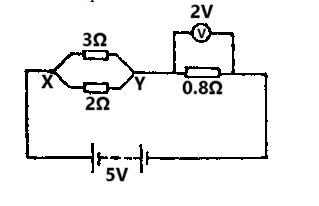
What is the potential difference between X and Y in the diagram above if the battery is of negligible internal resistance?
Attached Figure / Diagram
A
3.0V
B
12.5V
C
5.8V
D
5.0V
medium Difficulty
Verified Correct Answer: Option A
Physical Principles & Numerical Solution
\(\frac{1}{R_{XY}}\) = \(\frac{1}{3} + \frac{1}{2} + \frac{1}{6}\) = \(\frac{5}{6}\)
\(\therefore\) R\(_{XY}\) = \(\frac{5}{6}\)\(\Omega\)
\(\therefore\) R\(_T\) = \(\frac{5}{6}\) + 0.8 = \(\frac{5}{6}\) + \(\frac{4}{5}\) = \(\frac{10}{5}\) = 2\(\Omega\)
But, V = IR\(_T\) where V = 5v and R\(_T\) = 2\(\Omega\)
I = \(\frac{\text{V}}{R_T}\) = \(\frac{5}{2}\)A
\(\therefore\) V\(_{across XY}\) = I R\(_{XY}\) = \(\frac{5}{2}\) x \(\frac{6}{5}\) = 3.0V.
Source: WAEC / JAMB / NECO Classroom Archive (Record #76406)
Physics
WAEC / WASSCE 2025
Current Electricity
Diagram
Solution
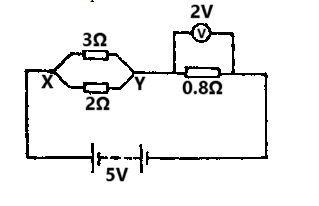
Calculate the current in the 3 Ω resistor in Question 47.
Attached Figure / Diagram
A
0.4 A
B
0.3 A
C
1.5 A
D
1.0 A
medium Difficulty
Verified Correct Answer: Option D
Physical Principles & Numerical Solution
V = IR Voltage across XY = 3V
V = 3I = 3V
I = \(\frac{3}{3}\) = 1.0 A
Source: WAEC / JAMB / NECO Classroom Archive (Record #76408)
Physics
WAEC / WASSCE 2025
Current Electricity
Solution
A given wire of resistance 10 Ω has a length of 5 m and a cross-sectional area of 4.0 × 10\(^{-3}\) m\(^2\). Calculate the conductivity of the wire.
A
2.50 × 10\(^2\) Ω\(^{-1}\)m\(^{-1}\)
B
2.02 × 10\(^2\) Ω\(^{-1}\)m\(^{-1}\)
C
1.25 × 10\(^2\) Ω\(^{-1}\)m\(^{-1}\)
D
0.80 × 10\(^2\) Ω\(^{-1}\)m\(^{-1}\)
medium Difficulty
Verified Correct Answer: Option C
Physical Principles & Numerical Solution
The resistance \(R\) of a wire is related to its resistivity \(\rho\), length \(L\), and cross-sectional area \(A\) by the formula: \(R = \frac{\rho L}{A}\)
The conductivity \(\sigma\) is the reciprocal of the resistivity:
\(\sigma = \frac{1}{\rho}\)
\(\rho = \frac{R A}{L}\)
\(\sigma = \frac{L}{R A}\)
Substitute the given values (\(L = 5\) m, \(R = 10\) \Omega, \(A = 4.0 \times 10^{-3}\) m²):
\(\sigma = \frac{5}{10 \times 4.0 \times 10^{-3}} = \frac{5}{0.04} = 125\)
The conductivity of the wire is 125 \Omega\(^{-1}\)m\(^{-1}\) = 1.25 x 10\(^2\) \Omega\(^{-1}\)m\(^{-1}\)
Source: WAEC / JAMB / NECO Classroom Archive (Record #76411)
Physics
WAEC / WASSCE 2025
Current Electricity
Diagram
Solution
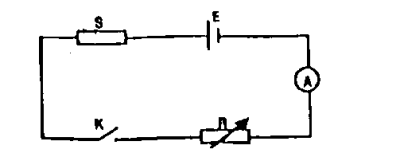
3a. (i) Measure and record the e.m.f of the accumulator provided.
(ii) Connect the circuit as shown in the diagram. S is a standard resistor, and R is a resistance box.
(iii) With R = 0 Ω, close the key K. Read and record the ammeter reading I. Evaluate I\(^{-1}\).
(iv) Repeat the procedure for R = 1, 2, 3, 4, and 5 Ω. Tabulate your readings.
(v) Plot a graph of R on the vertical axis and I\(^{-1}\) on the horizontal axis, starting both axes from the origin (0,0).
(vi) Determine the slope s of the graph and find the intercept c on the vertical axis.
(vii) State two precautions taken to ensure accurate results. [21 marks]
bi. State two advantages of a lead-acid accumulator over a Leclanche cell. [2 marks]
ii. A parallel combination of 3 Ω and 4 Ω resistors is connected in series with a resistor of 4 Ω and a battery of negligible internal resistance. Calculate the effective resistance in the circuit. [2 marks]
Attached Figure / Diagram
medium Difficulty
Verified Correct Answer: Option
Physical Principles & Numerical Solution
3a. The e.m.f of the accumulator = 1.5V
Tables of values
R(\(\Omega\))
I(A)
I\(^{-1}\)((A\(^{-1}\))
0
0.78
1.28
1
0.50
2.00
2
0.38
2.63
3
0.30
3.33
4
0.25
4.00
5
0.22
4.55
S = \(\frac{y_2 - y_1}{x_2 - x_1}\) = \(\frac{4 - 2}{4 - 1}\) = \(\frac{2}{3}\) = 0.67
The intercept on the vertical axis = 1.32\(\Omega\)
Precautions:
(i) I ensured all electrical connections were securely tightened to prevent loose contacts, which could lead to fluctuating or inaccurate readings.
(ii) I avoided parallax error by positioning my eyes directly in line with the scale when reading the ammeter or voltmeter for precise measurements.
(iii) I checked and corrected for any zero error on the ammeter and voltmeter before taking readings to improve accuracy.
(iv) I removed the key from the circuit when not taking measurements to avoid unnecessary heating and potential damage to components.
(v) I took multiple readings at each data point and averaged the values to minimize random errors and ensure more reliable results.
(vi) I ensured the apparatus was properly calibrated and regularly checked for consistency throughout the experiment.
bi. 1. Rechargeability: A lead-acid accumulator is rechargeable, making it more suitable for long-term use, whereas a Leclanché cell is primarily a primary (non-rechargeable) cell.
2. Higher Current Supply: Lead-acid accumulators can deliver higher currents, making them ideal for applications requiring significant power, like in vehicles, while Leclanché cells are suitable for low-current devices.
3. Longer Lifespan: Due to its rechargeable nature, the lead-acid accumulator has a longer operational life compared to a Leclanché cell, which has a limited lifespan and must be replaced after depletion.
4. Stable Voltage: Lead-acid accumulators provide a relatively stable output voltage during discharge, while the voltage of a Leclanché cell drops significantly over time.
bii. Since 3 \Omega and 4 \Omega are connected in parallel,
\(\frac{1}{\text{R}}\) = \(\frac{1}{3}\) + \(\frac{1}{4}\)
\(\frac{1}{\text{R}}\) = \(\frac{4 + 3}{12}\)
\(\frac{1}{\text{R}}\) = \(\frac{7}{12}\)
R = \(\frac{12}{7}\) = 1.71 \Omega
Now, 1.71 \Omega is connected in series with 4 \Omega.
∴ The effective resistance in the circuit = 1.71 \Omega + 4 \Omega = 5.71 \Omega
Source: WAEC / JAMB / NECO Classroom Archive (Record #76605)
Physics
UTME / JAMB 2025
Energy and Power
Solution
A 500W electric oven plugged into a 220 V source will consume an electric current of
A
4.88A
B
2.27A
C
6.43A
D
3.23A
medium Difficulty
Verified Correct Answer: Option B
Physical Principles & Numerical Solution
Answer: B. 2.27A
(I = \(\frac{\text{P}}{\text{V}}\) = \(\frac{500}{220}\) ≈ 2.27 A.)
Source: WAEC / JAMB / NECO Classroom Archive (Record #74361)