Question Library
Browse, filter, and study verified past examination questions with step-by-step mathematical reasoning.
Searching 18,000+ Questions...
Sifting topics, KaTeX formulas & verified solutions
Showing 301–315 of 784 verified questions
Sort by:
Physics
WAEC / WASSCE 2006
Waves and Optics
A ray from a fixed object is incident on a plane mirror at an angle of 20o. If the mirror is rotated through 30o by how many degree would the reflected ray rotate?
A
60o
B
50o
C
40o
D
30o
medium Difficulty
Verified Correct Answer: Option A
Physical Principles & Numerical Solution
No expanded working has been attached for this question yet. The verified answer is Option A.
Source: Myschool Past Questions Archive (Record #34672)
Physics
WAEC / WASSCE 2006
Waves and Optics
Solution
Which of the following distances is usually adjustable in the camera? The distance between the
A
lens and the film
B
diaphragm and the shutter
C
shutter and the film
D
diaphragm and the film
medium Difficulty
Verified Correct Answer: Option A
Physical Principles & Numerical Solution
The lens and the film: This distance can be adjusted for focusing the image on the film or sensor, while the distance between the diaphragm and the shutter (B) is generally fixed and not usually adjustable.
Source: Myschool Past Questions Archive (Record #34675)
Physics
WAEC / WASSCE 2006
Waves and Optics
In which of the following media would sound wave travel fastest?
A
wood
B
water
C
iron
D
mercury
medium Difficulty
Verified Correct Answer: Option C
Physical Principles & Numerical Solution
No expanded working has been attached for this question yet. The verified answer is Option C.
Source: Myschool Past Questions Archive (Record #34682)
Physics
WAEC / WASSCE 2006
Waves and Optics
Solution
A paralIel beam of unpolarized light is incident on a plane glass of refractive index 1.60 at an angle to the normal. If the reflected beam is completely polarized, calculate the angle of incidence of the beam.
medium Difficulty
Verified Correct Answer: Option
Physical Principles & Numerical Solution
tan\(\theta = \mu \text{(Brewsters law)}\)
\(\theta tan^{-1} = \mu = tan{-1} 1.60 = 58^o\)
Source: Myschool Past Questions Archive (Record #53729)
Physics
WAEC / WASSCE 2006
Waves and Optics
Solution
List three observations in support of the de-Broglie's assumptions that moving particles behave like waves.
medium Difficulty
Verified Correct Answer: Option
Physical Principles & Numerical Solution
— Electrons show diffraction patterns
— They have frequencies or wavelengths
— They show fraction or reflection
— The molecular velocities can determined in gases
Source: Myschool Past Questions Archive (Record #53730)
Physics
WAEC / WASSCE 2006
Waves and Optics
Solution
(a) With the aid of ray diagrams, explain total internal reflection.
(b) Describe, with the aid of a labelled diagram, the essential features of an astronomical telescope in normal adjustment.
(c) A converging lens forms a real image of a real object. If the magnification is 2 and the distance between the image and the object is 90.0 cm, determine the
(i) focal length of the lens;
(ii) object distance for which the image would be the same size as the object.
medium Difficulty
Verified Correct Answer: Option
Physical Principles & Numerical Solution
(a) Consider a ray of light travelling from a denser medium (glass) to a less dense medium (air) at a small angle of incidence.
(i)
As angle of incidence increases i, the angle of refraction r also increases, at a point when r = 90^\circ, i = C (the critical angle)
If the angle of incidence i is made greater than the critical angle C no refraction in the less dense medium, the ray is totally internally reflected.
(b)
An astronomical telescope consists of two converging lenses i.e an objective lens of long focal length fo and an eye piece of short focal length fe. In normal adjustment the principal foci of the lenses coincide, the separation of the lenses d = fo + fe.
(c)(i) But M = \(\frac{v}{u} = 2 = \frac{v}{u}\)
v = 2u
u + v = 90
u + 2u = 90
u = 30cm
f = \(\frac{uv}{u + v} = \frac{u \times 2u}{u + 2u} = \frac{2u}{3}\)
= \(\frac{2 \times 30}{3}\) = 20cm
(iii) U = 2f = 2 x 20
= 40cm
Source: Myschool Past Questions Archive (Record #53737)
Physics
WAEC / WASSCE 2006
Waves and Optics
Solution
You have been provided with a rectangular glass prism, optical pins, and other necessary apparatus. Using the above diagram as a guide, carry out the following instructions:
Fix the drawing paper provided to the drawing board
Place the glass prism on the drawing paper and trace the outline, ABCD of the prism
Remove the prism, mark a point O on AB such that AO is about one-quarter of AB
Draw a normal through point O. Also draw an incident ray to make an angle i = 25 with the normal at O. Fix two pins at \(P_1\) and \(P_2\) On the incident ray.
Replace the prism. Fix two other pins at \(P_3\) and \(P_4\) such that the pins appear to be in a straight line with the images of the pins at \(P_1\) and \(P_2\) when viewed through the block along DC
remove the prism. Join points Pa and P4 and produce it to meet DC at 1. Also, draw a line to join Ol (
With O as center and using any Concinient radius, draw a circle to Cut the incident ray and the refracted ray at E and H respectively. Maintain this radius throughout the experiment
Draw the perpendiculars EF and GH. Measure and record d= EF and I= GH.
Repeat the procedure for four other values of i = 35^\circ, 45, 55^\circ, and 65^\circ respectively. In each case measure and record d and I
Plot a graph of d on the vertical axis against I on the horizontal axis
Determine the slope of the graph
State two precautions taken to ensure accurate results. [Attach your traces to your answer booklet)
(b)i. State Snell's law.
ii. Calculate the critical angle for a water-air interface. [refractive index of water = \(\frac{4}{3}\)]
medium Difficulty
Verified Correct Answer: Option
Physical Principles & Numerical Solution
Table of values (Observation)
S/N
iº
d(cm)
i (cm)
1
25^\circ
0.85
0.55
2
35^\circ
1.15
0.75
3
45^\circ
1.50
0.95
4
55^\circ
1.65
1.10
5
65^\circ
1.85
1.20
Slope of the graph = \(\frac{y}{x} = \frac{\bigtriangleup {d}}{\bigtriangleup {L}} = \frac{1.4}{0.9}\) = 1.56
Precautions:
I ensured that pins were vertical.
l ensured that pins were reasonably spaced (at least 1 cm apart) and pinpoints were seen on traces.
I ensured neat traces (sharp pencils)
I noted and corrected zero errors on the metre rule.
l avoided parallax using metre rule/protractor
(b) Snell's law states that for a given pair of media, the ratio of the sine of the angle of incidence to the sine of the angle of refraction is always a constant. Or The ratio of the sine of the angle of incidence to the sine of the angle of refraction is a constant for the media concerned. Or
\(\frac{\text {sin i}}{\text {sin r}}\) = a constant for a given pair of media where
i = angle of incidence and
r = angle of refractions.
ii. \(\frac{1}{\text { sin C}}\) = \(_{a}\)\(n_w\)
Where C = critical angle, and
\(_{a}\)\(n_w\) = refractive index of water.
i.e. sin C = \(\frac{3}{4}\) = 0.75
C = sin\(^{-1}\), 0.75 = 48.6^\circ
Source: Myschool Past Questions Archive (Record #60068)
Physics
UTME / JAMB 2005
Waves and Optics
Solution
Marching soldiers crossing a suspension bridge are usually advised to break their steps to avoid damaging the bridge owing to
A
oscillation
B
resonance
C
swinging
D
vibration
medium Difficulty
Verified Correct Answer: Option B
Physical Principles & Numerical Solution
Marching soldiers crossing a suspension bridge are usually advised to break their steps to avoid damaging the bridge owing to resonance. The steps of the marching soldiers can set the bridge into vibration, and when the frequency of the bridge is equal to that of the steps of the soldiers, the resonance occurs,and at this resonance, the bridge vibrates violently with maximum amplitude, and can collapse.
Source: Myschool Past Questions Archive (Record #13167)
Physics
UTME / JAMB 2005
Waves and Optics
Solution
The sharpness of the boundary of the shadow of an object is determined by the
A
intensity of light striking the object
B
rays of light passing through the object
C
nature of the object
D
opacity of the object
medium Difficulty
Verified Correct Answer: Option A
Physical Principles & Numerical Solution
The characteristics of a shadow are dependent on the intensity of the light source. A hard light will produce a shadow with a sharp edge, a soft light will produce a shadow with a more blurry edge.
Source: Myschool Past Questions Archive (Record #13240)
Physics
UTME / JAMB 2005
Waves and Optics
Solution
A real image three times the size of an object is formed 24cm from a converging mirror. what is the focal length of the mirror.
A
16cm
B
6cm
C
8cm
D
12cm
medium Difficulty
Verified Correct Answer: Option B
Physical Principles & Numerical Solution
for a real image 3 times the size of the object, it implies that the magnification 3 = v/u, 3 = 24/u, therefore 3u = 24, u = 8cm thus we have from the relation:m = (f)/(u)-f; that 3 = (f)/(8) - f. therefore f = 3(8-f) f = 24 - 3f ∴4f = 24; f = 6cm OR: (1)/(u) + (1)/(v) = (1)/(f).
(1)/(8) + (1)/(24) = (1)/(f)
therefore (3+1)/(24) = (1)/(f)
4/24=1/f;therefore 4f = 24
f = 6cm
Source: Myschool Past Questions Archive (Record #13654)
Physics
UTME / JAMB 2005
Waves and Optics
Diagram
Solution
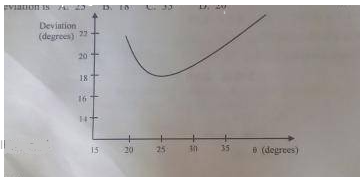
The figure above shows a plot of angles of deviation through a glass prism when light is incident at \theta degrees on the prism. The incident angle that produces the minimum deviation is
Attached Figure / Diagram
A
20o
B
18o
C
35o
D
25o
medium Difficulty
Verified Correct Answer: Option D
Physical Principles & Numerical Solution
From the given graph, when the angle of minimum deviation = 18º, the angle of incidence = 25º
Source: Myschool Past Questions Archive (Record #14271)
Physics
WAEC / WASSCE 2005
Waves and Optics
The frequency of a swinging pendulum is the
A
number of complete oscillations the pendulum makes in a second
B
number of amplitudes the bob makes in a second
C
angle the bob swings through in a second
D
distance the bob covers in a second
medium Difficulty
Verified Correct Answer: Option A
Physical Principles & Numerical Solution
No expanded working has been attached for this question yet. The verified answer is Option A.
Source: Myschool Past Questions Archive (Record #34454)
Physics
WAEC / WASSCE 2005
Waves and Optics
Which of the following statements about a progressive mechanical wave is correct?
A
it can be a plane polarised
B
its energy is localised at specific points of its profile
C
it does not require a material medium for its propagation
D
its frequency remains constant as it travels between different media
medium Difficulty
Verified Correct Answer: Option D
Physical Principles & Numerical Solution
No expanded working has been attached for this question yet. The verified answer is Option D.
Source: Myschool Past Questions Archive (Record #34488)
Physics
WAEC / WASSCE 2005
Waves and Optics
Solution
The distance between two points in phase on a progressive wave is 5cm. If the sped of the wave is 0.2ms-1, calculate its period
A
4.00s
B
2.50s
C
0.25s
D
0.04s
medium Difficulty
Verified Correct Answer: Option C
Physical Principles & Numerical Solution
F = \(\frac{v}{\lambda} = \frac{0.2}{5 \times 10^{-2}} = 4Hz\)
T = \(\frac{1}{f} = \frac{1}{4} = 0.25s\)
Source: Myschool Past Questions Archive (Record #34516)
Physics
WAEC / WASSCE 2005
Waves and Optics
Solution
Radio waves travel in air at 3.0 x 10⁸ms-1. If the waves enter water of refractive index \(\frac{4}{3}\), calculate the speed of radio waves in water
A
4.33 x 10⁸ms-1
B
4.00 x 10⁸ms-1
C
2.25 x 10⁸ms-1
D
1.33 x 10⁸ms-1
medium Difficulty
Verified Correct Answer: Option C
Physical Principles & Numerical Solution
\(_an_w = \frac{4}{3} = \frac{\text{speed of light in air}}{\text{speed of light in water}}\)
\(\frac{4}{3} = \frac{3 \times 10^8}{x}\)
x = \(\frac{9 \times 10^4}{4}\)
= 2.25 x 10⁸m/s
Source: Myschool Past Questions Archive (Record #34517)