Question Library
Browse, filter, and study verified past examination questions with step-by-step mathematical reasoning.
Searching 18,000+ Questions...
Sifting topics, KaTeX formulas & verified solutions
Showing 301–315 of 1709 verified questions
Sort by:
Physics
WAEC / WASSCE 2017
Mechanics and Properties of Matter
Solution
(a) (i) What is nuclear fission?
(ii) State the function of each of the following ma-terials in a nuclear fision reactor:
(\(\alpha\)) graphite, (\(\beta\)) boron rods; (\(\gamma\)) liquid sodium
(b) The table below gives some of the energy levels of a hydrogen atom.
n
1
2
3
4
5
\(\infty\)
E\(_n\)/\_eV\)
-13.60
-3.39
-1.51
-0.85
-0.54
0.00
(i) Draw the energy level diagram for the atom.
(ii) Determine the wavelength of the photon emitted when the atom goes from the energy state n = 3 to the ground state. [h = 6.6 x 10\(^{-34}\) Js, c = 3 x 10\(^{8}\)ms\(^{-1}\), e = 1.6 x 10\(^{-19}\)]
(c) A piece of ancient bone from an excavation site showed \(^{14}_{6}\)C activity of 9.5 disintegrations per minute per 1.0x10\(^{-3}\)kg. If a bone specimen from a living creature shows \(^{14}_{6}\)C activity of 12.0 disintegrations per minute per 1.0 x 1 0\(^{-3}\), determine the age of the ancient bone. [Half - life of \(^{14}_{6}\)C = 5572 years].
medium Difficulty
Verified Correct Answer: Option
Physical Principles & Numerical Solution
(a)(i) Nuclear Fission is the splitting up of a heavy nucleus into lighter nuclei with release of a huge amount of energy and neutrons.
(ii) (\(\alpha\)) graphite; (\(\beta\)) Boron rods; (\(\gamma\) )Liquid sodium
Material
Function
Graphite
Slows down high energetic neutrons in the reaction chamber.
Boron rods
To absorb excess neutrons so as to control fission rate
Liquid sodium
Extraction / conduction of excess heat from the reaction chamber.
(b)(i) E\(_n\), n = \(\alpha\) ---------------------------------- 0.eV
E\(_4\), n = 5 ---------------------------------------------------- - 0.54eV
E\(_3\), n = 4 ---------------------------------------------------- - 0.85eV
E\(_2\), n = 3 ---------------------------------------------------- 1.51eV
E\(_1\), n = 2 ------------------------------------------------------ 3.39eV
(ii) Using \(\lambda\) = \(\frac{hc}{\Delta E}\)
= \(\frac{6.6 \times 10^{-34} \times 3.0 \times 10^8}{(-1.51 - ( - 13.60)) \times 1.6 \times 10^{-19}}\)
= 1.02 x 10\(^{-7}\)m
(c) \(\lambda\) = \(\frac{0.693}{ T^{\frac{1}{2}}}\) = \(\frac{0.693}{5572}\)
= 0.0001244 years\(^{-1}\)
N = Noe\(^{- \lambda t}\)
e\(^{0.0001244t}\) = 1.2632
0.0001244t = 0.234
t = 1878 years
Source: Myschool Past Questions Archive (Record #52904)
Physics
WAEC / WASSCE 2017
Mechanics and Properties of Matter
Diagram
Solution
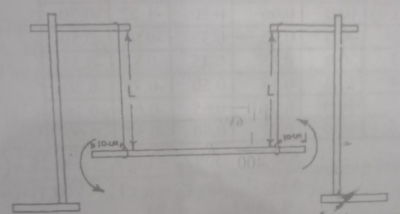
You are provided with two retort stands, two-metre rules, pieces of thread, and other necessary apparatus. ( see illustration above)
i. Set up the apparatus as illustrated above ensuring the strings are permanently 10cm from either end of the rule.
ii. Measure and record the length L = 80 cm of the two strings.
iii. Hold both ends of the rule and displace the rule slightly, then release so that it oscillates about a vertical axis through its centre.
iv. Determine and record the time t for 10 complete oscillations.
v. Determine the period T of oscillations.
vi. Evaluate log T and L.
vii. Repeat the procedure for four other values of L= 70 cm, 60 cm, 50 cm, and 40 cm
viii. Tabulate your readings.
ix. Plot a graph with log T on the vertical axis and log L on the horizontal axis.
x. Determine the slope, s, and the intercept, c on the vertical axis.
xi. State two precautions taken to ensure accurate results.
(b)i. Define simple harmonic motion.
ii. Determine the value of L corresponding to t= 12 s from the graph in 1.
Attached Figure / Diagram
medium Difficulty
Verified Correct Answer: Option
Physical Principles & Numerical Solution
S/N
L/CM
t/s
T=t/o/S
LogT/S
LogL/cm
1
80.0
17.90
1.79
0.252
1.903
2
70.0
17.30
1.73
0.238
1.845
3
60.0
15.34
1.53
0.185
1.775
4
50.0
13.90
1.39
0.145
1.698
5
40.0
13.06
1.31
0.155
1.602
Slope (s) = \(\frac{\bigtriangleup \text{logT}_{2}}{\bigtriangleup\text{logL}_{2}}\) - \(\frac{\bigtriangleup \text{logT}_{1}}{\bigtriangleup\text{logL}_{1}}\)
= \(\frac{0.15 - 0.05}{0.164 - 0.148}\)
= \(\frac{0.100}{0.016}\) = 6.25
PRECAUTIONS
1. avoided zero error in the reciding of the stop watch
2. avoided Parallax in reading the metre rule and the stop watch
3. ensured that the support of the bifilar pendulum is rigid
4. ensured smooth and regular oscillations in a horizontal plane.
b. i. Simple harmonic motion is defined as the motion of an object whose acceleration is proportional to the distance from a fixed point and is always directed towards that point
see graph above
Source: Myschool Past Questions Archive (Record #59906)
Physics
WAEC / WASSCE 2017
Mechanics and Properties of Matter
Solution
You are provided with a beaker, a thermometer, a stirrer Stopwatch/clock, measuring cylinder, table salt, water, and other necessary materials.
i. You Measure 200cm\(^{3}\) of water into the beaker.
ii. Heat the water until it boils steadily for about 2 minutes.
iii. Read and record the boiling point \(b_0\).
iv. Add table salt of mass M = 10.0 g to the boiling water and stir continuously until another boiling point \(b_1\) is attained.
v. Read and record \(b_i\).
vi. Evaluate \(\theta_{i}\) = (\(b_i\) - \(b_0\))
vii. Using the same mixture, repeat the procedure four more times by adding 10.0 g of salt each time to give the cumulative mass \(M_i\) of salt as 20 g, 30g, 40g, and 50g.
viii. In each case allow the mixture to boil steadily for at least 2 minutes then read and record the boiling point b.
ix. Tabulate your readings.
x. Plot a graph with \(M_i\) on the vertical axis and \(\theta_{1}\) on the horizontal axis.
xi. Determine the slope, s, of the graph.
xii. State two precautions taken to ensure accurate results.
(b) i. Define the boiling point of a liquid.
ii. What effects do impurities have on the boiling point of a liquid?
medium Difficulty
Verified Correct Answer: Option
Physical Principles & Numerical Solution
bo = 102^\circc
S/N
M/g
bi/ ^\circc
\(\theta_{1}\)=(bi-bo)/^\circ
1.0
10.0
104.00
104 - 102 = 2.00
2.0
20.0
106.00
106 - 102 = 4.00
3.0
30.0
108.00
108 - 102 = 6.00
4.0
40.0
110.00
110 - 102 = 8.00
5.0
50.0
112.00
112 - 102 = 10.00
Slope, s = \(\frac{\bigtriangleup M_{2} - \bigtriangleup M_{1}}{\bigtriangleup\theta_{2} - \bigtriangleup\theta_{1}}\)
= \(\frac{40}{8} - \frac{10}{2} = \frac{30}{6}\)
S = 5
PRECAUTIONS
1. stirred the water gently to ensure uniform temperature.
2. avoided splashing of the water
3. avoided error due to parallax in reading the thermometer and the stop clock.
(b) i. Boiling point is defined as the point when liquid changes to vapour when the saturation vapour pressure is equal to the atmospheric pressure.
ii. Impurities affect the boiling of a liquid because their presence inicreases the boiling rboint of the liquidelcom- pared to the boiling point of a pure solvent.
Source: Myschool Past Questions Archive (Record #59919)
Physics
UTME / JAMB 2016
Mechanics and Properties of Matter
Solution
A satellite moves in a circular orbit of radius 4R round the earth. The acceleration of the satellite in terms of g is
A
\(\frac{g}{16}\)
B
\(\frac{g}{4}\)
C
\(\frac{4}{g}\)
D
\(\frac{16}{g}\)
medium Difficulty
Verified Correct Answer: Option A
Physical Principles & Numerical Solution
\(\frac{g}{R^2}\) = \(\frac{g}{4^2}\) = \(\frac{g}{16}\)
Source: Myschool Past Questions Archive (Record #44663)
Physics
UTME / JAMB 2016
Mechanics and Properties of Matter
I.Chemical II.Sound III.Electricity
Which of the above forms of energy can directly be converted to light energy?
A
I and II only
B
II and III only
C
I, II and III
D
I and III only
medium Difficulty
Verified Correct Answer: Option D
Physical Principles & Numerical Solution
No expanded working has been attached for this question yet. The verified answer is Option D.
Source: Myschool Past Questions Archive (Record #44664)
Physics
UTME / JAMB 2016
Mechanics and Properties of Matter
Solution
The rate of cooling of a heated quantity of liquid in an enclosure depends on the
A
Pressure of the liquid
B
Temperature in the enclosure
C
Pressure of the enclosure
D
Volume of the liquid
medium Difficulty
Verified Correct Answer: Option B
Physical Principles & Numerical Solution
The temperature difference between the heated liquid and the surrounding environment (the enclosure) is a crucial factor in determining the rate of heat transfer.
According to Newton's Law of Cooling, the rate of cooling is proportional to the temperature difference between the object and its surroundings.
Source: Myschool Past Questions Archive (Record #44684)
Physics
UTME / JAMB 2016
Mechanics and Properties of Matter
A saturated vapour pressure of a liquid increases when the
A
Temperature of a liquid increases
B
Volume of the liquid increases
C
Volume of the liquid decreases
D
Temperature of the liquid decreases
medium Difficulty
Verified Correct Answer: Option A
Physical Principles & Numerical Solution
No expanded working has been attached for this question yet. The verified answer is Option A.
Source: Myschool Past Questions Archive (Record #44694)
Physics
UTME / JAMB 2016
Mechanics and Properties of Matter
Solution
What force has to be exerted on a mass 60kg to give it an acceleration of 10ms-2 vertically upwards?
[g = 10ms-2
A
300N
B
600N
C
1200N
D
400N
medium Difficulty
Verified Correct Answer: Option C
Physical Principles & Numerical Solution
F = Ma + mg = 60 x 10 x 60 x 10 = 1200N
Source: Myschool Past Questions Archive (Record #44696)
Physics
UTME / JAMB 2016
Mechanics and Properties of Matter
Solution
A metre rule is pivoted at its mid-point with a vertical force of 10N hanging from the distance 30cm from the mid-point. At what distance must a 15N force hang to balance the ruler horizontally?
A
30cm
B
10cm
C
20cm
D
25m
medium Difficulty
Verified Correct Answer: Option C
Physical Principles & Numerical Solution
Clockwise moment = Anti-clockwise moment
10 x 30 = 15 x X
X = 20cm
Source: Myschool Past Questions Archive (Record #44698)
Physics
UTME / JAMB 2016
Mechanics and Properties of Matter
Solution
A projectile is fired from the ground level with a velocity of 300ms-1 at an angle of a 30o to the horizontal.
Calculate the time taken to reach the maximum height?
[g = 10ms-2]
A
30s
B
20s
C
25s
D
15s
medium Difficulty
Verified Correct Answer: Option D
Physical Principles & Numerical Solution
The total time of flight is given as
\(T = \frac{2usin\theta}{g}\)
Hence, time to maximum height is half of the total time of flight,
t = \(\frac{u sin\theta}{g}\)
= \(\frac{300 \text {sin} 30}{10}\) = 15s
Source: Myschool Past Questions Archive (Record #44702)
Physics
UTME / JAMB 2016
Mechanics and Properties of Matter
Solution
A train with an initial velocity of 20ms-1 is subjected to a uniform deceleration of 2ms-2. The time required to bring the train to a complete halt is
A
40s
B
10s
C
20s
D
5s
medium Difficulty
Verified Correct Answer: Option B
Physical Principles & Numerical Solution
t = \(\frac{v - u}{a}\) = \(\frac{20 - 0}{2}\)
= 10s
Source: Myschool Past Questions Archive (Record #44706)
Physics
UTME / JAMB 2016
Mechanics and Properties of Matter
Solution
Calculate the temperature of 6 moles of an ideal gas at a pressure of 7.6 x 10⁶Nm-2 with a volume of 10-3m3.
[R = 8.3jmol-1K-1]
A
201oC
B
126oC
C
153oC
D
185oC
medium Difficulty
Verified Correct Answer: Option C
Physical Principles & Numerical Solution
T = \(\frac{PV}{nR}\) = \(\frac{7.6 x 10^6 x 10^-3}{6 x 8.3}\)
= 153oC
Source: Myschool Past Questions Archive (Record #44710)
Physics
UTME / JAMB 2016
Mechanics and Properties of Matter
The relative density of a liquid is the ratio of the
A
Mass of water to the mass of an equal volume of liquid
B
Upthrust in the liquid to the upthrust in water
C
Density of water to the density of the liquid
D
Upthrust in water to the upthrust in the liquid
medium Difficulty
Verified Correct Answer: Option B
Physical Principles & Numerical Solution
No expanded working has been attached for this question yet. The verified answer is Option B.
Source: Myschool Past Questions Archive (Record #44711)
Physics
UTME / JAMB 2016
Mechanics and Properties of Matter
What will happen to the pressure of a gas if its temperature is reduced to -273oC?
A
It will decrease
B
it will drop to zero
C
It will increase
D
It will remain constant
medium Difficulty
Verified Correct Answer: Option B
Physical Principles & Numerical Solution
No expanded working has been attached for this question yet. The verified answer is Option B.
Source: Myschool Past Questions Archive (Record #44712)
Physics
UTME / JAMB 2016
Mechanics and Properties of Matter
Solution
A manometer is an instrument used for measuring
A
Relative density of liquid
B
Pressure in liquids and gases
C
Humidity
D
Atmospheric pressure
medium Difficulty
Verified Correct Answer: Option B
Physical Principles & Numerical Solution
a manometer is used to measure pressure in liquids and gases. Manometer gauges measure the pressure of gases and vapors from atmospheric to about 1 Pa by balancing the force exerted by the gas or vapor against the weight of a column of liquid, usually mercury, water, or oil.
Source: Myschool Past Questions Archive (Record #44730)