Question Library
Browse, filter, and study verified past examination questions with step-by-step mathematical reasoning.
Searching 18,000+ Questions...
Sifting topics, KaTeX formulas & verified solutions
Showing 301–315 of 557 verified questions
Sort by:
Physics
NECO SSCE 2002
Electricity and Magnetism
Lenz’s law of electromagnetic induction states that
A
e.m.f. is induced in a circuit whenever there is a change in the magnetic flux linked with the circuit
B
the induced e.m.f. in a circuit is proportional to the rate of change f the number of lines of force linking the circuit
C
the induced current in a conductor is in such a direction as to oppose the change producing it
D
a force is exerted in a current-carrying conductor in a magnetic field.
E
the induced e.m.f. is proportional to the current producing the magnetic flux.
medium Difficulty
Verified Correct Answer: Option C
Physical Principles & Numerical Solution
No expanded working has been attached for this question yet. The verified answer is Option C.
Source: Myschool Past Questions Archive (Record #42886)
Physics
NECO SSCE 2002
Electricity and Magnetism
The phenomenon of photoelectric effect is NOT used in
A
automatic doors
B
bimetallic strip thermometers
C
light meters in cameras
D
setting off burglar alarms
E
sound production from film tracks.
medium Difficulty
Verified Correct Answer: Option B
Physical Principles & Numerical Solution
No expanded working has been attached for this question yet. The verified answer is Option B.
Source: Myschool Past Questions Archive (Record #42900)
Physics
UTME / JAMB 2002
Electricity and Magnetism
Solution
Explain the action of direct electric current in an electrolytic process with a dilute solution of sodium chloride as electrolyte
medium Difficulty
Verified Correct Answer: Option
Physical Principles & Numerical Solution
Ions present in dilute sodium chloride solution are -H\(^-\), OH\(^-\) and Cl\(^-\) + Na\(^+\). When D.C is passed through it positive ions H+ and Na+ are attracted to the cathode while negative ions OH\(^-\) and CI\(^-\) are attracted to the anode.
Source: Myschool Past Questions Archive (Record #54084)
Physics
UTME / JAMB 2002
Electricity and Magnetism
Solution
Explain why a direct electric current is used instead of an alternating current in electroplating.
medium Difficulty
Verified Correct Answer: Option
Physical Principles & Numerical Solution
When a D.C is a applied, the positive ions of the electrolyte are attracted to the cathode and the appropriate ions are discharged and deposited. But if an A.C. is used, the mass deposited during one half of the cycle will be completely removed during the next half cycle, hence there will be no electroplating.
Source: Myschool Past Questions Archive (Record #54088)
Physics
UTME / JAMB 2001
Electricity and Magnetism
Solution
when a piece of rectangular glass block is inserted between two parallel capacitor,at constant plate area and distance of separation, the capacitance of the capacitor will
A
increase
B
decrease
C
decrease then increase
D
remain constant
medium Difficulty
Verified Correct Answer: Option A
Physical Principles & Numerical Solution
When you insert a dielectric material (like glass) between the plates, the permittivity ε increases because the dielectric constant k of glass is greater than that of air or vacuum. The new capacitance when a dielectric is inserted is given
C′ = \(\frac{\text{kεoA}}{\text{d}}\)
where k is the dielectric constant of the glass, and ε\(_0\) is the permittivity of free space.
Since k >1 for glass, inserting it increases the capacitance:
C ′ = kC
Thus, with the glass block inserted, the capacitance C′ will be greater than the original capacitance C.
Source: Myschool Past Questions Archive (Record #9032)
Physics
UTME / JAMB 2001
Electricity and Magnetism
Solution
A cell can supply current of 0.4 A and 0.2 A through a 4.0Ω and 10.0Ω resistors respectively.
This internal resistance of the cell is
A
2.0Ω
B
1.0Ω
C
2.5Ω
D
1.5Ω
medium Difficulty
Verified Correct Answer: Option A
Physical Principles & Numerical Solution
let the internal resistance of the cell = r,
therefore E = I (R+r)
(i) E = 0.4(4+r), (ii) E = 0.2 (10+r)
therefore 0.4 (4+r)= 0.2 (10+r)
1.6 + 0.4r = \(2.0 \times 0.2\text{r}\)
0.4r - 0.2r = 2.0 - 1.6
therefore 0.2r = 0.4 => r = \(\frac{0.4}{0.2}\) = 2Ω
therefore r = 2Ω
Source: Myschool Past Questions Archive (Record #9034)
Physics
UTME / JAMB 2001
Electricity and Magnetism
Solution
A resistance R is connected across the terminal of an electric cell of internal resistance 2Ω and the voltage was reduced to 3/5 of its nominal value.
The value of R is
A
3 Ω
B
2 Ω
C
1 Ω
D
6 Ω
medium Difficulty
Verified Correct Answer: Option A
Physical Principles & Numerical Solution
I = \(\frac{V}{R}\) = \(\frac{E}{R+r}\) , if r = 2Ω
V = \(\frac{3}{5}\)E
=> \(\frac{3E}{5R} = \frac{E}{R+2}\)
i.e 3E(R+2) = 5RE
3RE + 6E = 5RE ( the Es will cancel out)
i.e 3R + 6 = 5R
6 = 5R - 3R
=> 2R = 6 i.e R = \(\frac{6}{2}\) = 3Ω
Source: Myschool Past Questions Archive (Record #7280)
Physics
UTME / JAMB 2001
Electricity and Magnetism
Solution
A student is at a height 4m above the ground during a thunderstorm. Given that the potential difference between the thundercloud and the ground is 10\(^7\)V, the electric field created by the storm is
A
2.0 x 10\(^6\) NC\(^{-1}\)
B
2.5 x 10\(^6\) NC\(^{-1}\)
C
1.0 x 10\(^7\) NC\(^{-1}\)
D
4.0 x 10\(^7\) NC\(^{-1}\)
medium Difficulty
Verified Correct Answer: Option B
Physical Principles & Numerical Solution
E = \(\frac{V}{d}\)
E is the electric field (in volts per meter, V/m),
V is the potential difference (in volts, V),
d is the distance between the two points (in meters, m)
Given: Potential difference V = 10\(^7\)
Height d = 4m
That is, E = \(\frac{10^7}{4} = 2.5\times 10^6 NC^{-1}\)
Source: Myschool Past Questions Archive (Record #7286)
Physics
UTME / JAMB 2001
Electricity and Magnetism
Solution
The current through a resistor in an a.c circuit is given as 2 sin wt. Determine the d.c. equivalent of the current
A
\(\frac{1A}{\sqrt{2}}\)
B
\(\sqrt{2}\)A
C
2 A
D
2\(\sqrt{2}\)A
medium Difficulty
Verified Correct Answer: Option B
Physical Principles & Numerical Solution
If I = 2 Sin wt; but in a.c. circuit current I = I\(_0\) Sin wt; thus comparing the two equations, it implies that I\(_0\) = 2A; Again, the root means square (I(rms)) of an a.c. current is the value of the d.c. current that will dissipate the same amount of heat in a given resistance as the a.c.
and I(rms) = \(\frac{I_0}{\sqrt{2}}\) = \(\frac{2.0A}{\sqrt{2}}\) = \(\sqrt{2}\)A (by rationalizing the denominator \(\frac{2.0A}{\sqrt{2}}\))
Source: Myschool Past Questions Archive (Record #9069)
Physics
UTME / JAMB 2001
Electricity and Magnetism
Solution
A transistor function mainly as a
A
switch and amplifier
B
rectifier and an amplifier
C
charge storer and an amplifier
D
charge storer and a switch
medium Difficulty
Verified Correct Answer: Option A
Physical Principles & Numerical Solution
Transistors are versatile components used in electronic circuits mainly for two purposes: they can act as electronic switches, controlling the flow of current in a circuit, and they can amplify electrical signals, making them essential in audio devices, radios, and various electronic applications. Thus, option A correctly describes the main functions of a transistor.
Source: Myschool Past Questions Archive (Record #9211)
Physics
UTME / JAMB 2001
Electricity and Magnetism
Diagram
Solution
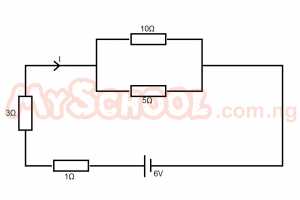
In the diagram above , the current I is
Attached Figure / Diagram
A
3/8
B
9/11
C
11/9
D
8/3
medium Difficulty
Verified Correct Answer: Option B
Physical Principles & Numerical Solution
I = \(\frac{E}{R + r}\)
For parallel of 5\Omega and 10\Omega
\(\frac{1}{R}\) = \(\frac{1}{10}\) + \(\frac{1}{5}\) = \(\frac{1+2}{10}\) = \(\frac{3}{10}\)
∴R = \(\frac{10}{3}\)
Total R = 3\(\frac{1}{3}\) + 3 x 1 = 7\(\frac{1}{3}\)
∴I = 6\(\div\) 7\(\frac{1}{3}\) = \(\frac{6}{1}\) x \(\frac{3}{22}\) = \(\frac{18}{22}\) = \(\frac{9}{11}\)
∴I = \(\frac{9}{11}\)
Source: Myschool Past Questions Archive (Record #11835)
Physics
UTME / JAMB 2001
Electricity and Magnetism
Diagram
Solution
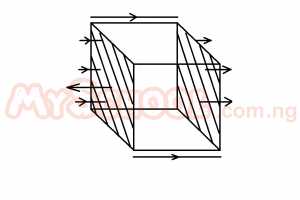
The diagram above shows a closed side 0.5m in a uniform electric field E in the direction shown by the arrows. What is the flux Φ for the box?
Attached Figure / Diagram
A
0.5 E
B
2.0 E
C
0.2 E
D
0.0 E
medium Difficulty
Verified Correct Answer: Option D
Physical Principles & Numerical Solution
0.0 E since one of the electric fields points in the opposite direction (left)
Source: Myschool Past Questions Archive (Record #11868)
Physics
UTME / JAMB 2001
Electricity and Magnetism
Diagram
Solution
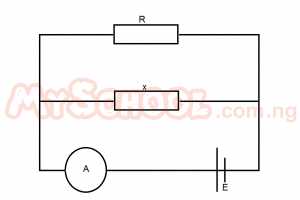
In the circuit diagram above , the ammeter reads a current of 3A when R is 5\Omega and 6A when R is 2\Omega. Determine the value of x
Attached Figure / Diagram
A
8Ω
B
2Ω
C
10Ω
D
4Ω
medium Difficulty
Verified Correct Answer: Option C
Physical Principles & Numerical Solution
for a parallel R and X, when R = 5\Omega,
Effective resistance R = \(\frac{5X}{5 + X}\)
and when R = 2\Omega
Effective resistance R = \(\frac{2X}{2 + X}\)
Thus since E = I(R+r), and if r = 0 then E = IR
∴(i) E = 3(\(\frac{5X}{(5+x)}\)); (ii) E = 6(\(\frac{2X}{(2+x)}\))
∴3(\(\frac{5X}{(5+X)}\)) = 6(\(\frac{2X}{(2+X)}\))
=> (\(\frac{5X}{(5+X)}\)) = 2(\(\frac{2x}{(2+X)}\))
∴ (\(\frac{5X}{(5+X)}\)) = (\(\frac{4X}{(2+X)}\))
5x(2+x) = 4x(5+x)
10x + 5x\(^2\) = 20x + 4x\(^2\)
5x\(^2\) - 4x\(^2\) = 20x - 10x
=> x\(^2\) = 10x
∴x\(^2\) - 10x = 0
x(x - 10) = 0
∴ x = 0 or 10
∴ x = 10\Omega
Source: Myschool Past Questions Archive (Record #11871)
Physics
UTME / JAMB 2001
Electricity and Magnetism
Diagram
Solution
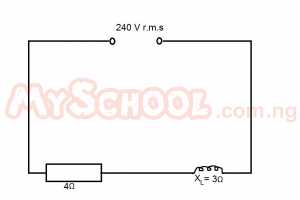
In the diagram above, determine the r.m.s current
Attached Figure / Diagram
A
31A
B
48A
C
60A
D
80A
medium Difficulty
Verified Correct Answer: Option B
Physical Principles & Numerical Solution
Ir.m.s = Vr.m.s/Z
But Z =
\sqrt R2 + XL2
=
\sqrt 42 + 32
=
\sqrt 16 + 9
=
\sqrt 25
∴Ir.m.s = 240/5
= 48.0A
Source: Myschool Past Questions Archive (Record #11875)
Physics
WAEC / WASSCE 2001
Electricity and Magnetism
Solution
An electric bulb is rated 60W, 220V. Calculate the resistance of its filament when it is operating normally
A
296.7\(\Omega\)
B
400.0\(\Omega\)
C
512.2\(\Omega\)
D
806.7\(\Omega\)
medium Difficulty
Verified Correct Answer: Option D
Physical Principles & Numerical Solution
R = \(\frac{v^2}{P} = \frac{220^2}{100} = 806.7\Omega\)
Source: Myschool Past Questions Archive (Record #33938)