Question Library
Browse, filter, and study verified past examination questions with step-by-step mathematical reasoning.
Searching 18,000+ Questions...
Sifting topics, KaTeX formulas & verified solutions
Showing 301–315 of 573 verified questions
Sort by:
Mathematics
UTME / JAMB 2002
Algebra
Solution
Find the maximum value of y in the equation y = 1 - 2x - 3x\(^2\)
A
5/4
B
5/3
C
3/4
D
4/3
medium Difficulty
Verified Correct Answer: Option D
Step-by-Step Mathematical Solution
\(y = 1 - 2x - 3x^2\)
At maximum point, \(\frac{\mathrm d y}{\mathrm d x} = 0\)
\(\frac{\mathrm d y}{\mathrm d x} = -2 - 6x\)
\(-2 - 6x = 0 \implies -2 = 6x\)
\(x = -\frac{1}{3}\)
At x = \(-\frac{1}{3}\), y = \(1 - 2(-\frac{1}{3}) - 3(-\frac{1}{3})^{2}\)
= \(1 + \frac{2}{3} - \frac{1}{3}\)
= \(\frac{4}{3}\)
Source: Myschool Past Questions Archive (Record #3354)
Mathematics
UTME / JAMB 2002
Algebra
Solution
If the 9th term of an A.P is five times the 5th term, find the relationship between a and d.
A
2a + 2 = 0
B
3a + 5d = 0
C
a + 3d = 0
D
a + 2d = 0
medium Difficulty
Verified Correct Answer: Option C
Step-by-Step Mathematical Solution
\(T_{n} = a + (n - 1) d\) (nth term of an AP).
\(T_{9} = 5T_{5}\)
\(a + 8d = 5(a + 4d) \implies a + 8d = 5a + 20d\)
\(5a - a + 20d - 8d = 0 \implies 4a + 12d = 0\)
\(a + 3d = 0\)
Source: Myschool Past Questions Archive (Record #3356)
Mathematics
UTME / JAMB 2002
Algebra
Solution
If -2 is the solution of the equation 2x + 1 - 3c = 2c + 3x - 7, find the value of c.
A
4
B
3
C
2
D
1
medium Difficulty
Verified Correct Answer: Option C
Step-by-Step Mathematical Solution
-2 is the solution implies x = -2.
2x + 1 - 3c = 2c + 3x - 7
2(-2) + 1 - 3c = 2c + 3(-2) - 7
-4 + 1 - 3c = 2c - 6 - 7
-3 + 13 = 2c + 3c \(\implies\) c = 2.
Source: Myschool Past Questions Archive (Record #3367)
Mathematics
UTME / JAMB 2002
Algebra
Solution
Find the equation of the set of points which are equidistant from the parallel lines x = 1 and x = 7
A
y = 3
B
x = 3
C
x = 4
D
y = 4
medium Difficulty
Verified Correct Answer: Option C
Step-by-Step Mathematical Solution
The line equidistant from x = 1 and x = 7 is
\(x = \frac{1 + 7}{2} \implies x = 4\)
Source: Myschool Past Questions Archive (Record #3376)
Mathematics
WAEC / WASSCE 2002
Algebra
Solution
Find the nth term of the sequence 4, 10, 16 ,...
A
2(3n- 1)
B
2(2 + 3 n-1)
C
2 n + 2
D
2(3n+2)
medium Difficulty
Verified Correct Answer: Option A
Step-by-Step Mathematical Solution
\(T_{1} = 4; T_2 = 10; T_3 = 16\)
\(T_{2} - T_1 = T_3 - T_1 = 6\)
\(T_n = a + (n - 1) d\)
= \(4 + (n - 1) \times 6\)
= \(4 + 6n - 6\)
= \(6n - 2\)
= 2(3n - 1)
Source: Myschool Past Questions Archive (Record #26537)
Mathematics
WAEC / WASSCE 2002
Algebra
Diagram
Solution
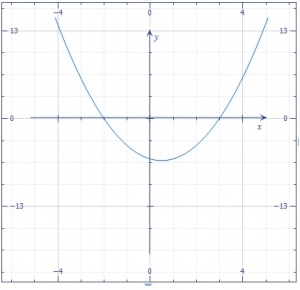
Which of the following is represented by the above sketch?
Attached Figure / Diagram
A
y = x2 + x - 6
B
y = x2 - x - 6
C
y = x2 - x + 6
D
y = x2 + x + 6
medium Difficulty
Verified Correct Answer: Option B
Step-by-Step Mathematical Solution
From the graph, the zeros of the equation exist at x = -2 and x = 3
\(\therefore\) (x + 2) = 0 and (x - 3) = 0
\(\implies (x + 2)(x - 3) = 0\)
\(x^2 - 3x + 2x - 6 = 0\)
\(x^2 - x - 6 = 0\) is the equation represented on the graph.
Source: Myschool Past Questions Archive (Record #26539)
Mathematics
WAEC / WASSCE 2002
Algebra
Solution
For what values of x is the expression \(\frac{3x-2}{4x^2+9x-9}\) undefined?
A
\(\frac{-3}{4} \hspace{1mm}or \hspace{1mm}3\)
B
\(\frac{-2}{3} \hspace{1mm}or \hspace{1mm}-3\)
C
\(\frac{2}{3} \hspace{1mm}or \hspace{1mm}3\)
D
\(\frac{3}{4} \hspace{1mm}or \hspace{1mm}-3\)
medium Difficulty
Verified Correct Answer: Option D
Step-by-Step Mathematical Solution
The equation \(\frac{3x - 2}{4x^2 + 9x - 9}\) is undefined when the denominator = 0.
\(4x^2 + 9x - 9 = 0\)
\(4x^2 + 12x - 3x - 9 = 0\)
\(4x(x + 3) - 3(x + 3) = 0\)
\((4x - 3)(x + 3) = 0\)
x = \(\frac{3}{4}\) or x = -3.
Source: Myschool Past Questions Archive (Record #26541)
Mathematics
NECO SSCE 2002
Algebra
A quadratic equation with roots -1\(\frac{1}{2}\) and \(\frac{1}{4}\) is
A
x2 + 3x + 4 = 0
B
8x2 + 10x + 3 = 0
C
8x2 +12x – 3 = 0
D
8x2 + 10x-3.= 0
E
8x2 + 12x + 3 = 0
medium Difficulty
Verified Correct Answer: Option D
Step-by-Step Mathematical Solution
No expanded working has been attached for this question yet. The verified answer is Option D.
Source: Myschool Past Questions Archive (Record #42161)
Mathematics
NECO SSCE 2002
Algebra
Solution
Solve the equation: \(\frac{1}{3}x\) + \(\frac{2}{5}\) = \(\frac{3}{4}x\) - \(\frac{1}{6}\)
A
\(\frac{17}{30}\)
B
\(\frac{65}{102}\)
C
\(\frac{25}{34}\)
D
\(\frac{102}{75}\)
E
\(\frac{34}{25}\)
medium Difficulty
Verified Correct Answer: Option E
Step-by-Step Mathematical Solution
\(\frac{1}{3}x\) + \(\frac{2}{5}\) = \(\frac{3}{4}x\) - \(\frac{1}{6}\)
collect like terms
\(\frac{2}{5}\) + \(\frac{1}{6}\) = \(\frac{3}{4}x\) - \(\frac{1}{3}x\)
\(\frac{17}{30}\) = \(\frac{5x}{12}\)
cross multiply
150x = 204
x = \(\frac{204}{150}\) = \(\frac{34}{25}\)
Source: Myschool Past Questions Archive (Record #42213)
Mathematics
WAEC / WASSCE 2002
Algebra
Solution
(a) A manufacturer offers distributors a discount of \(20%\) on any article bought and a further discount of \(2\frac{1}{2}%\) for prompt payment.
(i) if the marked price of an article is N25,000, find the total amount saved by a distributor for paying promptly. (ii) if a distributor pays N11,700 promptly for an article marked Nx, find the value of x.
(b) Factorize \(6y^{2} - 149y - 102\), hence solve the equation \(6y^{2} - 149y - 102 = 0\).
medium Difficulty
Verified Correct Answer: Option
Step-by-Step Mathematical Solution
(a) (i) First discount = 20% of N25,000
= \(\frac{20}{100} \times N25,000 = N5,000\)
Further discount for prompt payment = \(2\frac{1}{2}%\) of N25,000.
= \(\frac{5}{200} \times N25,000 = N625\)
\(\therefore \text{Total amount saved by distributor} = N(5,000 + 625)\)
= \(N5625\)
(ii) Total %age discount for prompt payment = \((20 + 2\frac{1}{2})% = 22\frac{1}{2}%\)
Therefore, the distributor paid \((100% - 22\frac{1}{2}%) \times Nx\)
= \(77\frac{1}{2}% \times Nx\)
\(\implies 77\frac{1}{2}% \times x = 11,700\)
\(x = \frac{11,700 \times 200}{155}\)
= \(N15,096.77\)
(b) \(6y^{2} - 149y - 102 \)
= \(6y^{2} - 153y + 4y - 102\)
= \(3y(2y - 51) + 2(2y - 51)\)
= \((3y + 2)(2y - 51)\)
\(\therefore 6y^{2} - 149y - 102 = 0 \implies (3y + 2)(2y - 51) = 0\)
\(3y + 2 = 0 \implies 3y = -2 \)
\(y = -\frac{2}{3}\)
\(2y - 51 = 0 \implies 2y = 51\)
\(y = 25\frac{1}{2}\)
\(\therefore y = -\frac{2}{3} ; y = 25\frac{1}{2}\)
Source: Myschool Past Questions Archive (Record #53318)
Mathematics
WAEC / WASSCE 2002
Algebra
Solution
(a) Simplify : \(\frac{1}{2}\log_{10} 25 - 2\log_{10} 3 + \log_{10} 18\)
(b) If \(123_{y} = 83_{10}\), obtain an equation in y, hence find the value of y.
(c) Solve the equation \(\frac{9^{2x - 3}}{3^{x + 3}} = 1\)
medium Difficulty
Verified Correct Answer: Option
Step-by-Step Mathematical Solution
(a) \(\frac{1}{2}\log_{10} 25 - 2\log_{10} 3 + \log_{10} 18\)
= \(\log_{10} (25^{\frac{1}{2}}) - \log_{10} (3^{2}) + \log_{10} 18\)
= \(\log_{10} (\frac{5 \times 18}{9})\)
= \(\log_{10} 10\)
= 1
(b) \(123_{y} = (1 \times y^{2}) + (2 \times y^{1}) + (3 \times y^{0})\)
\(y^{2} + 2y + 3 = 83\)
\(y^{2} + 2y + 3 - 83 = 0 \implies y^{2} + 2y - 80 = 0\)
Equation : \(y^{2} + 2y - 80 = 0\)
\(y^{2} - 8y + 10y - 80 = 0\)
\(y(y - 8) + 10(y - 8) = 0\)
\((y + 10)(y - 8) = 0 \implies y = -10 ; 8\)
y = 8 since y cannot be negative.
(c) \(\frac{9^{2x - 3}}{3^{x + 3}} = 1\)
\(\implies 9^{2x - 3} = 3^{x + 3}\)
\((3^{2})^{2x - 3} = 3^{x + 3}\)
\(3^{4x - 6} = 3^{x + 3}\)
\(\implies 4x - 6 = x + 3\)
\(4x - x = 3 + 6 \implies 3x = 9\)
\(x = 3\)
Source: Myschool Past Questions Archive (Record #53327)
Mathematics
WAEC / WASSCE 2002
Algebra
Solution
(a) The first term of an Arithmetic Progression(AP) is 3 and the common difference is 4. Find the sum of the first 28 terms.
(b) Given that \(x = \frac{2m}{1 - m^{2}}\) and \(y = \frac{2m}{1 + m}\), express 2x - y in terms of m in the simplest form.
(c) The angles of pentagon are x^\circ, 2x^\circ, 3x^\circ, 2x^\circ and (3x - 10)^\circ. Find the value of x.
medium Difficulty
Verified Correct Answer: Option
Step-by-Step Mathematical Solution
(a) \(a = 3; d = 4 ; n = 28\)
\(S_{n} = \frac{n}{2}(2a + (n - 1)d)\)
\(S_{28} = \frac{28}{2}(2(3) + (28 - 1) 4)\)
= \(14(6 + 108)\)
= \(14(114)\)
= \(1596\)
(b) \(x = \frac{2m}{1 - m^{2}} ; y = \frac{2m}{1 + m}\)
\(2x - y = 2(\frac{2m}{1 - m^{2}}) - (\frac{2m}{1 + m})\)
= \(\frac{4m}{1 - m^{2}} - \frac{2m}{1 + m}\)
= \(\frac{4m - 2m(1 - m)}{1 - m^{2}}\)
= \(\frac{4m - 2m + 2m^{2}}{1 - m^{2}}\)
= \(\frac{2m^{2} + 2m}{1 - m^{2}}\)
= \(\frac{2m(m + 1)}{(1 + m)(1 - m)}\)
= \(\frac{2m}{1 - m}\)
(c) Sum of interior angles = (2n - 4)90^\circ
When n = 5 (pentagon),
= \((2(5) - 4) \times 90^\circ\)
= \(540^\circ\)
\(x + 2x + 3x + 2x + (3x - 10) = 11x - 10\)
= \(11x - 10 = 540^\circ\)
= \(11x = 550^\circ\)
= \(x = 50^\circ\)
Source: Myschool Past Questions Archive (Record #53335)
Mathematics
WAEC / WASSCE 2002
Algebra
Solution
Given is the graph of the relation \(y = ax^{2} + bx + c\) where a, b and c are constants. Use the graph to :
(a) find the roots of the equation \(ax^{2} + bx + c = 0\);
(b) determine the values of constants a, b and c in the relation using the values of the coordinates P and Q and hence write down the relation illustrated in the graph
(c) find the maximum value of y and the corresponding value of x at this point.
(d) find the values of x when y = 2.
medium Difficulty
Verified Correct Answer: Option
Step-by-Step Mathematical Solution
(a) The roots of the equation are -1.5 or 2.
(b) C = 6 (intercept on the positive vertical axis)
\(ax^{2} + bx + c = 0\)
When x = 2, c = 6
\(4a + 2b + 6 = 0 \implies 4a + 2b = -6 ....(1)\)
When x = -1.5, c = 6
\(a(-1.5)^{2} + b(-1.5) = -6\)
\(\frac{9a}{4} - \frac{3b}{2} = -6 \implies 9a - 6b = -24 ... (2)\)
Multiply (1) by 3 : \(12a + 6b = -18 ... (1a)\)
(1a) + (2) : \(12a + 9a = -18 - 24 \implies 21a = -42\)
\(a = -2\)
\(4a + 2b = -6 \implies 4(-2) + 2b = -6\)
\(2b = -6 + 8 = 2 \implies b = 1\)
(a, b, c) = (-2, 1, 6)
Hence the relation illustrated in the graph is \(y = -2x^{2} + x + 6\).
(c) When \(x = 0.2, y_{max} = 6.2\)
(d) When \(y = 2, x = \text{ -1.2 or 1.7}\)
Source: Myschool Past Questions Archive (Record #53374)
Mathematics
UTME / JAMB 2001
Algebra
Solution
Solve the equations
m2 + n2 = 29
m + n = 7
A
(2, 3) and ( 3, 5)
B
(2, 5) and (5, 2)
C
(5, 2) and ( 5, 3)
D
(5, 3) and (3, 5)
medium Difficulty
Verified Correct Answer: Option B
Step-by-Step Mathematical Solution
m2 + n2 = 29 .......(1)
m + n = 7 ............(2)
From (2),
m = 7 - n
but m2 + n2 = 29, substituting;
(7-n)2 + n2 = 29
49 - 14n + n2 + n2 = 29
=> 2n2 -14n + 20 = 0
Thus n2 -7n + 10 = 0
Factorizing;
(n-5)(n-2) = 0
n - 5 = 0, => n = 5
n - 2 = 0, => n = 2.
When n = 5,
m + n = 7, => m = 2,
When n = 2,
m + n = 7, => m = 5.
Thus (m,n) = (5,2) and (2,5)
Source: Myschool Past Questions Archive (Record #1151)
Mathematics
UTME / JAMB 2001
Algebra
Solution
The sixth term of an A.P is half of its twelfth term. The first term of the A.P is equal to
A
zero
B
half of the common difference
C
double the common difference
D
the common difference
medium Difficulty
Verified Correct Answer: Option D
Step-by-Step Mathematical Solution
1st statement: U6 = 1/2(U12)
a + (n -1)d = 1/2[a + (n-1)d]
a + 5d = a + 11d
2(a + 5d) = a + 11d
2a + 10d = a + 11d
Solving, => a = d
Hence the first term is equal to the common difference
Source: Myschool Past Questions Archive (Record #1153)