Question Library
Browse, filter, and study verified past examination questions with step-by-step mathematical reasoning.
Searching 18,000+ Questions...
Sifting topics, KaTeX formulas & verified solutions
Showing 301–315 of 29811 verified questions
Sort by:
Physics
WAEC / WASSCE 2025
Heat and Temperature
Solution
The temperature of a glass vessel containing 100 cm\(^3\) of mercury is raised from 10°C to 100°C. Calculate the apparent cubic expansion of the mercury. (Real cubic expansivity of mercury = 1.8 × 10\(^{-4}\) K\(^{-1}\), Cubic expansivity of glass = 2.4 × 10\(^{-5}\) K\(^{-1}\))
A
1.87 cm\(^3\)
B
1.42 cm\(^3\)
C
14.22 cm\(^3\)
D
0.52 cm\(^3\)
medium Difficulty
Verified Correct Answer: Option B
Physical Principles & Numerical Solution
The apparent cubic expansion of mercury is the increase in its volume relative to the glass vessel (i.e., the volume of mercury that would overflow).
Let: \( V_0 = 100 \, \mathrm{cm}^3 \) (initial volume of mercury), \( \gamma_m = 1.8 \times 10^{-4} \, \mathrm{K}^{-1} \) (real cubic expansivity of mercury),
\( \gamma_g = 2.4 \times 10^{-5} \, \mathrm{K}^{-1} \) (cubic expansivity of glass), \( \Delta \theta = 100^\circ\mathrm{C} - 10^\circ\mathrm{C} = 90 \, \mathrm{K} \) (temperature rise).
The coefficient of apparent expansion is \(\gamma_a = \gamma_m - \gamma_g = 1.8 \times 10^{-4} - 2.4 \times 10^{-5} = 1.56 \times 10^{-4} \, \mathrm{K}^{-1}. \)
The apparent cubic expansion (change in volume) is \(\Delta V_a = V_0 \cdot \gamma_a \cdot \Delta \theta = 100 \times (1.56 \times 10^{-4}) \times 90.\)
First compute \( 1.56 \times 10^{-4} \times 90 = 0.01404 \),
then \(\Delta V_a = 100 \times 0.01404 = 1.404 \, \mathrm{cm}^3.\)
(Alternatively:
Real expansion of mercury = \( 100 \times 1.8 \times 10^{-4} \times 90 = 1.62 \, \mathrm{cm}^3 \).
Expansion of glass vessel = \( 100 \times 2.4 \times 10^{-5} \times 90 = 0.216 \, \mathrm{cm}^3 \).
Apparent expansion = \( 1.62 - 0.216 = 1.404 \, \mathrm{cm}^3 \).)
Thus, the apparent cubic expansion of the mercury is \( 1.404 \, \mathrm{cm}^3 \).
Source: WAEC / JAMB / NECO Classroom Archive (Record #76357)
Physics
WAEC / WASSCE 2025
Heat and Temperature
Solution
A balloon containing 546 cm\(^3\) of air is heated from 0°C to 10°C. If the pressure is kept constant, what will be its volume at 10°C?
A
556 cm\(^3\)
B
526 cm\(^3\)
C
546 cm\(^3\)
D
566 cm\(^3\)
medium Difficulty
Verified Correct Answer: Option D
Physical Principles & Numerical Solution
Using Charles' law;
\(\frac{V_1}{T_1} = \frac{V_2}{T_2}\)
\(\frac{546}{(0 + 273)} = \frac{V_2}{(10 + 273)}\)
V\(_2\) = \(\frac{546 \times 283}{273}\) = 566 cm\(^3\)
Source: WAEC / JAMB / NECO Classroom Archive (Record #76388)
Physics
UTME / JAMB 2025
Heat Transfer
Solution
A well-lagged thin metal rod of length 0.2 m has a temperature gradient of 416 K m\(^{-1}\). If one end is at 233º C, what is the temperature at the other end?
A
141.20°C
B
257.48°C
C
408.60°C
D
316.28°C
medium Difficulty
Verified Correct Answer: Option D
Physical Principles & Numerical Solution
Answer: D
Given a rod of length \( L = 0.2 \, \text{m} \) with a temperature gradient of \( 416 \, \text{K/m} \) and one end at \( T_1 = 233^\circ \text{C} \):
\(\Delta T = \text{gradient} \times L = 416 \, \text{K/m} \times 0.2 \, \text{m} = 83.2 \, \text{K}\)
The temperature at the other end \( T_2 \) is:
\(T_2 = T_1 + \Delta T = 233^\circ \text{C} + 83.2 \, \text{C} = 316.2^\circ \text{C}\)
Thus, the temperature at the other end is \( 316.2^\circ \text{C}\).
Source: WAEC / JAMB / NECO Classroom Archive (Record #74384)
Physics
UTME / JAMB 2025
Evaporation and Boiling
Solution
A collection of condensed suspended dust particles in the air constitute
A
Cloud
B
fog
C
Mist
D
Rain
medium Difficulty
Verified Correct Answer: Option B
Physical Principles & Numerical Solution
Clouds are collections of condensed water droplets or ice crystals suspended in the air, but high above the ground (typically hundreds of meters to kilometers up).
Fog is the same phenomenon (condensed suspended droplets, often with dust), but at ground level, reducing visibility.
The question specifies "in the air" near the surface (implied by dust particles and suspension context), so fog is correct, not cloud.
Source: WAEC / JAMB / NECO Classroom Archive (Record #74551)
Physics
WAEC / WASSCE 2025
Evaporation and Boiling
Solution
4a. Define the boiling point of a liquid.
b. Describe with the aid of a labelled diagram, an experiment to determine the boiling point of a small quantity of a liquid.
c. State two factors that may affect the boiling point of a liquid.
d. Using the kinetic theory of matter, explain why pure water changes to steam at S.T.P without any change in temperature, although heat is being supplied to the water.
medium Difficulty
Verified Correct Answer: Option
Physical Principles & Numerical Solution
a. The boiling point of a liquid is the temperature at which a (pure) liquid changes from the liquid to the gaseous state without a change in temperature when the atmospheric pressure is normal (760 mmHg)
b. Aim: To determine the boiling point of a small quantity of a liquid
Apparatus: J-tube, thermometer, water, beaker & source of heat.
Procedure: The J-tube, as shown in the diagram, is heated in a beaker of water, and the water in the J-tube is monitored. It remains trapped until the water in the beaker is boiling. Then the water in the tube comes to the same level in each limb, showing that the pressure of the vapour in the closed limb is equal to the pressure of air outside. Conclusion: Equal levels in the two limb shows that the vapour pressure is equal to the atmospheric pressure, which is the boiling point of the liquid. The experiment is repeated, and the mean is taken.
c. (i). Presence of impurities (ii). Pressure on the liquid (iii) Nature of liquid.
d. According to the kinetic theory of matter, temperature depends on the average kinetic energy of the molecules. When pure water boils, the heat supplied is not used to increase the kinetic energy of the molecules. Instead, it is used to overcome the intermolecular forces holding the water molecules together in the liquid state.
This energy, called latent heat of vaporization, separates the molecules to form steam. Since the kinetic energy of the molecules does not increase, the temperature remains constant until all the water has changed to steam.
Source: WAEC / JAMB / NECO Classroom Archive (Record #76501)
Physics
UTME / JAMB 2025
Gravitational Field
Solution
If the weight of an object on the Earth's surface is 2.5 x 10\(^3\)N, what is its weight on the moon's surface if the gravitational force of the moon is one-sixth of the Earth's(g = 10m/s\(^{-2}\))
A
360.87N
B
416.67N
C
214.49N
D
510.79N
medium Difficulty
Verified Correct Answer: Option B
Physical Principles & Numerical Solution
Weight on Earth:
\(W_e = 2.5 \times 10^3 \, \text{N}, \quad g_e = 10 \, \text{m/s}^2\)
Mass: \(m = \frac{W_e}{g_e} = \frac{2500}{10} = 250 \, \text{kg}\)
Moon's gravity is approximately \( \frac{1}{6} \) of Earth's:
\(g_m = \frac{10}{6} \, \text{m/s}^2\)
Weight on the Moon: \(W_m = m \times g_m = 250 \times \frac{10}{6} = \frac{2500}{6} \approx 416.67 \, \text{N}\)
Thus, the weight on the Moon is: 416.67N
Source: WAEC / JAMB / NECO Classroom Archive (Record #74570)
Physics
UTME / JAMB 2025
Gravitational Field
Solution
The gravitational force between two masses, P and Q, is 10N, find the new value of the force if both masses are doubled
A
40.0N
B
20.0N
C
10.0N
D
2.5N
medium Difficulty
Verified Correct Answer: Option A
Physical Principles & Numerical Solution
The gravitational force \( F \) between two masses is given by Newton's law of universal gravitation:
\(F = G \frac{m_1 m_2}{r^2}\)
where \( G \) is the gravitational constant, \( m_1 \) and \( m_2 \) are the masses (P and Q), and \( r \) is the distance between their centers.
Originally, \( F = 10 \, \text{N} \).
If both masses are doubled (\( m_1' = 2P \), \( m_2' = 2Q \)) and \( r \) remains constant, the new force is:
\(F' = G \frac{(2P)(2Q)}{r^2} = G \frac{4PQ}{r^2} = 4 \left( G \frac{PQ}{r^2} \right) = 4 \times 10 = 40 \, \text{N}\)
Source: WAEC / JAMB / NECO Classroom Archive (Record #74573)
Physics
WAEC / WASSCE 2025
Gravitational Field
Solution
What is the escape velocity of a body on the surface of the Earth of radius R if the gravitational constant is G and the mass of the Earth is M? (Neglect energy losses to the surroundings)
A
\(\sqrt{(2GR^2}\)
B
\(\sqrt{(2GR)}\)
C
\(\sqrt{(2GM)}\)
D
\(\sqrt{(\frac{2G}{\text{R}})}\)
medium Difficulty
Verified Correct Answer: Option C
Physical Principles & Numerical Solution
v\(_e\) = \(\sqrt{(2gR)}\)
Since gR = GM
\(\therefore\), v\(_e\) = \(\sqrt{(2GM)}\)
Source: WAEC / JAMB / NECO Classroom Archive (Record #76386)
Physics
WAEC / WASSCE 2025
Gravitational Field
Solution
1a. Explain what is meant by the acceleration of free fall due to gravity, g.
b. State two reasons why g varies on the surface of the Earth.
c. A stone is projected upwards at an angle of 30° to the horizontal from the top of a tower of height 100 m and it hits the ground at a point Q. If the initial velocity of projection is 100 ms\(^{-1}\), calculate the:
i. maximum height of the stone above the ground (neglect air resistance and take g as 10 ms\(^{-2}\))
ii. time it takes to reach this height
iii. time of flight.
iv. horizontal distance from the foot of the tower to the point Q (neglect air resistance and take g as 10 ms\(^{-2}\))
medium Difficulty
Verified Correct Answer: Option
Physical Principles & Numerical Solution
1a. Acceleration of a free fall due to gravity is the force of attraction of the Earth on a unit mass.
b. g varies on the surface of the earth because of the shape of the earth and the rotation of the earth about its polar axis.
ci. \theta = 30^\circ; H = 100 m; u = 100 m/s; h = ?
Total height = H + h
=> h = \(\frac{u^2 sin^2 \theta }{2g}\) = \(\frac{100^2 sin^2 30^\circ}{ 2 \times 10}\)
= \(\frac{10000 \times 0.25}{ 20}\) = \(\frac{2500}{ 20}\) = 125 m
. Height from the ground = height of tower + the maximum height the stone reached = 100 + 125 = 225 m
ii. t = \(\frac{u sin \theta }{\text{g}}\) = \(\frac{100 \times sin 30^\circ}{10}\) = \(\frac{100 \times 0.5 }{10}\) = 10 \times 0.5 = 5 s
iii. Time of flight = time taken for a particle which is projected to return to its original level T = \(\frac{2u sin \theta}{\text{g}}\) = \(\frac{2 \times 100 \times sin 30^\circ}{10}\) = \(\frac{200 \times 0.5}{10}\) = 10 s
Time of flight = 10 s
But the total time taken to land on the ground = T + time used to return from the top of the tower to the ground level. Since it's falling S\(_y\) = 100 m
S\(_y\) = ut sin \theta - \(\frac{1}{2}\) g t\(^2\) => -100
= 100t sin 30^\circ - \(\frac{1}{2}\) (10) t\(^2\) =>
-100 = 100t \times 0.5 - 5 t\(^2\) => -100 = 50t - 5 t\(^2\) => 5 t\(^2\) - 50t - 100 = 0 => t\(^2\) - 10t - 20 = 0
t = \(\frac{10 \pm \sqrt{10^2 - 4 \times -20 \times 1}}{2}\) = \(\frac{10 \pm \sqrt{100 + 80}}{2}\)
t = \(\frac{10 + 13.416}{2}\) = \(\frac{23.416}{2}\) ≈ 11.7s (ignore the -ve part)
t = 11.7 s => Total time = 10 + 11.7 = 21.7 seconds
iv. Horizontal distance = the range = \(\frac{u^2 sin 2\theta}{\text{g}}\) = \(\frac{100^2 sin 60^\circ}{10}\) = \(\frac{10000 \times 0.866}{10}\) = 1000 \times 0.866 = 866 m
Source: WAEC / JAMB / NECO Classroom Archive (Record #76484)
Physics
UTME / JAMB 2025
Electric Field
Diagram
Solution
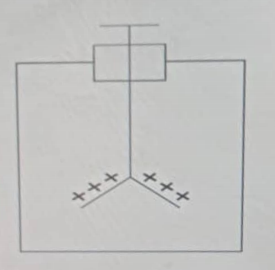
If a positively charged rod is brought close to the cap in the diagram above, the divergence
Attached Figure / Diagram
A
is unchanged
B
Increases
C
decreases
D
Collapses
medium Difficulty
Verified Correct Answer: Option B
Physical Principles & Numerical Solution
B. Increases
When a positively charged rod is brought near the cap of a positively charged gold-leaf electroscope (as indicated by the diverging leaves with + signs in the diagram), electrostatic induction occurs. The rod attracts negative charges toward the cap and repels additional positive charges toward the leaves. This increases the positive charge on the leaves, enhancing their mutual repulsion and thus increasing the divergence.
Source: WAEC / JAMB / NECO Classroom Archive (Record #74569)
Physics
UTME / JAMB 2025
Magnetic Field
Solution
The point where no magnetic effect is felt around a magnet is
A
near point
B
far point
C
Infinite point
D
Neutral point
medium Difficulty
Verified Correct Answer: Option D
Physical Principles & Numerical Solution
The neutral point around a magnet is where the magnetic field strength is zero, meaning no magnetic effects (like deflection of a compass needle) are observed, often due to cancellation by Earth's magnetic field.
Source: WAEC / JAMB / NECO Classroom Archive (Record #74477)
Physics
UTME / JAMB 2025
Magnetic Field
Solution
The commonly used materials for shielding or screening magnetism is
A
Alumumium
B
Brass
C
Soft iron
D
Copper
medium Difficulty
Verified Correct Answer: Option C
Physical Principles & Numerical Solution
Soft iron has high magnetic permeability, so it easily attracts and redirects magnetic field lines, shielding areas from external magnetic fields. Aluminum, brass, and copper do not have this property and are ineffective for magnetic shielding.
Source: WAEC / JAMB / NECO Classroom Archive (Record #74556)
Physics
UTME / JAMB 2025
Magnetic Field
Solution
A method of demagnetization is
A
placing the magnetic bar in a solenoid
B
double-stroking the magnet with soft in n-s direction
C
heating a magnetic bar red hot and allowed to cool e-w direction
D
hammering the magnetic bar repeatedly in n-s direction
medium Difficulty
Verified Correct Answer: Option C
Physical Principles & Numerical Solution
This process disrupts the alignment of magnetic domains, effectively demagnetizing the bar.
Source: WAEC / JAMB / NECO Classroom Archive (Record #74662)
Physics
UTME / JAMB 2025
Electromagnetic Field
Solution
The device that operates using the magnetic effect of electric current is
A
Rheostat
B
Thermostat
C
Electric bell
D
Carbon microphone
medium Difficulty
Verified Correct Answer: Option C
Physical Principles & Numerical Solution
Answer: C
An electric bell works using an electromagnet.
Source: WAEC / JAMB / NECO Classroom Archive (Record #74373)
Physics
WAEC / WASSCE 2025
Electromagnetic Field
Solution
2a. State Faraday's law of electromagnetic induction.
b. Draw a labelled diagram of an induction coil and explain how it works.
c. How is the effect of eddy currents minimized in the coil?
d. State two reasons why a capacitor should be included in the primary circuit of the coil.
e. State three uses of an induction coil.
medium Difficulty
Verified Correct Answer: Option
Physical Principles & Numerical Solution
a. Faraday's law of electromagnetic induction states that the induced e.m.f. in a circuit is directly proportional to the rate of change of the magnetic flux, or field lines, linking the circuit i.e e ∝ \(\frac{dφ}{\text{dt}}\).
b. See diagram above. How it works: it has a primary coil of a few turns and a secondary coil of many turns. When the primary circuit is made, a current flows in P. A is then attracted, so breaking the circuit at the contact point. This makes the large magnetic flux in the secondary fall very quickly. A high voltage is then produced at its terminals X and Y, and a spark appears across the air gap as the circuit is made and broken repeatedly.
c. The eddy current can be minimized by laminating the core to reduce energy losses.
d. The spark which produce across the gap of the make and break device is reduced by the capacitor. Thus, it should be included.
e. (i). It is used in the operation of X-ray tubes. (ii). It is used in the generation of high voltages. (iii). It is used in morse radio transmitter.
Source: WAEC / JAMB / NECO Classroom Archive (Record #76494)