Question Library
Browse, filter, and study verified past examination questions with step-by-step mathematical reasoning.
Searching 18,000+ Questions...
Sifting topics, KaTeX formulas & verified solutions
Showing 286–300 of 784 verified questions
Sort by:
Physics
WAEC / WASSCE 2007
Waves and Optics
Solution
A particle is projected at an angle of 30^\circ to the horizontal with a speed of 250 ms\(^{-1}\). Calculate the;
(a) total time of flight of the particle;
(b) speed of the particle at its maximum height. [ g = 10 ms\(^{-2}\)]
medium Difficulty
Verified Correct Answer: Option
Physical Principles & Numerical Solution
(a) T = \(\frac{2Usin\theta}{g} = \frac{2 \times 250 \times sin 30}{10}\)
= 25s
(b) Speed at h\(_{\text{max}} Ucos \theta\)
= 250 cos 30\(^o\) = 216m/s
Source: Myschool Past Questions Archive (Record #53636)
Physics
WAEC / WASSCE 2007
Waves and Optics
Solution
State;
(a) the difference between plane polarized light and ordinary light;
(b) two uses of polaroids.
medium Difficulty
Verified Correct Answer: Option
Physical Principles & Numerical Solution
(a) In plane polarized light the vibration of the particles are confirmed to a single plane while in ordinary light, the particles vibrate in all planes perpendicular to the direction of propagation of the wave.
(b) Uses of polaroids are:
— stress analysis
— measurement of concentration of sugar solution
— used to eliminate sun glare
— used in sun glasses to reduce the intensity of sunlight
Source: Myschool Past Questions Archive (Record #53637)
Physics
WAEC / WASSCE 2007
Waves and Optics
Diagram
Solution
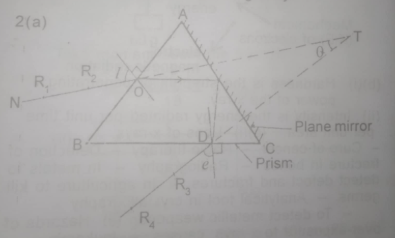
Using the above diagram as a guide, carry out the following experiment:
Place the equilateral triangular glass prism on the drawing paper. Trace the outline ABC of the prism.
remove the prism. Draw a line NO such that it makes an angle i = 25º with the normal at point O on side AB
fix two pins \(R_1\) and \(R_2\) vertically on line N0. Replace the prism on its outline;
place the reflecting surface of the plane mirror in contact with the face AC of the prism;
looking through the face BC of the prism, fix two other pins at \(R_3\) and \(R_4\) such that the pins appear to be in a straight line with the images of the pins at \(R_1\) and \(R_2\);
remove the prism, the mirror, and the pins. Draw a line to join points \(R_4\) and \(R_3\)
produce line \(R_4\)\(R_3\) to meet line NO produced at T;
measure and record the angle \(\theta\) at T and e at D;
repeat the procedure for four other values of i = 30^\circ, 35^\circ, 40^\circ, and 45^\circ. In each case, measure and record the corresponding values of \(\theta\) and e. Tabulate your readings;
plot a graph of e on the vertical axis and \(\theta\) on the horizontal axis;
evaluate k = s\(^{-1}\)
state two precautions taken to ensure accurate results. [Attach your traces to your answer booklet]
(b)i. State four characteristics of the image of an object formed by a plane mirror.
ii. State two Conditions necessary for total internal reflection to occur in a medium.
Attached Figure / Diagram
medium Difficulty
Verified Correct Answer: Option
Physical Principles & Numerical Solution
Table of values (observation)
S/N
i^\circ
\(\theta\)^\circ
eº
1
25
62
28
2
30
54
32
3
35
45
35
4
40
40
37
5
45
30
41
Slope (s) = \(\frac{\bigtriangleup {e}}{\bigtriangleup {\theta}}\) = \(\frac{49 - 20}{83 - 10} = \frac{29}{73}\) = 0.397
Intercept (c) = 53
Evaluation: \(K_1\) = S\(^{-1}\) = 0.397\(^{-1}\) = 2.519
Precautions;
l ensured neat traces/sharp pencil (shown)
I ensured mirror is firmly attached to prism
I ensured pins are reasonably spaced (about 4 cm)
l avoided parallax error in reading protractor.
(b)i. Characteristics of images formed by a plane mirror
- Same size as object
- Same distance from mirror as object
- Virtual
- Erect
- Laterally inverted.
ii. For total internal reflection of light to occur:
(a)Light must be travelling from a more dense to a less dense medium
(b)Angle of incidence in the denser medium must be greater than the critical angle
Source: Myschool Past Questions Archive (Record #60041)
Physics
UTME / JAMB 2007
Waves and Optics
Solution
A photon of wavelength 6.0 x 10\(^{-7}\) m behaves like a particle of a certain mass. The value of that mass is [h = 6.63 x 10\(^{-34}\) Js, c = 3.0 x 10\(^8\) ms\(^{-1}\)]
A
3.5 x 10\(^{-36}\)kg
B
2.2 x 10\(^{-35}\)kg
C
1.1 x 10\(^{-35}\)kg
D
2.2 x 10\(^{-7}\) kg
medium Difficulty
Verified Correct Answer: Option A
Physical Principles & Numerical Solution
\(\lambda\) = \(\frac{h}{mv}\), then, h = mv\(\lambda\)
m = \(\frac{h}{v \lambda}\) = \(\frac{6.63 \times 10^{-34}}{6.0 \times 10^{-7} \times 3 \times 10^8}\) = 3.68 x 10\(^{-36}\) kg
OPtion A is the closest.
Source: Myschool Past Questions Archive (Record #72219)
Physics
UTME / JAMB 2006
Waves and Optics
Solution
An object placed 10cm from a concave mirror of focal length 5cm would have its image
A
at the centre of convature
B
at the radius of curvature
C
at infinity
D
10 cm from the focus
medium Difficulty
Verified Correct Answer: Option A
Physical Principles & Numerical Solution
Center of Curvature: For a concave mirror, the center of curvature (C) is located at twice the focal length. With a focal length of 5 cm, C is at 10 cm.
Object Placement: The object is placed at 10 cm, which is exactly at the center of curvature.
Image Formation: When an object is at the center of curvature, the image is also formed at that same point, resulting in a real and inverted image
(When the object is located at the center of curvature, the image will also be located at the center of curvature.)(For concave mirror)
Source: Myschool Past Questions Archive (Record #13897)
Physics
UTME / JAMB 2006
Waves and Optics
Solution
A submarine is observed to rise from a real depth of 80 m to 60 m in water. Calculate the change in apparent depth.
[Refraction index of water \(\frac{4}{3}\)]
A
45 m
B
80 m
C
15 m
D
60 m
medium Difficulty
Verified Correct Answer: Option C
Physical Principles & Numerical Solution
Refraction index (n) = \(\frac{\text{Real depth}}{\text{App. depth}}\)
For 80 m Real depth: \(\frac{4}{3}\) = \(\frac{80}{\text{App.depth}}\)
App. dept = \(\frac{80 \times 3}{4}\) = 60 m
For 60 m real depth; \(\frac{4}{3}\) = \(\frac{60}{\text{App.depth}}\)
App. depth = \(\frac{60 \times 3}{4}\) = 45 m
∴change in App. depth = 60 - 45 = 15 m
Source: Myschool Past Questions Archive (Record #13898)
Physics
UTME / JAMB 2006
Waves and Optics
Solution
Non-luminous object can be seen because they
A
reflect light
B
are near
C
are polished
D
emit light
medium Difficulty
Verified Correct Answer: Option A
Physical Principles & Numerical Solution
Non-luminous objects do not emit light; instead, they are visible because they reflect light from luminous sources (such as the sun or artificial lights). This reflection allows us to see them.
Source: Myschool Past Questions Archive (Record #13899)
Physics
UTME / JAMB 2006
Waves and Optics
Solution
The wavelength of the first overtone of a note in a closed pipe of length 33 cm is?
A
33 cm
B
44 cm
C
22 cm
D
17 cm
medium Difficulty
Verified Correct Answer: Option B
Physical Principles & Numerical Solution
In a closed tube, the fundamental note occurs when the length of the tube l = \(\frac{\lambda}{4}\),
the first overtone occurs when the length of the tube l = \(\frac{3 \lambda}{4}\)
\lambda = \(\frac{4l}{3}\) = \(\frac{ 4 \times 33}{3}\) = 44 cm
Source: Myschool Past Questions Archive (Record #13900)
Physics
UTME / JAMB 2006
Waves and Optics
Solution
A person can focus objects when they lie beyond 75 cm from his eyes. The focal length of the lens required to reduce his least distance of distinct vision to 25 cm is?
A
37.50 cm
B
75.00 cm
C
18.75
D
25.00 cm
medium Difficulty
Verified Correct Answer: Option A
Physical Principles & Numerical Solution
The least distance of distinct vision required = 25 cm.
∴ for the person to see an object clearly at 25 cm from the eye, the image must be formed at 75 cm on the same side of lens, at his near point.
∴ U = 25 cm; V = -75 cm (image should be virtual)
thus \(\frac{1}{f}\) = \(\frac{1}{v}\) +\(\frac{1}{u}\)
= \(\frac{1}{75}\) + \(\frac{1}{25}\)
= \(\frac{-1 + 3}{75}\) = \(\frac{2}{75}\)
∴f = \(\frac{75}{2}\) = 37.50cm.
Source: Myschool Past Questions Archive (Record #13901)
Physics
UTME / JAMB 2006
Waves and Optics
Solution
A mirror of weight 75N is hung by a cord from a hook on the wall. If the cord makes an angle of 30o with horizontal, the tension in the cord is
A
100N
B
1500N
C
250N
D
150N
medium Difficulty
Verified Correct Answer: Option D
Physical Principles & Numerical Solution
For vertical equilibrium, we have
2Ty = 75N
But \(\frac{Ty}{T}\) = \(\frac{adj}{hyp}\) = cos 60º
∴ Ty = T Cos 60º
=> 2Ty = 2Tcos 60º = 75N
2 x T x 0.5 = 75 => T = 75N
∴ Total tension in the rope = 2 T.
= 2 x 75 = 150N
Source: Myschool Past Questions Archive (Record #14330)
Physics
UTME / JAMB 2006
Waves and Optics
Solution
A progressive wave equation is represented by y = a sin(150 \pit - \(\frac{\pix}{4}\)). if the phase difference of a progressive wave is 45^\circ, the value of x in the equation is
A
3 cm
B
4 cm
C
1 cm
D
2 cm
medium Difficulty
Verified Correct Answer: Option C
Physical Principles & Numerical Solution
Y = sin \pi(150\pit - \(\frac{\pix}{4}\))
Comparing the above with the standard wave equation:
Y = A sin \pi (\(\frac{(2vt)}{\lambda}\) - \(\frac{(2x)}{\lambda}\))
=> the phase difference \(\frac{x}{4}\) = \(\frac{2x}{\lambda}\)
∴ \(\frac{1}{4}\) = \(\frac{2}{\lambda}\) => \lambda = 8cm
∴ \(\frac{2\pix}{8}\) = 45^\circ
since \pi = 180^\circ
45^\circ X 8 = 2 X 180^\circ x
∴ x = 1cm
Source: Myschool Past Questions Archive (Record #14334)
Physics
UTME / JAMB 2006
Waves and Optics
Diagram
Solution
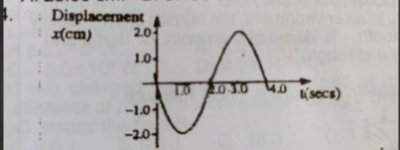
The frequency of the wave in the diagram above is
Attached Figure / Diagram
A
0.17 Hz
B
0.25 Hz
C
1.57 Hz
D
1.05 Hz
medium Difficulty
Verified Correct Answer: Option B
Physical Principles & Numerical Solution
Generally, period T = 1/f(reciprocal of frequency).
=> f = 1/T
And from the diagram, period T = 4s
∴ frequency, f = 1/T = 1/4 = 0.25 Hz
Source: Myschool Past Questions Archive (Record #14335)
Physics
WAEC / WASSCE 2006
Waves and Optics
The S.I units of frequency, period and amplitude of a wave are respectively
A
hertz, second and centimeter
B
second, metre and hertz
C
metre, hertz and seconds
D
hertz, second and metre
medium Difficulty
Verified Correct Answer: Option D
Physical Principles & Numerical Solution
No expanded working has been attached for this question yet. The verified answer is Option D.
Source: Myschool Past Questions Archive (Record #34666)
Physics
WAEC / WASSCE 2006
Waves and Optics
Solution
Which of the following observations cannot be explained using the rectilinear propagation of light?
A
production of images by a pinhole camera
B
production of real images of objects by lenses
C
formation of an annular eclipse
D
diffraction patterns of light
medium Difficulty
Verified Correct Answer: Option D
Physical Principles & Numerical Solution
The rectilinear propagation of light refers to the principle that light travels in straight lines. This principle explains the production of images by a pinhole camera and the production of real images of objects by lenses. However, it does not explain the formation of diffraction patterns of light. Diffraction is a wave property of light that involves the bending of light waves around obstacles or the spreading of light waves after they pass through a small opening. This phenomenon cannot be explained by the rectilinear propagation of light
Source: Myschool Past Questions Archive (Record #34670)
Physics
WAEC / WASSCE 2006
Waves and Optics
Solution
The distance between the successive crests of a wave travelling at 20ms\(^{-1}\) is 25cm. Calculate the frequency of the wave
A
0.8Hz
B
5.0Hz
C
50.0Hz
D
80.0hz
medium Difficulty
Verified Correct Answer: Option D
Physical Principles & Numerical Solution
f = \(\frac{v}{\lambda} = \frac{20}{0.25} = 80Hz\)
Source: Myschool Past Questions Archive (Record #34671)