Question Library
Browse, filter, and study verified past examination questions with step-by-step mathematical reasoning.
Searching 18,000+ Questions...
Sifting topics, KaTeX formulas & verified solutions
Showing 286–300 of 5315 verified questions
Sort by:
Physics
UTME / JAMB 2024
Heat and Temperature
Solution
The bursting of water pipes during very cold weather, when the water in the pipes form ice could be attributed to
A
contraction of pipes when cooled
B
expansion of water on freezing
C
contraction of water on freezing
D
expansion of ice on melting
medium Difficulty
Verified Correct Answer: Option B
Physical Principles & Numerical Solution
The bursting of water pipes in very cold weather occurs because water expands as it freezes. This expansion increases pressure inside the pipes, which can lead to bursting.
Source: WAEC / JAMB / NECO Classroom Archive (Record #70689)
Physics
WAEC / WASSCE 2024
Heat and Temperature
Solution
A temperature of 60º C is equivalent to
A
25ºF
B
140ºF
C
50ºF
D
108ºF
medium Difficulty
Verified Correct Answer: Option B
Physical Principles & Numerical Solution
ºF = (ºC x 1.8) + 32
But ºC = 60º
º F = (60 x 1.8) + 32 = 108 + 32 = 140ºF
Source: WAEC / JAMB / NECO Classroom Archive (Record #72045)
Physics
WAEC / WASSCE 2024
Heat and Temperature
Solution
Atmospheric pressure decreases with an increase in altitude because:
A
Acceleration due to gravity increases with altitude.
B
Temperature increases with altitude.
C
Internal energy increases with altitude.
D
Interaction among air molecules decreases due to less quantity of air.
medium Difficulty
Verified Correct Answer: Option D
Physical Principles & Numerical Solution
As altitude rises, there is less air above a particular point, leading to a decrease in atmospheric pressure. Furthermore, the density of air diminishes with increased altitude, which also contributes to this phenomenon.
Source: WAEC / JAMB / NECO Classroom Archive (Record #72068)
Physics
WAEC / WASSCE 2024
Heat and Temperature
Solution
Four pieces of constantan wire, marked E, F, G, and H, each of length 1.0m, are at the temperature. Their respective diameters are 1 mm, 2 mm, 6 mm, and 10 mm. Which wire has the highest resistance?
A
E
B
F
C
G
D
H
medium Difficulty
Verified Correct Answer: Option A
Physical Principles & Numerical Solution
Using the equation, R = \(\frac{\rho l}{A}\)
we conclude that the wire with the smallest diameter will have the highest resistance i.e. wire E
Source: WAEC / JAMB / NECO Classroom Archive (Record #72073)
Physics
WAEC / WASSCE 2024
Heat and Temperature
Solution
Water is readily available but it is not a thermometric liquid mainly because
A
clings to glass
B
does not expand uniformily
C
boils at low temperature
D
is colourless
medium Difficulty
Verified Correct Answer: Option B
Physical Principles & Numerical Solution
All the options are reasons why water is not a good thermometric substance, but the most critical one is its lack of uniform expansion. Water's non-linear expansion makes it difficult to correlate temperature changes with volume changes perfectly.
Source: WAEC / JAMB / NECO Classroom Archive (Record #72081)
Physics
WAEC / WASSCE 2024
Heat and Temperature
Solution
The fractional change in length produced in an elastic material of spring constant 680Nm\(^{-1}\) when a force of 306N is applied to stretch it is 1.5. Calculate the original length of the material.
medium Difficulty
Verified Correct Answer: Option
Physical Principles & Numerical Solution
From Hooke's law, F = kx where x = extension, k = force constant
K = 680Nm\(^{-1}\), F = 306N
x = \(\frac{\text{F}}{\text{x}}\) = \(\frac{306}{680}\) ≈ 0.450m
Fractional Change in Length: Given the fractional change is 1.5:
1.5 = \(\frac{\text{x}}{\text{L}}\)
L = \(\frac{0.450}{1.5}\) = 0.30m.
Source: WAEC / JAMB / NECO Classroom Archive (Record #72090)
Physics
UTME / JAMB 2024
Heat Transfer
Solution
288KJ is conducted across two opposite faces of a 3m cube of temperature gradient 90ºCm\(^{-1}\) in 7200s. Calculate the thermal conductivity.
A
4.9 x 10\(^{-2}\)Wm\(^{-1}\)k\(^{-1}\)
medium Difficulty
Verified Correct Answer: Option A
Physical Principles & Numerical Solution
k = \(\frac{Q.d}{A. ΔT .t}\)
d = thickness = 3m
A = 9m\(^2\)
Q = 288kJ = 288000J, t = 7200s, ΔT = 90ºC/m → 90K/m x 3 = 270K
k = \(\frac{288000 \times 3}{9 \times 270 \times 7200}\)
k = 4.93 x 10\(^{-2}\)Wm\(^{-1}\)k\(^{-1}\)
Source: WAEC / JAMB / NECO Classroom Archive (Record #70374)
Physics
UTME / JAMB 2024
Heat Transfer
Solution
A blacksmith heated a metal whose cubic expansivity is 3.9 x 10\(^{-6}\)K\(^{-1}\). Calculate the area expansivity.
A
3.9 x 10\(^{-6}\)K\(^{-1}\)
B
2.6 x 10\(^{-6}\)K\(^{-1}\).
C
1.3 x 10\(^{-6}\)K\(^{-1}\).
D
1.6 x 10\(^{-6}\)K\(^{-1}\).
medium Difficulty
Verified Correct Answer: Option B
Physical Principles & Numerical Solution
3\(\alpha\) = \(\gamma\)
\(\alpha\) = \(\frac{3.9\times 10^{-6}}{3}\) = 1.3 x 10\(^{-6}\)
BUT \(\beta\) = 2\(\alpha\)
\(\beta\) = 2 x 1.3 x 10\(^{-6}\) = 2.6 x 10\(^{-6}\)K\(^{-1}\)
Source: WAEC / JAMB / NECO Classroom Archive (Record #70661)
Physics
WAEC / WASSCE 2024
Heat Transfer
Solution
The vacuum and silvered wall surfaces of a vacuum flask walls are respectively
A
minimize conduction and convection and prevent radiation
B
prevent conduction and convection and minimize radiation
C
prevent conduction and minimize convection and radiation
D
minimize convection and prevent conduction and radiation
medium Difficulty
Verified Correct Answer: Option B
Physical Principles & Numerical Solution
Vacuum: It prevents conduction and convection because there are no air molecules to transfer heat.
Silvered Walls: They minimize radiation by reflecting thermal radiation back.
Source: WAEC / JAMB / NECO Classroom Archive (Record #72005)
Physics
WAEC / WASSCE 2024
Heat Transfer
Solution
In which of the following devices is the thermal expansion considered a disadvantage?
A
Fire alarm
B
Thermostat
C
Bimetallic thermometer
D
Balance wheel of a watch
medium Difficulty
Verified Correct Answer: Option D
Physical Principles & Numerical Solution
Thermal expansion can affect accuracy and timekeeping in a watch's balance wheel, making it disadvantageous in this application.
Source: WAEC / JAMB / NECO Classroom Archive (Record #72065)
Physics
WAEC / WASSCE 2024
Heat Transfer
Diagram
Solution
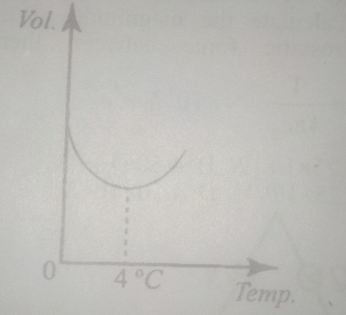
The diagram above illustrates the graph for
Attached Figure / Diagram
A
the variation of the volume of a gas with increasing temperature
B
expansion curve of mercury
C
expansion curve of liquid oxygen
D
anomalous expansion of water
medium Difficulty
Verified Correct Answer: Option D
Physical Principles & Numerical Solution
The given graph illustrates the anomalous expansion of water, where water has its highest density and consequently its lowest volume at 4ºC
Source: WAEC / JAMB / NECO Classroom Archive (Record #72083)
Physics
UTME / JAMB 2024
Measurement of Heat Energy
Solution
5 X 10\(^{-3}\)kg of liquid at its boiling point is evaporated in 20s by the heat generated by a resistor of 2\(\Omega\) when a current of 10A is used. The specific latent heat of vaporization of the liquid is
A
8.0 x 10\(^4\)Jkg\(^{-1}\)
B
8.0 x 10\(^5\)Jkg\(^{-1}\)
C
8.0 x 10\(^6\)Jkg\(^{-1}\)
D
8.0 x 10\(^7\)Jkg\(^{-1}\)
medium Difficulty
Verified Correct Answer: Option B
Physical Principles & Numerical Solution
Electrical heat generated = quantity of heat required to change water from liquid to vapour
I\(^2\) R t = mL
I = current = 10A, R = resistance = 2\Omega, t = time = 20s, m = mass of water = 5 X 10\(^{-3}\)kg and L = specific latent heat of vaporization.
10\(^2\) x 2 x 20 = 5 X 10\(^{-3}\)L
4000 = 5 X 10\(^{-3}\)L
L = \(\frac{4000}{5\times10^{-3}}\) = 800000 ⇔ 8.0 x 10\(^5\)Jkg\(^{-1}\)
Source: WAEC / JAMB / NECO Classroom Archive (Record #70365)
Physics
UTME / JAMB 2024
Measurement of Heat Energy
Solution
How much joules of heat are given out when a piece of iron, of mass 60g and specific heat capacity 460JKg\(^{-1}\)K\(^{-1}\), cools from 75ºC to 35ºC
A
1000J
B
1050J
C
1067J
D
1104J
medium Difficulty
Verified Correct Answer: Option D
Physical Principles & Numerical Solution
Quantity of heat Q = mass of iron x specific heat capacity of iron x change in temperature.
Q = mc\(\delta\)\(\theta\)
m = 60g ⇒ 0.060, c = 460Jkg\(^{-1}\)k\(^{-1}\) and \(\delta\)\(\theta\) = 75 - 35 = 40ºC
Q = 0.060 x 460 x 40 = 1104J.
Source: WAEC / JAMB / NECO Classroom Archive (Record #70407)
Physics
UTME / JAMB 2024
Measurement of Heat Energy
Solution
Calculate the quantity of heat for copper rod whose thermal capacity is 400Jk\(^{-1}\) for a temperature change of 60ºC to 80ºC
A
2KJ
B
4KJ
C
6KJ
D
8KJ
medium Difficulty
Verified Correct Answer: Option D
Physical Principles & Numerical Solution
Quantity of Heat = heat capacity x change in temperature
Q = C\(_p\) x \(\Delta\)\(\theta\)
Q = 400 x 20 = 8000J = 8kJ
Source: WAEC / JAMB / NECO Classroom Archive (Record #70474)
Physics
UTME / JAMB 2024
Measurement of Heat Energy
Solution
The quantity of heat required to melt ice of 0.2 kg whose specific latent heat is 3.4 x 10\(^5\)J/Kg is
A
6.8 x 10\(^4\)J
B
8.6 x 10\(^4\)J
C
1.7 x 10\(^5\)J
D
1.7 x 10\(^6\)J
medium Difficulty
Verified Correct Answer: Option A
Physical Principles & Numerical Solution
The quantity of heat required to melt ice = mass of ice x specific latent heat
Q = m L = 0.2 x 3.4 x 10\(^5\) = 6.8 x 10\(^4\)J
Source: WAEC / JAMB / NECO Classroom Archive (Record #70501)