Question Library
Browse, filter, and study verified past examination questions with step-by-step mathematical reasoning.
Searching 18,000+ Questions...
Sifting topics, KaTeX formulas & verified solutions
Showing 286–300 of 573 verified questions
Sort by:
Mathematics
UTME / JAMB 2003
Algebra
Diagram
Solution
The triangle OPQ above is the solution of the inequalities
Attached Figure / Diagram
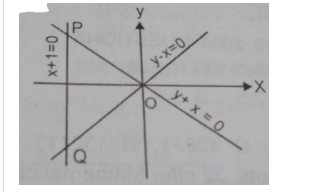
A
x + 1 ≥ 0, y + x ≤ 0, y - x ≥ 0
B
y + x ≤ 0, y - x ≥ 0, x -1 ≥ 0
C
x - 1 ≤ 0, y - x ≥ o, y + x ≥ 0
D
x - 1 ≤ 0, y + x ≤ 0, y - x ≤ 0
medium Difficulty
Verified Correct Answer: Option A
Step-by-Step Mathematical Solution
Lines bounding \Delta OPQ
OQ; y - x = 0
y - x \ge 0
PQ; x + 1 = 0
x + 1 \ge = 0
PO; y + x = 0
y + x \le 0
∴ x + 1 \ge 0, y + x \le 0, y - x \ge 0
Source: Myschool Past Questions Archive (Record #7768)
Mathematics
UTME / JAMB 2003
Algebra
Solution
The sum of the first n terms of an arithmetic progression is 252. If the first term is -16 and the last term is 72, find the number of terms in the series
A
6
B
7
C
8
D
9
medium Difficulty
Verified Correct Answer: Option D
Step-by-Step Mathematical Solution
Using: \(S_n = \frac{n}{2} (a + l)\)
where:- \(S_n\) is the sum of the first \(n\) terms, \(a\) is the first term, \(l\) is the last term.
Given: \(S_n = 252\), a = -16, l = 72
Step 1: Substitute the Known Values
Substituting the values into the sum formula:
\(252 = \frac{n}{2} (-16 + 72)\)
\(252 = \frac{n}{2} \cdot 56\)
\(504 = n \cdot 56\)
Now, divide both sides by 56:
n = \(\frac{504}{56}\) = 9
Thus, the number of terms in the series is: 9
Source: Myschool Past Questions Archive (Record #7775)
Mathematics
UTME / JAMB 2003
Algebra
Solution
If \(^{n}P_{3} - 6(^{n}C_{4}) = 0\), find the value of n.
A
5
B
6
C
7
D
8
medium Difficulty
Verified Correct Answer: Option C
Step-by-Step Mathematical Solution
To solve the equation \(^{n}P_{3} - 6(^{n}C_{4}) = 0\), we start by using the formulas for permutations and combinations:
\(^{n}P_{r} = \frac{n!}{(n-r)!}\)
\(^{n}C_{r} = \frac{n!}{r!(n-r)!}\)
\(^{n}P_{3} = \frac{n!}{(n-3)!}\)
\(^{n}C_{4} = \frac{n!}{4!(n-4)!}\)
\(\frac{n!}{(n-3)!} - 6 \left(\frac{n!}{4!(n-4)!}\right) = 0\)
Factor out \(n!\)
Factoring \(n!\) from both terms gives:
\(n! \left(\frac{1}{(n-3)!} - \frac{6}{4!(n-4)!}\right) = 0\)
Since \(n! \neq 0\), we can simplify to:
\(\frac{1}{(n-3)!} - \frac{6}{4!(n-4)!} = 0\)
Recall that \(4! = 24\), so:
\(\frac{6}{4!(n-4)!} = \frac{6}{24(n-4)!} = \frac{1}{4(n-4)!}\)
The equation now is:
\(\frac{1}{(n-3)!} - \frac{1}{4(n-4)!} = 0\)
Multiply through by \(4(n-3)!(n-4)!\) gives:
\(4(n-4)! - (n-3)! = 0\)
Recall that \((n-3)! = (n-3)(n-4)!\), so:
\(4(n-4)! - (n-3)(n-4)! = 0\)
\((n-4)!\)
Factoring out \((n-4)!\) gives:
\((n-4)! \left(4 - (n-3)\right) = 0\)
Since \((n-4)! \neq 0\), we have:
\(4 - (n-3) = 0\)
Solving for \(n\):
\(n - 3 = 4 \implies n = 7\)
The value of n is: 7
Source: Myschool Past Questions Archive (Record #7844)
Mathematics
UTME / JAMB 2003
Algebra
Solution
Find the equation of the locus of a point P(x,y) which is equidistant from Q(0,0) and R(2,1).
A
4x + 2y = 5
B
4x - 2y = 5
C
2x + 2y = 5
D
2x + y = 5
medium Difficulty
Verified Correct Answer: Option A
Step-by-Step Mathematical Solution
Locus of a point P(x,y) which is equidistant from Q(0,0) and R(2,1) is the perpendicular bisector of the straight line joining Q and R
Mid point QR = \(\frac{x_2 + x_1}{2}, \frac{y_2 + y_1}{2}\)
= \(\frac{2 + 0}{2}, \frac{1 + 0}{2}\)
= \((1, \frac{1}{2})\)
Gradient of QR = \(\frac{y_{2} - y_{1}}{x_{2} - x_{1}}\)
= \(\frac{1 - 0}{2 - 0}\)
= \(\frac{1}{2}\)
Gradient of PM = \(\frac{-1}{\frac{1}{2}}\)
= -2
Equation of PM = y - y\(_1\) = m(x-x_\(_1\))
i.e y - 1/2 = -2(x-1)
2y - 1 = -4(x-1)
2y - 1 = -4x + 4
2y + 4x = 5
Source: Myschool Past Questions Archive (Record #11105)
Mathematics
WAEC / WASSCE 2003
Algebra
Diagram
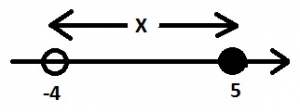
Interprete the inequality represented on the number line
Attached Figure / Diagram
A
-4< X ≤ 5
B
-4 ≤ x< 5
C
-4
D
-4≤x≤5
medium Difficulty
Verified Correct Answer: Option A
Step-by-Step Mathematical Solution
No expanded working has been attached for this question yet. The verified answer is Option A.
Source: Myschool Past Questions Archive (Record #26574)
Mathematics
WAEC / WASSCE 2003
Algebra
Solution
Find the value of x which satisfies the equation
5(x-7)=7-2x
A
x =2
B
x=4
C
x=6
D
x = 14
medium Difficulty
Verified Correct Answer: Option C
Step-by-Step Mathematical Solution
5(x - 7) = 7 - 2x
5x - 35 = 7 - 2x
5x + 2x = 7 + 35
7x = 42
x = \(\frac{42}{7}\)
= 6
Source: Myschool Past Questions Archive (Record #26581)
Mathematics
WAEC / WASSCE 2003
Algebra
Solution
Find the value of x in the equation 3x\(^2\) - 8x - 3 = 0
A
\(\frac{1}{3},-3\)
B
\(-\frac{1}{3},-3\)
C
\(-\frac{1}{3},3\)
D
\(\frac{1}{3},3\)
medium Difficulty
Verified Correct Answer: Option C
Step-by-Step Mathematical Solution
3x\(^2\) - 8x - 3 = 0
3x\(^2\) - 9x + x - 3 = 0
3x(x - 3) + 1(x - 3) = 0
(3x + 1)(x - 3) = 0
3x = -1 \(\implies\) x = \(-\frac{1}{3}\)
or x = 3.
Source: Myschool Past Questions Archive (Record #26586)
Mathematics
WAEC / WASSCE 2003
Algebra
Solution
Which of the following is/are not the interior angle(s) of a regular polygon? I.108^\circ II. 116^\circ III. 120^\circ
A
I only
B
II only
C
III only
D
I and III only
medium Difficulty
Verified Correct Answer: Option B
Step-by-Step Mathematical Solution
Using the formula, \((n - 2) \times 180^\circ\) to get the sum of the interior angles. Then we can have
\((n - 2) \times 180^\circ = 108n\) ... (1)
\((n - 2) \times 180^\circ = 116n\) ... (2)
\((n - 2) \times 180^\circ = 120n\) ... (3)
Solving the above given equations, where n is not a positive integer then that angle is not the interior for a regular polygon.
(1): \(180n - 360 = 108n \implies 72n = 360\)
\(n = 5\) (regular pentagon)
(2): \(180n - 360 = 116n \implies 64n = 360\)
\(n = 5.625\)
(3): \(180n - 360 = 120n \implies 60n = 360\)
\(n = 6\) (regular hexagon)
Hence, 116^\circ is not an angle of a regular polygon.
Source: Myschool Past Questions Archive (Record #26599)
Mathematics
WAEC / WASSCE 2003
Algebra
Solution
Find the equation whose roots are \(-\frac{2}{3}\) and 3
A
3x2+11x-6=0
B
3x2+7x+6=0
C
3x2-11x-6=0
D
3x2-7x-6=0
medium Difficulty
Verified Correct Answer: Option D
Step-by-Step Mathematical Solution
\(x = -\frac{2}{3} \implies x + \frac{2}{3} = 0\)
\(x = 3 \implies x - 3 = 0\)
\(\implies (x - 3)(x + \frac{2}{3}) = 0\)
\(x^2 - 3x + \frac{2}{3}x - 2 = 0\)
\(x^2 - \frac{7}{3}x - 2 = 0\)
\(3x^2 - 7x - 6 = 0\)
Source: Myschool Past Questions Archive (Record #26609)
Mathematics
WAEC / WASSCE 2003
Algebra
Solution
(a) If p varies directly as \(r^{2}\) and p = 3.2 when r = 4, find the value of p when r = 6.5.
(b) Solve the simultaneous equations :
\(\frac{x}{2} + \frac{y}{4} = 1 ; \frac{x}{3} - \frac{y}{4} = \frac{-1}{6}\)
medium Difficulty
Verified Correct Answer: Option
Step-by-Step Mathematical Solution
(a) \(p \propto r^{2}\)
\(\implies p = kr^{2}\)
\(3.2 = k(4^{2}) \implies 3.2 = 16k\)
\(k = \frac{3.2}{16} = 0.2\)
\(\therefore p = 0.2r^{2}\)
When r = 6.5,
\(p = 0.2 (6.5^{2}) \)
= \(0.2(42.25)\)
\(p = 8.45\)
(b) \(\frac{x}{2} + \frac{y}{4} = 1 ... (1)\)
\(\frac{x}{3} - \frac{y}{4} = -\frac{1}{6} .... (2)\)
Adding equation (1) and (2), we have
\(\frac{x}{2} + \frac{x}{3} = 1 - \frac{1}{6}\)
\(\frac{5x}{6} = \frac{5}{6} \implies x = 1\)
Put x = 1 in (1),
\(\frac{1}{2} + \frac{y}{4} = 1 \implies \frac{y}{4} = 1 - \frac{1}{2}\)
\(\frac{y}{4} = \frac{1}{2} \implies y = 2\)
\((x, y) = (1, 2)\).
Source: Myschool Past Questions Archive (Record #53261)
Mathematics
WAEC / WASSCE 2003
Algebra
Solution
(a) Simplify : \(625^{\frac{3}{8}} \times 5^{\frac{1}{2}} \div 25\)
(b) Solve the following equations correct to one decimal place.
(i) \(\tan (\theta + 25)^\circ = 5.145\)
(ii) \(5\cos \theta - 1 = 0\), where \(0^\circ \leq \theta \leq 90^\circ\).
medium Difficulty
Verified Correct Answer: Option
Step-by-Step Mathematical Solution
(a) \(625^{\frac{3}{8}} \times 5^{\frac{1}{2}} \div 25\)
= \((5^{4})^{\frac{3}{8}} \times 5^{\frac{1}{2}} \div 5^{2}\)
= \(5^{\frac{3}{2}} \times 5^{\frac{1}{2}} \div 5^{2}\)
= \(5^{\frac{3}{2} + \frac{1}{2} - 2}\)
= \(5^{0} = 1\)
(b)(i) \(\tan (\theta + 25)^\circ = 5.145\)
\(\theta + 25 = \tan^{-1} (5.145)\)
\(\implies \theta + 25 = 79^\circ\)
\(\theta = 79^\circ - 25^\circ = 54^\circ\)
(ii) \(5 \cos \theta - 1 = 0\)
\(\implies 5 \cos \theta = 1\)
\(\cos \theta = \frac{1}{5} = 0.2\)
\(\theta = \cos^{-1} (0.2) = 78.463^\circ\)
\(\approxeq 78.5^\circ\) (to one d.p)
Source: Myschool Past Questions Archive (Record #53265)
Mathematics
WAEC / WASSCE 2003
Algebra
Solution
The table below shows the values of the relation \(y = 11 - 2x - 2x^{2}\) for \(-4 \leq x \leq 3\).
x
-4
-3
-2
-1
0
1
2
3
y
-13
11
(a) Copy and complete the table.
(b) Using a scale of 2 cm to 1 unit on the x- axis and 2 cm to 5 units on the y- axis, draw the graph of \(y = 11 - 2x - 2x^{2}\).
(c) Use your graph to find : (i) the roots of the equation \(11 - 2x - 2x^{2} = 0\) ; (ii) the values of x for which \(3 - 2x - 2x^{2} = 0\) ; (iii) the gradient of the curve at x = 1.
medium Difficulty
Verified Correct Answer: Option
Step-by-Step Mathematical Solution
(a)
x
-4
-3
-2
-1
0
1
2
3
\(x^{2}\)
16
9
4
1
0
1
4
9
\(11\)
11
11
11
11
11
11
11
11
\(-2x\)
8
6
4
2
0
-2
-4
-6
\(-2x^{2}\)
-32
-18
-8
-2
0
-2
-8
-18
y
-13
-1
7
11
11
7
-1
-13
(b)
(c)(i) x = -2.9 or 1.9
(ii) \(y + (3 - 2x - 2x^{2}) = 11 - 2x - 2x^{2}\)
\(y = 11 - 2x - 2x^{2} - 3 + 2x + 2x^{2}\)
\(y = 8\)
\(\therefore x = \text{-1.8 or 0.8}\)
(iii) \(y = 11 - 2x - 2x^{2}\)
\(\frac{\mathrm d y}{\mathrm d x} = -2 - 4x\)
Gradient at x = 1 : \(-2 - 4(1) = -2 - 4 = -6\)
Source: Myschool Past Questions Archive (Record #53313)
Mathematics
UTME / JAMB 2003
Algebra
Solution
If \(\left| \begin{array}{cc} -x & 2 \\ 4x &1 \end{array} \right|\) = \(\left| \begin{array}{cc} 3 & 3x \\ 4 & -5 \end{array} \right|\), find the value of x
A
5
B
2
C
-2
D
-5
medium Difficulty
Verified Correct Answer: Option D
Step-by-Step Mathematical Solution
\(\left| \begin{array}{cc} -x & 2 \\ 4x &1 \end{array} \right|\) = \(\left| \begin{array}{cc} 3 & 3x \\ 4 & -5 \end{array} \right|\),
Means that the determinants of both Matrices are equal
- x - 8x = -15 - 12x
-9x = -15 - 12x
12x - 9x = - 15
3x = -15
x = \(\frac{-15}{3}\) = -5
Source: Myschool Past Questions Archive (Record #76304)
Mathematics
UTME / JAMB 2003
Algebra
Solution
A matrix P has an inverse P\(^{-1}\) = \(\begin{pmatrix} 1 & -3 \\ 0 & 1 \end{pmatrix}\). Find P
A
\(\begin{pmatrix} -1 & 3 \\ 0 & -1 \end{pmatrix}\)
B
\(\begin{pmatrix} 1 & 3 \\ 0 & -1 \end{pmatrix}\)
C
\(\begin{pmatrix} 1 & -3 \\ 0 & -1 \end{pmatrix}\)
D
\(\begin{pmatrix} 1 & 3 \\ 0 & 1 \end{pmatrix}\)
medium Difficulty
Verified Correct Answer: Option D
Step-by-Step Mathematical Solution
Let \( A = \begin{pmatrix} 1 & -3 \\ 0 & 1 \end{pmatrix} \) (given as \( P^{-1} \)).
Determinant of \( A \) = \( (1)(1) - (-3)(0) = 1 \).
Inverse of \( A \) is \( \frac{1}{1} \begin{pmatrix} 1 & 3 \\ 0 & 1 \end{pmatrix} \), which is exactly \( P \).
Source: Myschool Past Questions Archive (Record #76305)
Mathematics
UTME / JAMB 2002
Algebra
Solution
Solve for x in the equation x\(^3\) - 5x\(^2\) - x + 5 = 0
A
1, - 1, or 5
B
1, 1, or -5
C
-1, 1, or -5
D
1, 1, or 5
medium Difficulty
Verified Correct Answer: Option A
Step-by-Step Mathematical Solution
x\(^3\) - 5x\(^2\) - x + 5 = 0.
\(x^{2}(x - 5) - 1(x - 5) = 0\)
\((x^2 - 1)(x - 5) = 0 \implies (x - 1)(x + 1)(x - 5) = 0\)
\(\therefore x = 1, -1, 5\)
Source: Myschool Past Questions Archive (Record #3345)