Question Library
Browse, filter, and study verified past examination questions with step-by-step mathematical reasoning.
Searching 18,000+ Questions...
Sifting topics, KaTeX formulas & verified solutions
Showing 286–300 of 4783 verified questions
Sort by:
Chemistry
UTME / JAMB 2024
Atomic Structure and Periodic Table
Solution
An example of a physical change is
A
exposing sodium metal to air
B
boiling of water
C
dissolving calcium metal in water
D
burning of kerosene
medium Difficulty
Verified Correct Answer: Option B
Chemical Principles & Mechanism
Boiling water is a physical change. The chemical composition of water remains the same when it boils. The chemical formula for water is H\(_2\)O, and it remains the same whether the water is a liquid, gas, or solid.
When sodium reacts with oxygen in the air, it breaks bonds in the sodium and oxygen molecules and forms new bonds in sodium oxide and sodium peroxide. This process is called oxidation, which is a chemical reaction. This reaction is similar to calcium metal dissolved in water.
Also, when kerosene is burnt, you can't recover it anymore, hence it is not easily reversible. It is a chemical change.
Source: Myschool Past Questions Archive (Record #70457)
Chemistry
UTME / JAMB 2024
Atomic Structure and Periodic Table
Solution
The product formed when ethyne is passed through a hot tube containing finely divided iron is
A
polymeric
B
saturated
C
hydrated
D
aromatic
medium Difficulty
Verified Correct Answer: Option D
Chemical Principles & Mechanism
When ethyne, also known as acetylene (C₂H₂), is passed through a red-hot iron tube at 873 K, the product formed is benzene. This process is called cyclic polymerization. Benzene is an aromatic compound since aromatic compounds are substances that consist of one or more rings that contain alternating single and double bonds in its chemical structure.
The chemical equation for this reaction is: 3C\(_2\)H\(_2\) (g) → C\(_6\)H\(_6\) (g), where three molecules of ethyne combine to produce one molecule of benzene.
Source: Myschool Past Questions Archive (Record #70458)
Chemistry
UTME / JAMB 2024
Acids, Bases, and Salts
Solution
H\(_2\)S\(_{(g)}\) + Cl\(_2\)\(_{(g)}\) → 2HCl\(_{(g)}\) + S\(_{(s)}\)
What is the change in oxidation state of sulphur from reactant to product?
A
-3 to -1
B
-3 to 1
C
-2 to 0
D
-1 to 0
medium Difficulty
Verified Correct Answer: Option C
Chemical Principles & Mechanism
Oxidation state of S in H\(_2\)S = 0
H = +1, (+1 X 2) + S = 0
+ 2 + S = 0
S = - 2 ( from the reactant)
Already, from the equation, S is in solid form,as an element, therefore the oxidation state of elements in their free state is 0
The change in oxidation state of sulphur is from - 2 to 0
Source: Myschool Past Questions Archive (Record #70459)
Chemistry
UTME / JAMB 2024
Atomic Structure and Periodic Table
Solution
If a stable neutral atom has a mass number of 31, the number of electrons and neutrons respectively are
A
15 and 16
B
16 and 31
C
15 and 31
D
16 and 15
medium Difficulty
Verified Correct Answer: Option A
Chemical Principles & Mechanism
The only information we are given is the mass number, so we have to work our answer from the options.
Using the elimination method, options B and C are incorrect because when you add the numbers together, they give 47 and 46 respectively which is more than 31.
We are left with options A and D. However, the correct answer will be option A, since there are 15 electrons which invariably means, we also have 15 number of protons.
⇒ The element has atomic number of 15 (Phosphorus)
Source: Myschool Past Questions Archive (Record #70460)
Chemistry
UTME / JAMB 2024
Atomic Structure and Periodic Table
Solution
Scandium is not regarded as a transition metal because its ion has
A
no electron in the d-orbital
B
a partially filled d-orbitals
C
a completely filled 4S orbital
D
a partially filled 4S orbital
medium Difficulty
Verified Correct Answer: Option A
Chemical Principles & Mechanism
Scandium is not considered a transition metal because its most stable ion has no d-electrons. A transition metal is an element that forms an ion with an incomplete d subshell. Scandium's most stable ion is Sc\(^{3+}\), which has no electrons in its d orbitals.
Explanation
Scandium's electronic configuration is Ar 3d\(^1\) 4s\(^2\)
To form the Sc\(^{3+}\) ion, scandium loses the two electrons in its 4s shell and one electron in its 3d shell.
The Sc\(^{3+}\) ion is colourless because it has an empty 3d sub-shell, which prevents electronic transitions that produce colour.
Source: Myschool Past Questions Archive (Record #70461)
Chemistry
UTME / JAMB 2024
Atomic Structure and Periodic Table
Solution
An example of highly unsaturated hydrocarbon is
A
C\(_2\)H\(_2\)
B
CH\(_4\)
C
C\(_2\)H\(_4\)
D
C\(_4\)H\(_{10}\)
medium Difficulty
Verified Correct Answer: Option A
Chemical Principles & Mechanism
The unsaturated hydrocarbons are the alkenes and the alkynes. However, the alkynes are more highly unsaturated than the alkenes due to their Carbon-Carbon triple bond. Hence, C\(_2\)H\(_2\) is an alkyne
Source: Myschool Past Questions Archive (Record #70462)
Chemistry
UTME / JAMB 2024
Matter & Separation Techniques
Solution
Biodegradable pollutants are not safe in water systems because they can cause
A
air pollution
B
soil degradation
C
ill health
D
greenhouse effect
medium Difficulty
Verified Correct Answer: Option C
Chemical Principles & Mechanism
Biodegradable pollutants are natural organic substances that can be broken down by biological processes into simple, non-toxic products. These processes are carried out by microorganisms, such as bacteria and fungi, which are known as decomposers. While biodegradable pollutants can break down naturally, they are still not considered safe in water systems because their decomposition process can rapidly deplete oxygen levels in the water, leading to issues like fish kills, disrupt the ecosystem balance, and potentially harbour harmful pathogens if not managed properly; essentially, the rapid breakdown can create a high demand for oxygen by decomposing microbes, leaving less available for other aquatic life.
Source: Myschool Past Questions Archive (Record #70463)
Chemistry
UTME / JAMB 2024
Acids, Bases, and Salts
Solution
An example of a compound that is acidic in solution is
A
H\(_3\)PO\(_4\)
B
NH\(_4\)Cl
C
Na\(_2\)CO\(_3\)
D
MgCl\(_2\)
medium Difficulty
Verified Correct Answer: Option B
Chemical Principles & Mechanism
H\(_3\)PO\(_4\) (phosphoric acid) is acidic in solution. It's a weak acid, meaning it doesn't fully dissociate into ions when dissolved in water. Phosphoric acid can donate three hydrogen ions (H\(^+\)) to water, making it a triprotic acid. Also, ammonium chloride (NH\(_4\)Cl) is acidic in solution. This is because NH\(_4\)Cl is formed from a strong acid (HCl) and a weak base (NH\(_3\)), and the ammonium ion (NH\(_4\)\(^+\)) acts as a weak acid when dissolved in water, causing the solution to have a lower pH than 7.
Both H\(_3\)PO\(_4\) (phosphoric acid) and NH\(_4\)Cl(ammonium chloride) are acidic in solution, but we can say NH\(_4\)Cl is more acidic due to the hydrolysis of the ammonium ion. H\(_3\)PO\(_4\) (phosphoric acid) is acidic in solution as well. It's a weak acid, meaning it doesn't fully dissociate into ions when dissolved in water.
Consequently, we can go for option B.
Source: Myschool Past Questions Archive (Record #70464)
Chemistry
UTME / JAMB 2024
Matter & Separation Techniques
Solution
The amount of water a substance chemically combined with is called water of
A
dehydration
B
solution
C
hydration
D
crystallization
medium Difficulty
Verified Correct Answer: Option D
Chemical Principles & Mechanism
The amount of water that is chemically combined with a substance is called water of crystallization. The substance that contains water chemically combined with it is called a hydrate.
Source: Myschool Past Questions Archive (Record #70465)
Chemistry
UTME / JAMB 2024
Atomic Structure and Periodic Table
Solution
Heat of solution involves two steps that is accompanied by heat change. The energies involved in this steps are
A
lattice energy and hydration energy
B
lattice energy and ionic energy
C
Heat energy and lattice energy
D
hydration energy and heat energy
medium Difficulty
Verified Correct Answer: Option A
Chemical Principles & Mechanism
Both lattice energy and hydration energy are involved in heat of solution.
Lattice energy: The energy required to break an ionic solid into gaseous ions.
Hydration energy:The energy released when ions are separated from a lattice and dissolved in water. Hydration enthalpies are always negative.
Heat of solution:The heat released when a compound is dissolved. The heat of solution can be calculated by adding the lattice energy and hydration energy:
Heat of solution = Lattice energy + Hydration energy
Source: Myschool Past Questions Archive (Record #70466)
Chemistry
UTME / JAMB 2024
Acids, Bases, and Salts
Diagram
Solution
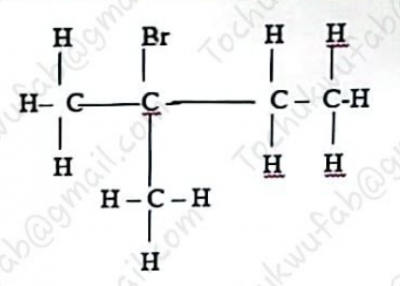
The IUPAC name of the compound above is
Attached Figure / Diagram
A
3-methyl, 3-bromo butane
B
2-methyl, 2-bromo butane
C
2-bromo, 2-methyl butane
D
3-bromo, 3-methyl butane
medium Difficulty
Verified Correct Answer: Option C
Chemical Principles & Mechanism
The longest Carbon chain is 4C atoms which implies the parent name is butane.
There are two substituents on C-2. i.e Bromo and Methyl. However, alphabetically, Bromo comes first and we'll have to make reference to it while naming before methyl.
Consequently, the IUPAC Nomenclature of the compound is 2- bromo, 2- methyl butane.
Source: Myschool Past Questions Archive (Record #71024)
Chemistry
UTME / JAMB 2024
Atomic Structure and Periodic Table
Solution
The shape of ammonia molecule is
A
V-Shaped or bent
B
Tetrahedral
C
co-plannar
D
trigonal
medium Difficulty
Verified Correct Answer: Option D
Chemical Principles & Mechanism
The ammonia molecule is predicted to have a trigonal pyramidal or distorted tetrahedral shape by the valence shell electron pair repulsion (VSEPR) theory. The nitrogen atom at the center of the molecule has five electrons in its valence shell, three of which it shares with the three hydrogen atoms to form bonds. The remaining two electrons form a lone pair. The lone pair repels the bonding orbitals, which causes the molecule to have a distorted tetrahedral shape.
Consequently, The ammonia molecule (NH\(_3\)) has a trigonal pyramidal shape.
Source: Myschool Past Questions Archive (Record #71028)
Chemistry
UTME / JAMB 2024
Matter & Separation Techniques
Solution
The percentage of carbon(IV) oxide in air is
A
0.01
B
0.02
C
0.05
D
0.03
medium Difficulty
Verified Correct Answer: Option D
Chemical Principles & Mechanism
Air is a mixture of gases in the proportion of Nitrogen - 78%, Oxygen - 21%, Carbon(IV) oxide - 0.03%, Argon - 1% etc
Source: Myschool Past Questions Archive (Record #71029)
Chemistry
UTME / JAMB 2024
Matter & Separation Techniques
Solution
Boyle's law can be expressed mathematically as
A
PV = K
B
PV = RT
C
V =KT
D
\(\frac{V}{T}\) = K
medium Difficulty
Verified Correct Answer: Option A
Chemical Principles & Mechanism
Boyle's law states that the pressure and volume of a gas have an inverse relationship when the temperature is kept constant.
⇒ P ∝ \(\frac{1}{V}\)
P = K\(\frac{K}{V}\)
PV = K
Boyle's law can be represented mathematically as PV = K, where P = Pressure, V = Volume and K is a constant.
Source: Myschool Past Questions Archive (Record #71047)
Chemistry
UTME / JAMB 2024
Stoichiometry & Mole Concept
Solution
What is the vapour density of 560cm\(^3\) of a gas that weighs 0.4g at s.t.p?
[Molar Volume of gas at s.t.p = 22.4 dm\(^3\) ]
A
6.0
B
8.0
C
16.0
D
32.0
medium Difficulty
Verified Correct Answer: Option B
Chemical Principles & Mechanism
Firstly, Relative Molecular mass = 2 x Vapour Density
The challenge is to find the relative molecular mass = Molar mass of the gas
But we were given V = 560cm\(^3\) , Molar Volume = 22.4 dm\(^3\) = 22400cm\(^3\) and Mass = 0.4g
However, we can obtain the value for Number of moles, then easily obtain the value for our Molar mass, using mass given.
⇒ n = \(\frac{V}{M.V}\) = \(\frac{560}{22400}\) = 0.025 mole
Also, n = \(\frac{m}{M}\)
M = \(\frac{m}{n}\) = \(\frac{0.4}{0.025}\) = 16.0
Recall that Molar mass of gas = 2 x V.D
Therefore, V.D = \(\frac{16.0}{2}\) = 8.0
Source: Myschool Past Questions Archive (Record #71052)