Question Library
Browse, filter, and study verified past examination questions with step-by-step mathematical reasoning.
Searching 18,000+ Questions...
Sifting topics, KaTeX formulas & verified solutions
Showing 271–285 of 1709 verified questions
Sort by:
Physics
UTME / JAMB 2017
Mechanics and Properties of Matter
Solution
Which of the following surfaces will absorb radiant heat energy?
A
white
B
red
C
black
D
blue
medium Difficulty
Verified Correct Answer: Option C
Physical Principles & Numerical Solution
A black solution is a better radiator of heat and allow a better absorber of heat.
Source: Myschool Past Questions Archive (Record #46434)
Physics
UTME / JAMB 2017
Mechanics and Properties of Matter
Solution
The instrument to measure the relative density of liquid is
A
thermometer
B
hydrometer
C
spring balance
D
beaker
medium Difficulty
Verified Correct Answer: Option B
Physical Principles & Numerical Solution
Thermometer is used to measure temperature
Hydrometer is used to measure relative density of liquid.
Spring balance is used to measure the weight of an object
Beaker is used to measure or take volume of a liquid
Source: Myschool Past Questions Archive (Record #46436)
Physics
UTME / JAMB 2017
Mechanics and Properties of Matter
Solution
What is the cost of running seven 40 W lamps and five 80 W lamps for 12 hours of the electrical energy cost N7.00kWh?
A
N80.00
B
N45.36
C
N65.00
D
N57.12
medium Difficulty
Verified Correct Answer: Option D
Physical Principles & Numerical Solution
Seven 40W lamps = 7 \times 40 = 280W
Five 80W lamps = 5 \times 80 = 400W
Total power = 280W + 400W
= 680W
= \(\frac{680KW}{1000}\) = 0.68KW
The kilowatt hour = 0.68 KW \times 12 hrs
= 8.16 KWh
Cost is N 7 per KWh
So the cost of running them = 8.16KWh \times N 7/KWh
= 57.12
Source: Myschool Past Questions Archive (Record #46442)
Physics
UTME / JAMB 2017
Mechanics and Properties of Matter
Solution
Calculate the time taken for a mango fruit that fall from the tree 20 m to the ground [g = 10 ms-2]
A
10s
B
5s
C
4s
D
2s
medium Difficulty
Verified Correct Answer: Option D
Physical Principles & Numerical Solution
u = , H = 20, g = 10
From equation of motion under gravity
H = ut ± \(\frac{1}{2}\)gt2, It is falling so g is +ve
H = 0 + \(\frac{1}{2}\)gt2
H = \(\frac{1}{2}\)gt2
2H = gt2
\(\frac{2H}{g}\) = t2
t = \(\frac{\sqrt{2H}}{g}\)
= \(\frac{\sqrt {2 \times 20}}{10}\)
= √4
= 2s
Source: Myschool Past Questions Archive (Record #46464)
Physics
UTME / JAMB 2017
Mechanics and Properties of Matter
Solution
The velocity ratio of an inclined plane where angle of inclination in θ is
A
Sinθ
B
Cosθ
C
Tanθ
D
\(\frac{1}{\sin \theta}\)
medium Difficulty
Verified Correct Answer: Option D
Physical Principles & Numerical Solution
Consider an inclined plane shown below, as the effort moves along OB, the load moves is lifted up through a vertical height AB
V.R = \(\frac{\text{distance moved by effort}}{\text{distance moved by load}}\) = \(\frac{OB}{AB}\)
But Sinθ = \(\frac{opp}{hyp}\) = \(\frac{AB}{OB}\)
therefore; = \(\frac{OB}{AB}\) = \(\frac{1}{\sin \theta}\)
Source: Myschool Past Questions Archive (Record #46466)
Physics
UTME / JAMB 2017
Mechanics and Properties of Matter
Solution
The volume of a fixed mass of gas is 10cm3 when its pressure is 400cmHg. Determine the volume of the gas when its pressure is 200cmHg.
A
30cm3
B
40cm3
C
50cm3
D
20cm3
medium Difficulty
Verified Correct Answer: Option D
Physical Principles & Numerical Solution
Using boyle's law
P1V1 = P2V2
V2 = \(\frac{P_1 V_1}{200}\) = \(\frac{400 \times 10}{200}\)
= 20cm3
Source: Myschool Past Questions Archive (Record #46467)
Physics
WAEC / WASSCE 2017
Mechanics and Properties of Matter
Solution
Which of the following is the dimension for impulse?
A
MLT\(^{-1}\)
B
MLT\(^{-2}\)
C
MLT
D
ML
medium Difficulty
Verified Correct Answer: Option A
Physical Principles & Numerical Solution
Impulse = Force \(\times\) time
Force has the dimension \(\frac{ML}{T^{2}}\), hence
Impulse= \(\frac{ML}{T^{2}} \times T = \frac{ML}{T}\)
Source: Myschool Past Questions Archive (Record #49912)
Physics
WAEC / WASSCE 2017
Mechanics and Properties of Matter
Solution
A body accelerates uniformly from rest at 2\(ms^{-2}\). Calculate its velocity when it has travelled a distance of 9m.
A
3.0\(ms^{-1}\)
B
4.5\(ms^{-1}\)
C
6.0\(ms^{-1}\)
D
18.0\(ms^{-1}\)
medium Difficulty
Verified Correct Answer: Option C
Physical Principles & Numerical Solution
Given that \(u = 0ms^{-1}, a = 2ms^{-2}, s = 9m\)
We can use the equation, \(v^{2}=u^{2} +2as\) so that we have,
\(v^{2} = 0^{2} + 2\times 2\times 9\)
\(v^{2} = 36; v= 6.0ms^{-1}\)
Note; u = Initial velocity
v = final velocity
a = acceleration
s = distance covered
Source: Myschool Past Questions Archive (Record #49913)
Physics
WAEC / WASSCE 2017
Mechanics and Properties of Matter
Solution
A ball is projected horizontally from the top of a tower. Neglecting air resistance, which of the following statements about its motion is/are correct?
I. Vertical acceleration on the ball decreases as it falls
II. The vertical force on the ball remains constant
III. The vertical speed of the ball increases as it falls
A
I only
B
II only
C
I and II only
D
II and III only
medium Difficulty
Verified Correct Answer: Option D
Physical Principles & Numerical Solution
The body while coming down is acted upon by acceleration due to gravity, hence, the vertical force is constant. Also, at maximum height, the vertical velocity is 0 and then increases as the body comes downward.
Source: Myschool Past Questions Archive (Record #49922)
Physics
WAEC / WASSCE 2017
Mechanics and Properties of Matter
Diagram
Solution
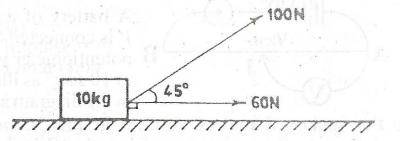
Two forces 100N and 60N act on an object of mass 10kg as illustrated in the diagram above. Neglecting friction, calculate the acceleration of the object.
Attached Figure / Diagram
A
4.0\(ms^{-2}\)
B
13.4\(ms^{-2}\)
C
16.0\(ms^{-2}\)
D
22.6\(ms^{-2}\)
medium Difficulty
Verified Correct Answer: Option B
Physical Principles & Numerical Solution
Resolving 100N into horizontal and vertical
100 sin45 = 0.7071 * 100 = 70.71
100cos45 = 70.71
Vertical forces = 100 - 70.71 → 29.29
Horizontal force = 70.71 + 60 → 130.71
Resultant of vertical and horizontal forces using pythagoras thoerem
Resultant force (F) = m * a
a = F/m → 133.9/10
a = 13.4
Source: Myschool Past Questions Archive (Record #49934)
Physics
WAEC / WASSCE 2017
Mechanics and Properties of Matter
Solution
A body weighing 14N in air is partially immersed in water. If the mass of water displaced in the process is 200g, calculate the upthrust on the body. [g=10\(m/s^{2}\)]
A
2.0N
B
3.0N
C
3.5N
D
7.0N
medium Difficulty
Verified Correct Answer: Option A
Physical Principles & Numerical Solution
Upthrust = weight of liquid displaced
= mass of liquid displaced \(\times\) acceleration due to gravity
= \(\frac{200}{1000} \times 10\)
= 2N
Source: Myschool Past Questions Archive (Record #49940)
Physics
WAEC / WASSCE 2017
Mechanics and Properties of Matter
Diagram
A body is whirled round a circular path at constant speed. Which of the following diagrams correctly indicates the direction of the body's velocity (v) and its acceleration (a)?
Attached Figure / Diagram

A
I
B
II
C
III
D
IV
medium Difficulty
Verified Correct Answer: Option B
Physical Principles & Numerical Solution
No expanded working has been attached for this question yet. The verified answer is Option B.
Source: Myschool Past Questions Archive (Record #49956)
Physics
WAEC / WASSCE 2017
Mechanics and Properties of Matter
Solution
A motorist travelling at 72\(kmh^{-1}\) had his eyes shut for 0.4s during a hard sneeze. Calculate the distance covered by him during this time interval.
A
50.0m
B
28.8m
C
18.0m
D
8.0m
medium Difficulty
Verified Correct Answer: Option D
Physical Principles & Numerical Solution
Convert velocity from \(kmh^{-1}\) to \(ms^{-1}\), by multiplying \(\frac{1000}{3600}\),
\(72 \times \frac{1000}{3600}\) = \(20ms^{-1}\)
Therefore, distance covered in 0.4s = \(20 \times 0.4 = 8m\)
Source: Myschool Past Questions Archive (Record #49958)
Physics
WAEC / WASSCE 2017
Mechanics and Properties of Matter
Diagram
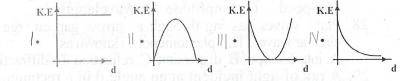
Which of the following graphs correctly represents the relationship between the kinetic energy (K.E) and the displacement (d) from point of release of a swinging pendulum bob?
Attached Figure / Diagram
A
I
B
II
C
III
D
IV
medium Difficulty
Verified Correct Answer: Option B
Physical Principles & Numerical Solution
No expanded working has been attached for this question yet. The verified answer is Option B.
Source: Myschool Past Questions Archive (Record #49965)
Physics
WAEC / WASSCE 2017
Mechanics and Properties of Matter
Solution
The energy stored in a spring of stiffness constant k = 2000\(Nm^{-1}\) when extended 4cm is
A
0.16J
B
1.60J
C
16.00J
D
160.00J
medium Difficulty
Verified Correct Answer: Option B
Physical Principles & Numerical Solution
The spring constant = the measure of stiffness = 2000\(Nm^{-1}\)
Energy stored in a spring = Work done to stretch it through a distance = change in potential energy
= \(\frac{kx^{2}}{2}\) = \(\frac{2000 \times (0.04)^{2}}{2}\) (converting 4cm to metres)
= \(\frac{3.2}{2} = 1.60J\)
Source: Myschool Past Questions Archive (Record #49968)