Question Library
Browse, filter, and study verified past examination questions with step-by-step mathematical reasoning.
Searching 18,000+ Questions...
Sifting topics, KaTeX formulas & verified solutions
Showing 271–285 of 573 verified questions
Sort by:
Mathematics
WAEC / WASSCE 2004
Algebra
Solution
Solve for t in the equation \(\frac{3}{4}t+\frac{1}{3}(21-t)\) = 11,
A
\(\frac{9}{13}\)
B
\(\frac{9}{5}\)
C
5
D
\(9\frac{3}{5}\)
medium Difficulty
Verified Correct Answer: Option D
Step-by-Step Mathematical Solution
\(\frac{3}{4}t+\frac{1}{3}(21-t) = 11; \frac{3t}{4} + \frac{7}{1} - \frac{t}{3} = \frac{11}{1}\\
\frac{3 \times 3t + 7\times 12 – 4 \times t = 11 \times 12}{12}\\
9t + 84 – 4t = 132; 5t = 132 – 84\\
5t = 48; t = \frac{48}{5} = 9\frac{3}{5}\)
Source: Myschool Past Questions Archive (Record #26620)
Mathematics
WAEC / WASSCE 2004
Algebra
Solution
Find the next two terms of the sequence
1, 5, 14, 30, 55, ...
A
61,110
B
67,116
C
81,140
D
91, 140
medium Difficulty
Verified Correct Answer: Option D
Step-by-Step Mathematical Solution
\(1 + 2^2 = 5 + 3^2 = 14 + 4^2 = 30 + 5^2 = 55\)
\(55 + 6^2 = 91 + 7^2 = 140\).
91, 140 are the next two terms.
Source: Myschool Past Questions Archive (Record #26636)
Mathematics
WAEC / WASSCE 2004
Algebra
Solution
Solve the equation 10-3x-x2 = 0
A
x=2 or-5
B
x= -2 or 5
C
x = 1 or 10
D
x = 2 or 5
medium Difficulty
Verified Correct Answer: Option A
Step-by-Step Mathematical Solution
10 – 3x - x2 = 0; 10 – 5x + 2x - x2 = 0
5(2 – x) + x(2 – x) = 0; (2 – x)(5 + x) = 0
2 – x = 0 or 5 + x = 0; x = 2 or x = -5
Source: Myschool Past Questions Archive (Record #26638)
Mathematics
WAEC / WASSCE 2004
Algebra
Solution
Find the sum of the roots of the equation 2x2 + 3x - 9 = 0
A
-18
B
-6
C
\(-\frac{9}{2}\)
D
\(-\frac{3}{2}\)
medium Difficulty
Verified Correct Answer: Option D
Step-by-Step Mathematical Solution
The general quadratic equation
x2 - (sum of roots) x + (product of root) = 0
Comparing with the given equation
2x2 +3x2 - 9 = 0; \(x^2 + \frac{3}{2}x - \frac{9}{2} = 0\\
Sum \hspace{1mm} of \hspace{1mm}roots = -\frac{3}{2}\)
Source: Myschool Past Questions Archive (Record #26643)
Mathematics
WAEC / WASSCE 2004
Algebra
Solution
Find the mean deviation of 6, 7, 8, 9, 10
A
1.2
B
1.5
C
2
D
8
medium Difficulty
Verified Correct Answer: Option A
Step-by-Step Mathematical Solution
\(\begin{matrix}
x & x-m & |x-m| \\
6 & -2 & 2 \\
7 & -1 & 1 \\
8 & 0 & 0 \\
9 & 1 & 1 \\
10 & 2 & 2 \\
& & 6
\end{matrix}
\)
Mean deviation\(=\frac{\sum|x-m|}{n}=\frac{6}{5} = 1.2\)
Source: Myschool Past Questions Archive (Record #26646)
Mathematics
WAEC / WASSCE 2004
Algebra
Diagram
Solution
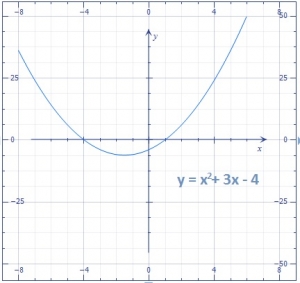
Use the graph to answer the Question below
What are the roots of the equation x2 + 3x - 4 = 0?
Attached Figure / Diagram
A
1, 4
B
-1, -4
C
-1, 4
D
-4, 1
medium Difficulty
Verified Correct Answer: Option D
Step-by-Step Mathematical Solution
x2 + 3x – 4 = 0 has roots value at the curve makes touches with the x – axis. The curve contact is at x = -4 and +1.
Source: Myschool Past Questions Archive (Record #26659)
Mathematics
WAEC / WASSCE 2004
Algebra
Solution
Which of the following quadratic equations has \(-\frac{1}{2}\) and \(\frac{3}{4}\) as its roots?
A
8x2 + 11x - 3 = 0
B
8x2 -11x – 3 = 0
C
8x2 + 2x -3 = 0
D
8x2 - 2x – 3 = 0
medium Difficulty
Verified Correct Answer: Option D
Step-by-Step Mathematical Solution
X2 - (sum of the roots)x + (product of the roots) = 0
Sum of the roots \(= -\frac{1}{2}+\frac{3}{4} = \frac{-2+3}{2}=\frac{1}{4}\)
Product of the roots = \(-\frac{1}{2}\times \frac{3}{4}=\frac{-3}{8}\\
X^2-\left(\frac{1}{4}\right)x-\frac{3}{8} = 0. Taking \hspace{1mm}the\hspace{1mm} common\)
\(8x^2-2x-3=0\);
Source: Myschool Past Questions Archive (Record #26661)
Mathematics
NECO SSCE 2004
Algebra
Solution
The nth term of a sequence is given as \(4 \times 3^{(3 - n)}\). Calculate the third term.
A
12
B
32
C
4
D
3
E
1
medium Difficulty
Verified Correct Answer: Option C
Step-by-Step Mathematical Solution
\(4 \times 3^{(3 - n)}\)
for the third term, n = 3
then
\(4 \times 3^{(3 - 3)}\) = \(4 \times 3^{0}\) = 4 x 1 = 4.
Source: Myschool Past Questions Archive (Record #42249)
Mathematics
NECO SSCE 2004
Algebra
Solve the equation: \(\frac{3}{[2(x - 2)]} - \frac{2}{[3(2 - x)]} = 0\)
A
3
B
2
C
\(\frac{3}{2}\)
D
\(\frac{2}{3}\)
E
-3
medium Difficulty
Verified Correct Answer: Option B
Step-by-Step Mathematical Solution
No expanded working has been attached for this question yet. The verified answer is Option B.
Source: Myschool Past Questions Archive (Record #42308)
Mathematics
NECO SSCE 2004
Algebra
The roots of a quadratic equation in x, are -m and 2n. Fine equation.
A
x2 - x(2n-m) – 2mn = 0
B
x2 + x(2n - m) - 2mn = 0
C
x2 + x(m - 2n) + 2mn = 0
D
X2 + x (m + 2n ) + 2mn = 0
E
x2 - x (m - 2n) - 2mn = 0
medium Difficulty
Verified Correct Answer: Option A
Step-by-Step Mathematical Solution
No expanded working has been attached for this question yet. The verified answer is Option A.
Source: Myschool Past Questions Archive (Record #42313)
Mathematics
WAEC / WASSCE 2004
Algebra
Solution
(a) In the simultaneous equations : \(px + qy = 5 ; qx + py = -10\); p and q are constants. If x = 1 and y = -2 is a solution of the equations, find p and q.
(b) Solve : \(\frac{4r - 3}{6r + 1} = \frac{2r - 1}{3r + 4}\).
medium Difficulty
Verified Correct Answer: Option
Step-by-Step Mathematical Solution
(a) \(px + qy = 5 \)
When x = 1 and y = -2, we have
\(p - 2q = 5 .... (1)\)
\(qx + py = -10 \)
When x = 1 and y = -2, we have
\(q - 2p = -10 .... (2)\)
Multiplying (1) by -2, we have
\(-2p + 4q = -10 ... (1a)\)
\(\equiv 4q - 2p = -10\)
(2) - (1a) : \(q - 4q = -10 + 10\)
\(-3q = 0\)
\(q = 0\)
Putting q = 0 in (1a), we have
\(-2p = -10 \implies p = 5\)
Hence, p = 5 and q = 0.
(b) \(\frac{4r - 3}{6r + 1} = \frac{2r - 1}{3r + 4}\)
\((4r - 3)(3r + 4) = (2r - 1)(6r + 1)\)
\(12r^{2} + 16r - 9r - 12 = 12r^{2} + 2r - 6r - 1\)
\(12r^{2} - 12r^{2} + 7r + 4r = - 1 + 12\)
\(11r = 11\)
\(r = 1\).
Source: Myschool Past Questions Archive (Record #53122)
Mathematics
UTME / JAMB 2004
Algebra
Solution
The inverse of the matrix \(\begin{pmatrix} 2 & 1 \\ 1 & 1 \end{pmatrix}\) is
A
\(\begin{pmatrix} 1 & -1 \\ -1 & 2 \end{pmatrix}\)
B
\(\begin{pmatrix} 1 & -1 \\ 1 & 2 \end{pmatrix}\)
C
\(\begin{pmatrix} 1 & 1 \\ 1 & 2 \end{pmatrix}\)
D
\(\begin{pmatrix} -1 & 1 \\ 1 & 2 \end{pmatrix}\)
medium Difficulty
Verified Correct Answer: Option A
Step-by-Step Mathematical Solution
To find the inverse of the matrix
\(A = \begin{pmatrix} 2 & 1 \\ 1 & 1 \end{pmatrix}\)
We can use the formula for the inverse of a \( 2 \times 2 \) matrix:
\(A^{-1} = \frac{1}{ad - bc} \begin{pmatrix} d & -b \\ -c & a \end{pmatrix}\)
where \( A = \begin{pmatrix} a & b \\ c & d \end{pmatrix} \).
Identify \( a, b, c, d \)}
In our matrix, we have:
\(a = 2, \quad b = 1, \quad c = 1, \quad d = 1\)
Calculate the determinant \( ad - bc \)
Calculating the determinant:
\(ad - bc = (2)(1) - (1)(1) = 2 - 1 = 1\)
Calculate the inverse:
Now substituting into the formula for the inverse:
\(A^{-1} = \frac{1}{1} \begin{pmatrix} 1 & -1 \\ -1 & 2 \end{pmatrix} = \begin{pmatrix} 1 & -1 \\ -1 & 2 \end{pmatrix}\)
Thus, the inverse of the matrix \( \begin{pmatrix} 2 & 1 \\ 1 & 1 \end{pmatrix} \) is \(\begin{pmatrix} 1 & -1 \\ -1 & 2 \end{pmatrix}\)
Source: Myschool Past Questions Archive (Record #72305)
Mathematics
UTME / JAMB 2004
Algebra
Solution
If P = \(\begin{pmatrix} 1 & 0 & -1 \\ 3 & 4 & 5 \\ -1 & 0 & 1 \end{pmatrix}\), then |P| is
A
-8
B
0
C
4
D
8
medium Difficulty
Verified Correct Answer: Option B
Step-by-Step Mathematical Solution
The determinant of the matrix
\(P = \begin{pmatrix} 1 & 0 & -1 \\ 3 & 4 & 5 \\ -1 & 0 & 1 \end{pmatrix}\)
is calculated as follows:
\(|P| = 1 \cdot (4 \cdot 1 - 5 \cdot 0) - 0 \cdot (3 \cdot 1 - 5 \cdot -1) + (-1) \cdot (3 \cdot 0 - 4 \cdot -1) = 4 - 0 - 4 = 0\)
Thus, the determinant of the matrix \( P \) is
\(|P| = 0\).
Source: Myschool Past Questions Archive (Record #72307)
Mathematics
UTME / JAMB 2003
Algebra
Solution
Find the range of the value of x satisfying the inequalities 5 + x \(\leq\) 8 and 13 + x \(\geq\) 7
A
-3 \(\leq\) x \(\leq\) 3
B
3 \(\leq\) x \(\leq\) 6
C
-6 \(\leq\) x \(\leq\) 3
D
-6 \(\leq\) x \(\leq\) -3
medium Difficulty
Verified Correct Answer: Option C
Step-by-Step Mathematical Solution
5 + x \(\leq\) 8 and 13 + x \(\geq\) 7
5 + x \(\leq\) 8
X \(\leq\) 8 – 5
X \(\leq\) 3
And 13 + x \(\geq\) 7
X \(\geq\) 7 – 13
X \(\geq\) -6
Combining the two
-6 \(\leq\) x \(\leq\) 3
Source: Myschool Past Questions Archive (Record #7748)
Mathematics
UTME / JAMB 2003
Algebra
Solution
The graph of the function y = x\(^2\) + 4 and a straight line PQ are drawn to solve the equation x\(^2\) - 3x + 2 = 0. What is the equation of PQ?
A
y = 3x - 2
B
y = 3x + 2
C
y = 3x - 4
D
y = 3x + 4
medium Difficulty
Verified Correct Answer: Option B
Step-by-Step Mathematical Solution
x\(^2\) + 4 = x\(^2\) - 3x + 2
3x + 2 = y
Source: Myschool Past Questions Archive (Record #7751)