Question Library
Browse, filter, and study verified past examination questions with step-by-step mathematical reasoning.
Searching 18,000+ Questions...
Sifting topics, KaTeX formulas & verified solutions
Showing 256–270 of 345 verified questions
Sort by:
Mathematics
UTME / JAMB 1994
Statistics and Probability
Solution
\(\begin{array}{c|c} x & 1 & 2 & 3 & 4 & 5 \\ \hline f & y + 2 & y - 1 & 2y - 3 & y + 4 & 3y - 4\end{array}\)
This table shows the frequency distribution of a data if the mean is \(\frac{43}{14}\), find y
A
1
B
2
C
3
D
4
medium Difficulty
Verified Correct Answer: Option B
Step-by-Step Mathematical Solution
x
1
2
3
4
5
Total
f
y + 2
y - 1
2y - 3
y + 4
3y - 4
8y - 2
fx
y + 2
2y - 2
6y - 9
4y + 16
15y - 20
28y - 13
Mean = \(\frac{\sum fx}{\sum f}\)
\(\therefore \frac{28y - 13}{8y - 2} = \frac{43}{14}\)
\(\implies 14(28y - 13) = 43(8y - 2)\)
\(392y - 182 = 344y - 86\)
\(392y - 344y = -86 + 182 \implies 48y = 96\)
\(y = 2\)
Source: Myschool Past Questions Archive (Record #31113)
Mathematics
UTME / JAMB 1994
Statistics and Probability
Solution
Find the mean deviation of the set of numbers 4, 5, 9
A
zero
B
2
C
5
D
6
medium Difficulty
Verified Correct Answer: Option B
Step-by-Step Mathematical Solution
x = \(\frac{\sum x}{N}\)
= \(\frac{18}{3}\)
= 6
\(\begin{array}{c|c} x & x - x & x - x \\ \hline 4 & -2 & 2\\ 5 & 1 & 1\\ 9 & 3 & 3\\ \hline & & 6\end{array}\)
M.D = \(\frac{|x - x|}{N}\)
= \(\frac{6}{3}\)
= 2
Source: Myschool Past Questions Archive (Record #31121)
Mathematics
UTME / JAMB 1994
Statistics and Probability
Solution
Class interval
1 - 5
6 - 10
11 - 15
16 - 20
21 - 25
Frequency
6
15
20
7
2
Estimate the median of the frequency distribution above
A
10\(\frac{1}{2}\)
B
11\(\frac{1}{2}\)
C
12
D
13
medium Difficulty
Verified Correct Answer: Option C
Step-by-Step Mathematical Solution
Median = L + [\(\frac{\frac{N}{2} - f}{fm}\)]h
N = Sum of frequencies
L = lower class boundary of median class
f = sum of all frequencies below L
fm = frequency of modal class and
h = class width of median class
Median = 11 + [\(\frac{\frac{50}{2} - 21}{20}\)]5
= 11 + (\(\frac{25 - 21}{20}\))5
= 11 + (\(\frac{(4)}{20}\))
11 + 1 = 12
Source: Myschool Past Questions Archive (Record #31122)
Mathematics
UTME / JAMB 1994
Statistics and Probability
Solution
\(\begin{array}{c|c} x & 1 & 2 & 3 & 4 & 5 \\ \hline f & 2 & 1 & 2 & 1 & 2\end{array}\)
Find the variance of the frequency distribution above
A
\(\frac{3}{2}\)
B
\(\frac{9}{4}\)
C
\(\frac{5}{2}\)
D
3
medium Difficulty
Verified Correct Answer: Option B
Step-by-Step Mathematical Solution
\(\begin{array}{c|c} x & f & fx & \bar{x} - x & (\bar{x} - x)^2 & f(\bar{x} - x)^2 \\ \hline 1 & 2 & 2 & -2 & 4 & 8\\ 2 & 1 & 2 & -1 & 1 & 1\\ 3 & 2 & 6 & 0 & 0 & 0\\ 4 & 1 & 4 & 1 & 1 & 1\\ 2 & 2 & 10 & 2 & 4 & 8\\ \hline & 8 & 24 & & & 18 \end{array}\)
x = \(\frac{\sum fx}{\sum f}\)
= \(\frac{24}{8}\)
= 3
Variance (62) = \(\frac{\sum f(\bar{x} - x)^2}{\sum f}\)
= \(\frac{18}{8}\)
= \(\frac{9}{4}\)
Source: Myschool Past Questions Archive (Record #31123)
Mathematics
UTME / JAMB 1994
Statistics and Probability
Solution
In a survey, it was observed that 20 students read newspapers and 35 read novels. If 40 of the students read either newspapers or novels, what is the probability of the students who read both newspapers and novels?
A
\(\frac{1}{2}\)
B
\(\frac{2}{3}\)
C
\(\frac{3}{8}\)
D
\(\frac{3}{11}\)
medium Difficulty
Verified Correct Answer: Option C
Step-by-Step Mathematical Solution
40 = 20 - x + x + 35 - x
40 = 55 - x
x = 55 - 40
= 15
∴ P(both) \(\frac{15}{40}\)
= \(\frac{3}{8}\)
Source: Myschool Past Questions Archive (Record #31124)
Mathematics
WAEC / WASSCE 1994
Statistics and Probability
Solution
The table below gives the frequency distribution of the marks obtained by some students in a scholarship examination.
Scores (x)
15
25
35
45
55
65
75
Freq (f)
1
4
12
24
18
8
3
(a) Calculate, correct to 3 significant figures, the mean mark.
(b) Find the : (i) mode ; (ii) range of the distribution.
medium Difficulty
Verified Correct Answer: Option
Step-by-Step Mathematical Solution
(a)
x
f
fx
15
1
15
25
4
100
35
12
420
45
24
1080
55
18
990
65
8
520
75
3
225
70
3350
\(Mean = \frac{\sum fx}{\sum f} = \frac{3350}{70} = 47.8571\)
\(\approxeq 47.9\) (to 3 sig. figs)
(b)(i) Mode = 45 (score with the highest frequency)
(ii) Range = Highest mark - Lowest mark
= 75 - 15 = 60.
Source: Myschool Past Questions Archive (Record #54553)
Mathematics
WAEC / WASSCE 1994
Statistics and Probability
Solution
A bag contains 12 white balls and 8 black balls, another contains 10 white balls and 15 black balls. If two balls are drawn, without replacement from each bag, find the probability that :
(a) all four balls are black ;
(b) exactly one of the four balls is white.
medium Difficulty
Verified Correct Answer: Option
Step-by-Step Mathematical Solution
(a) 1st bag contains 12 white (W) balls and 8 black (B) balls; 2nd bag contains 10 white (W) balls and 15 black (B) balls.
P(two black balls from the 1st bag and two black balls from 2nd bag)
= \((\frac{8}{20} \times \frac{7}{19}) \times (\frac{15}{25} \times \frac{14}{24})\)
= \(\frac{14}{95} \times \frac{7}{20}\)
= \(\frac{49}{950}\)
(b) P(picking exactly one white ball) = P(WB from 1st bag and BB from 2nd bag) + P(BW from 1st bag and BB from 2nd bag) + P(BB from 1st bag and WB from 2nd bag) + P(BB from 1st bag and BW from 2nd bag)
= \(\frac{12}{20} \times \frac{8}{19} \times \frac{15}{25} \times \frac{14}{24} + \frac{8}{20} \times \frac{12}{19} \times \frac{15}{25} \times \frac{14}{24} + \frac{8}{20} \times \frac{7}{19} \times \frac{10}{25} \times \frac{15}{24} + \frac{8}{20} \times \frac{7}{19} \times \frac{15}{25} \times \frac{10}{24}\)
= \(\frac{42}{475} + \frac{42}{475} + \frac{7}{190} + \frac{7}{190}\)
= \(\frac{238}{950}\)
Source: Myschool Past Questions Archive (Record #54555)
Mathematics
WAEC / WASSCE 1994
Statistics and Probability
Solution
The table below gives the ages, to the nearest 5 years of 50 people.
Age in years
10
15
20
25
30
No of people
8
19
10
7
6
(a) Construct a cumulative frequency table for the distribution.
(b) Draw a cumulative frequency curve (Ogive)
(c) From your Ogive, find the : (i) median age ; (ii) number of people who are at most 15 years of age ; (iii) number of people who are between 20 and 25 years of age.
medium Difficulty
Verified Correct Answer: Option
Step-by-Step Mathematical Solution
(a)
Age in years
No of people
Cum Freq
10
8
8
15
19
27
20
10
37
25
7
44
30
6
50
(b)
(c)(i) Median age = 14.5 years
(ii) Number of people who are at most 15 years of age = 27 people
(iii) Number of people who are between 20 and 25 years = people who are 25 years - people who are 20 years
= 44 - 37 = 7 people
Source: Myschool Past Questions Archive (Record #54557)
Mathematics
WAEC / WASSCE 1993
Statistics and Probability
Solution
Find the median of the following set of numbers: 28, 29, 39, 38, 33, 37, 26, 20, 15, 25
A
33
B
29.5
C
29
D
28.5
E
28
medium Difficulty
Verified Correct Answer: Option D
Step-by-Step Mathematical Solution
15, 20, 25, 26, 28, 29, 33, 37, 38, 39
median = \(\frac{28 + 29}{2}\)
= 28.5
Source: Myschool Past Questions Archive (Record #23222)
Mathematics
WAEC / WASSCE 1993
Statistics and Probability
Diagram
Solution
The table above shows the scores of a group of 40 students in a physics test.
If the mode is m and the median is n, then (m,n) is
Attached Figure / Diagram

A
(5,5)
B
(5,6)
C
(6,5)
D
(9,4)
E
(9,5)
medium Difficulty
Verified Correct Answer: Option A
Step-by-Step Mathematical Solution
Mode = 5
Median = 5
(m, n) = (5, 5)
Source: Myschool Past Questions Archive (Record #23224)
Mathematics
WAEC / WASSCE 1993
Statistics and Probability
Solution
Find the median of the set of numbers 12, 15, 13, 14, 12, 12.
A
12
B
12.5
C
13
D
13.5
E
14
medium Difficulty
Verified Correct Answer: Option B
Step-by-Step Mathematical Solution
12, 12, 12, 13, 14, 15
Median = \(\frac{12 + 13}{2}\)
= 12.5
Source: Myschool Past Questions Archive (Record #23226)
Mathematics
WAEC / WASSCE 1993
Statistics and Probability
Solution
A fair die is rolled once. What is the probability of obtaining a number less than 3?
A
1/6
B
1/3
C
2/3
D
1/2
E
5/6
medium Difficulty
Verified Correct Answer: Option B
Step-by-Step Mathematical Solution
Prob(less than 3) = \(\frac{2}{6}\)
= \(\frac{1}{3}\)
Source: Myschool Past Questions Archive (Record #23231)
Mathematics
WAEC / WASSCE 1993
Statistics and Probability
Solution
What is the probability that a total sum of seven would appear in two tosses of a fair die?
A
5/36
B
1/6
C
7/36
D
5/6
E
1
medium Difficulty
Verified Correct Answer: Option B
Step-by-Step Mathematical Solution
No of possible outcome = 36
Required outcome (R) = {(1, 6), (6, 1), (2, 5), (5, 2), (3, 4), (4, 3)}
n(R) = \(\frac{6}{36}\)
= \(\frac{1}{6}\)
Source: Myschool Past Questions Archive (Record #23233)
Mathematics
WAEC / WASSCE 1993
Statistics and Probability
Diagram
Solution
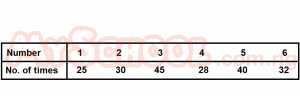
A die is rolled 200 times the outcomes obtained are shown in the table below.
Find the probability of obtaining 2.
Attached Figure / Diagram
A
0.002
B
0.015
C
0.15
D
16
E
0.2
medium Difficulty
Verified Correct Answer: Option C
Step-by-Step Mathematical Solution
Prob(obtaining a 2) = \(\frac{30}{200}\)
= \(0.15\)
Source: Myschool Past Questions Archive (Record #23234)
Mathematics
WAEC / WASSCE 1993
Statistics and Probability
Solution
Number
1
2
3
4
5
6
No of times
25
30
45
28
40
32
A die rolled 200 times. The outcome obtained are shown in the table above.
What is the probability of obtaining a number less than 3 ?
A
0.125
B
0.150
C
0.275
D
0.500
E
0.725
medium Difficulty
Verified Correct Answer: Option C
Step-by-Step Mathematical Solution
Prob(less than 3) = \(\frac{25 + 30}{200}\)
= \(\frac{11}{40}\)
= 0.275
Source: Myschool Past Questions Archive (Record #23235)