Question Library
Browse, filter, and study verified past examination questions with step-by-step mathematical reasoning.
Searching 18,000+ Questions...
Sifting topics, KaTeX formulas & verified solutions
Showing 256–270 of 573 verified questions
Sort by:
Mathematics
WAEC / WASSCE 2005
Algebra
Diagram
Solution
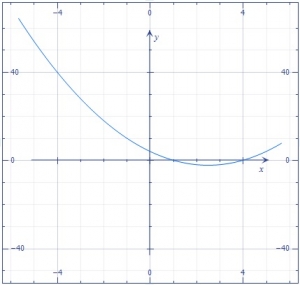
What are the roots of the equation?
Attached Figure / Diagram
A
-1 and 1
B
4 and 1
C
1 and 4
D
4 and 4
medium Difficulty
Verified Correct Answer: Option C
Step-by-Step Mathematical Solution
The two points of contact of the curve with the x-axis are x = 1 and x = 4. The roots of the equation are x = 1 and x = 4
Source: Myschool Past Questions Archive (Record #26706)
Mathematics
WAEC / WASSCE 2005
Algebra
Diagram
Solution
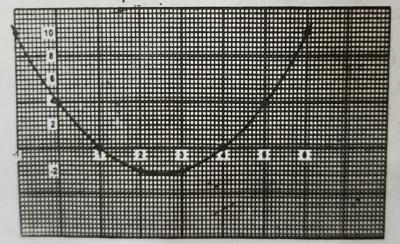
What is the equation of the curve?
Attached Figure / Diagram
A
\(y=x^2+6x+4\)
B
\(y=x^2-5x-4\)
C
\(y=x^2-5x+4\)
D
\(y=x^2+5x-4\)
medium Difficulty
Verified Correct Answer: Option C
Step-by-Step Mathematical Solution
The factor for the curve are (x-1)(x-4). The product off the curves gives \(=x^2-5x+4=y\)
Source: Myschool Past Questions Archive (Record #26707)
Mathematics
NECO SSCE 2005
Algebra
Solve for x in the quadratic equation. 2x2 + 12x + 10 = 0
A
x = -5, -1
B
x = -5,1
C
x = -3, -2
D
x = 3, 2
E
x = 6, 5
medium Difficulty
Verified Correct Answer: Option A
Step-by-Step Mathematical Solution
No expanded working has been attached for this question yet. The verified answer is Option A.
Source: Myschool Past Questions Archive (Record #42413)
Mathematics
WAEC / WASSCE 2005
Algebra
Solution
(a) Evaluate : \(2 \div (\frac{64}{125})^{-\frac{2}{3}}\)
(b) The lines \(y = 3x + 5\) and \(y = - 4x - 1\) intersect at a point k. Find the coordinates of k.
medium Difficulty
Verified Correct Answer: Option
Step-by-Step Mathematical Solution
(a) \((\frac{64}{125})^{-\frac{2}{3}} = (\frac{125}{64})^{\frac{2}{3}}\)
= \((\frac{5}{4})^{3})^{\frac{2}{3}} \)
= \((\frac{5}{4})^{2}\)
= \(\frac{25}{16}\)
\(\therefore 2 \div (\frac{64}{125})^{-\frac{2}{3}} = 2 \div \frac{25}{16}\)
= \(2 \times \frac{16}{25}\)
= \(\frac{32}{25}\)
(b) \(3x + 5 = - 4x - 1\)
\(3x + 4x = - 1 - 5\)
\(7x = - 6\)
\(x = -\frac{6}{7}\)
\(y = 3x + 5\) ( You can use any of the given equations to get y)
\(y = 3(-\frac{6}{7}) + 5 = -\frac{18}{7} + \frac{35}{7}\)
= \(\frac{17}{7}\)
\(k = (x, y) = (-\frac{6}{7}, \frac{17}{7})\)
Source: Myschool Past Questions Archive (Record #53060)
Mathematics
WAEC / WASSCE 2005
Algebra
Solution
(a) Find the smallest integer that satisfies the inequality \(x + 8 < 4x - 15\).
(b) A sales girl is paid a monthly salary of N2,500 in addition to a commission of 5 kobo in the naira on all sales made by her during the month. If her sales for a month amounts to N200,000.00, calculate her income for that month.
(c) The diagram shows a window consisting of a rectangular and semi- circular parts. The radius of the semi- circular part is 35 cm and the height of the rectangular part is 50 cm. Find the area of the window. [Take \(\pi = \frac{22}{7}\)].
medium Difficulty
Verified Correct Answer: Option
Step-by-Step Mathematical Solution
(a) \(x + 8 < 4x - 15 \implies 4x - 15 > x + 8\)
\(4x - x > 8 + 15 \implies 3x > 23\)
\(x > \frac{23}{3}\)
\(x > 7\frac{2}{3}\).
(b) Extra income = 5k of N200,000
= \(\frac{5}{100} \times N200,000\)
= \(N10,000\)
Total income = Monthly income + commission
= N(2,500 + 10,000)
= N12,500.
(c) Area of semi- circle = \(\frac{\pi r^{2}}{2}\)
= \(\frac{1}{2} \times \frac{22}{7} \times 35 \times 35\)
= \(1925 cm^{2}\)
Length of rectangular part = 50 cm
Breadth = Diameter of semi- circle = 2(35 cm) = 70 cm
Area of rectangular part = \(length \times \breadth\)
= \(50 \times 70\)
= \(3500 cm^{2}\)
Total area of window = \((3500 + 1925) cm^{2}\)
= \(5425 cm^{2}\)
Source: Myschool Past Questions Archive (Record #53113)
Mathematics
WAEC / WASSCE 2005
Algebra
Solution
(a) Copy and complete the table.
\(y = x^{2} - 2x - 2\) for \(-4 \leq x \leq 4\)
x
-4
-3
-2
-1
0
1
2
3
4
y
22
-2
1
6
(b) Using a scale of 2 cm to 1 unit on the x- axis and 2 cm to 5 units on the y- axis, draw the graph of \(y = x^{2} - 2x - 2\).
(c) Use your graph to find : (i) the roots of the equation \(x^{2} - 2x - 2 = 0\) ; (ii) the values of x for which \(x^{2} - 2x - 4\frac{1}{2} = 0\) ; (iii) the equation of the line of symmetry of the curve.
medium Difficulty
Verified Correct Answer: Option
Step-by-Step Mathematical Solution
(a) \(y = x^{2} - 2x - 2\)
x
-4
-3
-2
-1
0
1
2
3
4
\(x^{2}\)
16
9
4
1
0
1
4
9
16
\(-2x\)
8
6
4
2
0
-2
-4
-6
-8
\(-2\)
-2
-2
-2
-2
-2
-2
-2
-2
-2
\(y\)
22
13
6
1
-2
-3
-2
1
6
(b)
(c)(i) \(x^{2} - 2x - 2 = 0\)
\(\therefore y = 0 ; x = \text{-0.7 or 2.7}\)
(ii) \(x^{2} - 2x - 4\frac{1}{2} = 0\)
\(x^{2} - 2x - 4\frac{1}{2} + 2\frac{1}{2} = 0 + 2\frac{1}{2}\)
\(x^{2} - 2x - 2 = 2.5\)
When y = 2.5, \(x = \text{-1.3 or 3.3}\).
(iii) Line of symmetry at x = 1.
Source: Myschool Past Questions Archive (Record #53120)
Mathematics
UTME / JAMB 2005
Algebra
Solution
A father decided to give 20% of his monthly income to his three children as their monthly allowance. The eldest child got 45% of the allowance and the youngest got 25%. How much was the father's monthly income if the second child got ₦ 3,000?
A
₦33,000
B
₦45,000
C
₦50,000
D
₦60,000
medium Difficulty
Verified Correct Answer: Option C
Step-by-Step Mathematical Solution
To find the father's monthly income, we follow these steps:
Let \( I \) = Father's monthly income, \( A \) = Total allowance.
The total allowance is given by:
\(A = 0.2 I\)
The second child receives 30% of the allowance:
\(0.3 A = 3000\)
Solving for \( A \):
\(A = \frac{3000}{0.3} = 10000\)
Father's Income:
Now, substituting \( A \) into the equation for income:
\(0.2 I = 10000 \implies I = \frac{10000}{0.2} = 50000\)
The father's monthly income is: ₦50,000
Source: Myschool Past Questions Archive (Record #72273)
Mathematics
UTME / JAMB 2005
Algebra
Solution
If P = \(\begin{pmatrix}1 & 3 & 2 \\ 4 & 5 & -1 \\ -3 & 2 & 0 \end{pmatrix}\), find the determinant of matrix P.
A
75
B
57
C
-57
D
-75
medium Difficulty
Verified Correct Answer: Option B
Step-by-Step Mathematical Solution
To find the determinant of the matrix
\(P = \begin{pmatrix} 1 & 3 & 2 \\ 4 & 5 & -1 \\ -3 & 2 & 0 \end{pmatrix}\)
We use the formula:
\(\text{det}(P) = a(ei - fh) - b(di - fg) + c(dh - eg)\)
Substituting the values:
- \(a = 1\), \(b = 3\), \(c = 2\)
- \(d = 4\), \(e = 5\), \(f = -1\)
- \(g = -3\), \(h = 2\), \(i = 0\)
Calculating:
\(ei - fh = 5 \cdot 0 - (-1) \cdot 2 = 2,\)
\(di - fg = 4 \cdot 0 - (-1) \cdot -3 = -3,\)
\(dh - eg = 4 \cdot 2 - 5 \cdot -3 = 8 + 15 = 23.\)
Thus,
\(\text{det}(P) = 1 \cdot 2 - 3 \cdot (-3) + 2 \cdot 23 = 2 + 9 + 46 = 57\)
The determinant of matrix \( P \) is 57
Source: Myschool Past Questions Archive (Record #72276)
Mathematics
UTME / JAMB 2005
Algebra
Solution
If M and N are two matrices defined by M = \(\begin{pmatrix} 1 & 3 & 2 \\ 4 & 5 & -1 \\ -3 & 2 & 0 \end{pmatrix}\) and N = \(\begin{pmatrix}1 & -2 & 3 \\ 4 & -1 & 5 \\ 2 & -3 & -1 \end{pmatrix}\). Evaluate 2M - 3N
A
\(\begin{pmatrix} -1 & 12 & 5 \\ 4 & 7 & 13 \\ 0 & -5 & -3 \end{pmatrix}\)
B
\(\begin{pmatrix} -1 & 0 & -5 \\ -4 & 7 & -17 \\ 0 & -5 & 3 \end{pmatrix}\)
C
\(\begin{pmatrix} -1 & 12 & -5 \\ -4 & 13 & -17 \\ -12 & 13 & 3 \end{pmatrix}\)
D
\(\begin{pmatrix} -1 & 12 & -5 \\ 4 & 13 & 13 \\ -12 & 13 & 3 \end{pmatrix}\)
medium Difficulty
Verified Correct Answer: Option C
Step-by-Step Mathematical Solution
To evaluate \( 2M - 3N \) where
\(M = \begin{pmatrix} 1 & 3 & 2 \\ 4 & 5 & -1 \\ -3 & 2 & 0 \end{pmatrix}\)
and \(N = \begin{pmatrix} 1 & -2 & 3 \\ 4 & -1 & 5 \\ 2 & -3 & -1 \end{pmatrix}\)
Calculate \( 2M \)
\(2M = 2 \times \begin{pmatrix} 1 & 3 & 2 \\ 4 & 5 & -1 \\ -3 & 2 & 0 \end{pmatrix} = \begin{pmatrix} 2 \cdot 1 & 2 \cdot 3 & 2 \cdot 2 \\ 2 \cdot 4 & 2 \cdot 5 & 2 \cdot -1 \\ 2 \cdot -3 & 2 \cdot 2 & 2 \cdot 0 \end{pmatrix} = \begin{pmatrix} 2 & 6 & 4 \\ 8 & 10 & -2 \\ -6 & 4 & 0 \end{pmatrix}\)
Calculate \( 3N \)
\(3N = 3 \times \begin{pmatrix} 1 & -2 & 3 \\ 4 & -1 & 5 \\ 2 & -3 & -1 \end{pmatrix} = \begin{pmatrix} 3 \cdot 1 & 3 \cdot -2 & 3 \cdot 3 \\ 3 \cdot 4 & 3 \cdot -1 & 3 \cdot 5 \\ 3 \cdot 2 & 3 \cdot -3 & 3 \cdot -1 \end{pmatrix} = \begin{pmatrix} 3 & -6 & 9 \\ 12 & -3 & 15 \\ 6 & -9 & -3 \end{pmatrix}\)
Calculate \( 2M - 3N \)
\(2M - 3N = \begin{pmatrix} 2 & 6 & 4 \\ 8 & 10 & -2 \\ -6 & 4 & 0 \end{pmatrix} - \begin{pmatrix} 3 & -6 & 9 \\ 12 & -3 & 15 \\ 6 & -9 & -3 \end{pmatrix}\)
Subtracting the matrices element-wise:
\(= \begin{pmatrix} 2 - 3 & 6 - (-6) & 4 - 9 \\ 8 - 12 & 10 - (-3) & -2 - 15 \\ -6 - 6 & 4 - (-9) & 0 - (-3) \end{pmatrix}\)
Calculating each element:
\(= \begin{pmatrix} -1 & 12 & -5 \\ -4 & 13 & -17 \\ -12 & 13 & 3 \end{pmatrix}\)
Final Result
Thus, the result of \( 2M - 3N \) is \(\begin{pmatrix} -1 & 12 & -5 \\ -4 & 13 & -17 \\ -12 & 13 & 3 \end{pmatrix}\)
Source: Myschool Past Questions Archive (Record #72281)
Mathematics
UTME / JAMB 2004
Algebra
Solution
What are the integer values of x which satisfy the inequality -1 < 3 -2x \(\leq\) 5?
A
-1. 0, 1, 2
B
-2, 1, 0 , -1
C
0, 1, 2
D
-1, 0, 1
medium Difficulty
Verified Correct Answer: Option D
Step-by-Step Mathematical Solution
-1 < 3 -2x and 3 - 2x \(\leq\) 5
2x < 3 + 1 and -2x \(\leq\) 5 - 3
2x < 4 and -2x \(\leq\) 2
x < 2 and x \(\geq\) 2/-2 = x \(\geq\) -1
If -1 \(\leq\) x < 2
it implies that x = -1, 0, 1
Source: Myschool Past Questions Archive (Record #8200)
Mathematics
UTME / JAMB 2004
Algebra
Solution
The nth term of two sequences are Qn = 3 . 2n - 2 and Um = 3 . 22m - 3. Find the product of Q2 and U2.
A
18
B
12
C
6
D
3
medium Difficulty
Verified Correct Answer: Option A
Step-by-Step Mathematical Solution
Qn = 3 * 2n - 2
Um = 3 * 22m - 3
Q2 * U2 = (3 * 22 - 2) * (3 * 22(2) - 3)
= 3 * 20 * 3 * 21
= 3 * 1 * 3 * 2
= 18
Source: Myschool Past Questions Archive (Record #8204)
Mathematics
UTME / JAMB 2004
Algebra
Solution
Find the sum to infinity of the series 1/2 , 1/6, 1/18, .....
A
2/3
B
1/3
C
3/4
D
1
medium Difficulty
Verified Correct Answer: Option C
Step-by-Step Mathematical Solution
\(a=\frac{1}{2}\\r=\frac{\frac{1}{6}}{\frac{1}{2}}=\frac{1}{6}\times\frac{2}{1}=\frac{1}{3}\\S_\infty = \frac{a}{1-r}\\S_\infty = \frac{\frac{1}{2}}{1-\frac{1}{3}}\\=\frac{\frac{1}{2}}{\frac{3}{2}}\\=\frac{1}{2}\times\frac{3}{2}\\=\frac{3}{4}\)
Source: Myschool Past Questions Archive (Record #8206)
Mathematics
WAEC / WASSCE 2004
Algebra
Solution
Given that \(P\propto \frac{1}{\sqrt{r}}\) and p = 3 when r = 16, find the value of r when p = \(\frac{3}{2}\)
A
48
B
64
C
72
D
324
medium Difficulty
Verified Correct Answer: Option B
Step-by-Step Mathematical Solution
Given that \( P \propto \frac{1}{\sqrt{r}} \), we can express this relationship as:
\(P = k \cdot \frac{1}{\sqrt{r}}\)
for some constant \( k \).
From the information provided, when \( P = 3 \) and \( r = 16 \):
\(3 = k \cdot \frac{1}{\sqrt{16}}\)
Since \( \sqrt{16} = 4 \), we have: \(3 = k \cdot \frac{1}{4}\)
Thus, \(k = 3 \cdot 4 = 12\)
Now we can write the equation as: \(P = \frac{12}{\sqrt{r}}\)
Next, we need to find \( r \) when \( P = \frac{3}{2} \):
\(\frac{3}{2} = \frac{12}{\sqrt{r}}\)
Cross-multiplying gives:
\(3\sqrt{r} = 24\)
Dividing both sides by 3:
\(\sqrt{r} = 8\)
Squaring both sides:
\(r = 64\). Thus, r = 64
Source: WAEC / JAMB / NECO Classroom Archive (Record #26663)
Mathematics
NECO SSCE 2004
Algebra
Solution
The first term of an A.P is equal to thrice the common difference, what is the sixth term of the A.P, if the common difference is 8?
A
64
B
48
C
43
D
24
E
11
medium Difficulty
Verified Correct Answer: Option A
Step-by-Step Mathematical Solution
first term[a] = 3 * d → 3 * 8 = 24
sixth term of the A.P = a + 5d → 24 + [5 * 8]
⇒ 24 + 40 = 64
Source: WAEC / JAMB / NECO Classroom Archive (Record #42305)
Mathematics
UTME / JAMB 2004
Algebra
Diagram
Solution
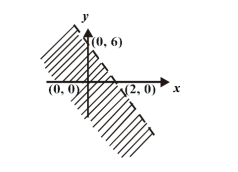
The shaded area in the diagram above is represented by
Attached Figure / Diagram
A
{(x,y) : y - 3x < -6}
B
{(x,y) : y + 3x < 6}
C
{(x,y) : y + 3x < -6}
D
{(x,y) : y - 3x < 6}
medium Difficulty
Verified Correct Answer: Option B
Step-by-Step Mathematical Solution
Coordinates of the line are (x1 y1)(0,2) respectively and (x2 y2)(2,0) respectively
Gradient (m) of the line = (y2 - y1) / (x2 - x1) = (0-6) / (2-0) = -6/2
= -3
Equation of the line y-y1 = m(x-x1)
y - 6 = -3(x - 0)
y - 6 = -3x
y + 3x = 6
inequality; from the y axis, the shaded region is below the line
∴ y + 3x ∠ 6 and line is a broken line
Source: Myschool Past Questions Archive (Record #11101)