Question Library
Browse, filter, and study verified past examination questions with step-by-step mathematical reasoning.
Searching 18,000+ Questions...
Sifting topics, KaTeX formulas & verified solutions
Showing 26731–26745 of 29811 verified questions
Sort by:
Chemistry
UTME / JAMB 1988
Electrolysis & Electrochemical Cells
Diagram
Use the graph above to answer this question. The mass of a substance, M, liberated at an electrode during electrolysis is proportional to the quantity of electricity, Q passing through the electrolyte. This is represented graphically by.
Attached Figure / Diagram
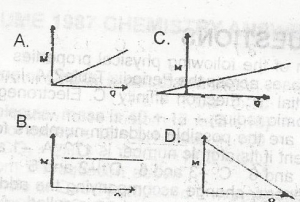
A
A
B
B
C
C
D
D
medium Difficulty
Verified Correct Answer: Option A
Chemical Principles & Mechanism
No expanded working has been attached for this question yet. The verified answer is Option A.
Source: Myschool Past Questions Archive (Record #31386)
Chemistry
UTME / JAMB 1988
Chemical Energetics & Thermochemistry
Diagram
Solution
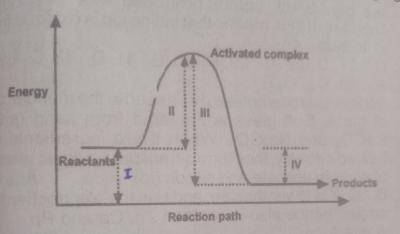
The diagram above shows the reaction path of an exothermic reaction. The heat of reaction is represented by
Attached Figure / Diagram
A
l
B
ll
C
lll
D
lV
medium Difficulty
Verified Correct Answer: Option D
Chemical Principles & Mechanism
The formula for the heat of reaction (\DeltaH) in an energy profile for an exothermic reaction is \DeltaH = H\(_{products}\) - H\(_{reactants}\). In an exothermic reaction, the products have a lower enthalpy than the reactants, resulting in a negative \DeltaH value, indicating heat is released.
In the energy profile, \DeltaH = H\(_{products}\) - H\(_{reactants}\) is represented by the part labelled IV
Source: Myschool Past Questions Archive (Record #31388)
Chemistry
UTME / JAMB 1988
Organic Chemistry II: Functional Groups, Polymers & Biomolecules
Diagram
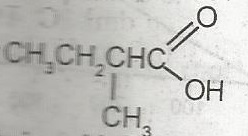
The IUPAC name for
Attached Figure / Diagram
A
2-methylbutanoic acid
B
2-methyl-1- hydroxyketone
C
2-methyl-1-hydroxy aldehyde
D
2-methylpentanoic acid
medium Difficulty
Verified Correct Answer: Option A
Chemical Principles & Mechanism
No expanded working has been attached for this question yet. The verified answer is Option A.
Source: Myschool Past Questions Archive (Record #31389)
Chemistry
UTME / JAMB 1988
Stoichiometry, Mole Concept & Volumetric Analysis
Diagram
Solution
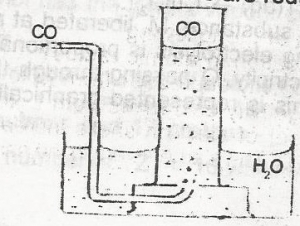
Carbon (ll) oxide may be collected as shown above because
Attached Figure / Diagram
A
is heavier than air
B
is less dense than air
C
is insoluble in water
D
burns in oxygen to form carbon (IV) oxide
medium Difficulty
Verified Correct Answer: Option C
Chemical Principles & Mechanism
Carbon monoxide (CO) gas is collected over water because it is relatively insoluble in water and less dense than water, allowing it to be collected by displacing the water in a container.
Source: Myschool Past Questions Archive (Record #31390)
Chemistry
UTME / JAMB 1988
Stoichiometry, Mole Concept & Volumetric Analysis
Diagram
The acidic hydrogen in the compound is the hydrogen attached to carbon number
Attached Figure / Diagram
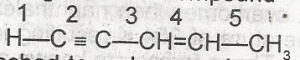
A
5
B
4
C
3
D
1
medium Difficulty
Verified Correct Answer: Option D
Chemical Principles & Mechanism
No expanded working has been attached for this question yet. The verified answer is Option D.
Source: Myschool Past Questions Archive (Record #31391)
Chemistry
WAEC / WASSCE 1988
Stoichiometry, Mole Concept & Volumetric Analysis
Solution
Aqueous solutions of zinc chloride, calcium chloride iron (lII) tetraoxosulphate (VI) and lead (II) trioxonitrate (IV) are contained in four separate bottles whose labels have been lost. Using aqueous ammonia solution only, show how you would identify the content of each bottle.
A
0.224 dm3
B
0.280 dm3
C
0.560 dm3
D
2.24 dm3
E
22.4 dm3
medium Difficulty
Verified Correct Answer: Option B
Chemical Principles & Mechanism
Add dil. aqueous NNH\(_3\) solution to about 2cm\(^3\) of each solution.
Observation
Inference
(i) White precipitate soluble in excess N\(H_3\)
(ii) No visible reaction
(iii) Reddish brown ppt. insoluble in excess NH\(_{3(aq)}\)
(iv) White precipitate insoluble in excess NH\(_{3(aq)}\)
Therefore ZnCl\(_2\)
It is therefore CaCl\(_2\)
Therefore Fe\(_2\)(SO\(_2\))
Therefore Pb(NO\(_3\))\(_3\)
Source: Official Exam / Past Question Archive
Chemistry
WAEC / WASSCE 1988
Non-Metals & Their Compounds
Solution
(a) Name two allotropes of carbon
(b) Name two products of the destructive distillation of coal and state one use of each.
medium Difficulty
Verified Correct Answer: Option
Chemical Principles & Mechanism
a. Two allotropes of carbon are Diamond and Graphite. Also is the amorphous .Carbon e.g wood, charcoal and sugar charcoal.
b.
Distillates of Coal
Use
(i) Coal gas
(ii) Ammonical liquor (mainly ammonia)
(iii) Coal tar
(iv) Coke
Industrial fuel
To produce (NH\(_4\))\(_2\)SO\(_4\) for fertilizer.
To produce useful chemicals such as disinfectants, perfumes
To produce water gas and producer gas as industrial and domestic fuels
Source: Myschool Past Questions Archive (Record #54580)
Chemistry
WAEC / WASSCE 1988
Stoichiometry, Mole Concept & Volumetric Analysis
Solution
(a) Give one example of;
(i) heavy chemicals
(ii) fine chemicals
(b) Write the structural formulae and the names of compounds having the formula CH\(_4\)CI,
medium Difficulty
Verified Correct Answer: Option
Chemical Principles & Mechanism
(a)(i) An example of heavy chemical is tetraoxosulphate(VI) acid (H\(_2\)SO\(_4\)). It is said to be heavy because. it is essential in almost all branches of industry.
(ii) Fine chemicals are manufactured for specific industrial and domestic purposes and are of high purity and expensive e.g. Additives for fuels.
(b)(i)
Molecular formula
Structural formulae
Names
C\(_2\)H\(_4\)Cl\(_2\)
CICH\(_2\)CH\(_2\)Cl
CH\(_3\)CHCl\(_2\)
1,2-dichloroethane
1,1-dichloroethane
Source: Myschool Past Questions Archive (Record #54581)
Chemistry
WAEC / WASSCE 1988
Atomic Structure, Orbitals & Nuclear Chemistry
Solution
(a) Arrange the following in their correct order of increasing energy: alpha particles, gamma rays and beta particles
(b) State one difference between nuclear fission and nuclear fusion
medium Difficulty
Verified Correct Answer: Option
Chemical Principles & Mechanism
(a) Alpha particles, beta particles, gamma rays
in order of increasing energy
in terms of penetrating energy
(b) Difference between nuclear fission and nuclear fusion
Nuclear fission
Nuclear fusion
A heavy isotope of element is split into fragments of lighter elements by neurons bombardments of the heavy nucleus
Lighter isotopes combine to give a heavier isotope E.g \(^2_1H + ^3_1H\) \(\to\) \(^4_2He\) + \(^1_0n\)
Source: Myschool Past Questions Archive (Record #54582)
Chemistry
WAEC / WASSCE 1988
Kinetic Theory of Matter & Gas Laws
Solution
50cm\(^{3}\) of sulphur (IV) oxide were produced at s.t.p. when some quantity of powdered sulphur were burnt in excess oxygen
(a) Write the equation for the reaction
(b) Calculate the volume of oxygen used up during the reaction
(c) Which of the gas laws is applicable? State the law.
medium Difficulty
Verified Correct Answer: Option
Chemical Principles & Mechanism
(a) S\(_{(g)}\) + O\(_{2(g)}\) --> SO\(_{2(g)}\)
(b) At s.t.p. 22400 cm\(^3\) SO\(_2\) is produced with 22400cm\(^3\)O\(_2\)
i.e 1cm\(^3\) SO\(_2\) will be produced with 1cm\(^3\) O\(_2\)
50cm\(^3\) SO\(_2\) will be produced with 50cm\(^3\) O\(_2\)
(c) Avogadro's Law is applicable in (b) above. Avogadro's Law states that equal volumes of gases at the same temperature and pressure must contain the same number of molecules
Source: Myschool Past Questions Archive (Record #54583)
Chemistry
WAEC / WASSCE 1988
Reaction Rates & Chemical Equilibrium
Solution
(a) How does the collision theory explain the rate of a chemical reaction?
(b) State how each of the following affects the rates of chemical reactions:
(i) surface area (ii) catalyst
medium Difficulty
Verified Correct Answer: Option
Chemical Principles & Mechanism
(a) That the number of collisions between the reactant molecules is directly proportional to the rate of reaction
Mathematically number of Collisions of reactant molecules \(\alpha\) Rate of reaction
(b)(i) The larger the surface area available for heterogeneous reaction the faster the reaction.
(ii) Catalyst increases the rate of a spontaneous reaction by reducing the activation energy of the reactant.
Source: Myschool Past Questions Archive (Record #54584)
Chemistry
WAEC / WASSCE 1988
Oxidation, Reduction & Redox Reactions
Solution
(a) Write the ionic equation for the reaction between zinc powder and silver trioxonitrate (VI) solution
(b) Which substance in (a) above is (i) oxidized, (ii) reduced?
(c) State two applications of oxidation numbers
medium Difficulty
Verified Correct Answer: Option
Chemical Principles & Mechanism
(a) Zn\(_{(s)}\) + 2Ag\(^+_{(aq)}\) --> Zn\(^{2+}_{(aq)}\) + 2Ag\(_{(S)}\)
(b)(i) In (a) above Zinc is oxidised
(ii) In (a) above Silver is reduced.
(c) Oxidation numbers identify which element in a compound is the giver or the acceptor of electron. Oxidation number is applied in the I.U.P.A. naming system.
Source: Myschool Past Questions Archive (Record #54585)
Chemistry
WAEC / WASSCE 1988
Organic Chemistry II: Functional Groups, Polymers & Biomolecules
Solution
(a) What is a carbohydrate?
(b) Name two types of carbohydrates and give one example of each type
medium Difficulty
Verified Correct Answer: Option
Chemical Principles & Mechanism
(a) Carbohydrate is a compound consisting of Carbon, Oxygen and Hydrogen as the composing elements. Sugars E.g glucose (C\(_6\)H\(_{12}\)O\(_6\)) natural carbohydrate polymer E.g Starch.
Source: Myschool Past Questions Archive (Record #54586)
Chemistry
WAEC / WASSCE 1988
Organic Chemistry II: Functional Groups, Polymers & Biomolecules
Solution
(a) Name the major raw materials used in the manufacture of the following:
(i) polythene
(ii) margarine
(iii) cement
(b) State one problem associated with oil producing areas
medium Difficulty
Verified Correct Answer: Option
Chemical Principles & Mechanism
(a)
Substance
Major raw materials
(i) Polythene
(ii) Margarine
(iii) Cement
(i) Polythene
(ii) Margarine
(iii) Cement
(b) Oil spillage is when the crude oil flows to pollute the body of water.
Source: Myschool Past Questions Archive (Record #54587)
Chemistry
WAEC / WASSCE 1988
Organic Chemistry I: Hydrocarbons & Crude Oil
Solution
Distinguish between cracking and reforming. Of what importance are the two processes in the petroleum industry?
medium Difficulty
Verified Correct Answer: Option
Chemical Principles & Mechanism
Cracking in the crude oil industry means breaking down large molecules into smaller types of molecules. Reforming means reshaping the molecules. Both the cracking and the reforming processes are mechanisms involved in the petroleum industry in which the fractions of less demand are converted into the more demanded fractions.
Source: Myschool Past Questions Archive (Record #54588)