Question Library
Browse, filter, and study verified past examination questions with step-by-step mathematical reasoning.
Searching 18,000+ Questions...
Sifting topics, KaTeX formulas & verified solutions
Showing 26431–26445 of 29811 verified questions
Sort by:
Mathematics
UTME / JAMB 1988
Plane Geometry, Polygons & Circle Theorems
Diagram
Solution
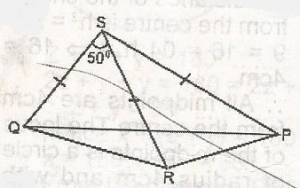
In the figure, PS = RS = QS and QSR = 50^\circ. Find QPR
Attached Figure / Diagram
A
25O
B
40O
C
50O
D
65O
medium Difficulty
Verified Correct Answer: Option A
Step-by-Step Mathematical Solution
In the figure PS = RS = QS, they will have equal base QR = RP
In angle SQR, angle S = 50º
In angle QRP, 65 + 65 = 130º
Since RQP = angle RPQ = \(\frac{180 - 130}{2}\)
= \(\frac{50}{2} = 25^o\)
QPR = 25^\circ
Source: Myschool Past Questions Archive (Record #32877)
Mathematics
UTME / JAMB 1988
Plane Geometry, Polygons & Circle Theorems
Diagram
Solution
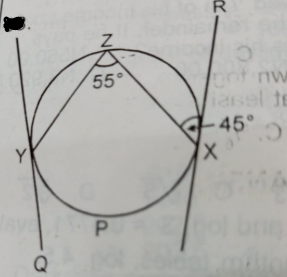
In the figure, XR and YQ are tangents to the circle YZXP if ZXR = 45^\circ and YZX = 55^\circ, Find ZYQ
Attached Figure / Diagram
A
135O
B
125O
C
100O
D
90O
medium Difficulty
Verified Correct Answer: Option C
Step-by-Step Mathematical Solution
Given: ∠ZXR = 45º (tangent XR), ∠YZX = 55º (inscribed angle).
∠YZX subtends arc YX, so arc YX = 2 \times 55^\circ = 110º.
Major arc YZX = 360º - 110º = 250º.
By the alternate segment theorem, ∠ZXR subtends arc XZ, so arc XZ = 2 \times 45º = 90º.
Arc YZ = 250º - 90º = 160º.
Major arc YZ = 360º - 160º = 200º.
∠ZYQ (tangent YQ) = \(\frac{1}{2}\) \times major arc YZ = \(\frac{1}{2}\) \times 200º = 100º (by alternate segment theorem, larger arc for obtuse angle).
Source: Myschool Past Questions Archive (Record #32878)
Mathematics
UTME / JAMB 1988
Mensuration (Areas, Perimeters & Volumes)
Diagram
Solution
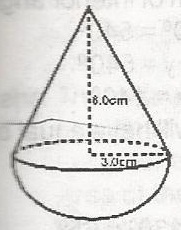
In the figure, a solid consists of a hemisphere surmounted by a right circular cone, with radius 3.0cm and height 6.0cm. Find the volume of the solid
Attached Figure / Diagram
A
36\(\pi\)cm 3
B
54\(\pi\)cm 2
C
18\(\pi\)cm 2
D
108\(\pi\)cm 2
medium Difficulty
Verified Correct Answer: Option A
Step-by-Step Mathematical Solution
The volume of the solid = vol. of cone + vol. of hemisphere
volume of cone = \(\frac{1}{3} \pi r^2 h\)
= \(\frac{1 \pi}{3} \times (3)^2 x 6 = 18 \pi cm^2\)
vol. of hemisphere = \(\frac{4 \pi r^3}{6} = \frac{2 \pi r^3}{3}\)
= \(\frac{2 \pi}{3} \times (3)^3 = 18\pi cm^3\)
vol. of solid = 18\(\pi\) + 18\(\pi\)
= 36\(\pi\)cm3
Source: Myschool Past Questions Archive (Record #32879)
Mathematics
WAEC / WASSCE 1988
Statistics (Data Representation, Central Tendency & Dispersion)
Solution
The number of items produced by a company over a five- year period is given below:
Year
1978
1979
1980
1981
1982
No produced
4100
2500
1500
1800
9200
(i) Plot a bar chart for this information; (ii) What is the average production for the five- year period.
medium Difficulty
Verified Correct Answer: Option
Step-by-Step Mathematical Solution
(i)
(ii) Average production in the period
= \(\frac{4100 + 2500 + 1500 + 1800 + 9200}{5}\)
= \(\frac{19100}{5}\)
= \(3820\)
Source: Myschool Past Questions Archive (Record #54696)
Mathematics
WAEC / WASSCE 1988
Trigonometry, Elevation & Bearings
Solution
In the diagram, < PQR = < PSQ = 90^\circ, |PS| = 9 cm, |SR| = 16 cm and |SQ| = x cm.
(a) Find the value of x using a trigonometric ratio.
(b) Calculate : (i) the size of < QRS to the nearest degree; (ii) |PQ|.
medium Difficulty
Verified Correct Answer: Option
Step-by-Step Mathematical Solution
(a)
Let \(< SQR = \theta ; < QRS = 90^\circ - \theta ; < QPS = \theta\)
In \(\Delta\) PQS, \(\tan \theta = \frac{x}{9} ... (1)\)
In \(\Delta\) QRS, \(\tan \theta = \frac{16}{x} ... (2)\)
From (1) and (2), \(\frac{x}{9} = \frac{16}{x}\)
\(x^{2} = 16 \times 9 \implies x = \sqrt{16 \times 9} = 12 cm\)
(b) (i) From \(\Delta\) QRS,
\(\tan \theta = \frac{16}{12} = 1.333\)
\(\theta = \tan^{-1} (1.333) = 53.1^\circ\)
\(\therefore < QRS = 90^\circ - 53.1^\circ = 36.9^\circ\)
\(\approxeq 37^\circ\) (to the nearest degree)
(ii) In \(\Delta\) PQS,
\(|PQ|^{2} = 12^{2} + 9^{2}\)
= \(144 + 81 = 225\)
\(|PQ| = \sqrt{225} = 15 cm\)
Source: Myschool Past Questions Archive (Record #54698)
Mathematics
WAEC / WASSCE 1988
Trigonometry, Elevation & Bearings
Solution
(a) Given that \(\sin \alpha = 0.3907\), use tables to find the value of : (i) \(\tan \alpha\) ; (ii) \(\cos \alpha\).
(b) A ladder of length 4.5m leans against a vertical wall making an angle of 50^\circ with the horizontal ground. If the bottom of a window is 4m above the ground, what is the distance between the top of the ladder and the bottom of the window? (Answer correct to the nearest cm)
medium Difficulty
Verified Correct Answer: Option
Step-by-Step Mathematical Solution
(a) Given \(\sin \alpha = 0.3907\)
From the sine table, \(\alpha = 23^\circ\)
(i) \(\tan \alpha = \tan 23^\circ = 0.4245\)
(ii) \(\cos \alpha = \cos 23^\circ = 0.9205\)
(b) Let T be the top of the ladder and B, the bottom of the vertical wall.
From the figure, above \(\sin 50^\circ = \frac{BT}{4.5m}\)
\(BT = 4.5 \sin 50^\circ = 4.5 \times 0.7660\)
\(BT = 3.447m\)
Distance between the top of the ladder and bottom of the window
= \(4 - 3.447 = 0.553m\)
= \( 0.553m \times 100\)
= \(55.3 cm\)
Source: Myschool Past Questions Archive (Record #54699)
Mathematics
WAEC / WASSCE 1988
Statistics (Data Representation, Central Tendency & Dispersion)
Solution
In a certain school, the lesson periods for each week are as itemised below: English 10, Mathematics 7, Biology 3, Statistics 4, Ibo 3, others 9. Draw a pie chart to illustrate this information.
medium Difficulty
Verified Correct Answer: Option
Step-by-Step Mathematical Solution
Subject
Period
Angle of sector in pie chart
English
10
\(\frac{10}{36} \times 360^\circ = 100^\circ\)
Mathematics
7
\(\frac{7}{36} \times 360^\circ = 70^\circ\)
Biology
3
\(\frac{3}{36} \times 360^\circ = 30^\circ\)
Statistics
4
\(\frac{4}{36} \times 360^\circ = 40^\circ\)
Igbo
3
\(\frac{3}{36} \times 360^\circ = 30^\circ\)
Others
9
\(\frac{9}{36} \times 360^\circ = 90^\circ\)
Total
36
360^\circ
Source: Myschool Past Questions Archive (Record #54701)
Mathematics
WAEC / WASSCE 1988
Mensuration (Areas, Perimeters & Volumes)
Solution
A sector of a circle of radius 7cm subtending an angle of 270^\circ at the centre of the circle is used to form a cone.
(a) Find the base radius of the cone.
(b) Calculate the area of the base of the cone to the nearest square centimetre.
[Take \(\pi = \frac{22}{7}\)]
medium Difficulty
Verified Correct Answer: Option
Step-by-Step Mathematical Solution
(a) Length of the arc XY = Circumference of the base.
\(\frac{\theta}{360^\circ} \times 2\pi r\)
where \(\theta\) = 270^\circ ; r = 7cm.
Length of arc XY = \(\frac{270^\circ}{360^\circ} \times 2 \times \frac{22}{7} \times 7 = 33cm\)
Let the radius of the base of the cone = x
\(2 \pi r = 33cm\)
\(2 \times \frac{22}{7} \times x = 33\)
\(\frac{44}{7} \times x = 33 \implies x = \frac{33 \times 7}{44}\)
\(x = 5.25cm\)
(b) Area of the base of the cone = \(\pi r^{2}\)
= \(\frac{22}{7} \times \frac{21}{4} \times \frac{21}{4}\)
= \(\frac{693}{8} cm^{2} = 86.625 cm^{2}\)
\(\approxeq 87 cm^{2}\)
Source: Myschool Past Questions Archive (Record #54708)
Mathematics
WAEC / WASSCE 1988
Sets, Logic & Venn Diagrams
Solution
(a) The subsets A, B and C of a universal set are defined as follows :
A = {m, a, p, e} ; B = {a, e, i, o, u} ; C = {l, m, n, o, p, q, r, s, t, u}. List the elements of the following sets.
(i) \(A \cup B\) ; (ii) \(A \cup C\) ; (iii) \(A \cup (B \cap C)\).
(b) Out of the 400 students in the final year in a Senior Secondary School, 300 are offering Biology and 190 are offering Chemistry.
(i) How many students are offering both Biology and Chemistry, if only 70 students are offering neither Biology nor Chemistry? (ii) How many students are offering at least one of Biology or Chemistry?
medium Difficulty
Verified Correct Answer: Option
Step-by-Step Mathematical Solution
(a) A = {m, a, p, e}; B = {a, e, i, o, u} ; C = {l, m, n, o, p, q, r, s, t, u}
(i) \(A \cup B = {a, e, i, m, o, p, u}\)
(ii) \(A \cup C = {a, e, l, m, n, o, p, q, r, s, t, u}\)
(iii) \(A \cup (B \cap C)\)
\(B \cap C = {o, u}\)
\(A \cup (B \cap C) = {m, a, p, e, o, u}\)
Biology students = n(B) = 190
Chemistry students = n(A) = 300
Let \(n(A \cap B) = a\)
(i) From the Venn diagram,
\((300 - a) + a + (190 - a) + 70 = 400\)
\(560 - a = 400 \implies a = 160\)
\(\therefore\) 160 students offer both Biology and Chemistry.
(ii) Students offering at least one of Biology and Chemistry
= \(n(A) + n(B) + n(A \cap B)\)
= \((300 - 160) + (190 - 160) + 160\)
= \(140 + 30 + 160\)
= 330 students
330 students offer at least one of Biology and Chemistry.
Source: Myschool Past Questions Archive (Record #54712)
Mathematics
WAEC / WASSCE 1988
Inequalities & Linear Programming
Solution
Illustrate the following on graph paper and shade the region which satisfies all the three inequalities at the same time :
\(- x + 5y \leq 10 ; 3x - 4y \leq 8\) and \(x > -1\).
medium Difficulty
Verified Correct Answer: Option
Step-by-Step Mathematical Solution
Draw the table of value such that \(-x + 5y \leq 10 \implies -x + 5y = 10\)
\(\implies 5y = 10 + x \)
\(y = 2 + \frac{x}{5}\)
and \(3x - 4y \leq 8 \implies 3x - 4y = 8\)
\(y = -2 + \frac{3x}{4}\)
Table of value for \(-x + 5y = 10\)
x
-4
0
4
y
1.2
2
2.8
Table of value for \(3x - 4y = 8\)
x
-4
0
4
y
-5
-2
1
Source: Myschool Past Questions Archive (Record #54714)
Mathematics
WAEC / WASSCE 1988
Inequalities & Linear Programming
Solution
The table below is for the relation \(y = 2 + x - x^{2}\)
x
-2
-1.5
-1
-0.5
0
0.5
1
1.5
2
2.5
3
y
-4
-1.75
0
1.25
2
2.25
2
1.25
0
-1.75
-4
(a) Using a scale of 2cm to 1 unit on each axis, draw the graph of the relation in the interval \(-2 \leq x \leq 3\).
(b) From your graph, find the greatest value of y and the value of x for which this occurs.
(c) Using the same scale and axes, draw the graph of \(y = 1 - x\)
(d) Use your graphs to solve the equation \(1 + 2x - x^{2} = 0\)
medium Difficulty
Verified Correct Answer: Option
Step-by-Step Mathematical Solution
(a)
(b) The greatest value of y = 2.25 and this occurs at x = 0.5.
(c) Table of values of \(y = 1 - x\)
x
-2
2
y
3
-1
(d) \(1 + 2x - x^{2} = 0\)
\(1 + 1 + 2x - x - x^{2} = 1 - x\)
\(2 + x - x^{2} = 1 - x\)
The solution of \(1 + 2x - x^{2} = 0\) occurs at the point of intersection of \(y = 2 + x - x^{2}\) and \(y = 1 - x\). This is at points A (x = -0.8) and B (x = 2.8).
Source: Myschool Past Questions Archive (Record #54715)
Mathematics
WAEC / WASSCE 1988
Mensuration (Areas, Perimeters & Volumes)
Solution
Two towns K and Q are on the parallel of latitude 46^\circN. The longitude of town K is 130^\circW and that of town Q is 103^\circW. A third town P also on latitude 46^\circN is on longitude 23^\circE, Calculate:
(i) the length of the parallel of latitude 46^\circN, to the nearest 100km;
(ii) the distance between K and Q, correct to the nearest 100km;
(iii) the distance between Q and P measured along the parallel of latitude, to the nearest 10km.
[Take \(\pi = 3.142\); Radius of the earth = 6400km]
medium Difficulty
Verified Correct Answer: Option
Step-by-Step Mathematical Solution
(i)
The length of the parallel of latitude 46^\circN = \(2 \pi R \cos 46^\circ\)
= \(2 \times 3.142 \times 6400 \times 0.6947\)
= \(27,939.167 km \approxeq 28000 km\) (to the nearest 100km)
(ii)
Longitudinal difference between K and Q = 130^\circ - 103^\circ = 27^\circ
Distance between K and Q = length of arc KQ
= \(\frac{27}{360} \times 2 \times 3.142 \times 6400 \times \cos 46^\circ\)
= \(2,095.31 km \approxeq 2100km\) (to the nearest 100km)
(iii)
Longitudinal difference between Q and P = 103^\circ + 23^\circ = 126^\circ
Distance between Q and P = \(\frac{126}{360} \times 2 \times 3.142 \times 6400 \times \cos 46^\circ\)
= \(9778.12 km \approxeq 9780 km\) (to the nearest 10km)
Source: Myschool Past Questions Archive (Record #54716)
Mathematics
WAEC / WASSCE 1988
Plane Geometry, Polygons & Circle Theorems
Solution
(a) Prove that the sum of the angles in a triangle is two right angles.
(b) In a triangle LMN, the side NM is produced to P and the bisector of < LNP meets ML produced at Q. If < LMN = 46^\circ, and < MLN = 80^\circ, calculate < LQN, stating clearly your reasins.
medium Difficulty
Verified Correct Answer: Option
Step-by-Step Mathematical Solution
(a) Given any \(\Delta\) ABC,
Required: That < A + < B + < C = 180^\circ.
Construction : Draw CP // BA and produce BC to Q.
Proof: Using the above figure,
\(a_{1} = a_{2}\) (alternate angles)
\(b_{1} = b_{2}\) (corresponding angles)
\(a_{1} + b_{1} + c = 180^\circ\) (angles on a straight line)
\(\therefore a_{2} + b_{2} + c = 180^\circ\)
\(< A + < B + < C = 180^\circ\) (proved)
(b)
< LNP = 46^\circ + 80^\circ = 126^\circ (exterior angles of triangle LMN)
\(\theta = \frac{126^\circ}{2} = 63^\circ\) (bisector divides into 2 equal halves)
\(< MLN = 180^\circ - 80^\circ = 100^\circ\) (angles on a straight line)
\(< LQN = 180^\circ - (63^\circ + 100^\circ) = 17^\circ\)
Source: Myschool Past Questions Archive (Record #54717)
Mathematics
WAEC / WASSCE 1988
Plane Geometry, Polygons & Circle Theorems
Using a ruler and a pair of compasses only,
(a) construct (i) a triangle ABC such that |AB| = 5cm, |AC| = 7.5cm and < CAB = 120^\circ ; (ii) the locus \(L_{1}\) of points equidistant from A and B ; (iii) the locus \(L_{2}\) of points equidistant from Ab and AC, which passes through the triangle ABC.
(b) Label the point P where \(L_{1}\) and \(L_{2}\) intersect;
(c) Measure |CP|.
medium Difficulty
Verified Correct Answer: Option
Step-by-Step Mathematical Solution
No expanded working has been attached for this question yet. The verified answer is Option .
Source: Myschool Past Questions Archive (Record #54718)
Mathematics
WAEC / WASSCE 1988
Statistics (Data Representation, Central Tendency & Dispersion)
Solution
The table below shows the frequency distribution of the marks of 800 candidates in an examination.
Marks
0-9
10-19
20-29
30-39
40-49
50-59
60-69
70-79
80-89
90-99
Freq
10
40
80
140
170
130
100
70
40
20
(a) (i) Construct a cumulative frequency table ; (ii) Draw the Ogive ; (iii) Use your ogive to determine the 50th percentile.
(b) The candidates that scored less than 25% are to be withdrawn from the institution, while those that scored than 75% are to be awarded scholarship. Estimate the number of students that will be retained, but will not enjoy the award.
medium Difficulty
Verified Correct Answer: Option
Step-by-Step Mathematical Solution
(a)(i)
Marks (%)
Freq
Cum Freq
0 - 9
10
10
10 - 19
40
50
20 - 29
80
130
30 - 39
140
270
40 - 49
170
440
50 - 59
130
570
60 - 69
100
670
70 - 79
70
740
80 - 89
40
780
90 - 99
20
800
(ii)
(iii) From the Ogive, the 50th percentile is 70 marks.
(b) Those who scored below 25% (24% and below) = 85 students
Those who scored 75% and below = 710
\(\therefore\) Those who scored above 75% = 800 - 710 = 90 students
Those to be retained without award = 800 - (85 + 90)
= 800 - 175 = 625 students.
Source: Myschool Past Questions Archive (Record #54719)