Question Library
Browse, filter, and study verified past examination questions with step-by-step mathematical reasoning.
Searching 18,000+ Questions...
Sifting topics, KaTeX formulas & verified solutions
Showing 26251–26265 of 29811 verified questions
Sort by:
Biology
WAEC / WASSCE 1989
Adaptation & Evolution
Solution
(a) Describe how the floral parts of a named flower are adapted to wind-pollination.
(b) Explain how each of the following behaviours in animals affects the reproduction process: (i) territoriality. (ii) display; (iii) seasonal migration.
medium Difficulty
Verified Correct Answer: Option
Biological Concept & Syllabus Guide
(a) Adaptation of the floral parts of named flower Maize (Zea mays) to wind pollination:
Flowers produce a large number of light, smooth and powdery pollen grains.
They are borne in large inflorescence but are small and inconspicuous.
Stigma are large and feathery and they hang outside the flower.
This ensures a large surface area for pollination and increases the chances of trapping pollen grains in the air.
They possess long style which makes the feathery stigma conspicuous.
Anthers are large and loosely attached to long filaments.
They hang out of the flower, exposing themselves to the wind.
These characteristics facilitate the dispersal of pollen grains.
The flower is usually dull in colour.
(b)(i)Territoriality; is defined as the ability of various species of animals to display a well developed social hierarchy in which the most senior or powerful or the largest in number occupies a dominant position. In this dispensation, some males that are weak may not be able to mate, hence there is reduction in population and the offsprings within a particular territory are able to have enough food to eat. When mating is controlled, the animals may go into extinction and there will be increase in the chances of having mates among the animals.
(ii) Display; is a situation where animals use certain behaviour in order to attract the opposite sex. This includes all sorts of movements ranging from flashing of colour, dancing, nodding, strutting, plumage display, etc. These behaviours lead to courtship which precedes mating.
(iii) Seasonal migration; is the movement of animals carried out at certain time of the year or regularly for some reasons, e.g. breeding, in search of food, avoiding dry sphere, etc. Fishes migrate upstream into their territories for breeding. This prevents the bigger fishes from eating the young ones. Migration leads to population control because many birds may meet adverse environmental condition and die before returning to their place of origin. It also leads to reduction in the number of predators due to migration when their prey are no longer there. The preys multiply fast in number when they return due to the absence of their predators or enemies.
Source: Myschool Past Questions Archive (Record #53074)
Biology
WAEC / WASSCE 1989
Excretion & Homeostasis
Solution
(a) List three functions of the kidney.
(b) Make a labelled diagram of the mammalian kidney tubule (nephron)
(c) Describe how the kidney carries out two of the functions listed in (a).
medium Difficulty
Verified Correct Answer: Option
Biological Concept & Syllabus Guide
(a)Functions of the kidney:
(1) Serves as excretory organ, e.g. urine
(2) As osmoregulatory organ
(3) Homeostasis
(4) Formation of urine
(5) Elimination of toxins, drugs and.harmful substances
(6) Heat production
(7) Water level regulator.
(c)(i) Osmo regulation: Kidney keeps the composition of the body plasma constant by means of osmosis, e.g. if there is too much water in the plasma, the kidneys excrete more water and thus reduce the amount in the plasma. In this way, the osmotic pressure of the plasma is kept constant by the kidney and this is important because, in this way, the balance of osmotic pressure between the blood and cells through the intermediate lymph is maintained. Normally the composition of the plasma is controlled or varied as a result of the amount of water and soluble substances absorbed from the alimentary canal or lost through sweating. The variation is corrected by the kidney.The osmotic pressure of the blood may rise due to too much water loss or excess salt intake. This is detected by sensitive cells in the hypothalamus of the brain which stimulate the production and release of antidiuretic hormone (ADH) by the pituitary gland. As soon as the hormone reaches the kidney, it induces the kidney tubules to reabsorb more water from the glomerular filtrate into the blood, making the urine Cortex more concentrated and thus, reducing more loss of water from the blood. This state helps to maintain the osmotic pressure of the blood.
(C)(ii) Excretion of urine: The unit of excretion is the nephron. Waste products are transported from the.renal artery to the kidney. Inside the Bowman's capsule is the glomerulus which serves as the ultrafilteration of the waste products. The filterate is transported down the kidney tubules. In the loop shaded position of the tubule, more salts are added to the fluid while water is removed from it, resulting in the formation of urine. The urine moves to the bladder by peristatsis and is stored until it is ready to be expelled.
Source: Myschool Past Questions Archive (Record #53097)
Biology
WAEC / WASSCE 1989
Reproduction in Plants & Animals
Solution
(a) What would you observe if a filament of spirogyra is immersed in 0. 1 m sodium chloride solution for about one hour?
(b) Name the process which occurred during the immersion of the spirogyra filament in 0.1 m sodium chloride solution.
medium Difficulty
Verified Correct Answer: Option
Biological Concept & Syllabus Guide
(a) The protoplasm would shrink from the cell wall and become smaller (b) Plasmolysis
Source: Myschool Past Questions Archive (Record #59793)
Biology
WAEC / WASSCE 1989
Reproduction in Plants & Animals
Solution
What is meant by the term endospermous seed?
medium Difficulty
Verified Correct Answer: Option
Biological Concept & Syllabus Guide
The meaning of endospermous seed: Is a seed that stores its food reserve in the endosperm, instead of the cotyledon
Source: Myschool Past Questions Archive (Record #59794)
Biology
WAEC / WASSCE 1989
Basic Ecological Concepts, Ecosystems & Biomes
Solution
State three advantages of vegetation to the soil
medium Difficulty
Verified Correct Answer: Option
Biological Concept & Syllabus Guide
it saves the soil from erosion (ii) Protects the soil from being baked (or leached) (iii) The soil derives its 3 nutrients in form of manure from vegetation (iv) It increases the humus content of the soil through decayed vegetation thereby increasing the fertility of the soil.
Source: Myschool Past Questions Archive (Record #59795)
Biology
WAEC / WASSCE 1989
Variation & Genetics (Heredity)
Solution
(a) (i) State one function of plastids to plants (i) Name one plastid found in plants (b) State one function each of (i) mitochondrion (ii) chromosome
medium Difficulty
Verified Correct Answer: Option
Biological Concept & Syllabus Guide
(a) it is used for photosynthesis (also for storage) (ii) Chloroplast (others are leucoplasts and chromoplast) (b) (i) Cellular respiration takes place here (power house DNA (Deoxyribonucleic acid) which stores genetic characters
Source: Myschool Past Questions Archive (Record #59796)
Biology
WAEC / WASSCE 1989
Transport System in Plants & Animals
Solution
(a) Name the vessel that carries blood from the wall of the small intestine to the liver (b) State two similarities in structure between the transport systems in plants and animals.
medium Difficulty
Verified Correct Answer: Option
Biological Concept & Syllabus Guide
(a) Hepatic portal vein (b) (i) They all carry materials in well-defined vessels that constitute the vascular system. The materials that are transported are in liquid form in both plants and animals.
Source: Myschool Past Questions Archive (Record #59797)
Biology
WAEC / WASSCE 1989
Cell Structure, Organization & Cell Division
Solution
List (a) two plant characteristics (b) two animal characteristics found in Euglena.
medium Difficulty
Verified Correct Answer: Option
Biological Concept & Syllabus Guide
(a) (i) Possession of chloroplasts (i) Possession of cell walls. Others are presence of large vacuoles, rigid cells, paramylum granules e.t.c
(b)(i) Eyespot (ii) Gullet
Source: Myschool Past Questions Archive (Record #59798)
Biology
WAEC / WASSCE 1989
Nutrition in Plants & Animals (Photosynthesis & Food Substances)
Solution
Specimen G is a paste made from a food material. Carry out the following tests to identify the food substances contained in specimen G. Wash the test tube after each use to ensure that the next sample is not contaminated. All tests and observations should be recorded in a table as shown below.
Test
observation
inference
(a) (i) Pour 5 cm/(^3/) of specimen G into a test tube and add three drops of sodium hydroxide solution. Shake two test tube. Record your observation. Then add three drops of copper (ii) tetraoxosulphate (VI) solution (CuSO/(_4/)). Shake the test tube. Record your observations and inference (b) Pour 5 cm/(^3/) of specimen G into a test tube and three drops of Sudan IIl. Shake the mixture. Record your observation and inference (d) To another 5 cm/(^3/) of specimen G add four drops of Fehling's solution. Shake the test tube. Warm the mixture. Record your observation and inference
medium Difficulty
Verified Correct Answer: Option
Biological Concept & Syllabus Guide
Test
observation
inference
(a) 5cm of specimen G +3 drops of NaOH solution + 3 drops of CuSO,
White or creamy suspension, purple or violet colour was was observed
Protein present
b) 5cm of specimen G + 3 drops Oil present of Sudan Ill and shaken
Red colour was obseved.
Oil present
(c) 5cm of specimen G + 3 drops
Blue-black or black colour was observed
(d) 5cm of specimen G +3 drops and warmed in the flame
No colour change or blue colour observed, reddish brown pink or red colour observed
Reducing sugar is absent. Reducing sugar is present of fehling's solution, shaken
Source: Myschool Past Questions Archive (Record #59804)
Biology
WAEC / WASSCE 1989
Nutrition in Plants & Animals (Photosynthesis & Food Substances)
Diagram
Solution
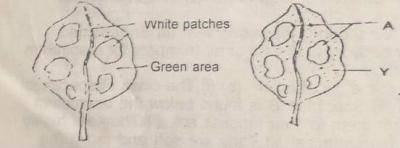
The diagram above illustrates a leaf before and after an experiment stated below. The leaf shown in diagram I was detached from a potted plant which had been exposed to sunlight for 4-5 hours while diagram ll shows the same leaf after the test for starch.
(7) (a) Name the type of leaf used for this experiment (b) Why is this type of leaf most suitable for the experiment? (c) State one precaution that should be taken in carrying out this experiment (d) What would be the colours of the parts labelled X and Y after the test for starch? (e) Suggest the aim of this experiment.
Attached Figure / Diagram
medium Difficulty
Verified Correct Answer: Option
Biological Concept & Syllabus Guide
7. (a) Variegated leaf (b) This is because chlorophyll is only present in the green patches, and not in other patches that have white, yellow or pink colours (c) The leaves must be exposed to sunlight for photosynthesis to take place (d) (i) x will only retain the brown colour of iodine (i) y will be blue-black in colour (e) Aim: To show that chlorophyll is essential for photosynthesis.
Source: Myschool Past Questions Archive (Record #59799)
Biology
WAEC / WASSCE 1989
Growth, Micro-organisms & Public Health
Solution
List íour crop diseases.
medium Difficulty
Verified Correct Answer: Option
Biological Concept & Syllabus Guide
(i) Cassava mosaic disease (ii) Blast disease of rice (iii) Black pod disease of cocoa (iv) Others are bacterial tomato wilt, soft spot of carrot (bacterial), mycoplasma disease of plants (bacteria), swollen shoot of cocoa and potato blight.
Source: Myschool Past Questions Archive (Record #59800)
Biology
WAEC / WASSCE 1989
Growth, Micro-organisms & Public Health
Diagram
Solution
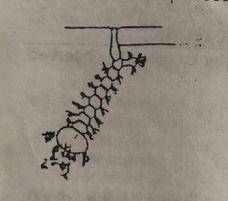
(a) Name the organism represented in the diagram above (b) Name the structure labelled x (c) Into what stage would the organism develop?
Attached Figure / Diagram
medium Difficulty
Verified Correct Answer: Option
Biological Concept & Syllabus Guide
(a) Culex mosquitoe's larva (b) Breathing (siphon) tube (c) Pupal stage. floss.
Source: Myschool Past Questions Archive (Record #59801)
Biology
WAEC / WASSCE 1989
Reproduction in Plants & Animals
Solution
You are provided with specimens A, B and C (a) identify specimens A, B and C without reason.
(b) Make a labelled drawing 6-8 cm long of the longitudinal section of specimen A to illustrate its essential features
(c) (i) Suggest the possible means of pollination of specimen A (ii) Give three reasons for your answer
(d) (i) Name one agent of dispersal each for specimen B and C (ii) Give one reason each for your answer.
medium Difficulty
Verified Correct Answer: Option
Biological Concept & Syllabus Guide
10. (a) Specimen A is an insect-pollinated flower (flambuoyant - flower). SpecimenC is a Tridax fruit with pappus shoot of cocoa and potato blight (a) Culex mosquitoe's larva (b) Breathing (siphon) tube (c) Pupal stage. or in some schools, a cotton seed with lint or with floss.
(c) (i)Specimen A is pollinated by insects (ii) Three reasons for my answer are: (a) Specimen A is brightly coloured (b) Specimen A is scented (c) Specimen A has nectar or nectary (d) It also has mature and sticky stigma (d) (i) Specimen B is dispersed by animals, Specimen Cis dispersed by wind () Reasons for the dispersal of specimen B are: It is brightly coloured. It is also soft, fleshy (succulent) and edible. Specimen C is light enough. It has lint or floss. It has tuft of hairs or pappus to aid buoyance in the air
Source: Myschool Past Questions Archive (Record #59802)
Mathematics
WAEC / WASSCE 1988
Algebraic Expressions, Polynomials & Factorisation
Solution
Evaluate (101.5)2 - (100.5)2
A
1
B
2.02
C
20.02
D
202
E
2020
medium Difficulty
Verified Correct Answer: Option D
Step-by-Step Mathematical Solution
(101.5)2 - (100.5)2;(101.5 + 100.5)
202 x 1
= 202
Source: Myschool Past Questions Archive (Record #22007)
Mathematics
WAEC / WASSCE 1988
Fractions, Decimals, Percentages & Approximations
Solution
Express the product of 0.06 and 0.09 in standard form
A
5.4 * 10-1
B
5.4*10-2
C
5.4*10-3
D
5.4*102
E
5.4*103
medium Difficulty
Verified Correct Answer: Option C
Step-by-Step Mathematical Solution
0.06 x 0.09 = 0.0054
= 5.4 x 10⁻³
Source: Myschool Past Questions Archive (Record #22008)