Question Library

Browse, filter, and study verified past examination questions with step-by-step mathematical reasoning.
Launch Interactive Practice
Searching 18,000+ Questions... Sifting topics, KaTeX formulas & verified solutions
Showing 26236–26250 of 29811 verified questions
Sort by:
Biology WAEC / WASSCE 1989 Population Ecology, Habitats & Conservation
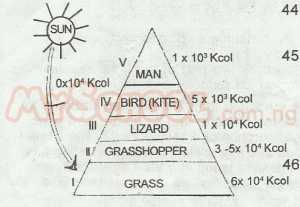
Which of the following effects would desertification have on the ecological balance represented in the diagram above? The calorific value' of the energy
Attached Figure / Diagram
Question diagram
A
. 10 x 104k cal obtained from the sun would decrease
B
10 x 104k cal obtained from the sun would increase
C
6 x 10⁴k cal obtained at level I would increase
D
1 x 10⁴k cal obtained at level V would increase
E
3.5x 10⁴k cal obtained at level II would increase
medium Difficulty
Biology WAEC / WASSCE 1989 Growth, Micro-organisms & Public Health
One of the methods of preventing measles is by
A
sleeping under mosquito net
B
attacking the vectors
C
attacking the secondary host
D
vaccinating young children
E
providing clean water supply
medium Difficulty
Biology WAEC / WASSCE 1989 Adaptation & Evolution
Group instinct or social behaviour is not displayed in
A
soldier ants
B
bees
C
chickens
D
weaver birds
E
termites
medium Difficulty
Biology WAEC / WASSCE 1989 Nervous, Hormonal Coordination & Sense Organs
The autonomic nervous system comprises
A
sympathetic and parasympathetic systems
B
cranial and sacral nerves
C
brain and cranial nerves
D
spinal cord and spinal nerves
E
brain and spinal nerves
medium Difficulty
Biology WAEC / WASSCE 1989 Cell Structure, Organization & Cell Division
The scientist who discovered the honey-comb structure of the cell was
A
Robert Hooke
B
Felix Dujardin
C
Mathias Schleiden
D
Theodore Schowann
E
Louis Pasteur
medium Difficulty
Biology WAEC / WASSCE 1989 Cell Structure, Organization & Cell Division
Which of the following organelles are likely to be present in cells that are actively respiring and hotosynthesizing?
A
Nucleoli and centrioles
B
Lysosomers and ribosomes
C
Endoplasmic reticulum and Golgi bodies
D
Chloroplasts and mitochondria
E
Food vacuoles and contractile vacuoles
medium Difficulty
Biology WAEC / WASSCE 1989 Growth, Micro-organisms & Public Health
Which of the following is not true about a bacterial colony growing on an agar plate?
A
They are visible without the aid of the microscope
B
Bacterial cells found in one colony often belong to one species
C
Different colonies have different colours
D
Only one species of bacterial colony can grow on a culture at any time
E
Colonies growing on an agar plate under the same conditions must belong to one species
medium Difficulty
Biology WAEC / WASSCE 1989 Adaptation & Evolution
The theory that new organs or characteristics develop in organisms when there is a need for them was postulated by
A
Charles Darwin
B
Jean Lamarck
C
Gregor Mendel
D
Wallace
E
Louis Pasteur
medium Difficulty
Biology WAEC / WASSCE 1989 Adaptation & Evolution
Which of the following is an example of reproductive adaptation?
A
Succulent stems of cactus plant
B
Changing colour of chameleon
C
Possession of spines by desert plants
D
Neck colouration in Agama lizard
E
Leaf-shedding in trees
medium Difficulty
Biology WAEC / WASSCE 1989 Nervous, Hormonal Coordination & Sense Organs
The large intercellular air spaces which penetrate the tissues of most hyrophytes provide a pathway through which
A
carbondioxide absorbed by leaves can diffuse to the roots
B
oxygen produced in the leaves can diffuse to the submerged parts
C
salts absorbed by roots can reach other parts of the plant
D
plant hormones are transported to various parts
E
manufactured food is translocated
medium Difficulty
Biology WAEC / WASSCE 1989 Basic Ecological Concepts, Ecosystems & Biomes
Which of the following processes will not introduce carbondioxide into the atmosphere?
A
Breathing
B
Photosynthesis
C
Respiration
D
Putrefaction
E
Burning
medium Difficulty
Biology UTME / JAMB 1989 Basic Ecological Concepts, Ecosystems & Biomes
Which ecological factor exerts the greatest influence on the structure of the profiles?
A
Topographic
B
Edaphic
C
Biotic
D
Climatic
medium Difficulty
Biology WAEC / WASSCE 1989 Nutrition in Plants & Animals (Photosynthesis & Food Substances)
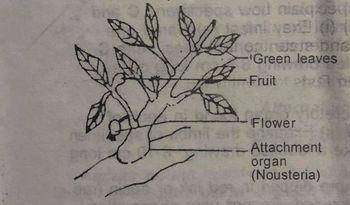
(a) identify specimen D without giving reason (b) (i) State two observable features of specimen D which indicate its mode of nutrition (b) (ii) What is the mode of nutrition cf specimen D? (c) Make a labelled drawing to show features of biological importance of the specimen (d) (i) Examine and identify without reasons specimens E and F
Attached Figure / Diagram
Question diagram
medium Difficulty
Biology WAEC / WASSCE 1989 Basic Ecological Concepts, Ecosystems & Biomes
(a) List five morphological features that are characteristic of plant found in each of the following habitats:-(i) tropical rainforest. (ii) savanna. In each case, state function of the features listed in (a) to the plant. (b) Explain the term: ecological succession (c) By means of a diagram only, outline the carbon cycle to show the relative importance of the cycle to life in general.
medium Difficulty
Biology WAEC / WASSCE 1989 Nervous, Hormonal Coordination & Sense Organs
(a) Describe an experiment to demonstrate the influence of auxins on the growth of plant shoot. (b) List three uses of auxins in agriculture. (c) Describe briefly the mechanism of transmission of impulses through a nerve fibre.
medium Difficulty
Page 1750 of 1988