Question Library
Browse, filter, and study verified past examination questions with step-by-step mathematical reasoning.
Searching 18,000+ Questions...
Sifting topics, KaTeX formulas & verified solutions
Showing 26011–26025 of 29811 verified questions
Sort by:
Physics
UTME / JAMB 1989
Work, Energy, Power & Simple Machines
Diagram
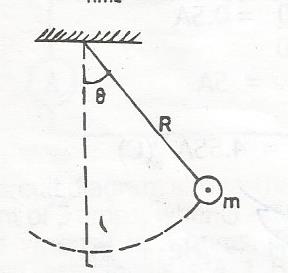
A simple pendulum of mass m moves along an arc pf a circle radius R in a vertical plane as shown above. What is the work done by gravity in a downward swing through the angle q to 0 degree
Attached Figure / Diagram
A
mgR sinθ
B
MgR (1- cos θ)
C
mgR
D
mgR (1 - sinθ)
medium Difficulty
Verified Correct Answer: Option B
Physical Principles & Numerical Solution
No expanded working has been attached for this question yet. The verified answer is Option B.
Source: Myschool Past Questions Archive (Record #41682)
Physics
UTME / JAMB 1989
Newton's Laws, Momentum & Collisions
Diagram
Solution
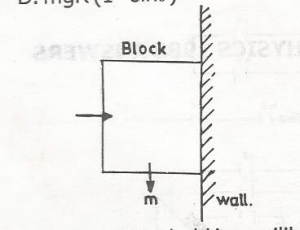
A block of mass m is held in equilibrium against a vertical wall by a horizontal force. If the coefficient of friction between the wall and the block is µ, the minimum value of the horizontal force is
Attached Figure / Diagram
A
µmg
B
(1-µ)mg
C
(1+µ)mg
D
mg/µ
medium Difficulty
Verified Correct Answer: Option D
Physical Principles & Numerical Solution
To keep the block of mass m in equilibrium against a vertical wall using a horizontal force F:
The normal reaction N = F
The frictional force f must balance the weight: f = mg
Maximum friction available: f = \muN = \muF
For the minimum horizontal force:
\muF = mg
F = mg / \mu
Source: Myschool Past Questions Archive (Record #41683)
Physics
UTME / JAMB 1989
Elasticity, Density, Pressure & Fluids
Diagram
Solution
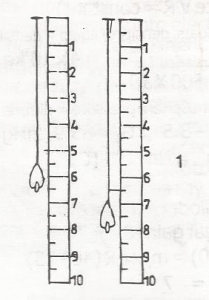
In the fig above W\(_1\) = 200g, and W\(_2\) =450g. Calculate the extension of the spring per unit load.
[g = 10ms\(^{-2}\)]
Attached Figure / Diagram
A
6.0 x 10⁻⁵mN-1
B
2.5 x 10⁻⁴mN-1
C
6.0 x 10 -3mN-1
D
2.5 x 10 -2mN-1
medium Difficulty
Verified Correct Answer: Option C
Physical Principles & Numerical Solution
From the diagram given in the question
Change in length = (6.5 - 5.0) x 10\(^{-2}\)m
Change in force(wg) = (420 - 200) x 10 x 10\(^{-3}\) = 2.5N ( g changed to kg)
extension per unit x = \(\frac{\Delta l}{\Delta F}\) = \(\frac{1.5 \times 10^{-2}}{2.5}\) = 6.0 x 10\(^{-3}\)
Source: Myschool Past Questions Archive (Record #41684)
Physics
UTME / JAMB 1989
Waves, Sound & Vibrations
Diagram
Solution
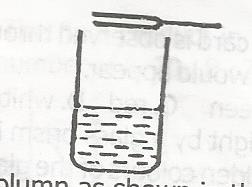
The air column as shown above is set into vibration by the turning fork. In this State of resonance, the waves in the air column will be
Attached Figure / Diagram
A
stationary and transverse
B
stationary and longitudinal
C
progressive and transverse
D
progressive and longitudinal
medium Difficulty
Verified Correct Answer: Option B
Physical Principles & Numerical Solution
In solids, sound can exist as either a longitudinal or a transverse wave. But in mediums which are fluid (e.g., gases and liquids), sound waves can only be longitudinal. For Longitudinal Waves, the displacement of the medium is parallel to the direction of propagation of the wave.
Source: Myschool Past Questions Archive (Record #41685)
Physics
UTME / JAMB 1989
Current Electricity & Electric Circuits
Diagram
In the above circuit diagrams A is the ammeter and V is the Voltmeter. Which of the circuits is correct for finding the correct value of the resistance R
Attached Figure / Diagram
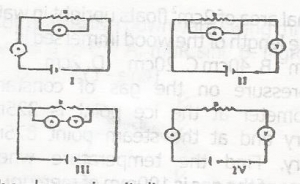
A
I
B
II
C
III
D
IV
medium Difficulty
Verified Correct Answer: Option A
Physical Principles & Numerical Solution
No expanded working has been attached for this question yet. The verified answer is Option A.
Source: Myschool Past Questions Archive (Record #41686)
Physics
UTME / JAMB 1989
Electrostatics & Capacitors
Diagram
Solution
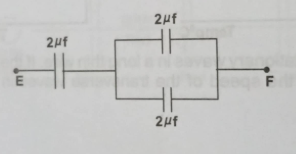
Three 2-µF capacitors are arranged as seen in the circuit above . The effective capacitance between E and F is
Attached Figure / Diagram
A
0.75µF
B
1.33µF
C
3.00µF
D
6.00µF
medium Difficulty
Verified Correct Answer: Option B
Physical Principles & Numerical Solution
\(C_T = \frac{2 \times (2 + 2)}{2 + (2 + 2)}\)
= \(\frac{8}{6}\)
= 1.33 \(\mu\)F
Source: Myschool Past Questions Archive (Record #41687)
Physics
UTME / JAMB 1989
Magnetism, Electromagnetism & AC Circuits
Diagram
The fig above shows a conductor PQ carrying a current I in the direction shown. At a particular position near the conductor is a compass needle K. Neglecting the earth's magnetic field, the compass needle will
Attached Figure / Diagram
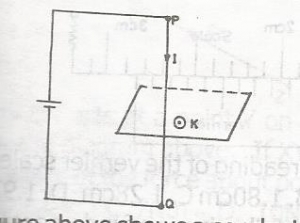
A
settle in any direction
B
settle in a fixed direction only if the conductor PQ is a magnetic material
C
settle in a fixed direction WHETHER the conductor PQ is a magnetic material OR NOT
D
be stationary
medium Difficulty
Verified Correct Answer: Option C
Physical Principles & Numerical Solution
No expanded working has been attached for this question yet. The verified answer is Option C.
Source: Myschool Past Questions Archive (Record #41689)
Physics
UTME / JAMB 1989
Atomic, Quantum, Nuclear Physics & Electronics
Diagram
Solution
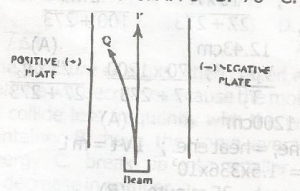
A beam of radiation is passed between a pair of charged plates as indicated in the fig above. Beam P is undetected While Q is deflected to the left. P and Q respectively should be
I.γ-rays \beta-rays
II. x-rays \beta-rays
III. γ-rays x-rays
IV. x-rays x-rays
Attached Figure / Diagram
A
I only
B
III only
C
I and II
D
III and IV
medium Difficulty
Verified Correct Answer: Option C
Physical Principles & Numerical Solution
studying the charges of the Gamma, Alpha, Beta and X-rays, you find that both the x-rays and theGamma rays possess zero-charge hence they could pass the charged plate undetected while the beta rays are negatively charged hence will deflect towards the positive charge of the plate. Alpha rays, on the other hand, are poisitively charged hence, they deflect towards the negative charge.
Source: Myschool Past Questions Archive (Record #41690)
Physics
WAEC / WASSCE 1989
Temperature, Thermometry & Thermal Expansion
Solution
(a) What is meant by the statement: The linear expansivity of a solid is \(1.0 \times 10^{-5}K^{-1}\)?
(b)(i) Describe an experiment to determine the linear expansivity of a steel rod. (ii) Steel bars, each of length 3m at 29^\circC are to be used for constructing a rail line. If the linear expansivity of steel is \(1.0 \times 10^{-5}K^{-1}\), calculate the safety gap that must be left between successive bars if the highest temperature expected is 41^\circC.
(c) State three advantages and two disadvantages of thermal expansion of solids.
medium Difficulty
Verified Correct Answer: Option
Physical Principles & Numerical Solution
(a) The statement: The linear expansivity of a solid is \(1.0 \times 10^{-5}K^{-1}\) means that, A unit length of the solid will expand in length by a fraction \(1.0 \times 10^{-5}\) of the original per kelvin rise in temperature.
(Note: \(1.0 \times 10-5 = \frac{1}{100,000}\), a fraction).
(b) Experiment to determine the linear expansivity of a steel rod.
The apparatus is set up as shown above. The length of the steel rod used is first measured with a meter rule and it is then placed in the jacket with one end fixed. The micrometer screw gauge is turned until the end of the screw just touches the end of the rod, and the gauge reading is noted. It is then turned back enough to make sure that the end of the rod can expand freely. The reading on the thermometer is noted and steam is now passed through the jacket for several minutes. The micrometer is used to note the new reading. More steam is passed again and the reading is taken until a constant reading is obtained. The reading is noted and the temperature is noted from the thermometer.
The formula \(\alpha = \frac{l_{f} - l_{i}}{l_{i} (\theta_{f} - \theta_{i})}\) is used to determine the linear expansivity.
\(l_{f} - \text{final length} ; l_{i} - \text{initial length} ; \theta_{f} - \text{final temperature} ; \theta_{i} - \text{initial temperature}\)
(b)(ii) \(l = 3m ; \theta_{i} = 29^\circC ; \theta_{f} = 41^\circC\)
\(\alpha = 1.0 \times 10^{-5} K^{-1}\)
Safety gap = change in length.
\(\Delta l = \alpha l \Delta \theta\)
= \(1 \times 10^{-5} \times 3.0 \times (41 - 29)\)
= \(36 \times 10^{-5} = 0.00036m\)
(c) Advantages:
(1) Used for marking bimetallic strip which is used in thermostat. (2) Removal of tight glass stopper (3) Red-hot rivets in ship building. (4) Expansion of metals is used in bimetallic thermometer.
Disadvantages:
(1) Expansion of metals or concrete bridges. (2) Cracking of glass cup when hot water is poured into the glass cup. (3) Expansion of balance wheel or wrist-watch. (4) Sagging of overhead wire. (5) Expansion of railway lines.
Source: Myschool Past Questions Archive (Record #54751)
Physics
WAEC / WASSCE 1989
Waves, Sound & Vibrations
Solution
(a) What is a wave motion?
The equation \(y = A \sin \frac{2\pi}{\lambda} (Vt-X)\) represents a wavetrain in which y is the vertical displacement of a particle at distance X from the origin in the medium through which the wave is travelling. Explain, with the aid of a diagram, what A and \(\lambda\) represent.
(b) (i) Describe an experiment to determine the frequency of a note emitted by a source of sound
(ii) A pipe closed at one end is 1 m long. The air in the pipe is set into vibration and a fundamental note is produced. If the velocity of sound in air is 340ms\(^{-1}\), calculate the frequency of the note
(c) State two differences between a sound wave and a radio wave.
medium Difficulty
Verified Correct Answer: Option
Physical Principles & Numerical Solution
(a) A wave motion is succession of pulses propagated with time from one region of space to another. Energy is transmitted in the process.
A is the amplitude. It is the maximum displacement from equilibrium position of the wave particle. \(\lambda\) - the wavelength, is the distance between two successive points on the wave that is in phase.
(b) Experiment to determine the frequency of a note emitted by a source of sound
Assuming that the source of sound is a turning fork. The vibrating tube turning fork is held close to the top of a moveable tube as shown. The tube is deeped in a cylinder that is 3/4 filled with water. Starting with the air column of length, I, with the turning fork sounding gently close to the top, the length I is gradually increased; The, sound coming from the air column is heard to increase. When the sound is loudest the air has been set into resonance by the fork. The length of I of the air column is measured and recorded. The length of the air column can be shown to be \(\frac{\lambda}{4}\) neglecting end correction. Thus using the equation:
\(f = \frac{V}{\lambda} = \frac{V}{4l}\)
where V is the velocity of sound in air, f the frequency of the turning-fork the source of sound, the frequency is then determined.
(ii) Using \(f = \frac{V}{\lambda} = \frac{V}{4l}\)
= \(\frac{340}{4 \times 1} = 85 Hz\)
(c) A sound wave :
(i) requires material medium for propagation. (ii) is a longitudinal wave motion. While radio wave (i) does not require material medium for propagation. (ii) is a transverse wave motion.
Source: Myschool Past Questions Archive (Record #54752)
Physics
WAEC / WASSCE 1989
Magnetism, Electromagnetism & AC Circuits
Solution
(a) State the laws of electromagnetic induction.
(b) (i) Describe a simple experiment to show how an induced e.m.f, can be produced; (ii) State two factors on which the magnitude of the induced e.m.f. depends
(c) Explain what is meant by the r.m.s. value of an alternating current
(d) (i) If the alternating current is represented by \(I = l_{o} \sin \omega t\), state what the symbol \(I, I_{o}, \omega\) and \(\omega t\)represent.
(ii) Calculate the instantaneous value of such a current, if in a circuit it has r.m.s value of 15.0A when its phase angle is 30^\circ.
medium Difficulty
Verified Correct Answer: Option
Physical Principles & Numerical Solution
(a) The laws of electromagnetic induction states that
(1) whenever there is a change in the magnetic flux linked with a circuit, an e.m.f. is induced, the strength of which is proportional to the rate of change of the flux linked with the circuit. The above law is sometimes called faraday's law of electromagnetic induction.
(2) The direction of the induced current is always such as to oppose the change producing it. This is called Lenz's law.
b(i) Experiment to show how an induced e.m.f. can be produced.
A coil with many turns is connected to centre-scale zero galvanometer G. As the bar magnet is moved rapidly close and through the turns, an induced e.m.f. is produced. The galvanometer pointer is deflected showing a flow of current. The same effects could be observed if the coil is moving towards the magnet instead. Or as long as there is relative motion between the two.
(ii) The magnitude of the induced e.m.f. depends on:
(1) The magnitude of flux linking the coil. (2) The relative speed between the magnet and the coil.
(c) The root-mean-square (r.m.s.) value of an alternating current is the steady or direct current which produces the same heating effect per secoridin a given resistor. Its relationship with the peak value of alternating current \(I_{o}\) is given by
\(I_{r.m.s} = \frac{1}{\sqrt{2}} I_{o}\)
d(i) \(I\) is the instantaneous current
\(I_{o}\) is the peak value of the current
\(\alpha\) is the angular frequency
\(\alpha t\) is the phase or the current (since it is wave-like).
(ii) \(I = I_{o} \sin \alpha t\)
= \(I_{r.m.s} \sqrt{2} \sin 30^\circ\)
= \(\sqrt{2} \times 15 \times \frac{1}{2} = 10.6A\)
Source: Myschool Past Questions Archive (Record #54753)
Physics
WAEC / WASSCE 1989
Atomic, Quantum, Nuclear Physics & Electronics
Solution
(a)(i) Explain the terms: photoelectric emission and threshold frequency; (ii) Einstein's photoelectric equation can be written as \(E = hf - hf_{o}\) What does each of the symbols used in the equation above represent?
(b) Calculate the frequency of the proton whose energy is required to eject a surface electron with a kinetic energy of \(1.97 \times 10^{-16} eV\) if the work function of the metal is \(1.33 \times 10^{-16}eV\). \((1 eV = 1.6 \times 10^{-18}J; h = 6.60 \times 10^{-34}JS)\).
(c) In a photoelectric cell, no electrons are emitted until the threshold frequency of light is reached. Explain what happens to the energy of the light before emission of electrons begins. State one factor that may affect the numbers of emitted electrons.
(d) Explain what is meant by the duality of matter, illustrating your answer with observation phenomena.
medium Difficulty
Verified Correct Answer: Option
Physical Principles & Numerical Solution
a(i) Photoelectric emission occurs when electrons are emitted from the surface of metal plate when it is illuminated by light of sufficient high frequency. Threshold frequency is the minimum frequency of the illuminating light which will just be sufficient to cause photoelectric emission. Below this frequency, electrons will not be emitted.
(ii) In the Einstein's photoelectric equation \(E = hf - hf_{0}\),
E - is the maximum kinetic energy of the emitted electron ;
hf - is the energy of the illuminating light;
\(hf_{0}\) - is the work function. It represents the minimum energy required to liberate electrons from the surface of the metal
\(f_{0}\) - is the threshold frequency.
(b) Using \(E = hf - hf_{0}\)
\(f = \frac{E + hf_{0}}{h}\)
(d) The duality of matter means that matter can exhibit wave properties as well as have particle properties. This double nature of matter is general in nature e.g. particles like electrons can have wave properties. Waves such as X-rays can have particle properties. This is equally illustrated by photoelectric effect.
De Broglie equation for the waves carried with particle is
\(\lambda = \frac{h}{mv} = \frac{h}{p}\)
mv = p is momentum of particle of mass m; h - planks constant.
Source: Myschool Past Questions Archive (Record #54754)
Chemistry
UTME / JAMB 1989
Stoichiometry, Mole Concept & Volumetric Analysis
Which of the following would support the conclusion that a solid sample is a mixture?
A
the solid can be ground to a fine powder
B
the density of the solid is 2.25 g dm3
C
the solid has a melting range of 300oC to 375oC
D
the solid absorbs moisture from the atmosphere
medium Difficulty
Verified Correct Answer: Option C
Chemical Principles & Mechanism
No expanded working has been attached for this question yet. The verified answer is Option C.
Source: Myschool Past Questions Archive (Record #27556)
Chemistry
UTME / JAMB 1989
Stoichiometry, Mole Concept & Volumetric Analysis
The molar ratio of carbon to hydrogen of a volatile liquid compound is 1: 2. 0. 12 g of the liquid on evaporation at s.t.p. gave 32 cm3 of vapour. The molecular formula of the liquid is
[G.M.V =22.4 dm 3, C = 12, H = 1]
A
C 3 H 6
B
C 4H 8
C
C 5C 10
D
C 6H 12
medium Difficulty
Verified Correct Answer: Option D
Chemical Principles & Mechanism
No expanded working has been attached for this question yet. The verified answer is Option D.
Source: Myschool Past Questions Archive (Record #27557)
Chemistry
UTME / JAMB 1989
Stoichiometry, Mole Concept & Volumetric Analysis
Solution
20.00 cm\(^3\) of a solution containing 0.53 g of anhydrous Na\(_2\)CO\(_3\) in 100 cm\(^3\) requires 25.00 cm\(^3\) of H\(_2\)SO\(_4\) for complete neutralisation. The concentration of the acid solution in moles per dm\(^3\) is [H =1, C = 12, O = 16, Na =23, S = 32]
A
0.02
B
0.04
C
0.06
D
0.08
medium Difficulty
Verified Correct Answer: Option B
Chemical Principles & Mechanism
First, we need to write a balanced equation for the chemical reaction:
H\(_2\)SO\(_4\) + Na\(_2\)CO\(_3\) → Na\(_2\)SO\(_4\) + H\(_2\)O + CO\(_2\)
Stoichiometrically, N\(_A\) = 1 , N\(_B\) = 1
Given:
V\(_B\) = 20cm\(^3\), V\(_A\) = 25cm\(^3\), C\(_A\) = ?
C\(_B\) = 0.53 g is dissolved in 100 cm\(^3\) of water
then Xg will be dissolved in 1000 cm\(^3\) of water (i.e 1dm\(^3\) = 1 Litre of water)
Xg = \(\frac{{0.53}\times{1000}}{100}\)
Xg = 5.3gdm\(^{-3}\) → This is the concentration of B in gdm\(^{-3}\). Hence we must have to convert it to moldm\(^{-3}\) before calculating the concentration of the acid.
To convert to molar concentration, we use the relationship;
Molar concentration (moldm\(^{-3}\)) = \(\frac{Mass concentration (gdm^{-3}}{Molar mass}\)
But Molar mass of Na\(_2\)CO\(_3\) = (23 x 2) + 12 + (16 x 3) = 106g/mol
Molar concentration (moldm\(^{-3}\)) = \(\frac{5.3}{106}\)
C\(_B\) = 0.05 moldm\(^{-3}\)
Using \(\frac{{C_A}{V_A}}{{C_B}{V_B}}\) = \(\frac{N_A}{N_B}\)
\(\frac{C_A}{V_A}{N_B}\)= \(\frac{C_B}{V_B}{N_A}\)
C\(_A\) = \(\frac{{C_B}{V_B}{N_A}}{{V_A}{N_B}}\)
C\(_A\) = \(\frac{{0.05}\times{20}\times{1}}{{25}\times{1}}\)
C\(_A\) = 0.04 moldm\(^{-3}\)
Source: Myschool Past Questions Archive (Record #27558)