Question Library
Browse, filter, and study verified past examination questions with step-by-step mathematical reasoning.
Searching 18,000+ Questions...
Sifting topics, KaTeX formulas & verified solutions
Showing 25726–25740 of 29811 verified questions
Sort by:
Mathematics
UTME / JAMB 1989
Statistics (Data Representation, Central Tendency & Dispersion)
Solution
If n is the median and m is the mode of the following set of numbers, 2.4, 2.1, 1.6, 2.6, 2.6, 3.7, 2.1, 2.6, then (n, m) is
A
(2.6, 2.6)
B
(2.5, 2.6)
C
(2.6, 2.5)
D
(2.5, 2.1)
medium Difficulty
Verified Correct Answer: Option B
Step-by-Step Mathematical Solution
Arrange the numbers in order, 1.6, 2.1, 2.1| 2.4, 2.6| 2.6, 2.6, 3.7
n = median = \(\frac{2.4 + 2.6}{2}\)
= 2.5
m = mode = 2.6
∴ (n, m) = (2.5, 2.6)
Source: Myschool Past Questions Archive (Record #31626)
Mathematics
UTME / JAMB 1989
Differentiation & Applications
Diagram
Solution
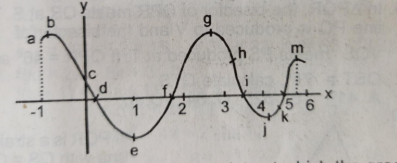
On the curve, the points at which the gradient of the curve is equal to zero are
Attached Figure / Diagram
A
c, d, f. i, l
B
b, e, g, j, m
C
a, b, c, d, f, i, j, l
D
c, d, f, h, i, l
medium Difficulty
Verified Correct Answer: Option B
Step-by-Step Mathematical Solution
The gradient of any curve is equal to zero at the turning points. i.e. maximum or minimum points. The points in the above curve are b, e, g, j, m
Source: Myschool Past Questions Archive (Record #32894)
Mathematics
UTME / JAMB 1989
Plane Geometry, Polygons & Circle Theorems
Diagram
Solution
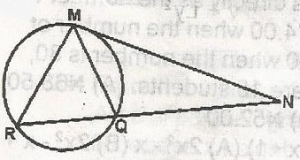
MN is tangent to the given circle at M, MR, and MQ are two chords. IF QMN is 60º and MNQ is 40º. Find RMQ
Attached Figure / Diagram
A
120o
B
110o
C
60o
D
20o
medium Difficulty
Verified Correct Answer: Option D
Step-by-Step Mathematical Solution
QMN = 60º
MRQ = 60º(angle in the alternate segment are equal)
MQN = 80º(angle sum of a \(\bigtriangleup\) = 180º)
60 + x = 80º(exterior angle = sum of opposite interior angles)
x = 80º - 60º = 20º
RMQ = 20º
Source: Myschool Past Questions Archive (Record #32895)
Mathematics
UTME / JAMB 1989
Fractions, Decimals, Percentages & Approximations
Diagram
Solution
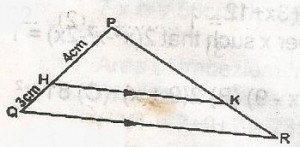
In the diagram, HK is parallel to QR, PH = 4cm and HQ = 3cm. What is the ratio of KR:PR?
Attached Figure / Diagram
A
7:3
B
3:7
C
3:4
D
4:3
medium Difficulty
Verified Correct Answer: Option B
Step-by-Step Mathematical Solution
In \(\bigtriangleup\)PHK and \(\bigtriangleup\)PAR = \(\frac{PH}{PQ} = \frac{PK}{PR}\)
\(\frac{4}{7} \times \frac{PR-KR}{PR}\)
4PR = 7(PR - KR) = 7PR - 7KR
\(\frac{KR}{PR} = \frac{3}{7}\)
KR:PR = 3:7
Source: Myschool Past Questions Archive (Record #32897)
Mathematics
UTME / JAMB 1989
Plane Geometry, Polygons & Circle Theorems
Diagram
Solution
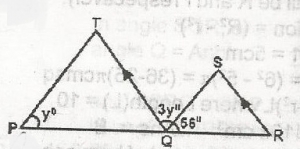
If PQR is a straight line with QS = QR, calculate TPQ, If QT\\SR and TQS = 3yo
Attached Figure / Diagram
A
62o
B
56\(\frac{3}{2}\)o
C
20\(\frac{3}{2}\)o
D
18o
medium Difficulty
Verified Correct Answer: Option C
Step-by-Step Mathematical Solution
Since QS = QR
then, angle SQR = angle SRQ
2 SQR = 180 - 56, SQR = \(\frac{124}{2}\) = 62o
QTP = 62o
QTP = 62o, corresponding angle
3y + 56 + 62 = 180 = 3y = 180 - 118
3y = 62 = 180
3y = 180 - 118
3y = 62
y = \(\frac{62}{3}\)
= 20\(\frac{3}{2}\)
Source: Myschool Past Questions Archive (Record #32903)
Mathematics
UTME / JAMB 1989
Plane Geometry, Polygons & Circle Theorems
Diagram
Solution
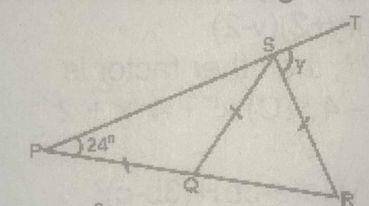
If PST is a straight line and PQ = QS = SR in the diagram, find y.
Attached Figure / Diagram
A
24o
B
48o
C
72o
D
84o
medium Difficulty
Verified Correct Answer: Option C
Step-by-Step Mathematical Solution
∠PSQ = ∠SPQ = 24 ( base ∠s of iso △)
∠SQR =
Source: Myschool Past Questions Archive (Record #32904)
Mathematics
WAEC / WASSCE 1989
Sets, Logic & Venn Diagrams
Solution
(a) Without using Mathematical tables, find x, given that \(6 \log (x + 4) = \log 64\)
(b) If \(U = {1, 2, 3,4, 5, 6, 7, 8, 9, 10}, X = {1, 2, 4, 6, 7, 8, 9}, Y = {1, 2, 3, 4, 7, 9}\) and \(Z = {2, 3, 4, 7, 9}\). What is \(X \cap Y \cap Z' \)?
medium Difficulty
Verified Correct Answer: Option
Step-by-Step Mathematical Solution
(a) \(6 \log (x + 4) = \log 64\)
\(\implies (x + 4)^{6} = 64\)
\((x + 4)^{6} = 2^{6}\)
\(\implies x + 4 = 2 ; x = 2 - 4 = -2\)
\(\therefore x = -2\)
(b) \(U = {1, 2, 3, 4, 5, 6, 7, 8, 9, 10}\)
\(X = {1, 2, 4, 6, 7, 8, 9}; Y = {1, 2, 3, 4, 7, 9} ; Z = {2, 3, 4, 7,9}\)
\(X \cap Y = {1, 2, 4, 7, 9}\)
\({1, 2, 4, 7, 9} \cap Z' = {1, 2, 4, 7, 9} \cap {1, 5, 6, 8, 10}\)
= {1}
Source: Myschool Past Questions Archive (Record #54655)
Mathematics
WAEC / WASSCE 1989
Statistics (Data Representation, Central Tendency & Dispersion)
Solution
The table shows the weights, to the nearest kilogram, of twelve students in a Further Mathematics class
Weight in kg
55
57
59
61
63
No of students
2
1
2
4
3
(a) Draw a bar chart to illustrate the above information;
(b) What is (i) the mode; (ii) the median of the distribution?
(c) Calculate the mean weight correct to the nearest kilogram.
medium Difficulty
Verified Correct Answer: Option
Step-by-Step Mathematical Solution
(a)
(b)(i) The mode is 61kg.
(ii) From the total number of students = 12, then the median is the average of the 6th and 7th weight.
From the table, the median = 61kg.
(c) Mean weight = \(\frac{\sum fx}{\sum f} = \frac{55 \times 2 + 57 \times 1 + 59 \times 2 + 61 \times 4 + 63 \times 3}{12}\)
= \(\frac{110 + 57 + 118 + 244 + 189}{12} = \frac{718}{12} = 59.833kg\)
\(\approxeq 60kg\)
Source: Myschool Past Questions Archive (Record #54659)
Mathematics
WAEC / WASSCE 1989
Mensuration (Areas, Perimeters & Volumes)
Solution
The diagram shows a wooden structure in the form of a cone, mounted on a hemispherical base. The vertical height of the cone is 24cm and the base height 7cm. Calculate, correct to three significant figures, the surface area of the structure. [Take \(\pi = \frac{22}{7}\)].
medium Difficulty
Verified Correct Answer: Option
Step-by-Step Mathematical Solution
Let the slant height = L ; height = 24cm ; r = 7cm.
\(\therefore L^{2} = 24^{2} + 7^{2} = 576 + 49 = 625\)
\(L = \sqrt{625} = 25cm\)
Surface area of the structure = Area of cone + Area of hemisphere
= \(\pi r L + 2 \pi r^{2} = \pi r (L + 2r)\)
= \(\frac{22}{7} \times 7 (25 + 2(7))\)
= \(22 \times 39 = 858 cm^{2}\)
Source: Myschool Past Questions Archive (Record #54668)
Mathematics
WAEC / WASSCE 1989
Plane Geometry, Polygons & Circle Theorems
Using a ruler and a pair of compasses only, construct a triangle ABC, given that |AB| = 8.4cm, |BC| = 6.5cm and < ABC = 30^\circ. Construct the locus:
(a) \(l_{1}\) of points equidistant from AB and BC, and within the angle ABC;
(b) \(l_{2}\) of points equidistant from B and C. Locate the point of intersection P of \(l_{1}\) and \(l_{2}\). Measure |AP|.
medium Difficulty
Verified Correct Answer: Option
Step-by-Step Mathematical Solution
No expanded working has been attached for this question yet. The verified answer is Option .
Source: Myschool Past Questions Archive (Record #54671)
Mathematics
WAEC / WASSCE 1989
Trigonometry, Elevation & Bearings
Solution
(a) If \(\cos \alpha = 0.6717\), use mathematical tables to find (i) \(\alpha\) ; (ii) \(\sin \alpha\)
(b) The angle of depression of a point P on the ground, from the top T of a building is 23.6^\circ. If the distance of P from the foot of the building is 50m, calculate the height of the building, correct to the nearest metre.
medium Difficulty
Verified Correct Answer: Option
Step-by-Step Mathematical Solution
(a) (i) Given \(\cos \alpha = 0.6717\)
\(\alpha = \cos^{-1} 0.6717 = 47.8^\circ\)
(From cosine of angle table)
(ii) \(\sin 47.8^\circ = 0.7408\)
(b)
From the diagram, \(< BPT = < PTR = 23.6^\circ\)
\(\therefore |BT| = |BP| \tan 23.6^\circ\)
= \(50 \tan 23.6^\circ = 50 \times 0.4369\)
= \(21.8469 m\)
\(\therefore\) The height of the building = 22m (to the nearest metre).
Source: Myschool Past Questions Archive (Record #54675)
Mathematics
WAEC / WASSCE 1989
Mensuration (Areas, Perimeters & Volumes)
Solution
(a)
In the diagram, O is the centre of the circle radius 3.2cm. If < PRQ = 42^\circ, calculate, correct to two decimal places, the area of the:
(i) minor sector POQ ; (ii) shaded part.
(b) If the sector POQ in (a) is used to form the curved surface of a cone with vertex O, calculate the base radius of the cone, correct to one decimal place.
medium Difficulty
Verified Correct Answer: Option
Step-by-Step Mathematical Solution
(a) (i) Area of minor segment POQ = \(\frac{84}{360} \times \frac{22}{7} \times (3.2)^{2}\)
= \(\frac{11 \times 10.24}{15}\)
= \(7.5093 cm^{2} \approxeq 7.51 cm^{2}\) (2 decimal places)
(ii) Area of \(\Delta\) in POQ = \(\frac{1}{2} \times 3.2 \times 3.2 \times \sin 84^\circ\)
= \(\frac{127.296}{25} = 5.0918 cm^{2}\)
Area of segment PQ (shaded part) = Area of sector POQ - Area of triangle
= \(7.5093 cm^{2} - 5.0918 cm^{2} = 2.4175 cm^{2}\)
\(\approxeq 2.42 cm^{2}\)
(b) Area of sector POQ = Curved surface area of the cone
\(7.5093 cm^{2} = \pi rl\)
where r = base radius, L = slant height = 3.2cm
\(7.5093 = \frac{22}{7} \times r \times 3.2 = \frac{70.4r}{7}\)
\(70.4r = 7.5093 \times 7 \implies r = \frac{7.5093 \times 7}{70.4} = 0.7467 cm\)
\(\approxeq 0.7cm\)
Source: Myschool Past Questions Archive (Record #54685)
Mathematics
WAEC / WASSCE 1989
Permutations, Combinations & Probability
Solution
When a stone is thrown vertically upwards, its distance d metres after t seconds is given by the formula \(d = 60t - 10t^{2}\). Draw the graph of \(d = 60t - 10t^{2}\) for values of t from 1 to 5 seconds using 2cm to 1 unit on the t- axis and 2cm to 20 units on the d- axis.
(a) Using your graph, (i) how long does it take to reach a height of 70 metres? (ii) determine the height of the stone after 5 seconds. (iii) after how many seconds does it reach its maximum height.
(b) Determine the slope of the graph when t = 4 seconds.
medium Difficulty
Verified Correct Answer: Option
Step-by-Step Mathematical Solution
Table of values of \(d = 60t - 10t^{2}\)
t
1
2
3
4
5
\(60t\)
60
120
180
240
300
\(- 10t^{2}\)
-10
-40
-90
-160
-250
d
50
80
90
80
50
(a)(i) It takes 1.6 seconds to reach a height of 70 metres.
(ii) Height of stone at 5 seconds was 50 metres but after 5 seconds, d < 50 metres.
(iii) It reaches its maximum height after 2.9 seconds.
(b) From the graph, the gradient of the slope = \(\frac{AB}{BC}\)
= \(\frac{56}{2.8} = 20 m/s\)
But it is a negative slope, hence the slope = -20 m/s.
Source: Myschool Past Questions Archive (Record #54686)
Mathematics
WAEC / WASSCE 1989
Plane Geometry, Polygons & Circle Theorems
Solution
(a) (i) Prove that the angle which an arc of a circle subtends at the centre is twice that which it subtends at any point on the remaining part of the circumference.
(ii) In the diagram above, O is the centre of the circle and PT is a diameter. If < PTQ = 22^\circ and < TOR = 98^\circ, calculate < QRS.
(b) ABCD is a cyclic quadrilateral and the diagonals AC and BD intersect at H. If < DAC = 41^\circ and < AHB = 70^\circ, calculate < ABC.
medium Difficulty
Verified Correct Answer: Option
Step-by-Step Mathematical Solution
(a)(i)
Given a circle APB with centre O.
To prove that < AOB = 2 < APB.
Construction: Draw PO and produce it to Q.
Proof : Referring to the lettering in the figure, |OA| = |OB| (radius)
\(\therefore x_{1} = x_{2}\) (base angles of isosceles triangle)
\(< AOQ = x_{1} + x_{2}\) (exterior angles of triangle AOP)
\(\therefore < AOQ = 2x_{2} (x_{1} = x_{2})\)
Similarly, \(< BOQ = 2y_{2}\)
\(< AOB = < AOQ + < BOQ \)
Hence, \(< AOB = 2x_{2} + 2y_{2} = 2(x_{2} + y_{2})\)
= \(2 \times < APB\)
(ii)
From the figure, \(|OQ| = |QT|\) (radius)
\(< OQT = 22^\circ = < QTO\) (base angles of isosceles triangle)
\(\therefore < POQ = 44^\circ \) (exterior angle of \(\Delta\) QOT)
\(< QOR = 180^\circ - (44^\circ + 98^\circ) = 180^\circ - 142^\circ = 38^\circ\) (Angles on a straight line)
\(< QOR = 2 \times < QSR = 38^\circ\)
\(\therefore < QSR = \frac{38^\circ}{2} = 19^\circ\)
(b)
\(< BHC = (180^\circ - 70^\circ) = 110^\circ\) (angle on a straight line)
\(< DAC = 41^\circ = < DBC\) (angles on the same segment)
But \(< DBC = < HBC\)
\(< AHB = < HBC + < HCB \) (exterior angles of \(\Delta\) BHC)
\(70^\circ = 41^\circ + < HCB \implies < HCB = 70^\circ - 41^\circ = 29^\circ\)
\(< ACB = < HCB = 29^\circ\)
Source: Myschool Past Questions Archive (Record #54687)
Mathematics
WAEC / WASSCE 1989
Sequences & Series (AP & GP)
Solution
(a) In an A.P, the difference between the 8th and 4th terms is 20 and the 8th term is \(1\frac{1}{2}\) times the 4th term. What is the:
(i) common difference ; (ii) first term of the sequence?
(b) The value of a machine depreciates each year by 5% of its value at the beginning of that year. If its value when new on 1st January 1980 was N10,250.00, what was its value in January 1989 when it was 9 years old? Give your answer correct to three significant figures.
medium Difficulty
Verified Correct Answer: Option
Step-by-Step Mathematical Solution
(a) \(T_{n} = a + (n - 1) d\) (terms of an A.P)
Given: \(T_{8} - T_{4} = 20\)
\(T_{8} = 1\frac{1}{2} \times T_{4}\)
\(\therefore a + 7d - (a + 3d) = 20\)
\(4d = 20 \implies d = 5\)
(ii) Put d = 5 in the equation
\(a + 7d = 1\frac{1}{2} \times (a + 3d)\)
\(a + 7d = 1.5a + 4.5d\)
\(7d - 4.5d = 1.5a - a \implies 2.5d = 0.5a\)
\(a = \frac{2.5 \times 5}{0.5} = 25\)
(b) \(A = P(1 - \frac{r}{100})^{n}\)
where P = N10,250.00
r = 5%
n = 9
\(\therefore A = (10,250) (1 - \frac{5}{100})^{9}\)
= \(10,250 \times (0.95)^{9} = 10,250 \times 0.6302\)
= \(N6,460.056 \approxeq N6,460\) (to 3 sig. figs)
Source: Myschool Past Questions Archive (Record #54688)