Question Library
Browse, filter, and study verified past examination questions with step-by-step mathematical reasoning.
Searching 18,000+ Questions...
Sifting topics, KaTeX formulas & verified solutions
Showing 25681–25695 of 29811 verified questions
Sort by:
Mathematics
WAEC / WASSCE 1989
Trigonometry, Elevation & Bearings
Solution
The angle of depression of a point on the ground from the top of a building is 20.3o. If the foot of the building is 40m, calculate the height of the building, correct to one decimal place
A
37.5m
B
28.1m
C
27.8m
D
14.8m
E
13.9m
medium Difficulty
Verified Correct Answer: Option D
Step-by-Step Mathematical Solution
Tan 69.7 = 40/h
h = 40/tan 69.7 = 40/2.703 h = 14.79 = 14.8
Source: Myschool Past Questions Archive (Record #22415)
Mathematics
WAEC / WASSCE 1989
Linear, Simultaneous & Quadratic Equations
Solution
Solve for x: (x\(^2\) + 2x + 1) = 25
A
-6, -4
B
6, -4
C
6, 4
D
-6, 4
E
5, 5
medium Difficulty
Verified Correct Answer: Option D
Step-by-Step Mathematical Solution
x\(^2\) + 2x + 1 = 25
x\(^2\) + 6x - 4x -24= 0
x(x + 6) - 4(x + 6) = 0
(x - 4)(x + 6) = 0
x = 4 or -6
Source: Myschool Past Questions Archive (Record #22416)
Mathematics
WAEC / WASSCE 1989
Indices, Logarithms & Surds
Solution
Given that logp = 2 logx + 3logq, which of the following expresses p in terms of x and q?
A
p = 5xq
B
p = 6xq
C
p = x2 + q3
D
p = 2x + 3q
E
p = x2q3
medium Difficulty
Verified Correct Answer: Option E
Step-by-Step Mathematical Solution
log p = 2log x + 3log q
log p = logx 2 + logq 3
logp = log x 2q 3
p = x 2q 3
Source: Myschool Past Questions Archive (Record #22417)
Mathematics
WAEC / WASSCE 1989
Trigonometry, Elevation & Bearings
Solution
sin\theta = \(\frac{1}{2}\) and cos\theta = -\(\frac{\sqrt{3}}{2}\), what is the value of \theta?
A
30 0
B
60 0
C
90 o
D
120 o
E
150 o
medium Difficulty
Verified Correct Answer: Option E
Step-by-Step Mathematical Solution
In the 2nd Quadrant, SINE is the only Positive.
Where \theta is 30 for the first quadrant and
150 in the 2nd quadrant, which makes COSINE negative
Sin \theta = \(\frac{1}{2}\)
\theta = Sin\(^{-1}(\frac{1}{2}\)) = 30º which is positive in the first quadrant
Sin 30 = Sin 150, i.e, (180 - 30), which is also positive in the second quadrant.
BUT Cos \theta = -\(\frac{\sqrt{3}}{2}\)
\theta = Cos\(^{-1}\)(-\(\frac{\sqrt{3}}{2}\)) = 150º which is in the second quadrant but negative
Hence, \theta = 150º
Source: Myschool Past Questions Archive (Record #22418)
Mathematics
WAEC / WASSCE 1989
Sequences & Series (AP & GP)
Solution
What is the probability that 3 customers waiting in a bank will be served in the sequence of their arrival at the bank
A
1/6
B
1/3
C
1/2
D
2/3
E
5/6
medium Difficulty
Verified Correct Answer: Option A
Step-by-Step Mathematical Solution
Probability that 3 customers are attended to in the sequence they arrive
= prob of attending to the 1st arrival x prob of attending to the second last x prob of attending to the last
= \(\frac{1}{3} \times \frac{1}{2} \times \frac{1}{1}\)
= \(\frac{1}{6}\)
Source: Myschool Past Questions Archive (Record #22419)
Mathematics
WAEC / WASSCE 1989
Plane Geometry, Polygons & Circle Theorems
Diagram
Solution
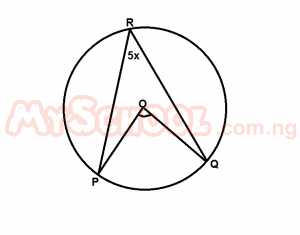
In the diagram, O is the center of the circle, If ∠POQ = 80o and ∠PRQ = 5x, find the value of x.
Attached Figure / Diagram
A
4o
B
8o
C
16o
D
20o
E
32o
medium Difficulty
Verified Correct Answer: Option B
Step-by-Step Mathematical Solution
80o = 2 x 5x(angle at the center)
=80o = 10x; x = 80o/10
= 8o
Source: Myschool Past Questions Archive (Record #22420)
Mathematics
WAEC / WASSCE 1989
Sequences & Series (AP & GP)
Solution
In an A.P. the first term is 2, and the sum of the 1st and the 6th term is 16\(\frac{1}{2}\). What is the 4th term
A
12
B
91/2
C
8
D
7
E
51/2
medium Difficulty
Verified Correct Answer: Option B
Step-by-Step Mathematical Solution
1st term a = 2; 6th term = a + (6 - 1)d = 2 + 5d
2 + (2 + 5d) = 16\(\frac{1}{2}\); 4 + 5d = 16\(\frac{1}{2}\)
5d = 12.5 ∴ = 2.5
the 4th term is 2 + (4 - 1)2.5= 9\(\frac{1}{2}\)
Source: Myschool Past Questions Archive (Record #22421)
Mathematics
UTME / JAMB 1989
Plane Geometry, Polygons & Circle Theorems
Solution
Which of the following is in descending order?
A
\(\frac{9}{10} \frac{4}{5} \frac{3}{4} \frac{17}{20}\)
B
\(\frac{4}{5} \frac{9}{10} \frac{3}{4} \frac{17}{20}\)
C
\(\frac{9}{10} \frac{17}{20} \frac{4}{5} \frac{3}{4}\)
D
\(\frac{4}{5} \frac{9}{10} \frac{17}{20} \frac{3}{4}\)
medium Difficulty
Verified Correct Answer: Option C
Step-by-Step Mathematical Solution
\(\frac{9}{10} \frac{4}{5} \frac{3}{4} \frac{17}{20}\) = \(\frac{18, 16, 15, 17}{20}\)
\(\frac{4}{5} \frac{9}{10} \frac{3}{4} \frac{17}{20}\) = \(\frac{16, 18, 15, 17}{20}\)
\(\frac{9}{10} \frac{17}{20} \frac{4}{5} \frac{3}{4}\) = \(\frac{18, 17, 16, 15}{20}\)
∴ \(\frac{9}{10}; \frac{17}{20}; \frac{4}{5}; \frac{3}{4}\) is in descending order.
Source: Myschool Past Questions Archive (Record #31492)
Mathematics
UTME / JAMB 1989
Plane Geometry, Polygons & Circle Theorems
Solution
Evaluate 2700 000 x 0.03 \div 18 000
A
4.5 x 100
B
4.5 x 101
C
4.5 x 10²
D
4.5 x 10³
medium Difficulty
Verified Correct Answer: Option A
Step-by-Step Mathematical Solution
\(2700000 \times 0.03 \div 18000\)
= \(\frac{2700000 \times 0.03}{18000}\)
= \(\frac{81000}{18000} = 4.5 \times 10^{0}\)
Source: Myschool Past Questions Archive (Record #31493)
Mathematics
UTME / JAMB 1989
Plane Geometry, Polygons & Circle Theorems
Solution
The prime factors of 2520 are
A
2, 9, 5
B
2, 9, 7
C
2, 3, 5, 7
D
2, 3, 7, 9
medium Difficulty
Verified Correct Answer: Option C
Step-by-Step Mathematical Solution
\(2520 = 2 \times 2 \times 2 \times 3 \times 3 \times 5 \times 7\) in terms of its prime factors. Hence, the prime factors of 2520 are 2, 3, 5, 7.
Source: Myschool Past Questions Archive (Record #31494)
Mathematics
UTME / JAMB 1989
Plane Geometry, Polygons & Circle Theorems
Solution
If \(12_{e} = X_{7}\), where e = 12, find X.
A
20
B
15
C
14
D
12
medium Difficulty
Verified Correct Answer: Option A
Step-by-Step Mathematical Solution
\(12_{12} = 1 \times 12^{1} + 2 \times 12^{0} = 12 + 2 = 14_{10}\)
7
14
7
2 rm 0
0 rm 2
\(\therefore 12_{e} = 20_{7}\)
Source: Myschool Past Questions Archive (Record #31495)
Mathematics
UTME / JAMB 1989
Plane Geometry, Polygons & Circle Theorems
Solution
Simplify \(\sqrt[3]{(64r^{-6})^{\frac{1}{2}}}\)
A
\(\frac{r}{2}\)
B
2r
C
\(\frac{1}{2r}\)
D
\(\frac{2}{r}\)
medium Difficulty
Verified Correct Answer: Option D
Step-by-Step Mathematical Solution
\(\sqrt[3]{(64r^{-6})^{\frac{1}{2}}}\)
= \(((64r^{-6})^{1/_2})^{1/_3}\)
=\((64r^{-6})^{1/_6}\)
= (\(64)^{1/_6}(r^{-6})^{1/_6}\)
=\(\frac{2}{\text{r}}\)
Source: Myschool Past Questions Archive (Record #31496)
Mathematics
UTME / JAMB 1989
Fractions, Decimals, Percentages & Approximations
Solution
What is the different between 0.007685 correct to three significant figures and 0.007685 correct to four places of decimal?
A
10-5
B
7 x 10⁻⁴
C
8 x 10⁻⁵
D
10-6
medium Difficulty
Verified Correct Answer: Option A
Step-by-Step Mathematical Solution
0.007685 = 0.00769 (three significant figures)
0.007685 = 0.0077(4d.p)
the difference = 0.0077 - 0.00769
= 0.00001
= 1.0 x 10⁻⁵
Source: Myschool Past Questions Archive (Record #31497)
Mathematics
UTME / JAMB 1989
Plane Geometry, Polygons & Circle Theorems
Solution
If a : b = 5 : 8, x : y = 25 : 16; evaluate \(\frac{a}{x}\) : \(\frac{b}{y}\)
A
125 : 128
B
3 : 5
C
3 : 4
D
2 : 5
medium Difficulty
Verified Correct Answer: Option D
Step-by-Step Mathematical Solution
a : b = 5 : 8 = 2.5 : 40
x : y = 25 : 16
\(\frac{a}{x}\) : \(\frac{b}{y}\) = \(\frac{25}{25}\) : \(\frac{40}{16}\)
= 1 : \(\frac{40}{16}\)
= 16 : 40
= 2 : 5
Source: Myschool Past Questions Archive (Record #31498)
Mathematics
UTME / JAMB 1989
Fractions, Decimals, Percentages & Approximations
Solution
Oke deposited N800.00 in the bank at the rate of 12\(\frac{1}{2}\)% simple interest. After some time the total amount was one and half times the principal. For how many years was the money left in the bank?
A
2\(\frac{2}{3}\)
B
4
C
5\(\frac{1}{3}\)
D
8
medium Difficulty
Verified Correct Answer: Option B
Step-by-Step Mathematical Solution
P = N800 (Principal), r = 12\(\frac{1}{2}\)% or 0.125
After sometimes, A = 1.5 x 800 = N1,200
A = P(1 + Tr) = 1200
= 800(1 + 0.125T)
= 1200
= 800(1 + 0.125T)
1200 = 800(1 + 0.125T)
0.125T = 0.5
T = \(\frac{0.5}{0.125}\)
= 4
Source: Myschool Past Questions Archive (Record #31499)