Question Library
Browse, filter, and study verified past examination questions with step-by-step mathematical reasoning.
Searching 18,000+ Questions...
Sifting topics, KaTeX formulas & verified solutions
Showing 25621–25635 of 29811 verified questions
Sort by:
Biology
WAEC / WASSCE 1990
Nervous, Hormonal Coordination & Sense Organs
Diagram
Solution
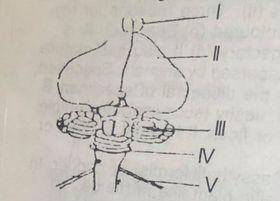
5. (a) Name the parts labelled | - IV (b) Which number indicates a part of the peripheral nervous system?
Attached Figure / Diagram
medium Difficulty
Verified Correct Answer: Option
Biological Concept & Syllabus Guide
(a) I-The olfactory lobe I| - the cerebrum ll - the cerebellum IV - the medulla oblongata V- spinal nerve
(b) V- spinal nerve
Source: Myschool Past Questions Archive (Record #59809)
Biology
WAEC / WASSCE 1990
Basic Ecological Concepts, Ecosystems & Biomes
Solution
6. Mention the process by which food can be synthesized in an ecosystem where tnere is no sunlight.
medium Difficulty
Verified Correct Answer: Option
Biological Concept & Syllabus Guide
The process of chemosynthesis.
Source: Myschool Past Questions Archive (Record #59810)
Biology
WAEC / WASSCE 1990
Variety of Organisms & Classification of Living Things
Solution
List two diseases that may be spread as a result of poor irrigation system.
medium Difficulty
Verified Correct Answer: Option
Biological Concept & Syllabus Guide
(i) Guinea worm disease (ii) Damping off of seedlings.
Source: Myschool Past Questions Archive (Record #59811)
Biology
WAEC / WASSCE 1990
Population Ecology, Habitats & Conservation
Solution
List three factors that can affect population growth.
medium Difficulty
Verified Correct Answer: Option
Biological Concept & Syllabus Guide
(i) Availability of food (ii) Competition (iii) Increased rate of mortality.
Source: Myschool Past Questions Archive (Record #59812)
Biology
WAEC / WASSCE 1990
Nutrition in Plants & Animals (Photosynthesis & Food Substances)
Solution
State two adaptations of Rhizopus to saprophytic mode of nutrition.
medium Difficulty
Verified Correct Answer: Option
Biological Concept & Syllabus Guide
(i) Secretion of enzyme for extracallular digestion of food (ii) Possession of rhzoids for absorption of nutrient
Source: Myschool Past Questions Archive (Record #59813)
Biology
WAEC / WASSCE 1990
Adaptation & Evolution
Diagram
Solution
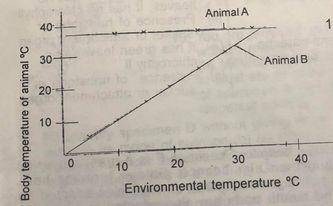
The graph below illustrates the changes in the body temperature of two animal A and B at different environmental temperatures. Study the graph carefully and use it to answer questions (a) to (c) (a) From the graph of the environmental to deductions on the effect of the environmental temperature on the body temperature of the animals indicated as (i) A (i) B (b) Suggest one way by which the animal indicated as B can maintain its body temperature or prevent its body from over-heating (c) Give one example each of an animal whose body temperature can be similarly affected by environmental temperatures cs (i) Animal A (ii) Animal B
Attached Figure / Diagram
medium Difficulty
Verified Correct Answer: Option
Biological Concept & Syllabus Guide
(a) The body temperature of animal A is constant and does not depend on the environmental temperature. Animal A is homoithermic. The body temperature of animal B increases as the environment. (a) temperature increases. Animal B is poikilothermic (b) Animal B can hibernate or aestivate (c) ()) Man, birds, cat (iü) Snake, lizard toad,
Source: Myschool Past Questions Archive (Record #59814)
Biology
WAEC / WASSCE 1990
Digestive System & Feeding Mechanisms
Solution
Study specimens A,B, C and D carefully (a) ldentify specimens A and B without reason (b) Name the organism responsible for the damage observed on specimens A and B (c) List two ways by which each of specimens A and B can be properly stored (d) (i) ldentify specimens C and D without reason (i) List one animal or crop each that can be attacked by specimens C and D (ii) Explain how specimens C and D affect the crop or animal they infest (e) Name one way each by which a farmer can control specimens C and D (f) Make a labelled drawing 6-8 cm long of the dorsal view of specimen D.
medium Difficulty
Verified Correct Answer: Option
Biological Concept & Syllabus Guide
(a) Specimen A is a bean seed(s) Specimen B is tomato fruit (b) Th2 organisms responsible for the damage Observed on specimen A = weevil or beetle. Specimen B= fungus or mould or bacteria (c) ()) Specimen A (bean seed) can be properly stored through (i) Storage in air- tight polythene bags (ii) Storage in silos () Storage in cool dry place (iv) Storage in deep freezer or refrigerator (v) Seed dressing with chemicals or fumigants (vi) Seed processing (vii) Canning (i) Specimen B (tomato fruit) can be properly stored through () drying () canning or processing (iii) freezing (d) (i) Specimen C = Tick Specimen D = Termite (soldier) (i) Specimen C (tick) attacks goats, sheep, dog, man Specimen D (termite) attacks maize, palm tree, rubber, coconut and rice (ii) How Specimnens C and D affect the crop or animal they infest: Specimen C sucks blood from the animal and causes loss or blood (or anaemia) to the animal. It also transmits disease causing organisms to the animal. It causes itching and irritation to the organism. It predisposes animals to diseases Specimen D eats up the roots or stems or woody parts of plants. It then destroys or damages them. It also predisposes plants to diseases (e) Ways by which a farmer can control specimen C (tick) are byenimals graze. Ways by which a farmer can control specimen D (termite) are (i) by the use of insecticide (ii) through ploughing (digging) to remove the queen termite.
Source: Myschool Past Questions Archive (Record #59815)
Biology
WAEC / WASSCE 1990
Excretion & Homeostasis
Solution
(a) ldentify specimens E, F, G and H without reason (b) Name one excretory organ found in each o specimens E, F, G and H (c) (i) State the habitats of specimens E and H (i) Examine the limbs of specimen H. List two ways by which specimen H is adapted to the habitat (ii) Make a labelled drawing 8-10 cm long of specimen E
medium Difficulty
Verified Correct Answer: Option
Biological Concept & Syllabus Guide
(a) Specimen E = earthworm, Specimen F = cockroach Specimen G = twig of flowering plant. Specimen H=rat (b) The excretory organs found in specimens E to H are: Specimen E = nephridium or body surface. Specimen F= malphighian tubule. Specimen G= leaf or stem, Specimen H= lungs kidney and skin (c) The habitats of Specimen E and H are ()) Specimen E (earthworm) soil or damp soil or marshy area. Specimen H (rat) burrows or holes or bush or food stores or house or cupboard. (ii) Ways by which specimen H(rat) is adapted to its habitat are (i) Limbs end in claws for digging the burrow (ii) Forelimbs are short and muscular for absorbing shock on landing (iii) Hind limbs are long and muscular for running fast
Source: Myschool Past Questions Archive (Record #59816)
Chemistry
WAEC / WASSCE 1989
Organic Chemistry I: Hydrocarbons & Crude Oil
Solution
The major raw material in a plastic industry is
A
ethanol
B
sulphur
C
methylethanoate
D
ethene
E
ethane
medium Difficulty
Verified Correct Answer: Option D
Chemical Principles & Mechanism
- Earlier, molasses act as a raw material which yield ethanol from which ETHENE (gotten is used to) produce a range of poly(ethene) plastics.
- Nowadays, starting new raw materials are obtained by the fractional distillation of crude oil or petroleum.
- During the thermal cracking of petroleum; long chain alkanes are converted into smaller chain alkanes, ALKENES (with Ethene being the predominate), etc.
- The Alkenes such as Ethene and Propene can be made into Poly(ethene) / plastic, nylon, etc.
Source: Myschool Past Questions Archive (Record #36056)
Chemistry
WAEC / WASSCE 1989
Non-Metals & Their Compounds
Which of the following reactions represents the laboratory preparation of hydrogen?
A
C(s) + H 2 O(l) → CO(g) + H2(g)
B
2Na(s) + 2H2O(l) → 2NaOH(aq) + H2(g)
C
Zn(s) + 2HCI(aq) → ZnCI2(aq) + H2(g)
D
Cu(s) + H2O(l) → CuO(s) + H2(g)
E
2AI(s) + 3H2O(l) → Al2O3(s) + 3H2(g)
medium Difficulty
Verified Correct Answer: Option C
Chemical Principles & Mechanism
No expanded working has been attached for this question yet. The verified answer is Option C.
Source: Myschool Past Questions Archive (Record #36057)
Chemistry
WAEC / WASSCE 1989
Organic Chemistry I: Hydrocarbons & Crude Oil
Which of the following statements best explains cracking ? It is a process
A
in which an alkene adds on itself repeatedly to form long chain polymers
B
in which large hydrocarbon molecules are broken into smaller units
C
for measuring theoctane number of petrol
D
in which carbon chain results in a zigzag arrangement
E
in which aromatic hydrocarbons are produced
medium Difficulty
Verified Correct Answer: Option B
Chemical Principles & Mechanism
No expanded working has been attached for this question yet. The verified answer is Option B.
Source: Myschool Past Questions Archive (Record #36058)
Mathematics
WAEC / WASSCE 1989
Mensuration (Areas, Perimeters & Volumes)
Solution
The angle of a sector of a circle of diameter 8cm is 135°. Find the area of the sector [Take \(\pi\) = 22/7].
A
\(9\frac{3}{7}cm^2\)
B
\(12\frac{4}{7}cm^2\)
C
\(18\frac{6}{7}cm^2\)
D
\(25\frac{1}{7}cm^2\)
medium Difficulty
Verified Correct Answer: Option C
Step-by-Step Mathematical Solution
Area of a sector
\(\frac{\theta}{360^\circ} * \pir^2\)
= \(\frac{135}{360} * 3.142 * 4 * 4\)
= \(18\frac{6}{7}cm^2\)
Source: WAEC / JAMB / NECO Classroom Archive (Record #22408)
Mathematics
UTME / JAMB 1989
Statistics (Data Representation, Central Tendency & Dispersion)
Diagram
Solution
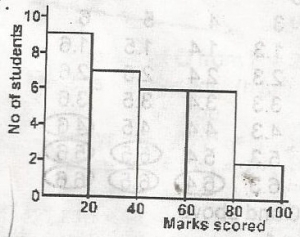
In a class of 30 students, the marks scored in an examination are displayed in the histogram. What percentage of the student scored more than 40%?
Attached Figure / Diagram
A
14%
B
40%
C
46\(\frac{3}{4}\)%
D
53\(\frac{1}{3}\)%
medium Difficulty
Verified Correct Answer: Option C
Step-by-Step Mathematical Solution
This histogram is transferred into this frequency table
\(\begin{array}{c|c} Marks & 20 & 40 & 60 & 80 & 100 \\ \hline students & 9 & 7 & 6 & 6 & 2\end{array}\)
Students who scored more than 40 = 6 + 6 + 2 = 14
i.e. \(\frac{14}{30}\) x 100% = 46\(\frac{3}{4}\)%
Source: WAEC / JAMB / NECO Classroom Archive (Record #32905)
Physics
WAEC / WASSCE 1989
Calorimetry, Latent Heat & Change of State
Solution
A block of ice at its melting point is left on a table in the atmosphere and observed to melt gradually. Which of the following statements is true about the melting process?
A
the reaction force of the table on the ice breaks the ice into water molecules
B
heat extracted from the ice block makes the ice block cold
C
the ice block absorbs heat from the atmosphere and its temperature rises
D
the atmosphere absorbs heat from the ice block and its temperature falls
E
the ice block absorbs heat from the atmosphere and its temperature remains constant as it melts
medium Difficulty
Verified Correct Answer: Option E
Physical Principles & Numerical Solution
The heat of fusion is the quantity of heat necessary to change of a solid to a liquid with no temperature change
Source: WAEC / JAMB / NECO Classroom Archive (Record #23913)
Physics
UTME / JAMB 1989
Current Electricity & Electric Circuits
Diagram
Solution
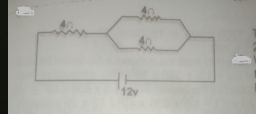
The total power drawn from the cell in the circuit above is
Attached Figure / Diagram
A
12W
B
24W
C
32W
D
40W
medium Difficulty
Verified Correct Answer: Option B
Physical Principles & Numerical Solution
Total resistance = resistance in series + resistance in parallel
= 4 + (\(\frac{4 \times 4}{4 + 4}\)) = 6\(\Omega\)
Total power drawn = \(\frac{V^2}{\text{R}}\) = \(\frac{12^2}{6}\) = 24W
Source: WAEC / JAMB / NECO Classroom Archive (Record #41688)