Question Library

Browse, filter, and study verified past examination questions with step-by-step mathematical reasoning.
Launch Interactive Practice
Searching 18,000+ Questions... Sifting topics, KaTeX formulas & verified solutions
Showing 25516–25530 of 29811 verified questions
Sort by:
Biology UTME / JAMB 1990 Variety of Organisms & Classification of Living Things
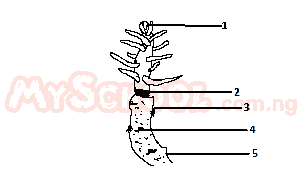
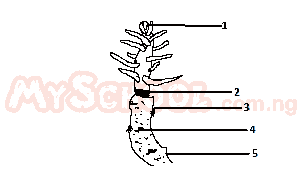
The part labelled 3 is the
Attached Figure / Diagram
Question diagram
A
leaf scar
B
lenticle
C
auxillary bud
D
girdle scar
medium Difficulty
Biology UTME / JAMB 1990 Nervous, Hormonal Coordination & Sense Organs
Which part of the twig produces auxins?
Attached Figure / Diagram
Question diagram
A
4
B
3
C
2
D
1
medium Difficulty
Biology UTME / JAMB 1990 Digestive System & Feeding Mechanisms
Which of the following animals has homodont dentition?
A
Rat
B
Man
C
Lizard
D
Pigeon
medium Difficulty
Biology UTME / JAMB 1990 Digestive System & Feeding Mechanisms
The vilius in the small intestine is significant because it
A
increase the surface area for absorption
B
increase the surface area for digestion
C
assists in mixing digested food
D
assists in filtering undigested food
medium Difficulty
Biology UTME / JAMB 1990 Variety of Organisms & Classification of Living Things
If a ring of bark and phloem is removed from a stem, the
A
plant dies immediately
B
plant dies after two days
C
movement of food is not affected
D
movement of minerals is hardly affected
medium Difficulty
Biology UTME / JAMB 1990 Transport System in Plants & Animals
Transpiration can be measured with a
A
photometer
B
hygrometer
C
potometer
D
barometer
medium Difficulty
Biology UTME / JAMB 1990 Excretion & Homeostasis
Excretory products responsible for the red, purple and blue colours of flowers are called
A
alkaloid
B
tannins
C
anthocyanins
D
resins
medium Difficulty
Biology UTME / JAMB 1990 Variety of Organisms & Classification of Living Things
Etiolation is caused by the influence of
A
minerals salt
B
water
C
carbondioxide
D
light
medium Difficulty
Biology UTME / JAMB 1990 Supporting Tissues & Skeletal System
Muscles are indirectly attached to bones by means of
A
ligaments
B
membranes
C
tendons
D
sutures
medium Difficulty
Biology UTME / JAMB 1990 Nervous, Hormonal Coordination & Sense Organs
During mammalian embryo development, large amounts of oestrogen and progesterone are produced in the
A
umbilical cord
B
amnion
C
placenta
D
amniotic fluid
medium Difficulty
Biology UTME / JAMB 1990 Reproduction in Plants & Animals
Fruits which develop without fertilization are described as
A
simple
B
pathencorpic
C
aggregate
D
compound
medium Difficulty
Biology UTME / JAMB 1990 Reproduction in Plants & Animals
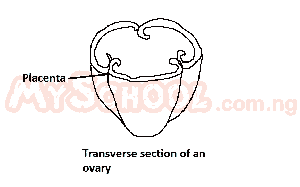
The type of placentation shown in the figure above is a
Attached Figure / Diagram
Question diagram
A
parietal
B
marginal
C
axile
D
free-central
medium Difficulty
Biology UTME / JAMB 1990 Variety of Organisms & Classification of Living Things
The elephant grass is propagated vegetatively by means of
A
corms
B
bubils
C
suckers
D
stolons
medium Difficulty
Biology UTME / JAMB 1990 Nervous, Hormonal Coordination & Sense Organs
The part of the ear that is concerned with balance is the
A
semi-circular canals
B
incus
C
malleus
D
Eustachian tube
medium Difficulty
Biology UTME / JAMB 1990 Variation & Genetics (Heredity)
In organism where the 2nd number of chromosomes is 16, the number of chromosomes in each gamete will be
A
32
B
16
C
8
D
4
medium Difficulty
Page 1702 of 1988